
Puppy Teething & Biting: Timeline and What Actually Works
Overview A puppy has all 28 deciduous ("baby") teeth by roughly eight weeks of age, and a full set of 42 permanent adult teeth by about six to seven months — which means the entire teething process yo
Reading Time
📖 18 min read
Guide Type
📋 General
Last Updated
📅 Sep 10, 2026
Breed
🐶 All Pets
In This Guide
Overview
Overview
A puppy has all 28 deciduous ("baby") teeth by roughly eight weeks of age, and a full set of 42 permanent adult teeth by about six to seven months — which means the entire teething process you are bracing for happens inside a four-to-five-month window, most of it concentrated between three and six months. That short, dated timeline matters because two of the most expensive mistakes in this whole topic are timing errors: punishing a puppy for mouthing during the weeks its mouth physically hurts (which damages bite inhibition for life), and failing to notice a baby tooth that did not fall out when the adult tooth erupted underneath it (which becomes a malocclusion and an extraction bill if it is not caught at the right visit).
This guide ties the biting problem and the dental problem to the same clock, because they are the same clock. The mouthing peaks precisely when the gums are sorest and the adult teeth are pushing through, and the single most important thing to understand is the distinction between bite inhibition and bite suppression. Bite inhibition is teaching a dog to control the force of its jaws — to use a soft mouth — and it can only be taught in puppyhood, while the puppy is still mouthing. Suppression is just shutting the behavior down with punishment; it produces an adult dog that has never learned to modulate pressure, so when it does bite under stress as an adult, it bites hard, because no one ever taught it the difference. The American Veterinary Society of Animal Behavior (AVSAB) is explicit that aversive handling of puppy mouthing is counterproductive for exactly this reason.
Four things carry most of the outcome here: a redirect protocol that channels the chewing onto safe objects instead of skin and furniture, bite-inhibition training done deliberately during the mouthing months rather than waited out, a vet check of the bite around four to seven months to catch retained deciduous teeth before they cause permanent misalignment, and chew selection that relieves teething pressure without fracturing teeth. If you do nothing else from this article: redirect rather than punish mouthing, have your veterinarian look at the mouth at the 4-to-6-month visits, and stop using chews hard enough that you cannot dent them with a thumbnail.
Daily Care
The Teething Timeline (Daily Care)
Use this as the week-by-week routine. The ages are approximate and vary a little by breed and individual, but the sequence and the vet checkpoints do not move — and "I'll watch the mouth later" is usually after the window to catch a retained tooth cheaply has closed.
| Age | Teeth event | Behavior you'll see | What to do | |---|---|---|---| | 2-4 wk | Deciduous teeth begin erupting | Starts mouthing littermates; learns first bite feedback from the litter | Leave with mother/littermates if possible — this is where natural bite inhibition starts | | 6-8 wk | Full set of 28 deciduous teeth in | Mouthy, explores everything with the mouth | Puppy-proof; start the redirect habit (object in the mouth, not skin) | | 12-16 wk | Deciduous incisors begin shedding; adult incisors erupt | Looser, more frantic chewing; you may find tiny teeth | Soft/frozen chews offered; begin deliberate bite-inhibition sessions | | 4-6 mo | Peak teething: premolars/canines shed, adult teeth push through | Hardest mouthing phase; gum soreness, mild blood-tinge on toys is common | Maximum safe-chew rotation; vet checks bite at a routine visit for retained baby teeth | | 6-7 mo | All 42 adult teeth in; jaw setting | Mouthing should be clearly fading if inhibition was trained | Confirm no retained deciduous teeth; transition off teething-specific chews | | 7-12 mo | Adult dentition; occasional adolescent chewing | Chewing now boredom/anxiety driven, not teething | Address with exercise and enrichment, not teething tools |
Print this. The single most common preventable problem here is an owner who waits the mouthing out, never trains inhibition, and arrives at the 6-month visit with both an adult dog that bites hard when startled and a retained baby canine that now needs surgical extraction — two problems that were each cheap to prevent on schedule and expensive to fix late.
The first weeks of the redirect habit
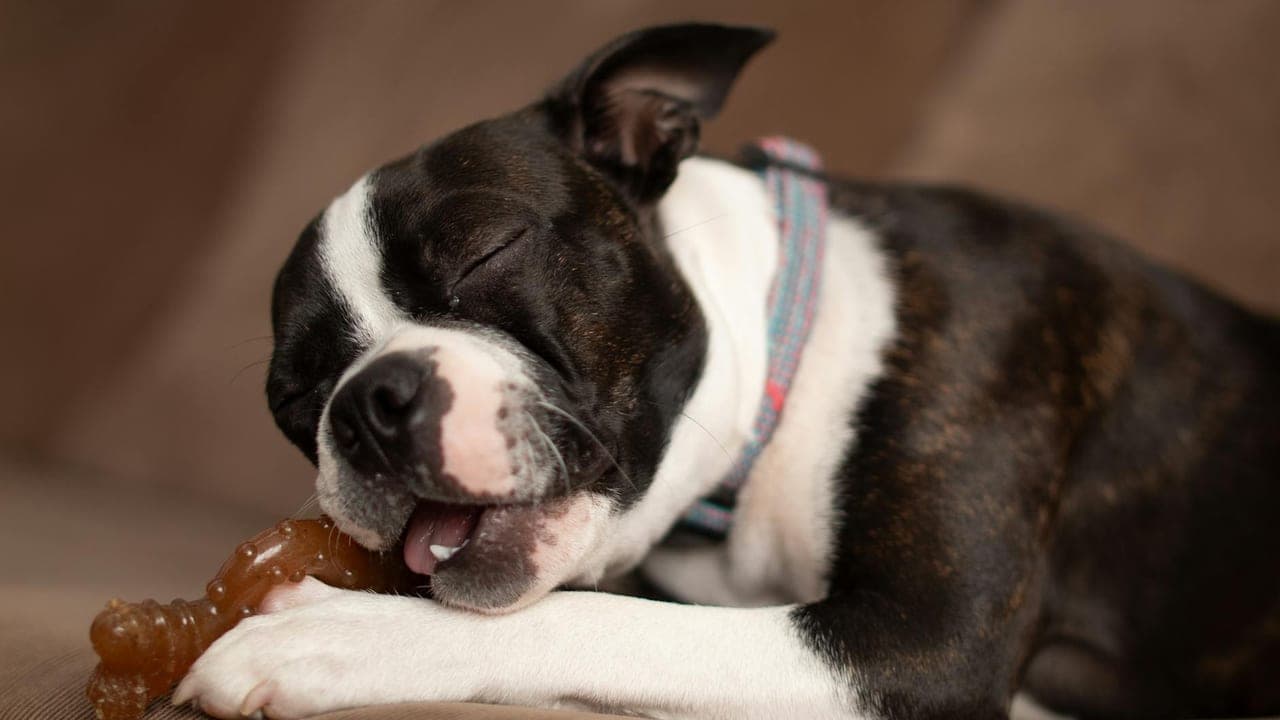
The behavior you are managing is normal: a puppy explores the world with its mouth, and during teething the gums genuinely hurt, so chewing provides real relief. The goal is not to stop the chewing — it is to decide what gets chewed. Keep two or three safe chew objects within arm's reach in every room the puppy uses, because the correction window is about two seconds: when teeth touch skin or furniture, the redirect onto an acceptable object has to happen almost immediately, or the puppy never connects the swap to the act.
The protocol that works is short and consistent. When the puppy mouths your hand, do not jerk it away fast (fast movement reads as prey and intensifies the bite); instead say a calm marker word, go briefly still, and present a chew toy. When the puppy takes the toy, that is the moment to praise. If the puppy is too aroused to disengage, the most effective response is to end the interaction for ten to twenty seconds — stand up, step away, withdraw the fun — rather than escalate physically. AVSAB-aligned trainers call this negative punishment (removing the reward of your attention), and it works because the thing a puppy wants most during play is the play itself; losing it briefly is information, not pain.
What does not work, and actively backfires: yelping loudly every time (some puppies find it exciting and bite harder), grabbing the muzzle and holding it shut, the so-called "alpha roll" (forcing the puppy onto its back), or any pain-based correction. These suppress the visible behavior without teaching jaw control, raise fear and defensive aggression, and damage the human-dog relationship — covered in detail in the health section, because it crosses from training into welfare.
Nutrition
Nutrition During Peak Teething
The nutrition lever for teething is narrow and specific: it is mostly about texture during the sorest weeks, not a special diet. Feed a complete-and-balanced food carrying the AAFCO statement for growth (or "all life stages"), and for large- and giant-breed puppies specifically, a large-breed growth formula — the calcium-to-phosphorus balance in those diets supports correct skeletal and jaw development, and an over-supplemented or adult-maintenance diet during growth is the actual nutritional risk here, not anything teething-specific.
During the 4-to-6-month peak, some puppies eat less or chew kibble reluctantly because the gums and erupting adult teeth are sore. If that happens, moistening dry food with warm water for ten minutes to soften it, or briefly mixing in a wet growth food, keeps intake up without changing the diet's nutritional profile — the reason this matters is that a growing puppy that under-eats for several days during a rapid-growth phase loses condition fast, faster than an adult dog would. This is a short-term texture accommodation, not a permanent switch; return to the normal food once the sorest phase passes, because prolonged soft-only feeding offers no developmental benefit and removes a small amount of natural dental abrasion.
Do not use food or treats hard enough to be a fracture risk as a "teething aid" — this is the same hazard described in the health section for chews. Frozen items can soothe sore gums, but a treat frozen rock-solid is as capable of slab-fracturing a tooth as a hard bone; the safe version is a soft chew or a rubber teether you fill and freeze, not a frozen-solid biscuit. If your puppy's appetite stays low for more than 24-48 hours, treat that as a health question (see the triage list), not a teething inconvenience — puppies decompensate quickly and persistent inappetence is rarely "just teething."
Exercise
Exercise: Why an Outlet Reduces the Biting
A tired, mentally satisfied puppy mouths far less than an under-stimulated one, and this is one of the most reliable, least-discussed levers on biting. Much of what owners label "teething aggression" in the 4-to-7-month window is actually arousal and frustration with nowhere to go: the puppy has energy and a drive to use its mouth and body, and in the absence of a legitimate outlet, your hands and ankles become the outlet. The reason structured activity reduces biting is mechanical, not mystical — it discharges the arousal that the mouthing was venting.
Match the amount and type to a growing skeleton. A common practitioner guideline is roughly five minutes of structured exercise per month of age, up to twice a day — so a 4-month-old gets about 20 minutes per session, not an hour run. The reason for the cap is orthopedic: growth plates do not close until roughly 8 to 18 months depending on breed size (later in large and giant breeds), and repetitive high-impact exercise — long forced runs, repeated jumping, stairs to exhaustion — before they close is a documented risk factor for joint problems. Forced-distance running and agility jumping should wait until your veterinarian confirms skeletal maturity.
Lean on mental work and sniffing, which tire a puppy disproportionately to the physical cost and are skeleton-safe. Food-dispensing toys, short reward-based training sessions of two to five minutes several times a day, scatter-feeding part of a meal in grass, and a frozen filled rubber chew all channel the same energy that becomes biting. Two specific pairings reduce mouthing the most: a frozen stuffed teether offered right before the predictable evening "witching hour" (the early-evening arousal spike when most puppy biting peaks), and a short training session immediately after physical play to bleed off the residual arousal that otherwise gets aimed at skin. The takeaway is that the biting and the under-exercise problem are usually the same problem — solve the second and a large fraction of the first resolves without any correction at all.
Grooming
Grooming: Start Tooth-Handling Habituation Now
For an adult dog, this is dental maintenance. For a teething puppy it is habituation — the months while the mouth is changing are the window to teach a dog that having its mouth touched by a human is normal and safe, and that lesson is roughly ten times harder to install in an adult dog that learned the opposite. Periodontal disease is among the most common health problems in adult dogs, and the difference between a 30-second daily home routine for life and recurring dental procedures under anesthesia is very often whether the dog was handled young.
Start while it is easy, and keep every session brief and food-paired. In the first weeks, simply lift a lip, touch the gums and teeth with a finger, and immediately reward — you are not cleaning anything yet, you are teaching that mouth-handling predicts good things. Progress over weeks to a finger brush and then a soft dog toothbrush with pet-safe enzymatic toothpaste only. Human toothpaste is not safe for dogs; many human toothpastes (and many "sugar-free" human products generally) contain xylitol, which is toxic to dogs even in small amounts, and the fluoride load is also inappropriate — use a product formulated for dogs.
There is a direct payoff during teething itself: a puppy comfortable having its mouth opened is a puppy whose bite you can actually inspect. That is what lets you, or your veterinarian, spot a retained deciduous tooth — a baby tooth still in place beside or behind its erupting adult counterpart, classically a retained upper canine — at the routine 4-to-6-month visits, while it is a simple extraction, rather than after it has forced the adult tooth into a malocclusion. A dog that fights every attempt to look in its mouth is a dog whose retained tooth gets found late. The handling you bank now is also what makes the AVDC-recognized check below something you can do at home between vet visits instead of a wrestling match.
Health
Health: Retained Teeth, Malocclusion & Chew Fractures
This is the YMYL core of the topic, and it has three named, vet-relevant problems — not vague "dental issues." The American Veterinary Dental College (AVDC) and AAHA dental guidance inform the thresholds below; none of this replaces an individual veterinary exam, but the lines for when to involve a vet are concrete.
Retained deciduous teeth. Normally each baby tooth's root resorbs and the tooth falls out as the adult tooth erupts. When the baby tooth does not shed, you get two teeth in one socket — most commonly a retained upper canine sitting in front of the erupting adult canine. This is more frequent in toy and small breeds (Yorkshire Terrier, Chihuahua, Pomeranian, Maltese, and brachycephalic breeds). It is not cosmetic: the crowded teeth trap food and plaque (early periodontal disease) and, more importantly, the misplaced adult tooth can be deflected into an abnormal bite. The rule veterinary dentistry uses is "never two teeth of the same type in the same place at the same time." If you can see or feel a baby tooth still present while the adult tooth is already up — typically noticed between four and six months — that is a book-a-vet-appointment finding, not a wait-and-see one. The standard treatment is extraction of the retained deciduous tooth, and it is far simpler and cheaper the earlier it is caught, ideally before the adult tooth has been pushed out of position.
Malocclusion. A malocclusion is a bite that does not align correctly — it can be genetic (jaw-length mismatch) or caused by a retained deciduous tooth deflecting an adult tooth. The clinically important ones are not the purely cosmetic over/underbites but the traumatic malocclusions, where a tooth (often a lower canine) strikes the palate or another tooth and causes pain, soft-tissue ulceration, or oronasal damage. Signs an owner can notice: a puppy that drops food, chews on one side, paws at the mouth, has noticeable bleeding from the gum where a tooth contacts, or has an obviously asymmetric jaw. Any of these is a veterinary exam, ideally before six to seven months while interceptive options (including timely extraction of a deflecting baby tooth) still exist — once the adult bite sets, correction is more involved.
Fractured teeth from hard chews. This is the most common chew injury and the one most tied to a decision owners make daily. Teeth crack when a dog bites down on something that does not yield — most fractures are slab fractures of the large upper carnassial (the big chewing premolar). High-risk items per veterinary-dental guidance: real weight-bearing bones (including dried/smoked), antlers, hard nylon bones, cow hooves, and ice cubes chewed hard. A fractured tooth with pulp exposure is painful and a route for infection; it is not always obvious, because dogs hide oral pain — watch for chewing on one side, dropping a previously loved chew, a discolored tooth, facial swelling, or reluctance to eat hard food. A suspected fractured tooth is a vet visit, not a monitor-at-home.
The chew-selection decision (the EQG line): the practical, vet-aligned rule is the thumbnail / kneecap test — if you cannot make a slight indentation with your thumbnail, or you would not want to be hit on the kneecap with it, it is hard enough to fracture a tooth and is not a safe chew. Safer choices are appropriately sized solid rubber chews, soft rubber teethers (freezable), and dog-specific dental chews of the right size; supervise all chewing and discard pieces small enough to swallow (intestinal-obstruction risk is the other hazard). Choosing a safe chew is not a minor preference — it is the difference between routine teething relief and a $1,000+ extraction.
What punishment-based bite training does to health. This crosses from training into welfare and belongs here. AVSAB's position is that aversive methods — alpha rolls, muzzle grabs, scruffing, hitting, or pinning a mouthing puppy — increase fear, anxiety, and the risk of defensive aggression, and do not teach bite inhibition. A puppy whose mouthing was suppressed by force has not learned to soften its jaws; it has learned that hands near its face are threatening, which is a recognized pathway to an adult dog that bites harder and with less warning. This is why the redirect-and-withdraw protocol is the recommended approach, not a gentler alternative to a "firmer" one.
Triage — when to involve a vet:
- Within a few days (book a routine visit): a baby tooth still present while the adult tooth is already erupting (suspected retained deciduous tooth); a bite that looks asymmetric or a tooth that appears to be hitting the palate or another tooth; mild persistent bad breath or one-sided chewing.
- Within 24 hours: a suddenly discolored or visibly fractured tooth; facial swelling near the jaw; bleeding from the mouth that is not a normal shed-tooth spot; refusing hard food when it ate it before; pawing at the mouth with distress.
- Same-day / urgent: a swallowed chew fragment with vomiting, retching, or inability to keep food down (possible obstruction or an item lodged in the mouth/throat); a dog unable to close its mouth or in obvious oral pain.
- "When in doubt, ask your vet" applies — but the lines above are where the doubt should already be resolved in favor of calling, especially the retained-tooth check, because its cost and difficulty rise steeply the longer it waits.
Costs
What This Actually Costs
Owners budget for chew toys and underestimate the line items that the avoidable mistakes generate. Approximate US ranges (regional variation is wide; corporate and specialty practices sit at the high end):
- A year of safe teething chews and rotation: appropriately sized rubber chews, freezable teethers, and dog-specific dental chews run roughly $60-$180 for the year — the smallest number in this list and the one that prevents the largest one.
- Routine dental/bite check at puppy visits: typically folded into the regular 4-to-6-month wellness visits at no separate charge, or a modest exam fee — this is the visit at which a retained tooth should be caught.
- Retained-deciduous-tooth extraction (the first hidden cost): extraction of retained baby teeth, usually done under anesthesia and often combined with the spay/neuter to share one anesthetic event, commonly runs $200-$800+ depending on the number of teeth, anesthesia, and region; multiple retained teeth or added imaging push the high end.
- Slab-fractured tooth from a hard chew (the second hidden cost): a fractured carnassial typically needs either surgical extraction or root canal therapy. Surgical extraction commonly runs $400-$1,200+; root canal at a veterinary dental specialist frequently $1,500-$3,000+. This is the line item the thumbnail test exists to prevent.
- Behavior/trainer help for a hard-mouthed adolescent: if bite inhibition was never trained and the mouthing has become a problem, a qualified force-free trainer or veterinary behaviorist consult runs $150-$400+, and remediation in an older puppy takes longer than prevention would have.
The hidden cost is not the chew budget — it is the two preventable surgeries: the retained baby tooth nobody looked for until it had displaced an adult tooth, and the carnassial cracked on a bone or antler that felt like a good idea. Each is a four-figure outcome that a $10 chew swap and one well-timed vet glance at the mouth would have prevented. The trade-off is stark and runs entirely in your favor: the cheap side is a soft-rubber chew, a daily two-minute mouth-handling habit, and the routine 4-to-6-month look; the expensive side is anesthesia and a specialist.
Frequently Asked Questions
When do puppies stop teething and biting?
A puppy has all 42 adult teeth by roughly six to seven months, and the heaviest mouthing peaks between about four and six months. If bite inhibition was trained during those months, mouthing should be clearly fading by seven months. Biting that continues strongly past then is usually arousal, under-exercise, or untrained inhibition — not teething — and is a training and enrichment question.
What is the difference between bite inhibition and just stopping the biting?
Bite inhibition teaches a dog to control jaw pressure — a soft mouth — and can only be taught while the puppy still mouths, in puppyhood. Suppressing the behavior with punishment produces an adult that never learned to modulate force, so an adult bite under stress is harder and gives less warning. AVSAB advises against aversive handling of puppy mouthing for this reason; redirect and withdraw attention instead.
My puppy still has a baby tooth next to an adult tooth — is that urgent?
It is a book-a-vet-visit finding, typically noticed between four and six months. Veterinary dentistry's rule is that two teeth of the same type should not occupy the same place at the same time; a retained deciduous tooth (often an upper canine) traps plaque and can deflect the adult tooth into a malocclusion. The standard treatment is extraction, and it is simpler and cheaper the earlier it is caught.
Which chews are safe for a teething puppy and which fracture teeth?
Use the thumbnail test: if you cannot dent it with a thumbnail, it is hard enough to slab-fracture a tooth. Real bones, antlers, hard nylon bones, cow hooves, and rock-solid frozen treats are common causes of fractured carnassial teeth per veterinary-dental guidance. Safer options are appropriately sized solid rubber chews, soft freezable rubber teethers, and size-appropriate dog dental chews, always supervised.
Is it bad to yell at or muzzle-grab a puppy for biting?
Yes. AVSAB's position is that aversive methods — yelling, muzzle grabs, alpha rolls, scruffing, or pinning — increase fear and the risk of defensive aggression and do not teach bite inhibition. They can produce an adult dog that is more likely to bite hard with less warning. The effective approach is to redirect onto a chew and briefly end the interaction when the puppy is too aroused.
Sources
This guide draws on the following published references. Each opens in a new tab so you can check it against what you have read here.
ASPCA
Common Dog Behavior Issues(opens in a new tab)AVMA
What's Your Pet's Life Stage?(opens in a new tab)Merck Veterinary Manual
Behavior Problems in Dogs(opens in a new tab)Merck Veterinary Manual
Puppy Care(opens in a new tab)Merck Veterinary Manual
Routine Health Care of Dogs(opens in a new tab)
Affiliate disclosure: We may earn a commission from qualifying purchases. This doesn't affect our recommendations.
Recommended Products
Vet-safe puppy teething chews (size-appropriate rubber)
Solid rubber chews soft enough to pass the thumbnail test — teething relief without the slab-fracture risk of bones, antlers, or hard nylon.
Freezable puppy teether (fillable rubber)
A fillable rubber teether you freeze to soothe sore gums during the 4-to-6-month peak — the safe version of 'something frozen,' unlike a rock-solid frozen biscuit.
Get personalized pet care tips
Join our newsletter for breed-specific advice, care guides, and expert tips delivered weekly.
No spam, ever. Unsubscribe anytime.