
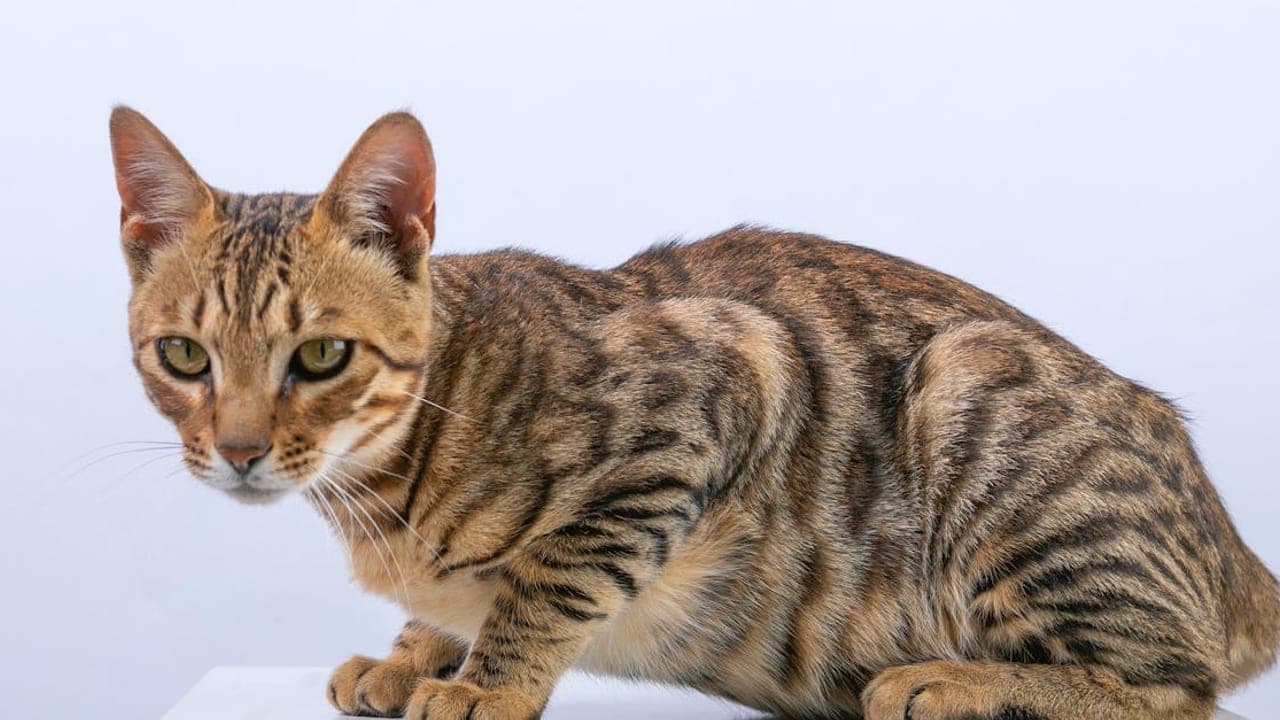
Bengal Cat Care Guide: The Wild-Looking Companion
Bengals are a hybrid breed — created by crossing the Asian Leopard Cat with domestic shorthairs in the 1960s-70s. The generation matters legally: F1 (50% wild) and F2 (25% wild) are restricted or bann
In This Guide
Overview
Bengals are a hybrid breed — created by crossing the Asian Leopard Cat with domestic shorthairs in the 1960s-70s. The generation matters legally: F1 (50% wild) and F2 (25% wild) are restricted or banned in many US states (NY, HI, CT, MA, GA, parts of CO, IA) and behave more like wild animals than pets. F4 and later (often labeled SBT) are fully domestic and legal nationwide. Most Bengals sold as pets are F4+; if a breeder offers you an F1-F3, check your state law before paying.
This guide covers what actually matters with a Bengal day-to-day: the 60+ minutes of structured engagement they need (skip it and they redecorate your apartment), the vertical climbing space that is non-negotiable, the genetic health screens that separate reputable breeders from kitten mills (HCM scans and PK-Def DNA tests), and the real annual cost of $1,200-$2,000 once you factor in the enrichment line item most buyers never budget for. Bengals are athletic, vocal, water-curious, and prey-driven. They are not a beginner cat. If you can commit to the lifestyle, they are extraordinary. If you can't, you will both be miserable.
Daily Care
Bengals need 60+ minutes of structured human engagement per day, split into two or three sessions. This is not a suggestion — it is the difference between the cat in the breeder's photos and the cat that destroys your blinds at 3 AM. Under-stimulated Bengals develop predictable problems: counter-surfing, faucet-opening, plant-shredding, vocal demand cycles that escalate the longer you ignore them, and (in extreme cases) over-grooming or aggression toward other pets.
- One floor-to-ceiling cat tree (6+ feet), minimum, in the room they spend most time in
- Wall-mounted shelves or a catwalk if you have wall space — Bengals genuinely use these, unlike many breeds
- A window perch with a view (bird-feeder outside is free entertainment)
- Multiple high-up resting spots — they prefer being above eye level
- Morning: 15-20 minutes of wand-toy or fetch play before you leave
- Evening: 30-45 minutes of structured play, ideally before dinner so they associate exercise with food
- Throughout the day: Puzzle feeders, rotating toy box, window perches, and ideally a second cat or dog for play
Multi-pet considerations. Bengals do well with other Bengals, active cat breeds (Abyssinian, Savannah, Oriental Shorthair), and confident dogs. They do poorly with senior cats, low-energy breeds (Persian, Ragdoll), and small prey animals (rabbits, hamsters, birds — do not house them in the same home; the Bengal will get to them eventually). If you work 9+ hours away from home, get two Bengals or a Bengal-plus-active-companion. A solo Bengal home alone develops behavioral problems within weeks, not months.
Indoor or catio — outdoor is risky. Bengals are prey-driven, fast, and visually distinctive ($1,000-$3,500 retail value makes them theft targets). Free-roaming outdoor Bengals get hit by cars, taken, or wander further than housecats because of their hunting drive. A catio (screened outdoor enclosure) gives them stimulation safely.
Decision rule: If you live alone, work 9+ hours daily, and travel monthly — get a different breed or get two Bengals. One Bengal in an empty house is a destruction story waiting to happen.
Nutrition
Bengals need more protein than the average domestic cat. The breed standard from CFA and TICA reflects their Asian Leopard Cat heritage: lean muscle mass, higher metabolic rate, and a digestive system that handles raw and high-protein diets better than most cats handle them.
Protein target. Aim for 35-40%+ protein on a dry-matter basis. Most premium adult cat foods sit at 30-35% — that's adequate for a Persian, low for a Bengal. Read the label, not the marketing copy. "High-protein" on the bag means nothing; the guaranteed analysis tells the truth.
Kitten (0-12 months): Free-feed a high-protein kitten formula. Bengals are growing fast and burning calories. Wet food at least once a day from 8 weeks builds the wet-food habit you'll want for FLUTD prevention later.
Adult (1-10 years): 250-350 calories/day, split into two meals. Watch the waistline — Bengals are athletic but not immune to obesity, especially indoor-only ones. A male over 14 lbs or female over 11 lbs is overweight unless your breeder specifically bred for size.
Senior (10+): Reduce calories 10-15% if activity drops. Add a senior formula with joint support (glucosamine, omega-3) — Bengals stay active longer than most breeds, which is good for quality of life but hard on aging joints.
Raw feeding — the real picture. Bengal owners gravitate toward raw because the breed handles it well. The risk is sourcing: bargain-brand raw from grocery freezers carries salmonella, listeria, and toxoplasma risk that can kill a kitten or immunocompromised adult. If you go raw, use commercial frozen raw from brands that test for pathogens (Stella & Chewy's, Primal, Vital Essentials), or balance a homemade raw diet with a feline nutritionist — not a Facebook group. Halfway raw — uncooked grocery chicken with no supplementation — is worse than premium kibble.
Water — fountains, not bowls. Bengals love moving water and will drink from faucets, paw at running streams, and sometimes climb in the shower. A pet water fountain ($30-$60) doubles or triples water intake compared to a still bowl. This matters because Bengals are predisposed to FLUTD and bladder stones, and chronic low water intake is the single biggest preventable contributor.
Decision rule: If your Bengal is overweight, cut portions 10% and add a third short play session before changing food brands. Bengals overeat when bored — fix the boredom first.
Exercise
Bengals are the opposite of a low-energy cat. They need structured exercise twice a day, every day, for life. Plan on 30-45 minutes per session, two sessions minimum.
- Wand toys with prey-mimicking action — Da Bird and Neko Flies are the Bengal owner standards ($10-$20). Drag the toy AWAY to trigger chase response, then let them "catch" at the end of each session. Interrupted prey sequences create frustration, not satisfaction.
- Fetch. Most Bengals retrieve naturally. Crumpled paper or soft toys work; some bring it back for an hour.
- Puzzle feeders. Indoor cats burn near-zero mental energy at meals. Puzzle feeders add 5-10 minutes of mental load per meal.
- Leash training. Realistic for Bengals in a way it isn't for most breeds. Start indoors with a harness ($15-$25), then progress to a quiet outdoor area. Many Bengals walk on leash like a small dog within 4-6 weeks.
- Climbing infrastructure. Cat trees and wall shelves aren't decoration — they're exercise equipment that burns energy while you work.
What doesn't work: Laser pointers as the primary toy. No prey to catch = frustration. Use as a 2-minute warm-up, then switch to a wand toy or fetch.
Decision rule: If your Bengal is destroying things, vocalizing at night, or attacking your feet — you need MORE exercise, not less attention. Add a third 15-minute play session before considering training or vet visits. 90% of "my Bengal is misbehaving" problems resolve when daily structured engagement crosses 60 minutes.
Grooming
Bengals have the lowest grooming load of any high-maintenance cat. Their coat is short, dense, and described as "pelted" — closer to a rabbit's pelt than a typical cat coat. Minimal undercoat, minimal shedding, minimal mat risk.
Brushing cadence: Once a week with a rubber curry brush or grooming mitt. 5 minutes. They don't need slicker brushes or undercoat rakes. Spring/fall shed seasons are mild — bump to twice weekly for 2-3 weeks.
Bathing: Optional, every 6-8 weeks. Bengal coats don't get oily fast. Many Bengals genuinely enjoy water and will tolerate baths better than other cats. Use cat-specific shampoo only — human or dog shampoo strips coat oils.
Nails — the active-climber problem. Bengals wear front nails down somewhat from climbing, but back nails grow long and indoor cats don't wear them down. Trim every 2-3 weeks. Skip it and they catch on cat trees and rip ($100+ vet visit), or grow into the paw pad. Clip just past the pink quick. If your Bengal won't tolerate it, a groomer does it for $15-$25.
Ears: Check weekly. Bengals have larger ears for their head size and accumulate wax. Wipe with a vet-approved cleaner if you see brown buildup. Excessive scratching, head shaking, or odor = vet visit (likely yeast or mites).
Dental: Brush 2-3 times per week with cat toothpaste (never human — fluoride is toxic to cats). Dental disease is the most common health issue in cats over 3, and professional cleaning under anesthesia runs $400-$800. Brushing prevents most of it.
Decision rule: If your Bengal hates being brushed, your brush is wrong. Switch from slicker (long coats) to rubber curry mitt (short coats). Most cats who "hate grooming" are reacting to the wrong tool.
Health
Bengals are generally healthy with a 12-16 year lifespan, but they carry breed-specific genetic risks every owner should know — and that reputable breeders should screen for. If you're paying $1,500-$3,500 for a kitten, you're paying partly for proof of these screens. If the breeder can't produce documentation, you're buying from a kitten mill regardless of what their website says.
Hypertrophic cardiomyopathy (HCM) — the leading cause of death in the breed. HCM is a thickening of the heart muscle that progresses silently for years before sudden onset (lethargy, labored breathing, sudden hind-leg paralysis from clot). Bengals have higher genetic incidence than the average breed. There is no Bengal-specific DNA test for HCM yet, so screening is by echocardiogram, not gene panel. Reputable breeders scan breeding cats annually with a board-certified cardiologist and show results. For your cat: baseline echo at age 1-2, repeat every 1-2 years until age 5, then per cardiologist recommendation. Cost per scan: $300-$500. This is a recurring expense most Bengal owners don't budget for. HCM caught early is manageable for years; HCM caught after symptoms is often fatal within months.
Pyruvate kinase deficiency (PK-Def) — DNA test exists, no excuse for unscreened lines. PK-Def is an inherited red blood cell disorder causing intermittent anemia, lethargy, and weakness. Affected cats can live normal lifespans with monitoring. The DNA test (PK-Def PCR panel) is available through UC Davis VGL and Optimal Selection for $50-$80. Reputable breeders test every breeding cat and show results. If a breeder shrugs off PK-Def, walk away — two carriers bred together produce affected kittens 25% of the time.
Progressive retinal atrophy (PRA-b, Bengal variant). Inherited retinal degeneration leading to gradual blindness, presenting between ages 1-4. DNA test available ($50-$80). Same rule as PK-Def: reputable breeders test and show paperwork; non-testers are kitten mills.
Feline lower urinary tract disease (FLUTD). Bengals are predisposed, partly from genetics and partly from low water intake on dry-only diets. Watch for: straining in the litter box, blood in urine, peeing outside the box, vocalizing while urinating. A male cat straining unsuccessfully is a true emergency — urinary blockage is fatal within 24-48 hours untreated, $1,500-$3,000 to resolve at an ER vet. Prevention: water fountain, wet food daily, weight management.
Flat-chested kitten syndrome (FCKS). Congenital chest-wall deformity affecting some Bengal kittens in the first 2-4 weeks. By the time a kitten is sold (8-12 weeks), this is resolved or culled — but ask if the breeder's lines have history.
- Kitten: vaccines at 8, 12, 16 weeks; spay/neuter at 4-6 months
- Adult (1-7): annual wellness exam + dental check
- Senior (8+): twice-yearly exams with bloodwork
Decision rule: Vet within 24 hours if: not eating for 24+ hours, hiding when normally social, labored breathing, straining to urinate without producing urine, sudden hind-leg weakness. The last one is HCM-related thromboembolism — minutes matter.
Costs
- Reputable breeder (HCM-screened parents, PK-Def and PRA DNA tests, registered with TICA): $1,500-$3,500 for pet quality, $3,500-$10,000+ for show quality
- Backyard breeder (no health testing, no registration): $500-$1,200 — you save upfront and pay 5x in vet bills
- Bengal-specific rescue or breed rescue: $150-$400
- F1-F3 generations (50%-12.5% wild): $2,000-$10,000+, often illegal in your state, require special permits and enclosures — not pets in any practical sense
First-year costs (kitten): $2,200-$3,500 including initial vet (vaccines + spay/neuter $300-$600), enrichment infrastructure (cat trees, wall shelves, fountain, harness $400-$700), food/litter ($600-$900), and initial wellness checks.
- Food (premium high-protein wet + dry): $500-$900
- Litter: $200-$350
- Routine vet + dental: $200-$400
- Pet insurance (recommended for HCM-prone breed): $300-$600
- Enrichment — the line item most buyers don't budget for: $30-$100/month for replacement toys, puzzle feeders, fountain filters, and rotating cat-tree refresh. Bengals destroy toys faster than other breeds and lose interest if you don't rotate. That's $360-$1,200/year, every year.
- Total typical year: $1,200-$2,000
Hidden cost most owners miss: cardiac screening. Echocardiograms every 1-2 years run $300-$500 per scan. Over a 14-year lifespan that's $1,800-$3,500 in screening alone. Not optional for this breed.
Lifetime cost: Roughly $20,000-$32,000 over 12-16 years before any major event. A single FLUTD blockage or HCM treatment adds $2,000-$5,000 in a year — pet insurance ($25-$50/month) is worth running the numbers on.
Sources
This guide draws on the following published references. Each opens in a new tab so you can check it against what you have read here.
Cat Fanciers' Association
Bengal — breed standard and profile(opens in a new tab)ASPCA
Cat Grooming Tips(opens in a new tab)Merck Veterinary Manual
Proper Nutrition for Cats(opens in a new tab)Cornell Feline Health Center
Feeding Your Cat(opens in a new tab)Merck Veterinary Manual
Routine Health Care of Cats(opens in a new tab)
Affiliate disclosure: We may earn a commission from qualifying purchases. This doesn't affect our recommendations.
Recommended Products
Get personalized pet care tips
Join our newsletter for breed-specific advice, care guides, and expert tips delivered weekly.
No spam, ever. Unsubscribe anytime.