
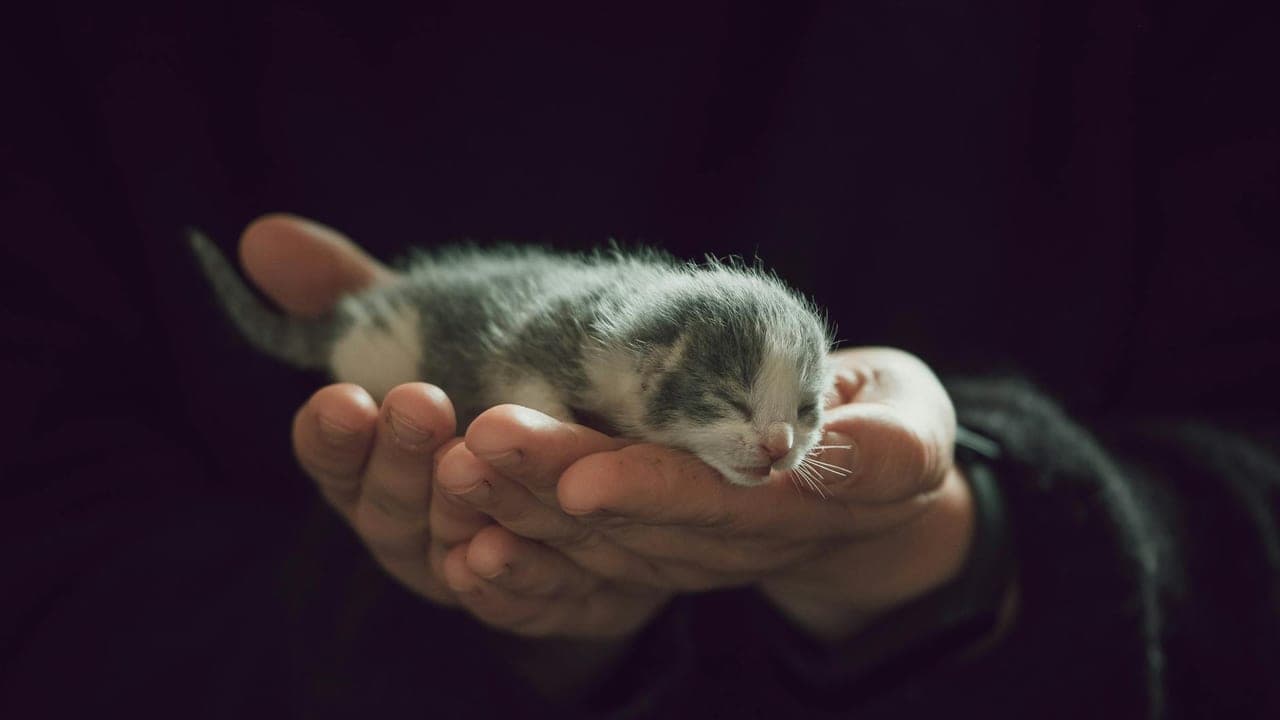
Bottle-Feeding & Caring for Orphaned Kittens (0-8 Weeks)
Overview A chilled neonatal kitten can stop digesting milk within a few hours, and a kitten fed while cold often aspirates and dies the same day. The two-week-old you found this morning is not a small
Reading Time
📖 17 min read
Guide Type
📋 General
Last Updated
📅 Sep 9, 2026
Breed
🐱 All Pets
In This Guide
Overview
Overview
A chilled neonatal kitten can stop digesting milk within a few hours, and a kitten fed while cold often aspirates and dies the same day. The two-week-old you found this morning is not a small cat — it cannot regulate its own body temperature, cannot urinate or defecate without help, and runs out of stored blood sugar in well under a day without feeding. This is the most time-sensitive care any pet owner takes on, and the difference between a thriving kitten and a fading one is usually measured in hours, not days.
Three killers account for most orphaned-kitten deaths, and they cascade in a fixed order. Hypothermia comes first: kittens under about three to four weeks cannot shiver effectively or maintain their core temperature, so a kitten separated from its mother and littermates cools rapidly. A cold kitten's gut shuts down — feeding a hypothermic kitten is one of the most common fatal mistakes, because the milk sits undigested and the kitten can inhale it. Hypoglycemia follows: with little fat reserve and a high metabolic rate, a neonate that misses feeds or stops nursing crashes its blood sugar, which presents as weakness, cold extremities, and collapse. Aspiration is the third: milk delivered too fast, with the kitten on its back, or while it is cold or weak, goes into the lungs and causes aspiration pneumonia, which is frequently fatal in a kitten this size.
The single most protective decision you can make is not a feeding technique — it is making a phone call. Contact a veterinarian or a licensed wildlife/companion-animal rescue or a feline-experienced foster network as early as possible, ideally before the first feed if the kitten is found cold or unresponsive. Orphaned-neonate care is the standard scope of feline rescue medicine; experienced fosters and shelter veterinarians do this routinely and can often take the kitten or coach you in real time. Per the American Association of Feline Practitioners (AAFP) and shelter-medicine guidance from groups such as the Association of Shelter Veterinarians, neonatal kittens are a triage-priority population precisely because they decompensate so fast. This guide is the protocol — what to do, in what order, with what numbers — but it does not replace a veterinarian or licensed rescue, and several points below are explicit instructions to stop and call one.
If the kitten is cold, limp, not crying, or you found it with an unknown history: do not feed it yet. Warm it slowly first (see the protocol below) and contact a veterinarian or licensed rescue immediately.
Daily Care
The Neonatal Protocol (Daily Care)
Everything in orphaned-kitten care is anchored to age, and the safest way to act is to estimate age and follow the row that matches. The figures below are conservative, widely published ranges consistent with KMR product labeling, AAFP life-stage guidance, and standard feline shelter-medicine references; treat them as a starting framework and follow your specific milk-replacer product's label and your veterinarian's or rescue's direct instructions, because exact volumes vary by product concentration and by the individual kitten. Underfeeding and overfeeding are both dangerous, which is why weight tracking (in the Health section) is the real control, not the table alone.
| Age | Approx. weight | Formula | Volume guidance | Feeding frequency | Elimination | Body temperature | |---|---|---|---|---|---|---| | 0–1 week | ~50–150 g | KMR only, freshly mixed, warm | Per product label; commonly ~8 mL of prepared formula per 100 g body weight per day, divided across all feeds | Every ~2 hours, including overnight | Stimulate before and after every feed | Must be warm before feeding; chilled = do not feed, warm + call | | 1–2 weeks | ~150–250 g | KMR only | Per label, scaled to weight; divided across feeds | Every ~2–3 hours, overnight feeds continue | After every feed | Keep nest warm; eyes begin opening ~7–14 days | | 2–3 weeks | ~250–350 g | KMR only | Per label, scaled to weight | Every ~3–4 hours; one slightly longer overnight gap acceptable if gaining well | After every feed until starting reliably on its own | Can begin to regulate slightly but still needs supplemental warmth | | 3–4 weeks | ~350–450 g | KMR; begin offering gruel (KMR + a little wet kitten food) | Bottle feeds reduce as gruel intake rises | Every ~4–5 hours | Usually starting to eliminate on its own; keep stimulating if not | Tolerating room temperature better; still provide a warm zone | | 4–6 weeks | ~450–700 g | Weaning: gruel thickening toward wet kitten food | Bottle phased out as solids increase | 4–5 small meals/day | Independent; introduce a shallow litter box | Largely self-regulating in a normal-temperature room | | 6–8 weeks | ~700 g–1 kg | Complete-and-balanced wet/dry kitten food (AAFCO "for growth") | Free-choice or 4 meals/day | 4 meals/day | Independent; using litter box | Self-regulating |
Feeding position is non-negotiable. Feed a neonatal kitten lying on its stomach (sternal recumbency), head level or slightly down, exactly as it would nurse from its mother — never on its back like a human baby. A kitten fed on its back almost always aspirates formula into its lungs. Tip the bottle so the nipple fills with milk (no air), let the kitten suckle at its own pace, and never squeeze formula into its mouth: forced milk is the fastest route to aspiration pneumonia, which is often fatal in a neonate. If formula bubbles from the nose, the kitten coughs, or it goes quiet and limp during feeding, stop immediately, hold it head-down to let fluid drain, and contact a veterinarian or licensed rescue now — aspiration is an emergency.
Warm before you feed, every time. Before any feed, the kitten should feel warm to the touch, not cool. A young kitten's environment should be kept warm and draft-free using a kitten-safe heating pad set on low and covered, a SnuggleSafe-type microwavable heat disc, or a warm-water bottle wrapped in a towel — always with a cool zone the kitten can crawl to so it cannot overheat, and never in direct contact with bare skin. Never feed a cold kitten: warm it slowly over 20–30 minutes first. Standard shelter-medicine references (Association of Shelter Veterinarians; AAFP life-stage guidance) treat warming-before-feeding as a fixed rule because cold gut motility plus milk equals aspiration and death. If a kitten is cold and unresponsive, warm it gradually and contact a veterinarian or licensed rescue immediately — do not attempt to feed it.
Nutrition
Nutrition
Use a commercial kitten milk replacer (KMR) and nothing else. Powdered or liquid KMR from established veterinary-nutrition manufacturers is formulated to approximate queen's (mother cat's) milk in protein, fat, and the calcium-to-phosphorus ratio a neonate needs. This is the only product category appropriate for an orphaned kitten, and it is widely endorsed by veterinarians and feline rescue networks. If you cannot obtain KMR immediately, contact a veterinarian or licensed rescue the same day for a safe interim recommendation — do not improvise a homemade formula from internet recipes without veterinary direction, because incorrect ratios cause diarrhea, dehydration, and metabolic bone disease.
Never feed cow's milk, goat's milk, or human infant formula. This is the most common and most damaging mistake well-meaning rescuers make. Cow's milk is too low in the protein and fat a kitten needs and too high in lactose for a kitten's digestive system; it predictably causes osmotic diarrhea, and diarrhea in a neonate means rapid, life-threatening dehydration. Goat's milk and human infant formula are likewise not nutritionally complete for kittens. There is no safe "just for tonight" cow's-milk option — if you have no KMR, the correct action is to keep the kitten warm and call a veterinarian or licensed rescue, not to feed cow's milk.
Mixing and temperature. Reconstitute powdered KMR exactly per the product label — over-concentrated formula causes diarrhea, over-diluted formula under-nourishes — using clean, recently boiled and cooled water. Mix fresh for each feed or refrigerate prepared formula only for the short window the label specifies, and discard leftovers; warmed milk is a bacterial growth medium. Warm the prepared formula to roughly body temperature (about 38°C / 100°F) — test a drop on your wrist as you would for an infant; it should feel warm, not hot. Feed from a kitten nursing bottle with an appropriately sized nipple opening: a hole that releases a slow drip when inverted, never a stream. Sterilize bottles and nipples between feeds.
Weaning timeline. Around 3.5 to 4 weeks of age, begin the transition off the bottle by offering a gruel of KMR mixed with a small amount of a complete-and-balanced wet kitten food (one labeled by AAFCO "for growth" or "all life stages"), warmed and offered on a shallow dish or your fingertip. Over the following two to three weeks, thicken the gruel and reduce its KMR content until, by roughly 6 to 8 weeks, the kitten is eating complete wet and/or moistened dry kitten food and bottle feeds have stopped. Fresh water should be available once the kitten is lapping. Do not rush weaning before about 3.5 weeks — a kitten whose suckle reflex is still dominant cannot yet manage solids and may aspirate; if a kitten this age is refusing both bottle and gruel, treat that as a red flag and contact a veterinarian or licensed rescue.
Exercise
Exercise & Early Socialization
A neonatal kitten needs almost no "exercise" in the usual sense — for the first two to three weeks its job is to sleep, feed, eliminate, and gain weight, and excessive handling at this stage stresses an animal with no thermal or metabolic reserve. Keep handling to what care requires: feeding, weighing, and stimulation. Outside of those, the kitten should be warm, quiet, and largely undisturbed, ideally in a draft-free nest box with soft, dry bedding changed whenever it is soiled.
From around three weeks, as the eyes and ears are fully working and the kitten begins to stand and toddle, gentle, brief, daily handling becomes valuable rather than risky — this is the start of the feline socialization-sensitive period the AAFP places at roughly two to seven weeks, which closes near nine weeks. Hand-raised kittens are at real risk of being under-socialized to other cats because they grow up without littermates, and they can also become over-bonded or, conversely, fearful, so deliberate, calm exposure matters. Hold the kitten softly, let it experience gentle touch on paws and ears, expose it to normal quiet household sounds, and — once it is eating solids and a veterinarian confirms it is healthy — careful, supervised contact with a known vaccinated, friendly adult cat or another kitten supports normal social development. Keep sessions short and stop at any sign of distress (persistent crying, going limp, cold extremities), and if those signs appear, prioritize warmth and a call to your veterinarian or licensed rescue over continued handling. Vigorous play proper — wand toys, chasing — belongs to the later weaning weeks (around six to eight weeks onward), not the neonatal period.
Grooming
Grooming & Elimination Stimulation
The most important "grooming" task for an orphaned neonate is one a mother cat normally performs and an orphan cannot do alone: stimulating urination and defecation. Until roughly three to four weeks of age, kittens cannot reliably eliminate on their own; the queen licks the genital and anal area to trigger it. If no one does this for an orphan, the kitten will not pass urine or stool, become distended and toxic, and can die. This is a core, non-optional part of the protocol, and it is widely documented in feline rescue-medicine and shelter guidance.
How to stimulate (after every feed, until ~3–4 weeks): with the kitten supported in a natural position, gently rub the genital and anal area with a soft tissue, cotton ball, or gauze square moistened with warm water, using light circular strokes for about 30–60 seconds until the kitten urinates and, usually at least once or twice a day, defecates. Urine should be pale and the kitten should produce some at most feeds; stool is typically passed somewhat less often. Wipe the area clean and dry afterward to prevent urine scald. Begin tapering stimulation as the kitten starts eliminating on its own around 3–4 weeks, at which point introduce a shallow, low-sided litter box with a small amount of non-clumping litter (clumping litter is unsafe if a kitten ingests it).
What to watch — and when this becomes a call, not a chore. No urine output across several feeds, no stool for more than about 24–48 hours despite consistent stimulation, hard straining, a tense distended belly, or diarrhea of any kind are not minor: in a neonate these mean dehydration or obstruction risk and require a veterinarian or licensed rescue the same day — diarrhea specifically can dehydrate a kitten this small fatally within a day. General hygiene also matters: keep the kitten and its bedding clean and dry, spot-clean the coat with a barely-damp warm cloth if it is soiled (a neonate must not get chilled by a bath), and check daily for fleas, which can cause life-threatening anemia in a kitten — if you find fleas, do not apply over-the-counter adult flea products, which can be toxic to neonates; ask a veterinarian or licensed rescue for a kitten-safe method.
Health
Health: Weight Tracking & the Red-Flag List
Weight gain is the single most important vital sign. A healthy neonatal kitten should gain weight every single day — a commonly cited benchmark is roughly 10–15 g per day, often summarized as about doubling birth weight by around two weeks. Weigh the kitten at the same time each day on a kitchen or gram scale and write it down. Steady daily gain is the strongest evidence that feeding volume, formula concentration, and temperature are all correct; this is why the weight log, not the volume table, is the true control on feeding. A kitten that fails to gain, stops gaining, or loses weight for even one to two days is a kitten in trouble and warrants a veterinarian or licensed rescue contact promptly — this is an early warning that precedes visible collapse.
"Fading kitten syndrome" is the term veterinarians use for a neonate that progressively weakens and declines, often over hours to a couple of days. Early signs include reduced suckling or refusing to feed, weak or absent crying (or, conversely, persistent distressed crying), going limp, cool body temperature, and separating from any warmth source. Fading is a medical emergency with a narrow window — outcomes depend on getting veterinary or experienced-rescue help fast, not on waiting to see if the kitten rallies overnight.
Red-flag list — call a veterinarian or licensed rescue NOW (do not wait and watch):
- Not feeding / weak or absent suckle — refusing the bottle or unable to latch is a top-priority emergency in a neonate.
- Cold to the touch / hypothermic — warm slowly, do not feed while cold, and call; cold is the first link in the fatal chain.
- No weight gain or weight loss over 24–48 hours — the earliest objective danger signal.
- Diarrhea or vomiting — a neonate can fatally dehydrate within a day; this is same-day urgent.
- Labored, open-mouth, or bubbly breathing, or formula from the nose — suggests aspiration or pneumonia; emergency.
- Not urinating across several feeds, no stool >24–48h, distended/tense belly — obstruction or dehydration risk.
- Limp, unresponsive, persistent distressed crying, collapse, or seizures — fading-kitten emergency.
- Pale or blue-tinged gums — circulatory or anemia emergency (heavy flea burden can cause this).
For any item on this list, the correct action is the same: contact a veterinarian or a licensed rescue immediately. Neonatal kittens are explicitly a triage-priority group in shelter-medicine guidance because the interval between "slightly off" and "critical" is so short — when in doubt with a kitten this young, doubt has already been resolved in favor of calling. None of the home-care steps in this guide are a substitute for that call when these signs appear.
Costs
What Orphaned-Kitten Care Actually Costs
The supply outlay is modest; the real cost is time and the risk of an emergency. Approximate US ranges (regional and brand variation is wide):
- Kitten milk replacer (KMR), powder or liquid: ~$15–$35 per container; a single orphan may need one to a few containers across the bottle-feeding weeks.
- Nursing bottle + nipple set: ~$5–$15.
- Kitten-safe heating pad or microwavable heat disc (e.g., SnuggleSafe-type): ~$15–$45.
- Gram scale, bedding, gruel-stage wet kitten food, shallow litter box: ~$30–$70 combined.
- Typical home-supply total: often $60–$150 for one kitten through weaning.
- Emergency / neonatal veterinary visit: an urgent exam commonly runs ~$75–$250, and a sick neonate needing fluids, supportive care, or hospitalization can reach several hundred to over a thousand dollars — neonatal patients are fragile and intensive to treat.
The most cost-effective decision is often the earliest one: contacting a licensed rescue, shelter, or feline foster network as soon as you find the kitten. Many shelters and rescue groups will take in orphaned neonates, supply KMR and equipment, or place the kitten with an experienced bottle-feeding foster at little or no cost — and an experienced foster's survival rate for fragile neonates is meaningfully higher than a first-time rescuer's. Weighing a free, faster, and safer route to an experienced caregiver against going it alone is a real trade-off worth making before, not after, a kitten starts to fade. Whichever route you choose, a relationship with a veterinarian or licensed rescue is part of the budget, not an optional add-on, for an animal this fragile.
Frequently Asked Questions
Can I give an orphaned kitten cow's milk just until I get KMR?
No. Cow's milk lacks the protein and fat a kitten needs and is too high in lactose, predictably causing diarrhea, which can fatally dehydrate a neonate within a day. There is no safe short-term cow's-milk option. If you have no kitten milk replacer, keep the kitten warm and contact a veterinarian or licensed rescue the same day for a safe interim plan rather than feeding cow's milk.
How often do I have to feed a newborn kitten, including overnight?
Very young kittens (roughly the first two weeks) typically need feeding about every 2 to 3 hours around the clock, including overnight, with the interval lengthening as they grow and begin weaning near 3.5–4 weeks. Follow your KMR product label and any direct guidance from a veterinarian or licensed rescue, and use daily weight gain (about 10–15 g/day) to confirm the schedule is working.
Why can't I feed a kitten lying on its back like a baby?
A kitten fed on its back almost always inhales formula into its lungs, causing aspiration pneumonia, which is frequently fatal in a neonate. Feed it on its stomach (sternal position), head level or slightly down, exactly as it would nurse from its mother, and let it suckle at its own pace. If formula bubbles from the nose or the kitten coughs or goes limp, stop and contact a veterinarian or licensed rescue immediately.
Why do I have to wipe a kitten to make it pee and poop?
Until about 3 to 4 weeks of age, kittens cannot eliminate on their own — the mother cat licks them to trigger it. For an orphan, you replace that by gently rubbing the genital and anal area with a warm, damp soft cloth after every feed. Without this the kitten cannot pass urine or stool and can become dangerously distended; if it does not eliminate despite stimulation, contact a veterinarian or licensed rescue the same day.
When should I stop trying to manage this at home and get help?
Contacting a veterinarian or licensed rescue early is always reasonable and often the safest route. Treat it as an emergency right now if the kitten is not feeding, is cold, is not gaining or is losing weight, has diarrhea or vomiting, is breathing with effort, is not eliminating, or is limp or unresponsive. Neonatal kittens decline within hours, so for any of these signs the answer is to call immediately, not to wait overnight.
Sources
This guide draws on the following published references. Each opens in a new tab so you can check it against what you have read here.
AVMA
What's Your Pet's Life Stage?(opens in a new tab)Merck Veterinary Manual
Kitten Care(opens in a new tab)Merck Veterinary Manual
Proper Nutrition for Cats(opens in a new tab)Cornell Feline Health Center
Feeding Your Cat(opens in a new tab)Merck Veterinary Manual
Routine Health Care of Cats(opens in a new tab)
Affiliate disclosure: We may earn a commission from qualifying purchases. This doesn't affect our recommendations.
Recommended Products
Kitten milk replacer (KMR) + nursing bottle & nipple set
Commercial KMR with a slow-flow nursing bottle — the only appropriate formula category for an orphaned kitten; never cow's milk.
Kitten-safe heating pad / SnuggleSafe heat disc
A covered low-heat pad or microwavable heat disc to keep a neonate warm before and between feeds, with a cool zone to prevent overheating.
Get personalized pet care tips
Join our newsletter for breed-specific advice, care guides, and expert tips delivered weekly.
No spam, ever. Unsubscribe anytime.