
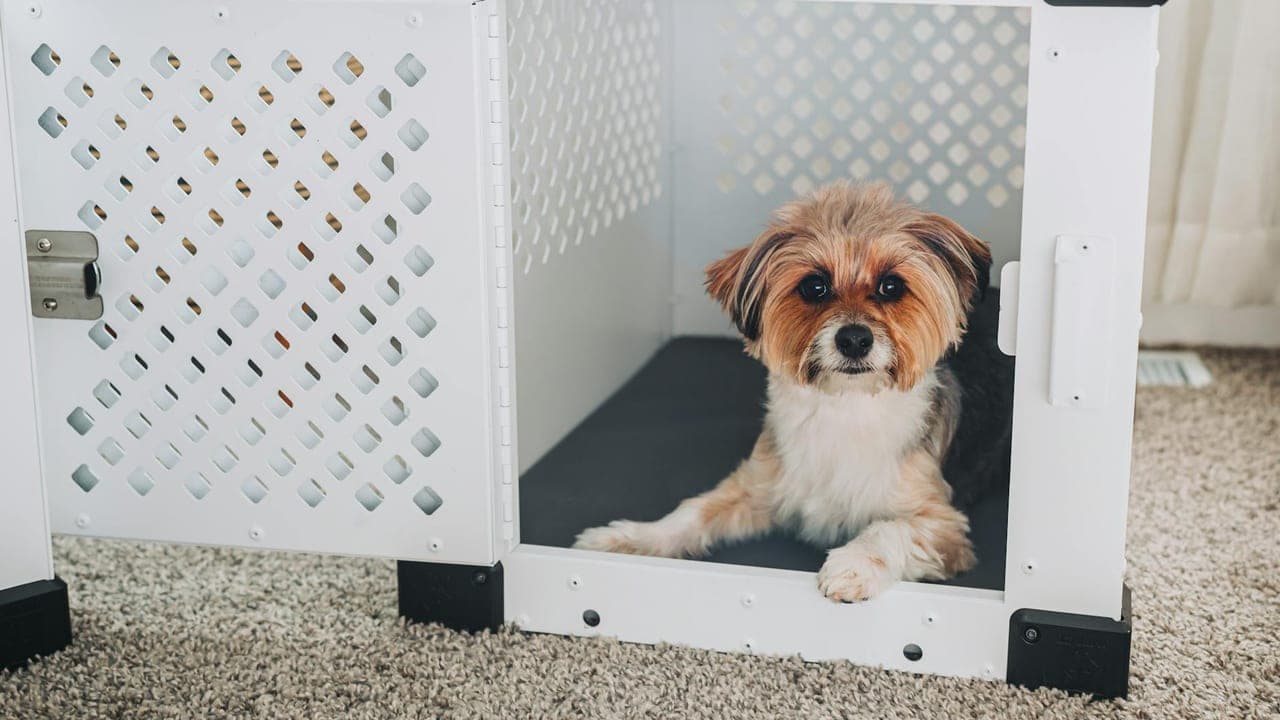
Puppy Crate Training: A Step-by-Step 14-Day Plan
Overview A crate is not a cage and it is not a babysitter — it is a den you are teaching a puppy to choose. The American Veterinary Society of Animal Behavior (AVSAB) frames crate training as a tool t
Reading Time
📖 15 min read
Guide Type
📋 General
Last Updated
📅 Sep 9, 2026
Breed
🐶 All Pets
In This Guide
Overview
Overview
A crate is not a cage and it is not a babysitter — it is a den you are teaching a puppy to choose. The American Veterinary Society of Animal Behavior (AVSAB) frames crate training as a tool that works only when it is built on positive association; the same crate that becomes a safe resting place when conditioned with food and rest becomes a source of fear and barrier-frustration when used as a place to dump a misbehaving puppy. The difference is entirely in how the first two weeks are run.
Most owners get one specific thing wrong, and it is the same thing: they put the puppy in the crate at full duration on day one and close the door because that is what the crate is for. A puppy that screams for forty-five minutes on its first night has not learned the crate is safe — it has learned the crate is where panic happens, and that lesson takes far longer to reverse than to avoid. This guide is the slower path that is actually faster: a 14-day conditioning plan where the duration only rises after the criterion at each stage is met.
Two decisions sit underneath the whole plan, and getting them right early prevents the most expensive failures: what size crate to buy (one crate with a divider, not a series of crates as the puppy grows), and how long a puppy can physically hold its bladder (age in months plus one, in hours, as a ceiling — not a target). Everything in the day-by-day plan below depends on those two numbers.
If you do nothing else from this article: never use the crate for punishment, never exceed the bladder ceiling for the puppy's age, and never raise the duration until the puppy is settling — not just tolerating — at the current one.
Daily Care
The 14-Day Crate Plan (Daily Care)
The plan moves in five stages, not fourteen identical days. You advance a stage only when the criterion is met — a puppy that is still whining at the door at the end of Day 3 does not move to Day 4's duration; it repeats Day 3. The day numbers are a typical pace, not a deadline. Rushing a stage because "it's Day 5" is the single most common way owners manufacture crate aversion.
| Day range | Goal | Crate duration (door state) | Advance criterion | |---|---|---|---| | Days 1–2 | Crate = food appears, door open | 0 min closed; meals fed just inside, door open | Puppy walks fully in to eat without coaxing | | Days 3–5 | Door closes briefly while you are present | 1–5 min closed, you in the room | Puppy stays relaxed (lies down/chews) for the full interval, no scratching at door | | Days 6–8 | You leave the room, short absences | 5–15 min closed, you step out and back | No sustained vocalizing; settles within ~60 sec of door closing | | Days 9–11 | Real absences begin | 20–45 min closed, you leave the house briefly | Calm on your return; no soiling; no barrier-damage behavior | | Days 12–14 | Daytime working duration + overnight | Up to the age-appropriate ceiling (see Health); overnight with one set alarm if very young | Sleeps/settles for the interval; eliminates on schedule, not in the crate |
Days 1–2: the crate only ever means good things
Feed every meal with the bowl placed just inside the open crate, and toss a few treats in throughout the day for the puppy to discover on its own. The door does not close — not once. The goal of these two days is a single association: crate space predicts food and nothing is taken away. A puppy that hesitates at the threshold is told you nothing yet; move the bowl to the doorway and inch it inward over the meals until the puppy steps fully in to eat without you placing it there. Do not close the door early to "save time" — a forced close here is exactly the experience you are spending two weeks engineering around.
Days 3–5: closing the door, with you visible
Once the puppy enters freely, close the door for one to five minutes while you sit beside the crate, then open it before the puppy asks. Time the open to a calm moment — never open the door in response to whining, because opening on a whine teaches that whining is the door-opener and you will hear that lesson for months. Give a stuffed chew (see Nutrition) so the closed interval has something to do that is itself rewarding. If the puppy is frantic at three minutes, your next rep is two minutes, not four.
Days 6–8: brief out-of-sight absences
Close the door and leave the room for five to fifteen minutes, returning before distress builds rather than after. A puppy that has learned "door closes, person disappears forever" is the puppy that develops separation-related crate panic; short, boring, undramatic departures and returns teach the opposite — that absence is routine and brief. Keep arrivals and departures low-key; a big emotional reunion makes the absence feel like the notable event it should not be.
Days 9–11: real absences
Now the absences become genuine — twenty to forty-five minutes, including leaving the house. Build to the duration, do not jump to it. This is the stage where the bladder ceiling becomes a hard constraint, not a guideline: a nine-week-old puppy physically cannot hold for three hours, and a soiled crate sets the entire plan back because the den association is broken.
Days 12–14: working duration and overnight
Daytime duration rises toward the age-appropriate ceiling, and overnight crating runs in parallel from Day 1 if you choose — but overnight is its own track. Very young puppies (8–10 weeks) will usually need one middle-of-the-night toilet trip; set an alarm rather than waiting for the cry, so the trip is a calm, lights-low, no-play escort to the toilet spot and straight back. Within one to three weeks most puppies extend overnight as bladder capacity grows.
Nutrition
Nutrition: Feeding the Crate Into a Positive Place
Food is the mechanism that does the conditioning, so feeding strategy is not separate from crate training — it is the training. For the first two weeks, every meal is served inside the crate. This is deliberate: eating is an inherently relaxing, parasympathetic activity, and a puppy that consistently relaxes-while-eating in the crate generalizes the calm to the crate itself. Skipping crate-fed meals and instead just "putting the puppy in with a toy" removes the strongest positive-association lever you have.
Layer in a long-duration food puzzle for the closed-door intervals from Day 3 onward. A frozen, food-stuffed rubber toy (smeared with a thin layer of wet food or plain canned pumpkin and frozen overnight) turns a fifteen-minute closed interval into a fifteen-minute chewing session that ends with the puppy tired and content rather than watching the door. The chew should outlast the interval at first — the puppy should be interrupted mid-chew when you open the door, so the crate is associated with an unfinished good thing, not a countdown to release.
Two cautions. First, do not leave the puppy unsupervised with a chew that can be bitten into swallowable chunks behind a closed door — solid rawhide and hard bones are an obstruction and choking risk in an unwatched crate; use a single-piece rubber puzzle toy designed to be gnawed, not consumed. Second, do not free-feed in the crate by leaving a full bowl all day: it removes the meal as a discrete training event and undermines the toilet schedule the whole plan depends on. Scheduled meals make elimination predictable, and predictable elimination is what keeps the crate clean.
Exercise
Exercise: Drain the Energy Before the Door Closes
A crate is a rest tool, not a containment tool, and the difference shows up in behavior. Asking an under-exercised, under-stimulated puppy to settle quietly in a crate is asking it to do something physiologically difficult — the body is primed to move and the crate prevents it, which produces exactly the whining, pawing, and barrier-frustration owners then misread as "hating the crate." The crate did not fail; the schedule did.
The rule is simple: a meaningful crate session follows a satisfied puppy, not precedes one. Before any daytime closed interval longer than a few minutes, run the puppy through a deliberate energy-and-brain drain — a short play or fetch burst, then five to ten minutes of training or sniff-work (scatter-feeding kibble in grass, a basic command session, a snuffle mat). Mental work fatigues a puppy disproportionately to its physical cost, and a mentally tired puppy settles in the crate within a minute or two rather than protesting for twenty.
Match the load to the age, because over-exercising a growing puppy carries its own cost. A widely used veterinary-behavior guideline is roughly five minutes of structured exercise per month of age, once or twice a day — so a four-month-old gets about twenty minutes per structured session, not an hour-long run that stresses developing joints. Free play and sniffing on top of that are fine and not counted against the rule; what the rule limits is repetitive forced exercise (long jogs, stairs, fetch to exhaustion) on immature joints. The sequence that works almost every time: exercise, then toilet, then a calm escort into the crate with the frozen chew — in that order.
Grooming
Grooming: A Brief, Useful Overlap
Grooming is largely separate from crate training, but two small habits started in these same first weeks pay off and are worth folding in. First, use the crate-conditioning mindset for handling: while the crate door is open and the puppy is relaxed near it, do thirty-second paw-holds, ear-touches, and brief brushing paired with a treat. The same positive-association principle that builds the crate builds a dog that tolerates nail trims and vet exams for life, and the relaxed-near-the-crate state is an ideal moment to practice it.
Second, keep the crate itself clean and odor-neutral. Use a washable, chew-resistant crate mat and launder it weekly; a crate that smells of a previous accident invites repeat soiling and quietly erodes the den association you are working to build. If the puppy soils the crate, the response is to clean thoroughly with an enzymatic cleaner (ordinary detergent leaves scent cues a dog can still detect) and to re-examine the schedule and crate size — not to scold, which only adds fear to a space that must stay safe.
Health
Health: Bladder Limits, Crate Stress vs Settling, and the Welfare Line
The bladder-capacity rule (the number the whole plan rests on)
A practical veterinary rule of thumb for daytime bladder capacity in a healthy puppy is age in months, plus one, in hours — as a ceiling, not a target. A 2-month-old can hold roughly 3 hours at most; a 4-month-old roughly 5 hours. Two hard limits sit on top of this: regardless of the formula, most guidance caps any single daytime crate stretch for a young puppy at about 3–4 hours, and overnight (sleeping, lower urine production) typically runs longer than the daytime number. These are physiological ceilings — willpower does not extend them, and a puppy forced past its limit will either soil the crate (breaking the den association) or, worse, learn to suppress elimination in ways that contribute to urinary problems. If your schedule requires the puppy to be alone longer than the ceiling, the answer is a midday walker, a pen with a toilet area, or a different schedule — not a longer crate stretch.
Reading the puppy: stress vs settling
These look different, and telling them apart is the core skill of crate training:
- Settling (proceed): a few seconds of fussing, then lying down; chewing the puzzle toy; a sigh and sleep; brief whine that self-resolves within roughly a minute.
- Stress (do not advance — step back a stage): escalating rather than decreasing vocalization; frantic digging or biting at the crate door or bars; panting and drooling unrelated to heat; refusal to eat a high-value chew it normally loves; soiling immediately despite a recent toilet trip.
The distinction matters because the response is opposite: settling means hold the duration and let the puppy succeed; stress means you raised duration faster than the association was built, and the fix is a shorter, easier rep — not waiting it out, which only deepens the aversion.
When over-crating crosses into a welfare or medical problem (triage)
Reduce crating now and consult a veterinary behaviorist or your vet within days, not weeks, if you see:
- Self-injury directed at the crate — broken teeth or nails, bloodied gums, abraded muzzle from biting the door or bars
- Panic that does not habituate after a properly run two-week plan: persistent frantic vocalizing, drooling, or destruction every absence (a hallmark of separation-related distress, which crating does not treat and can intensify)
- House-soiling that continues despite the schedule respecting the bladder ceiling — rule out a urinary tract infection or other medical cause with your vet before assuming it is behavioral
- Refusal to enter the crate at all after it was previously fine — this is learned aversion, and pushing through it makes it worse
Same-day veterinary attention (medical emergency, unrelated to behavior but seen because the puppy is crated): repeated vomiting or diarrhea, straining to urinate with little produced, a distended or painful belly, collapse, or laboured breathing.
A crate is a training aid for a normal puppy. It is not a treatment for separation anxiety, and it is not a place to leave a puppy that is genuinely panicking — in those cases the crate is the wrong tool and a professional behavior plan is the right one. "When in doubt, ask your vet" applies, but the lists above are the line at which doubt should already be resolved in favor of getting help.
Costs
What Crate Training Actually Costs
The visible cost of crate training is small and the hidden cost is large, which is exactly backwards from how owners budget it. Approximate US ranges (regional and brand variation is wide):
- Wire crate with a divider panel (adjustable, single purchase): ~$40–$120. The divider is the decision that saves money: it lets you buy one crate sized for the adult dog and partition it down so the puppy has only enough room to stand, turn, and lie down — large enough to be comfortable, small enough that it will not toilet in one corner and sleep in the other. Buying a series of correctly sized crates as the puppy grows costs more and discards a working one each time.
- Crate cover / calming chew toys / washable mat: ~$25–$70 combined. A breathable cover lowers visual stimulation and helps some puppies settle; a single-piece rubber puzzle chew is the workhorse of the closed-door intervals.
- Enzymatic cleaner (for accidents): ~$10–$20, and genuinely necessary — ordinary cleaners leave scent cues that invite repeat soiling.
- Visible setup total: typically ~$75–$200, one-time.
The hidden cost is the one that dwarfs all of the above: a puppy that develops a genuine crate aversion or separation-related distress because the conditioning was rushed or the crate was used as punishment. Remediating that is not a hardware problem — it is one to several sessions with a credentialed veterinary behaviorist or qualified force-free trainer at roughly $100–$250+ per session, often plus a behavior-modification plan that runs weeks. Spending two unhurried weeks running the plan correctly is the cheaper side of that trade-off by an order of magnitude. The crate itself is almost free; the mistake is what is expensive.
Frequently Asked Questions
How long can I leave my puppy in the crate during the day?
Use age in months plus one, in hours, as a ceiling — a 3-month-old roughly 4 hours at most — and cap any single daytime stretch at about 3–4 hours regardless of the formula. These are physiological bladder limits, not training targets. If your day requires longer, use a midday walker or a pen with a toilet area instead of extending the crate time.
My puppy cries in the crate at night — should I let it out?
Distinguish a self-resolving whine (settles within about a minute — wait it out) from escalating panic (do not wait it out — that deepens the aversion; step back a stage tomorrow). For very young puppies, a single cry near the expected toilet time is usually a genuine bladder signal: escort calmly to the toilet spot, no play, straight back. Never open the door in response to sustained whining, because that teaches whining opens the door.
Is it ever okay to use the crate as a time-out for bad behavior?
No. Using the crate for punishment is the most reliable way to create crate aversion, because it pairs the den with a negative event and undoes the positive association the whole plan is built on. Manage unwanted behavior with supervision, redirection, and exercise; keep the crate exclusively associated with rest and food.
What size crate should I buy for a puppy that will grow a lot?
Buy one wire crate sized for the projected adult dog and use the divider panel to partition it down. The puppy's section should be just big enough to stand, turn around, and lie down comfortably — enough room to relieve itself in one corner and sleep in another defeats the house-training logic the crate provides.
My puppy still panics in the crate after two weeks of the plan — what now?
A correctly run two-week plan that ends in persistent panic, destruction, or self-injury is a sign of a separation-related problem, which crating does not treat and can worsen. Stop escalating crate time and consult your veterinarian or a credentialed veterinary behaviorist within days; rule out a medical cause for any house-soiling first.
Sources
This guide draws on the following published references. Each opens in a new tab so you can check it against what you have read here.
ASPCA
Common Dog Behavior Issues(opens in a new tab)AVMA
What's Your Pet's Life Stage?(opens in a new tab)Merck Veterinary Manual
Behavior Problems in Dogs(opens in a new tab)Merck Veterinary Manual
Puppy Care(opens in a new tab)Merck Veterinary Manual
Routine Health Care of Dogs(opens in a new tab)
Affiliate disclosure: We may earn a commission from qualifying purchases. This doesn't affect our recommendations.
Recommended Products
Greenies Petite Training Treats (Low Calorie)
Tiny, low-calorie treats ideal for puppy training sessions. Won't overfeed puppies during frequent reward-based training.
Stella & Chewy's Freeze-Dried Training Bits (Premium)
Premium, high-value freeze-dried meat treats. Puppies go crazy for them—worth the cost for critical early training phases.
Midwest Homes for Pets iCrate Double Door (24 inch)
Industry-standard wire crate for puppies. Double doors for flexibility, divider panel adapts as puppy grows, collapsible for portability.
Frisco Basic Training Pads (100-count)
Leak-proof puppy pads for housebreaking. Attract-scent formula encourages use. Essential during the 8-16 week training window.
Frisco Nylon Adjustable Harness (XS/Small Puppy)
Lightweight, fully adjustable for growing puppies. No-pull design prevents neck strain and makes early walk training safer.
Adjustable wire crate with divider panel
One adult-sized crate you partition down as the puppy grows — the single purchase that replaces buying several.
Calming crate cover & single-piece rubber chew
Breathable cover to lower visual stimulation plus a stuffable chew for the closed-door intervals.
Get personalized pet care tips
Join our newsletter for breed-specific advice, care guides, and expert tips delivered weekly.
No spam, ever. Unsubscribe anytime.