
Puppy Feeding by Breed Size: Small, Medium & Large-Breed Plans
Overview A Great Dane reaches roughly 100 times its birth weight by adulthood; a Chihuahua reaches about 20 times its birth weight, and it does so in less than half the time. That single fact — not po
Reading Time
📖 16 min read
Guide Type
📋 General
Last Updated
📅 Sep 9, 2026
Breed
🐶 All Pets
In This Guide
Overview
Overview
A Great Dane reaches roughly 100 times its birth weight by adulthood; a Chihuahua reaches about 20 times its birth weight, and it does so in less than half the time. That single fact — not portion size — is why the same bag of "puppy food" can be correct for one and a documented orthopedic risk for the other. The American College of Veterinary Nutrition and the AAFCO growth profile draw a hard line at an expected adult weight of 70 pounds (about 31.8 kg): above it, a puppy needs a diet whose calcium content is actively controlled, because excess dietary calcium during rapid skeletal growth is a recognized cause of developmental orthopedic disease (DOD).
This is the part owners are not told at the breeder or the shelter. The instinct is to treat puppy feeding as one decision scaled up or down: a bigger puppy eats more of the same food. For small and most medium breeds, that instinct is roughly right. For large and giant breeds it is wrong in a way that shows up months later as a limping eight-month-old, a $4,000 surgical estimate, and the question "was it the food?" — to which the honest answer is often "partly, and it was preventable."
There are two decisions here, and they compound. The first is which formula: an AAFCO growth food appropriate for the projected adult size — for large-breed puppies, specifically one carrying the AAFCO large-size growth statement. The second is how long you feed it and how fast you let the puppy grow: small breeds finish skeletal growth near 10 months; large and giant breeds are still building bone at 18 to 24 months, and pushing maximum growth rate during that window trades adult joint health for a fuller-looking puppy now. This guide gives the size-class plan, the meal frequency by age, the calcium and AAFCO detail in plain terms, and the triage thresholds — because in a toy-breed puppy, "not eating" is a clock, not a wait-and-see. If you take one thing from this article: a large-breed puppy needs large-breed-formula growth food fed to a lean body condition, not as much puppy food as it will eat.
Daily Care
The Feeding Routine by Size Class (Daily Care)
Puppies do not eat like adult dogs, and the gap is widest in the smallest and the largest of them — for opposite reasons. A toy-breed puppy has minimal glycogen reserve and can drop into hypoglycemia within hours of a missed meal. A giant-breed puppy has the opposite problem: its appetite and gut capacity let it consume far more calories than its skeleton can safely use, so frequency and total intake are managed down, not up. Frequency, formula, and growth-window length all change by size class, not just amount.
The table below is the working plan. "Formula requirement" is the load-bearing column — it is the difference between scaling a portion and changing the food.
| Size class (projected adult weight) | Skeletal growth window | Meals/day by age | Formula requirement | |---|---|---|---| | Toy / Small (under ~20 lb / 9 kg) | Finishes ~9–10 months | 4/day to 12 wks → 3/day to ~6 mo → 2–3/day after; never long fasts | Standard AAFCO growth ("growth" or "all life stages"); calorie-dense, small kibble; hypoglycemia is the main risk | | Medium (~20–50 lb / 9–23 kg) | Finishes ~12 months | 4/day to 12 wks → 3/day to ~6 mo → 2/day after | Standard AAFCO growth food; transition to adult near 12 months | | Large (~50–90 lb / 23–41 kg) | Finishes ~15–18 months | 3–4/day to 6 mo → 2/day after; portion-controlled, not free-fed | Must carry the AAFCO large-size growth statement (≥70 lb expected adult weight) — controlled calcium | | Giant (over ~90 lb / 41 kg) | Finishes ~18–24 months | 3/day to 6 mo → 2/day after; lean target enforced | AAFCO large-size growth statement; lowest of the safe growth-rate range — grow slow on purpose |
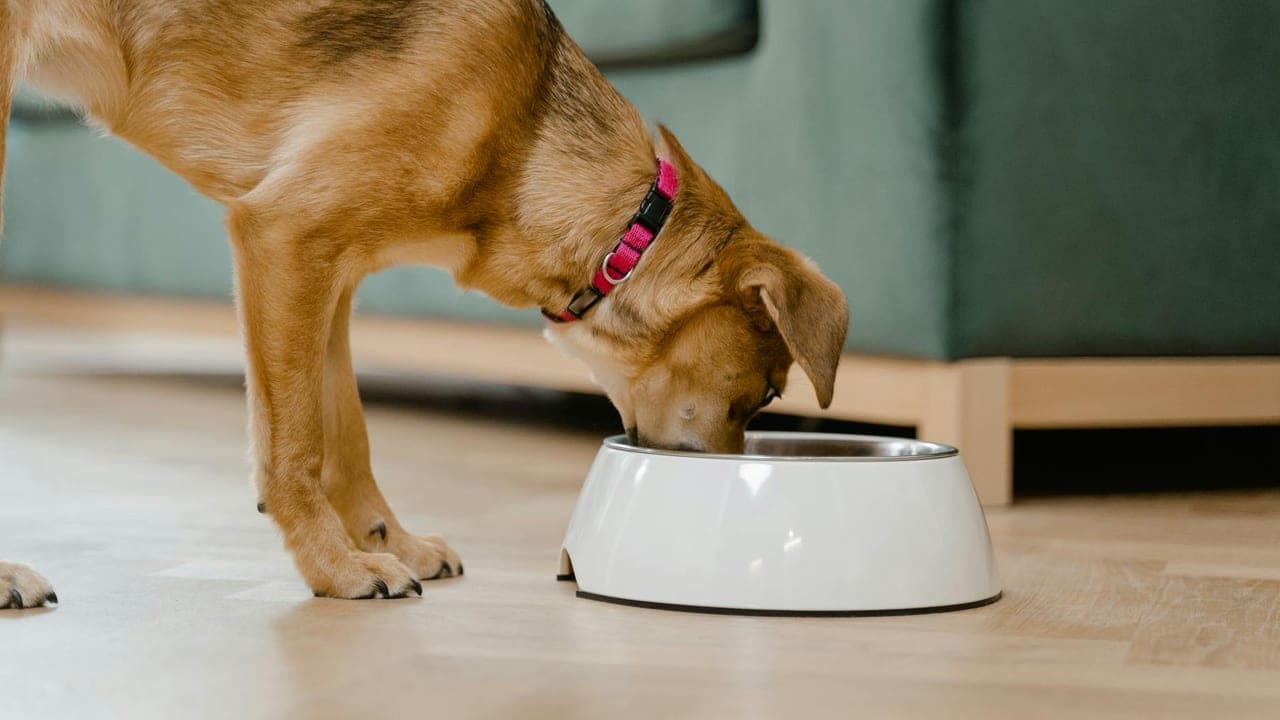
The single most useful habit across every size class is to feed measured meals against body condition, never free-choice from a bowl that is topped up. Free-feeding a Labrador puppy is the textbook version of the mistake: the Labrador is a breed with a documented appetite-regulation difference (a POMC-gene variant linked to food motivation), it will eat well past need, and a constantly available bowl converts that drive into a fast-growing, over-conditioned large-breed puppy — exactly the growth pattern DOD is associated with. Measured meals also give you a daily appetite check, which is the earliest illness signal you have, at no extra effort.
Weigh the puppy and run a hands-on body condition check every two weeks during growth. Large- and giant-breed puppies in particular should be kept visibly lean — ribs easily felt under a thin cover, a clear waist from above — through the whole growth window. A roly-poly giant-breed puppy is not healthy padding; it is accelerated load on growth plates that are still 18 months from done. The scale and the hands catch this earlier than the eye, because puppy fluff hides condition until it is significant.
Nutrition
Nutrition: The AAFCO Large-Breed Statement and Why You Don't Add Calcium
The most important sentence on a puppy food package is not on the front. Turn the bag over and find the AAFCO nutritional adequacy statement. For any puppy you need "formulated to meet the nutritional levels established by the AAFCO Dog Food Nutrient Profiles for growth" or "...for all life stages." Adult-maintenance food is, by definition, not formulated for growth — it can legally under-supply the protein and energy density a growing puppy needs, because it was never tested for that life stage. That is the floor for every size.
The large-breed addition is the part that matters most and is least understood. For a puppy whose expected adult weight is 70 pounds (about 31.8 kg) or more, the AAFCO statement must include the large-size growth qualifier — the modern phrasing is "...for growth, including growth of large size dogs (70 lb or more as an adult)." This is not marketing. AAFCO sets a maximum calcium level for large-size growth foods, not just a minimum, specifically because excess calcium during the rapid-growth phase of a large or giant breed is a recognized contributor to developmental orthopedic disease — including hypertrophic osteodystrophy (HOD), osteochondrosis (OCD), and angular limb deformities. A general-purpose growth food can legally carry more calcium than is safe for a Great Dane puppy. The large-size statement is the verification that calcium is capped.
Calcium-to-phosphorus ratio matters alongside total calcium. The AAFCO growth profile targets a ratio in roughly the 1:1 to 1.8:1 range; a complete-and-balanced large-breed growth food is already inside it. The clinical point that follows is the one to act on:
Do not supplement calcium. This is the named mistake, and it runs counter to intuition — "big puppy, big bones, give it calcium" is exactly the reasoning that causes harm. Adding a calcium supplement, bone meal, dairy, or a "growth" topper to a complete commercial growth diet does not build a sturdier skeleton; in large-breed puppies it disrupts the controlled calcium the large-size formula exists to provide and is associated with the orthopedic diseases above. A puppy on a complete-and-balanced large-breed growth food needs no calcium, phosphorus, or vitamin-D supplement, and adding one is a documented risk, not insurance. If a breeder or a forum recommends a calcium supplement for a growing large-breed pup, that recommendation runs against current veterinary nutrition guidance — confirm with your veterinarian before adding anything to a complete diet.
The growth-rate trade-off, named plainly. Within the safe range, a large- or giant-breed puppy can be fed toward the faster end or the slower end of normal growth. Faster growth produces a bigger-looking puppy sooner and reaches adult frame earlier. Slower, leaner growth produces the same adult size on a longer timeline with measurably lower DOD and hip-dysplasia expression. The veterinary consensus is unambiguous on which side to err: feed a large-breed puppy to grow steadily and lean, not maximally. You are not capping the dog's adult size — you are deciding whether it gets there with sound joints. That is the trade-off at the center of this entire topic: fast growth now versus joint health for the dog's life.
The cutoff and the transition. Switch off growth food at the end of the size-class window: ~10 months for small, ~12 months for medium, ~15–18 months for large, ~18–24 months for giant breeds. Transition over 7–10 days — roughly one-quarter new food days 1–3, half days 4–6, three-quarters days 7–9, full adult diet by day 10 — because the gut microbiome adapts over days and an abrupt swap commonly causes diarrhea, and a young puppy dehydrates faster than an adult dog. Switching a large-breed puppy off growth food early under-supplies the final mineralizing months; leaving it on calorie-dense growth food long past maturity drives obesity, which compounds any joint problem already present.
Exercise
Exercise: The Growth-Plate Caution for Big Puppies
Feeding and exercise are one system in a growing large-breed dog, because both load the same unfinished skeleton. A large- or giant-breed puppy's growth plates do not close until 12 to 18+ months, and until they do, the cartilage at the ends of the long bones is softer than the bone it will become. This is why exercise type — not just amount — is a feeding-adjacent health decision for big breeds.
The specific caution is forced, repetitive, high-impact exercise during the growth-plate window: long forced runs alongside a bike or jogger, repeated jumping (off furniture, out of a truck bed, agility-style jumps), and forced stair work in a heavy, fast-growing puppy. These load open growth plates in a way self-directed play does not, and in large breeds are associated with the same family of orthopedic problems the diet controls for. A useful working rule many veterinarians give: keep structured leash walks short and let the puppy set the pace, and avoid forced repetitive impact until growth plates close — for a giant breed that can mean past 18 months. Free play on soft, non-slip footing where the puppy can stop when tired is appropriate at every age; controlled stair and jump access matters until the skeleton finishes.
The because behind this is the same one behind the calcium rule: the goal in a large-breed puppy is a sound adult skeleton, and both over-rich food and over-impact exercise push against that goal during the exact window — roughly birth to 18 months — when the skeleton cannot defend itself. Lean body condition lowers the load further: every kilogram of excess puppy weight is extra force across cartilage that has not yet hardened.
Grooming
Grooming: Brief, and the One Feeding-Linked Item
Most puppy grooming — coat, nails, ears, early dental handling — does not vary by feeding plan, and the size-class details belong in a breed care guide rather than here. Two feeding-adjacent points are worth setting up early.
Start dental handling during the socialization months, regardless of breed size, because periodontal disease is among the most common adult canine conditions and a puppy habituated to a finger toothbrush and pet-safe enzymatic toothpaste before about 16 weeks tolerates brushing for life. Kibble provides only modest mechanical abrasion and is not a substitute for brushing. Use stainless-steel or ceramic food and water bowls and wash them daily: plastic bowls scratch, harbor bacteria, and in some dogs are linked to chin irritation — a cheap material swap, not a medical problem, when handled early. Neither of these changes by size class; both are easier to establish in an eight-week-old than to retrofit in an adult.
Health
Health: DOD, Panosteitis, Obesity, and Toy-Breed Hypoglycemia
Four feeding-linked health problems account for most of what goes wrong during the growth period, and each comes with a specific triage line — "ask your vet" here is always attached to a threshold, never a substitute for one.
Developmental orthopedic disease (DOD) is the large-breed one the whole diet exists to prevent. It is an umbrella for several conditions of the growing skeleton: hypertrophic osteodystrophy (HOD) — painful swelling at the ends of the long bones, often with fever and reluctance to stand, typically in fast-growing large breeds 2–6 months old; osteochondrosis (OCD) — abnormal joint cartilage that can fragment, commonly shoulder, elbow, or hock; and angular limb deformities from uneven growth-plate development. The recognized risk factors are excess dietary calcium, over-nutrition driving rapid growth, and excess body weight — the three things this guide's feeding plan controls. Triage threshold: a large- or giant-breed puppy that is limping, has a hot or swollen joint or long bone, is reluctant to stand, or has a fever and won't eat is a same-day or next-day veterinary visit, not a watch-and-wait — DOD is time-sensitive and the dietary contribution must be reviewed immediately.
Panosteitis ("growing pains") is the one that mimics DOD and is more benign — but only a vet can tell them apart. It causes a shifting lameness (one leg, then another) in large-breed puppies, often 5–18 months, and is usually self-limiting. The reason it still belongs on a same-week vet list: shifting large-breed-puppy lameness is also how early elbow OCD or panostitis-versus-DOD presents, and the differentiation is radiographic, not visual. Do not self-diagnose "just growing pains" in a limping big-breed puppy.
Obesity is the slow, common one that compounds everything above. An over-conditioned puppy carries extra load across unfinished joints during growth and becomes an over-conditioned adult at higher risk of osteoarthritis and metabolic disease. The lever is the measured portion against body condition, applied steadily through the growth window. The because: in a large breed, excess weight and accelerated growth are the same risk vector DOD sits on — keeping the puppy lean is not cosmetic, it is orthopedic prevention.
Hypoglycemia is the fast one, and it is the toy-breed mirror image of DOD. Toy and small-breed puppies under roughly 12 weeks — and very small individuals for longer — have minimal glycogen reserves and can drop into clinically low blood sugar within hours of not eating, stress, or cold. Signs: weakness, wobbliness, disorientation, cold to the touch, and in severe cases tremors, seizures, or collapse. Triage threshold: a toy-breed puppy that has not eaten for several hours and is weak, wobbly, or disoriented is an immediate same-day veterinary call. As a first-aid bridge while arranging care, a small amount of plain corn syrup or honey rubbed on the gums can buy time — it is a bridge to the vet, not a treatment, and is why frequent small meals (every 3–4 hours under 12 weeks) are non-negotiable in toy breeds.
When to call the vet during the growth period — the line, not the wait:
- A toy/small-breed puppy that is weak, wobbly, cold, or disoriented after a missed meal (possible hypoglycemia — immediate)
- Any puppy under 12 weeks not eating for more than 12 hours, or any puppy not eating for more than 24 hours
- A large- or giant-breed puppy limping, with a hot/swollen joint or bone, reluctant to stand, or feverish and off food (possible DOD — same/next-day)
- Repeated vomiting or diarrhea, especially with blood, or a distended, painful belly
- Steady growth food fed correctly but the puppy is not gaining over two weekly weigh-ins, or is gaining far faster than the breed expectation
"When in doubt, ask your vet" applies to feeding questions — but the lines above are where doubt should already be resolved in favor of calling. Puppies decompensate faster than adult dogs, and in a toy breed or a fast-growing giant breed the margin is measured in hours, not days.
Costs
What the Choice Actually Costs — and the Hidden One
The visible cost of feeding by size class is small and predictable. The expensive cost is the one that does not appear on the food receipt: it appears 8 to 14 months in as an orthopedic surgical estimate, and the feeding decisions in this guide are what sit between the two.
Approximate US ranges (regional, brand, and size variation is wide):
- Small/toy-breed growth food, year one: ~$15–$35/month — small dogs eat little; food cost is a minor line
- Large-breed AAFCO growth food, year one: ~$50–$110/month — a giant-breed puppy through its growth window is a real budget line; the large-size formula is not meaningfully more expensive than a comparable-quality general growth food, so cost is not a reason to skip it
- Body-condition tools (gram scale, slow-feeder bowl): ~$15–$40 one-time — the cheapest single spend that prevents the expensive one
- First-year feeding total (food only): roughly $200–$450 small breed; $600–$1,300 large/giant breed
The hidden cost is the trade-off this entire guide turns on. Corrective surgery for a single DOD-related condition — elbow or shoulder OCD arthroscopy, or surgical management of an angular limb deformity — commonly runs $2,000–$5,000+ per joint, frequently bilateral, with lifelong osteoarthritis management on top. Set against the zero incremental cost of choosing the correct large-breed growth formula and the ~$20 cost of a slow-feeder bowl and a scale, the math is not close. The reveal here is blunt: the price of feeding a large-breed puppy correctly is essentially the same as feeding it incorrectly — the difference in dollars shows up entirely on the orthopedic side, years later, and only in the puppy that was fed adult or over-rich food, free-fed to maximum growth, or topped with a calcium supplement nobody needed.
Frequently Asked Questions
Can I feed my large-breed puppy regular puppy food?
Not safely. A puppy whose expected adult weight is 70 lb or more needs a food whose AAFCO statement specifically includes large-size growth ("growth, including growth of large size dogs (70 lb or more as an adult)"). That statement verifies the calcium is capped, because excess calcium during rapid large-breed growth is a recognized cause of developmental orthopedic disease. A general puppy food can legally carry more calcium than is safe for a giant breed.
Should I give my growing large-breed puppy a calcium supplement for strong bones?
No. Adding calcium, bone meal, dairy, or a growth topper to a complete-and-balanced large-breed growth diet does not build a sturdier skeleton — it disrupts the controlled calcium the formula provides and is associated with orthopedic disease. A puppy on a complete commercial growth food needs no calcium, phosphorus, or vitamin-D supplement. Confirm any addition with your veterinarian first.
Is it bad to free-feed a Labrador or other large-breed puppy?
Yes, in practice. Free-feeding lets a food-motivated breed eat past need, driving rapid growth and excess weight — the exact pattern developmental orthopedic disease is associated with. Feed measured meals against body condition (lean: ribs easily felt, visible waist), which also gives you a daily appetite check that catches illness early.
How long do I keep my puppy on growth food by size?
Roughly to skeletal maturity: ~10 months small, ~12 months medium, ~15–18 months large, ~18–24 months giant breeds. Then transition to an adult diet over 7–10 days. Switching a large-breed puppy off growth food too early under-supplies the final mineralizing months; staying on it long past maturity drives obesity.
My large-breed puppy is limping — is that just growing pains?
Treat shifting or persistent lameness in a large-breed puppy as a veterinary question, not a self-diagnosis. Panosteitis (benign growing pains) and developmental orthopedic disease such as OCD present similarly and are differentiated by radiographs, not by appearance. A hot or swollen joint, reluctance to stand, or fever with the limp is a same- or next-day visit.
Sources
This guide draws on the following published references. Each opens in a new tab so you can check it against what you have read here.
ASPCA
Dog Nutrition Tips(opens in a new tab)AVMA
What's Your Pet's Life Stage?(opens in a new tab)ASPCA
General Dog Care(opens in a new tab)Merck Veterinary Manual
Puppy Care(opens in a new tab)Merck Veterinary Manual
Routine Health Care of Dogs(opens in a new tab)
Affiliate disclosure: We may earn a commission from qualifying purchases. This doesn't affect our recommendations.
Recommended Products
Large-breed AAFCO growth puppy food (70 lb+ adult, controlled calcium)
Filter for an AAFCO statement that names 'growth of large size dogs (70 lb or more)' — that line, not the brand, is the calcium safeguard.
Slow-feeder / portion-control puppy bowl
Converts free-eating into a measured, slower meal — the cheapest tool that counters the free-feeding-a-large-breed-puppy mistake.
Get personalized pet care tips
Join our newsletter for breed-specific advice, care guides, and expert tips delivered weekly.
No spam, ever. Unsubscribe anytime.