
What My Blind Cat Taught Me About Underestimating Animals
Story Subject
Pip
Type
Cat
Read Time
7 min
Shared By
Rachel Okonkwo
Editor
Mr Pet Lover Admin
In This Guide
Pip's glaucoma progressed faster than we expected. At her three-year checkup, she had pressure in one eye. By month four, she was blind in both.
Her ophthalmologist was kind and thorough: "Cats adapt remarkably well, but you should expect behavioral changes. She may be more cautious, more anxious, more dependent."
Pip went home, navigated the apartment at her usual pace using whisker and memory, found her food bowl, and went to sleep on her favorite shelf.
The Adaptation
What nobody tells you about cats and blindness: they map their environment with extraordinary precision. Cats use spatial memory, whisker spread (which senses air currents and proximity to objects), and hearing to build a mental model of their space that functions even without visual input.
What this requires of the owner: stability. Don't rearrange furniture. Don't leave objects on the floor in new positions. Don't move the food bowl, water bowl, or litter box.
We learned this through one incident: I moved a kitchen chair two feet to vacuum and Pip walked directly into it at moderate speed. Her response was the cat equivalent of extreme personal offense. I moved the chair back.
What Changed
Very little, honestly.
Pip plays with the same toys she always played with — she tracks them by sound, by the air movement of a wand toy, by the rustling of crinkle paper. She is slightly more vocal when she's looking for me in the apartment, which I answer with a consistent verbal response so she can locate me. She navigates the stairs we have with confidence because she has done it ten thousand times and the stairs have not moved.
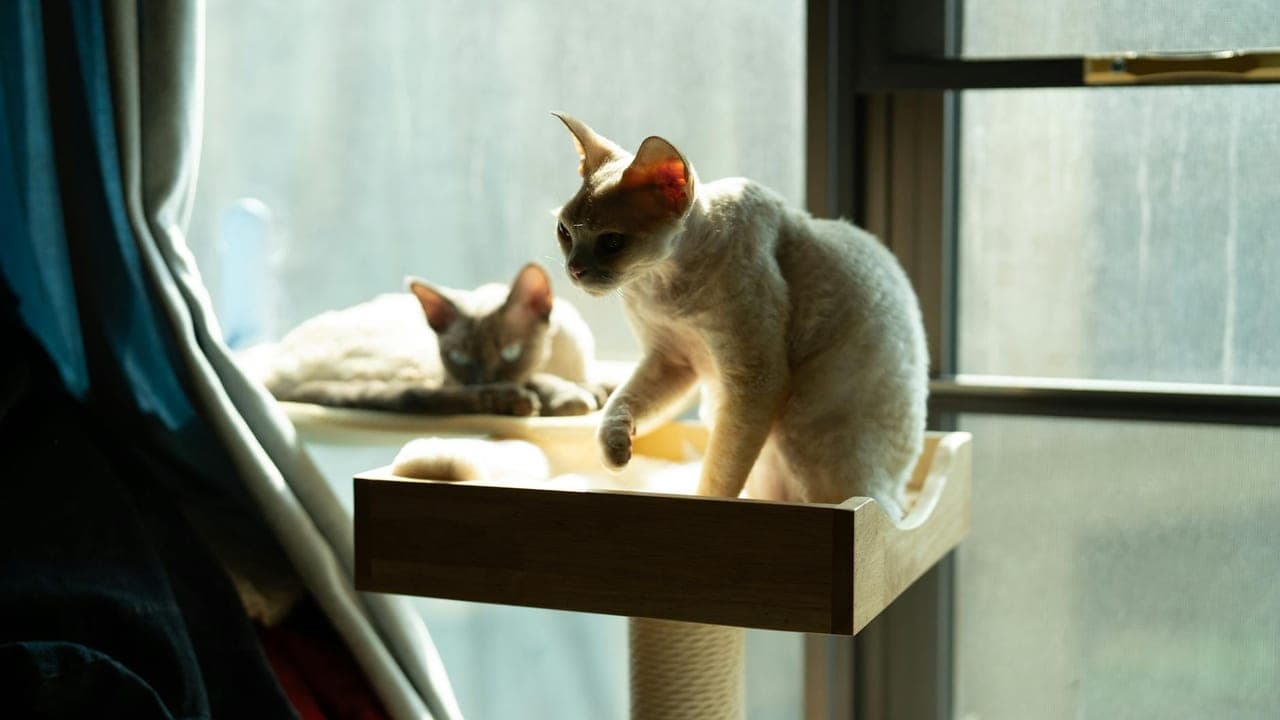
She is four now, one year post-diagnosis. She greets me at the door by sound. She climbs the cat tree by memory. She sits in the same sunny spot by the window, which she clearly still feels — the warmth is unchanged regardless of the vision.
I have stopped being sad about her blindness. She is not sad about it. It seems unkind to grieve on behalf of an animal who appears entirely unbothered.
Cats with vision loss can live full, normal lives with environmental consistency. Consult a veterinary ophthalmologist if your cat shows signs of vision changes.
Caring for a cat that has lost its sight
Pip's ophthalmologist was right about one thing and, in her case, wrong about another: cats do adapt remarkably well, but the anxious, dependent animal the warning describes usually only appears when the home changes, not the cat. A blind cat's welfare rests far more on the owner's habits than on the cat's temperament, and almost all of it comes down to keeping the world predictable.
The single most important rule is the one Pip taught with a kitchen chair: do not rearrange the environment. A sightless cat holds a detailed spatial map of the home in memory, so furniture, the cat tree, and — above all — the food bowl, water bowl and litter box should stay in fixed positions. Feed in the same spot at the same times, and leave the layout of frequently used rooms alone. When something must move, reintroduce the cat to it gently rather than assuming she will simply notice.
A blind cat also needs the home made a little safer to move through. Block access to open stairwells, balconies, unfenced heights and pools; pad or round off sharp table and counter corners at cat height; and keep floors clear of shoes, bags and clutter that appear in new positions. This is one of the strongest reasons a blind cat should live strictly indoors — outdoors she cannot see cars, dogs, or a route home. Our indoor cat care guide covers the enrichment, litter and safety basics that a vision-impaired cat depends on even more than a sighted one, and you can browse the rest of our feline care library from the cats hub.
Finally, cue her deliberately. Speak or make a consistent sound as you approach so you never startle her, talk to her as you move around the home so she can place you, and let scent and texture do navigational work — a particular rug by the litter box or familiar bedding helps her confirm where she is. Leave scent-marking posts where they are; those marks are part of her map.
How blind cats get around
Vision is only one of a cat's navigation tools, which is why losing it changes less than owners expect. A cat's whiskers sense air currents and the proximity of nearby objects, letting her feel a doorway or table edge before she reaches it. Her hearing is acute and directional, so she tracks people, prey and toys by sound. Her sense of smell flags familiar territory and the location of food, litter and resting spots. Layered over all of it is spatial memory — a learned mental model of a stable home that she can move through confidently in the dark.
That is exactly what the narrative above shows: Pip tracks toys by sound and air movement, greets the door by ear, climbs the cat tree by memory, and finds the same warm window spot she still feels. Remove sight from a cat living in a consistent home and you remove one input from a system built on four.
What Pip taught me about not grieving on her behalf
A year on, the thing I'd tell any owner facing this diagnosis is the thing I got wrong at the start: the sadness was mine, not hers. Pip didn't need me to mourn her eyes. She needed me to leave the chair where it was, keep her bowl in its spot, answer when she called, and keep her safe indoors. That is nearly the whole job. Blindness sounds like a tragedy, but in a home that stays still it turns out to be a manageable change — and the cat adapts long before the human does.
Questions About Pip
Common questions answered to help you better understand this story
Keep her world predictable. Leave furniture, the cat tree and — most of all — the food bowl, water bowl and litter box in fixed positions, and feed on a routine. Make the home safe by blocking stairwells and heights, padding sharp corners, and keeping floors clear of clutter. Announce yourself with your voice so you never startle her, and keep her strictly indoors where she can't meet hazards she can't see.
Yes. With a stable environment, most blind cats live full, ordinary lives — they play, climb, greet their owners and keep their routines. Cats rely heavily on smell, hearing, whiskers and spatial memory, so a sightless cat in a consistent home navigates confidently. The main change is required of the owner, not the cat: keep the layout still and the home safe, and have a vet rule out any painful or treatable cause of the vision loss.
By combining their other senses with memory. Whiskers detect air currents and nearby objects, so a cat feels an edge or doorway before touching it. Sharp, directional hearing tracks people and toys, and smell marks familiar territory, food and litter. Over that, a learned mental map of a home that doesn't move lets her walk, jump and climb routes she's traveled many times — which is why keeping furniture in place matters so much.
Start with a vet or veterinary ophthalmologist to identify the cause and treat any pain. Then adapt the home: fixed food, water and litter positions; no furniture rearranging; hazards like stairs, balconies and sharp corners blocked or padded; and indoor-only living. Use consistent verbal cues so she can locate you, and let scent and texture landmarks reinforce her map. Most cats settle within weeks once the environment is stable.
Generally, yes. Cats don't grieve the loss of sight the way people imagine — they adapt to it and carry on, provided they aren't in pain and their environment stays consistent. A blind cat that plays, eats well, seeks affection and moves confidently through a familiar home is showing the same contentment signals as any cat. If she seems withdrawn or stops eating, that points to pain or illness to check with a vet, not to blindness itself.
Didn't find your answer?
Get in touch →More Stories

Get more stories like this
Weekly heartwarming pet stories and care tips, straight to your inbox.
No spam, ever. Unsubscribe anytime.