
How We Introduced Our Dog to Our Newborn — What Worked and What Almost Went Wrong
Story Subject
Moose
Type
Dog
Read Time
8 min
Shared By
Jennifer & Tom Okafor
Editor
Mr Pet Lover Admin
In This Guide
We'd been warned. Read the books, watched the videos, consulted our trainer. But nothing quite prepares you for the moment your 70-pound Labrador Retriever realizes the house has changed and he can't figure out why.
Moose is gentle by nature — every Lab owner says this, and usually it's true. But gentle doesn't mean ready for a newborn. We made mistakes. Here's what we learned.
Before the Baby Arrived
Our trainer, Dana, gave us advice we should have started earlier: three months before the due date, begin teaching "place" — the command that sends a dog to a specific mat and keeps them there. We started it at six weeks out. It helped, but I wish we'd had more time.
We also introduced baby sounds (YouTube) and the smell of baby products around the house. We let Moose sniff the nursery furniture before it was in use. We changed his walk schedule to match our anticipated postpartum routine, so the adjustment happened before exhaustion hit.
The First Day Home
Tom brought home a receiving blanket from the hospital 24 hours before we arrived, so Moose had a full day to investigate the baby's scent without the stimulus of the actual baby.
When we walked in, Tom entered first with Moose on leash and redirected his energy with some basic commands and treats. Then I came in with the baby. Moose sat — shakily, but sat — and sniffed from a few feet away.
We didn't let him "greet" immediately. We let him observe from a distance, rewarded the calm, and kept sessions short. It took ten days before Moose stopped hyperventilating slightly around the carrier.
What Almost Went Wrong
Week three: exhausted, I set the baby on a blanket on the floor and dozed for two minutes on the couch. Woke to Moose standing directly over her, sniffing her face.
He wasn't threatening. But he was 70 pounds and unsupervised.
After that: never unattended, no exceptions, for the first year. Not because Moose is dangerous — because the risk calculus with a newborn requires zero margin of error.
Now
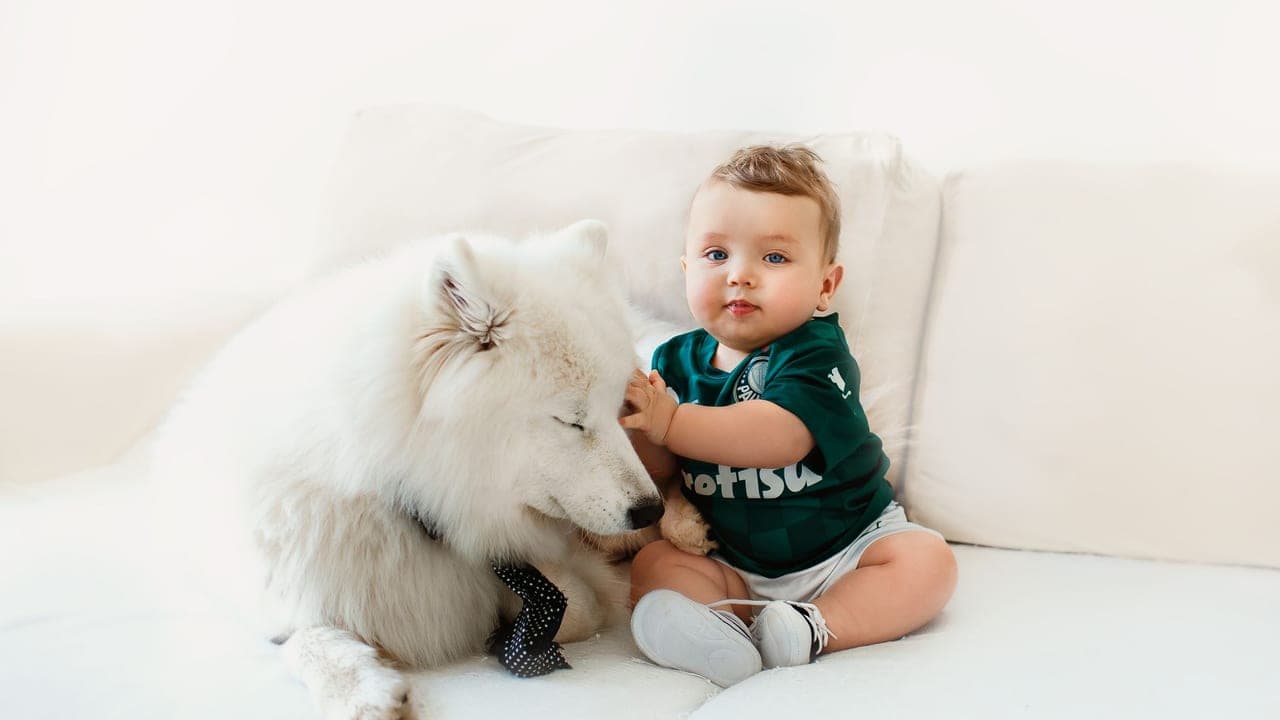
Ella is 18 months old. Moose follows her from room to room. She has learned to pet him "gently" (work in progress). He has learned to tolerate ear grabs with the patience of a saint.
Last week she fell asleep against him on the living room floor. He didn't move for an hour.
Labs are consistently ranked among the best family dogs. See our Labrador Retriever guide for what to expect at every life stage.
Why the Labrador temperament helps — and where it doesn't
There is a reason "good with children" is one of the first things people say about the breed. Our own Labrador Retriever profile describes the Lab as friendly, biddable, soft-mouthed and famously good with kids and other dogs — the same stable, people-oriented temperament that put the breed into service, guide and detection work. That disposition is a real head start when a newborn arrives, and it is why Moose's instinct was to investigate rather than to guard.
But temperament is not a safety guarantee, and the story above shows why. A Labrador is a 25–36 kg sporting dog: even a gentle one is large, fast and heavy enough that an accidental knock, a wagging tail or a paw in the wrong place can hurt an infant who cannot move away. The lesson Moose taught at week three — 70 pounds, calm, and still not something you leave alone with a baby — is the core professional rule: friendliness reduces the odds of intent, it does not remove the physics. Supervision is about size and unpredictability, not trust.
The other half of the Lab-specific picture is drive. The breed profile is blunt that an under-exercised Lab is a destructive Lab, and that food motivation runs "to a fault." Both matter with a newborn: a dog whose exercise has been quietly cut by a chaotic postpartum week has energy to spend somewhere, and a food-obsessed dog now lives in a house full of unattended bottles, spills and diaper bins. Keeping the walks and the mental work going — the routine Moose's owners deliberately shifted before the birth — is what keeps a bored, hungry Lab from making its own entertainment.
Preparing your dog before the baby arrives
The work that pays off happens in the weeks before you come home, not after. The behaviors below are well-established guidance from trainers and veterinary behaviorists, and they line up with what worked (and what was started too late) in the story:
- Front-load the training. Teach "place," a solid settle, and calm greetings early — the Lab is highly trainable and responds to positive reinforcement, so these are achievable, but they take repetition. Our Labrador Retriever care guide covers the breed's training and exercise baseline. Starting three months out, as Moose's trainer advised, beats scrambling at six weeks.
- Introduce the new sensory world gradually. Let the dog hear recorded baby sounds at low volume, smell the lotions and creams, and explore nursery furniture before it is in use, so none of it is a surprise on day one.
- Do the scent introduction first. Bringing home a blanket or worn garment carrying the baby's scent a day ahead lets the dog process the smell without the overwhelming stimulus of a new, moving, crying person.
- Protect the routine. Shift walk times, feeding times and alone-time toward the postpartum schedule in advance, so the change is decoupled from the baby's arrival and from the exhaustion that follows it.
- Manage the space. Baby gates, a secured "place" mat, and a strict no-food-left-out rule respect a Labrador's size and appetite rather than relying on willpower the dog does not have.
Reading your dog's body language
The single most useful skill is learning to read stress before it becomes a problem. Dogs communicate discomfort long before a growl. Watch for lip-licking, yawning out of context, "whale eye" (the whites showing), a tucked or stiff tail, a frozen body, panting, or simply choosing to leave the room — all recognised early stress signals. The right response is never to correct the dog for signalling; it is to calmly increase distance and lower the intensity, exactly as Moose's owners did when they let him observe the carrier from a few feet away and rewarded the calm.
Give your dog an always-available escape route — a mat or crate the baby never goes to — so retreat is a legitimate option rather than a corner. And know the line for professional help: persistent stiffening, freezing, resource guarding around the baby, growling, snapping, or a dog that cannot settle are signs to stop managing it alone and bring in a certified professional trainer or a veterinary behaviorist. Escalating tension is a reason to get expert eyes on it early, not to wait and hope it fades.
What Moose actually needed from us
Eighteen months in, the thing that made this work wasn't Moose's gentleness — plenty of gentle dogs still need every safeguard, and ours did too. It was the boring, deliberate stuff: starting the training earlier than felt necessary, protecting his walks when we had no energy left, introducing the baby's scent before the baby, and accepting that "never unsupervised" meant never, even with a dog we trusted. The breed gave us a calm, biddable Lab who wanted the arrangement to work. Our job was to manage his size, his energy and his appetite honestly, read his stress before it built, and let a friendship form on the floor — one hour-long nap at a time. If you're browsing the dog breeds to picture what a family dog becomes, that's the real answer: the temperament is the start, the routine is what keeps everyone safe.
Questions About Moose
Common questions answered to help you better understand this story
Introduce the scent first: bring home a blanket the baby has used a day before you arrive. On homecoming, have one person manage the dog on leash with treats and calm commands while the other holds the baby, and allow observation from a few feet rather than a close "greeting." Keep first sessions short, reward calm behaviour, and build proximity gradually over days, never forcing contact.
A gentle, well-socialised dog like a Labrador — a breed rated good with children — starts with the odds in its favour, but no dog should be left alone with a newborn. Even a friendly 25–36 kg Lab is large and fast enough to injure an infant by accident. Safety comes from constant adult supervision, managed introductions, and reading body language, not from trusting temperament alone.
What looks like jealousy is usually a dog reacting to lost attention, a disrupted routine, and competition for your focus. Labradors are intensely people-oriented and don't cope well with being sidelined, so behaviour changes often trace back to shortened walks or less interaction. Keep exercise and one-on-one time going, reward calm behaviour near the baby, and the dog learns the baby predicts good things rather than exclusion.
Start months ahead. Teach "place," settle and calm greetings; play recorded baby sounds; let the dog investigate baby scents and nursery furniture; and shift walk, feeding and alone-time schedules toward your expected postpartum routine before the birth. Set up baby gates and a dog-only retreat space in advance. Preparing early, rather than at the last minute, is the difference most owners wish they had made.
Watch for early, easily-missed signals: lip-licking, yawning out of context, "whale eye" with the whites showing, a tucked or stiff tail, a frozen posture, heavy panting, or leaving the room. These mean the dog wants more distance. Respond by calmly creating space rather than correcting. Persistent stiffness, growling, guarding or an inability to settle warrant a certified trainer or veterinary behaviorist.
Didn't find your answer?
Get in touch →More Stories
Get more stories like this
Weekly heartwarming pet stories and care tips, straight to your inbox.
No spam, ever. Unsubscribe anytime.