
How to Train Your Dog to Walk on a Loose Leash
Not individually reviewed by a veterinarian. Read our editorial standards.
Last updated:
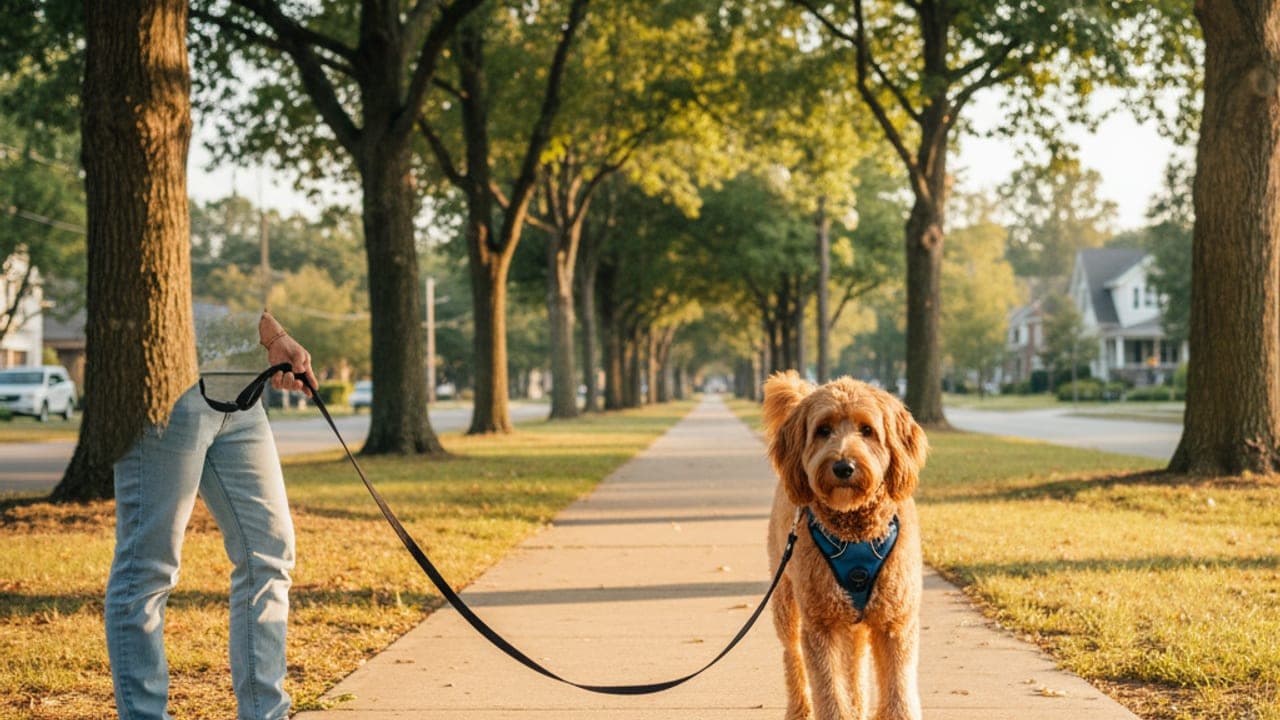
- Dogs pull because it works — they get to where they want to go faster
- Front-clip harnesses redirect pulling without pain or correction
- The stop-and-wait method teaches dogs that pulling makes walks slower, not faster
- Consistency is everything — if pulling works sometimes, the dog will keep trying
- Most dogs need 2-4 weeks of daily practice to develop reliable loose-leash habits
Your dog sees a squirrel across the street and suddenly you're water-skiing behind a 70-pound animal who has completely forgotten you exist. Your shoulder aches, your arm is stretched to its limit, and the "relaxing walk" you planned has turned into a wrestling match. If this sounds like your daily reality, you're not alone — leash pulling is the most common complaint among dog owners.
The good news is that loose leash walking is a trainable skill, not a personality trait. With the right equipment, consistent technique, and realistic expectations, almost any dog can learn to walk beside you without dragging you down the street.
Why Dogs Pull
Dogs don't pull to be dominant or to annoy you. They pull because:
Walking is exciting. The outdoor world is a sensory explosion — smells, sights, sounds, other animals. Your dog's enthusiasm exceeds his self-control. Imagine a five-year-old at a theme park. That's your dog on every walk.
Pulling works. This is the real reason pulling persists: every time your dog pulls and you follow, he's learned that pulling gets him where he wants to go. Pulling is self-reinforcing. The environment rewards it every single time.
You walk too slowly. A dog's natural walking pace is faster than a human's. Without training, your dog defaults to his natural speed, which means he's constantly at the end of the leash.
Choosing the Right Equipment
Equipment doesn't teach loose leash walking — training does. But the right equipment makes training dramatically easier.
Front-Clip Harness (Recommended for Most Dogs)
A front-clip harness has the leash attachment on the dog's chest. When the dog pulls, the leash redirects him toward you instead of allowing him to power forward. It reduces pulling by 50–75% immediately, giving you the control needed to train effectively.
Best for: Dogs of all sizes, especially strong pullers. Gentle Leaders, Easy Walk, and Freedom harness are popular options.
Not ideal for: Dogs with chest sensitivity or skin irritation at the clip point.
Head Halter
A head halter (like the Gentle Leader or Halti) fits around the dog's muzzle and behind the ears. It controls the dog's head — where the head goes, the body follows. Head halters provide the most control of any walking tool.
Best for: Very strong pullers, large-breed dogs, and dogs with high prey drive.
Requires acclimation: Most dogs resist head halters initially. Spend several days conditioning your dog to associate the halter with treats before using it on walks.
What to Avoid
Retractable leashes undermine loose leash training because they teach dogs that pulling extends their range — the exact opposite of what you want.
Prong collars and choke chains may suppress pulling through pain but don't teach the dog what you actually want. They risk physical injury (trachea damage, neck injuries) and can create negative associations with walks, other dogs, or people.
Back-clip harnesses (leash attachment on the dog's back) are comfortable but provide no pulling deterrent. They can actually make pulling easier because the dog can lean into the harness.
The Stop-and-Wait Method
This is the most widely recommended technique by professional trainers because it teaches the dog that pulling stops forward progress — the thing he wants most.
Step 1: Start walking. Hold the leash in your hand, leaving about 3 feet of slack. Walk at a normal pace.
Step 2: When the leash goes tight, stop. Don't pull back. Don't jerk the leash. stop walking and stand still like a tree.
Step 3: Wait. Your dog will pull, look around, and eventually look back at you or take a step toward you, creating slack in the leash. The moment the leash has slack, mark the behavior ("yes!" or click) and immediately resume walking.
Step 4: Repeat. Endlessly. In the beginning, you might stop every three steps. Your first few training walks will cover almost no distance. This is normal and necessary.
The principle: Forward motion is the reward. Pulling stops the reward. Slack leash earns the reward. Over time, your dog learns that the fastest way to get where he wants to go is to keep the leash loose.
The Direction-Change Method
This technique adds unpredictability that forces your dog to pay attention to you.
When your dog surges ahead, turn and walk in the opposite direction. Don't warn him. Don't say anything. Just turn. Your dog will hit the end of the leash, realize you've changed direction, and rush to catch up. As he reaches your side, mark ("yes!") and treat, then continue walking.
After several direction changes, your dog starts checking in with you more frequently because he's learned that you're unpredictable and he needs to pay attention to stay close.
This technique pairs well with stop-and-wait. Use both throughout the walk.
The Reward Zone
Define a specific area beside you — your left or right side, roughly between your knee and hip — as the "reward zone." Every time your dog is in this zone, good things happen: treats, praise, continued forward motion.
Building the zone:
- With your dog on leash, lure him to your chosen side with a treat.
- Feed a treat at your hip level (this teaches him to look up at you, not down at the ground).
- Take 2–3 steps. If he stays beside you, treat again.
- Gradually increase the number of steps between treats: 2, then 5, then 10, then random intervals.
The reward zone gives your dog a clear picture of what success looks like. Instead of just avoiding pulling (a confusing negative), he's actively choosing a position that earns rewards.
For a Labrador Retriever, who is famously food-motivated, the reward zone method is often the fastest path to success.
The Role of Consistency
Loose leash walking fails when training isn't consistent across walks, across family members, and across environments.
Every walk is a training walk during the learning phase. If you sometimes let your dog pull (because you're in a hurry, tired, or distracted), you're teaching him that pulling works some of the time — and variable reinforcement is the strongest reinforcement schedule in behavioral science. Your dog will keep pulling because it sometimes pays off.
Every family member follows the same rules. If you stop when the leash is tight but your partner lets the dog pull, the dog learns that pulling is person-dependent, not a universal rule.
New environments reset progress. Your dog may walk perfectly in your neighborhood but pull like a freight train at the park. This is normal. Every new environment requires re-training from scratch initially. Progress gets faster each time.
Realistic Timeline Expectations
Loose leash walking is one of the hardest skills to teach because it requires impulse control in the most stimulating environment your dog experiences.
Week 1–2: Your walks are painfully slow. You stop every few steps. You cover a fraction of your normal distance. This is expected.
Week 3–4: You start seeing longer stretches of loose leash walking between stops. Maybe 10–20 steps at a time. Treats are still frequent.
Month 2–3: Loose leash walking is becoming the default in familiar areas. New environments still trigger pulling, but recovery is faster.
Month 3–6: Consistent loose leash walking in most environments. Occasional pulls when something very exciting appears, but your dog responds to gentle leash pressure or a verbal cue to check in.
Ongoing: Maintenance. Loose leash walking requires periodic reinforcement throughout your dog's life. Treats can become intermittent, but praise and occasional food rewards should continue.
Dogs under two years old will take longer. Their impulse control is still developing. Be patient with young dogs — they're working harder than you realize.
Common Mistakes
Pulling back on the leash. When you pull, your dog instinctively pulls harder (opposition reflex). You're creating a tug-of-war, not teaching a skill.
Only using treats indoors. Practice inside your house and yard first, where distractions are minimal, before expecting success outdoors.
Skipping the equipment upgrade. Training with a flat collar on a strong puller is frustrating for both of you. A front-clip harness or head halter makes training achievable.
Expecting perfection too soon. Loose leash walking takes months. Expecting it in days leads to frustration and inconsistency.
For more on navigating walks confidently, check out our guide on dog walking etiquette.
Once your dog masters the loose leash, walks become enjoyable for both of you — and that's when etiquette starts to matter. Knowing how to handle off-leash dogs, passing pedestrians, and shared trails makes every outing smoother. Check our dog walking etiquette guide to brush up on the unwritten rules of the sidewalk.
FAQ
At what age can you start leash training?
Begin leash training as soon as your puppy has had their second round of vaccinations (typically 10–12 weeks). Start indoors with a lightweight leash and collar, just getting the puppy comfortable with the sensation. Short outdoor sessions (5–10 minutes) can begin once vaccinations allow outdoor access. Formal loose leash training is most effective starting around 4–5 months.
How do I handle a dog who pulls toward other dogs on walks?
This is reactivity, which is different from general pulling. When your dog fixates on another dog, create distance by turning and walking away before the dog reaches threshold (the point of lunging and barking). Reward calm behavior at a distance where your dog can notice the other dog without reacting. Gradually decrease distance over many sessions. A professional trainer can accelerate this process significantly.
Should I use a shorter or longer leash for training?
A standard 6-foot leash is ideal for loose leash training. It provides enough slack for the dog to walk comfortably beside you while being short enough to communicate effectively. Avoid retractable leashes during training. Some trainers recommend a 4-foot leash for the initial training phase in distracting environments.
My dog walks perfectly on the way home but pulls on the way out. Why?
Outbound walks are more exciting — every step leads to new territory, new smells, and new stimulation. Homebound walks cover familiar ground with decreasing novelty. This is completely normal. Focus your training effort on the outbound leg and maintain criteria even when your dog is at peak excitement.
Can older dogs learn loose leash walking?
Absolutely. Older dogs often learn faster than puppies because they have better impulse control and longer attention spans. The challenge is breaking established pulling habits, which requires more repetitions to override years of reinforced behavior. The techniques are identical regardless of age. Patience and consistency are even more important with adult dogs who have years of pulling practice.
Mr Pet Lover Team
The Mr Pet Lover team is dedicated to providing warm, accurate, and practical pet care advice backed by veterinary research and real-world experience.
Related Articles
How to Start a Dog Breeding Business
Most guides to this business will tell you how to register an LLC. None of the six ranking guides we read in full will tell you that when the 2004 UK Kennel Club/BSAVA purebred dog health survey covered 22,005 litters from 13,141 bitches across 151 breeds, more than 80% of litters in Boston Terriers, Bulldogs and French Bulldogs were delivered by caesarean section.
Can Cats Eat This? The Complete Toxic & Safe Human-Foods List
A cat-specific list of which human foods are safe, which are risky, and which are an emergency — with the active risk and a clear vet-now trigger for each.

Emergency Vet Costs: What 8 Common Emergencies Actually Cost (and How to Prepare)
What 8 common pet emergencies actually cost, how big an emergency fund needs to be, and what insurance covers vs. not — so one bad night doesn't become debt.