
Why Your Cat Brings You 'Gifts' — And What It Really Means
Not individually reviewed by a veterinarian. Read our editorial standards.
Last updated:
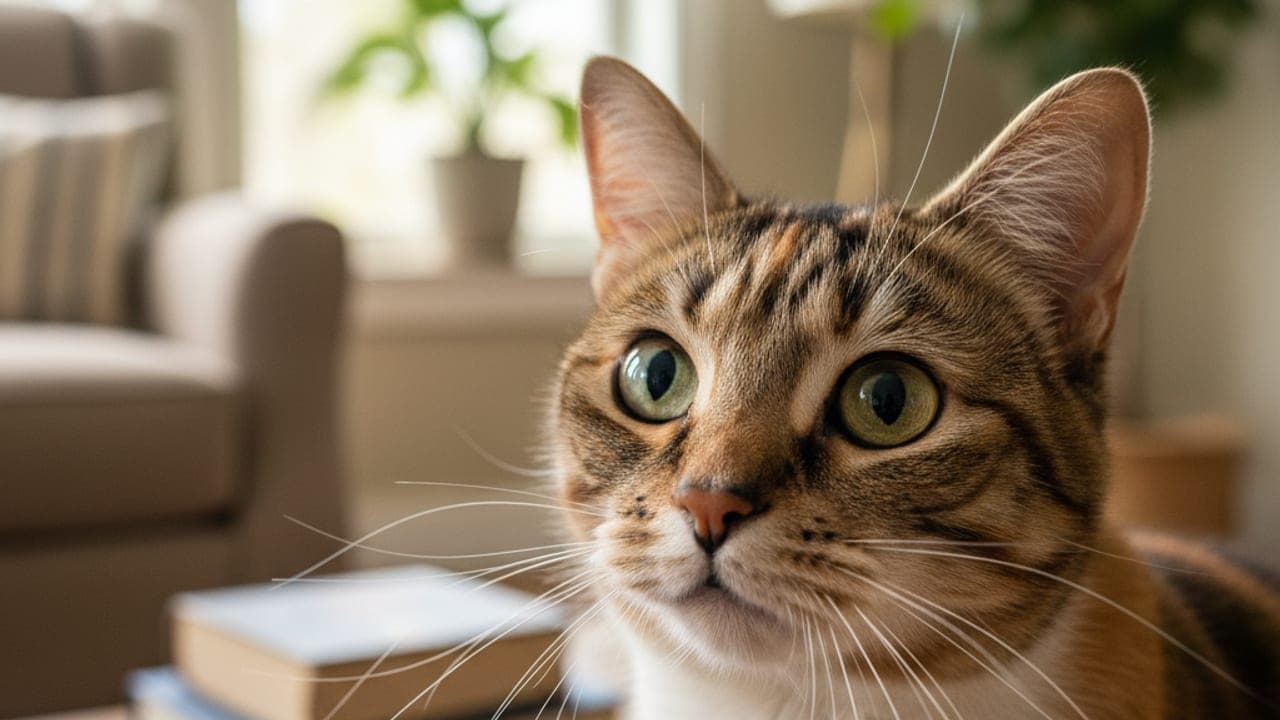
- Gift-bringing is an instinctive hunting behavior — your cat is sharing the 'catch' with their family group
- Indoor cats redirect this instinct to toys, socks, or hair ties when live prey isn't available
- Scolding your cat for bringing gifts can damage trust — a calm, neutral reaction works better
- Increase interactive play sessions (feather wands, laser pointers) to channel your cat's hunting drive safely
- If your outdoor cat brings live prey inside, keep a bell collar and limit nighttime outdoor access during peak hunting hours
You pad into the kitchen at 6 AM, eyes half-closed, heading for the coffee maker. Your bare foot touches something cold and wet on the tile. You look down. A mouse — very dead, very neatly placed — is positioned directly in your path. Your cat sits three feet away, looking at you with what can only be described as expectation.
If you've lived with a cat who has outdoor access or impressive indoor hunting skills (yes, some cats catch the occasional house mouse or bug with remarkable efficiency), you've likely experienced this ritual. The "gift" on the doorstep. The trophy on the pillow. The half-alive lizard released dramatically at your feet while you're trying to work.
It's one of the most discussed, most misunderstood, and most grimly amusing behaviors in feline life. So why do cats do this? The answer involves evolutionary biology, maternal instinct, and a surprising insight into how your cat perceives your role in her life.
The Teaching Theory: You're a Kitten (Sort Of)
The most widely accepted explanation among feline behaviorists is the "teaching hypothesis." In the wild, mother cats bring prey back to their kittens in a staged sequence. First, she brings dead prey. Then she brings partially alive prey. Then she brings live prey. Each stage teaches the kittens how to recognize, handle, and kill food.
Dr. John Bradshaw of the University of Bristol, one of the world's foremost feline behavior researchers, has proposed that spayed female cats (and some neutered males) redirect this teaching behavior toward their human companions. In other words, your cat sees you as a clumsy, furless kitten who clearly can't hunt for yourself — and she's trying to help.
This isn't as insulting as it sounds. It's actually a sign of social investment. Your cat is treating you as part of her family unit and responding to what she perceives as a gap in your survival skills. The fact that you open cans of food instead of catching sparrows doesn't compute in her evolutionary framework. She sees you eat. She never sees you hunt. In her logic, you need training.
The staged delivery pattern supports this theory. Many cats start by bringing fully dead prey to the door or kitchen. Over time, if you don't seem to be "learning," some cats escalate to bringing live or half-alive prey — literally providing you with practice material. It's one of the most sophisticated forms of interspecies teaching observed in domestic animals.
The Provision Theory: Bringing Home the Catch
A competing (but not mutually exclusive) theory frames gift-giving as provision rather than instruction. Feral cat colonies are loosely cooperative when it comes to food. Cats in social groups will sometimes bring prey back to a shared location — not necessarily to teach, but to contribute to the group's food supply.
Your home is the shared location. You are the group. When your cat drops a mouse at your feet, she may be participating in what she perceives as a cooperative food-sharing arrangement. She eats the commercial food you provide. She brings what she catches. In her mind, this is a fair exchange.
Dr. Dennis Turner, a Swiss animal behaviorist who has spent decades studying the human-cat bond, notes that cats who bring prey home tend to have stronger social bonds with their owners than cats who don't. The behavior correlates with other indicators of attachment — proximity-seeking, vocalizing toward the owner, and soliciting contact. Gift-giving cats are, by most behavioral measures, more socially invested in their humans.
The Trophy Theory: Pride and Display
There's a simpler explanation that may apply in some cases: the cat is bringing prey home not for you, but for herself — and home just happens to be where you are.
Cats often carry prey to a safe, familiar location to eat. If your cat's safe location is the kitchen or your bedroom, the prey arrives there too. The cat may not be presenting it to you at all — you're a bystander in her dining choice.
You can sometimes distinguish between presentation and coincidence by watching the cat's behavior after delivery. A cat who drops the prey, then looks at you and vocalizes (meowing, trilling) is likely making a social offering. A cat who drops the prey and immediately starts eating or playing with it was carrying lunch home.
What About Indoor Cats?
Indoor cats exhibit the same gift-giving instinct, just with different "prey." If your indoor cat has ever deposited a toy mouse, a crumpled ball of paper, a hair tie, or an unfortunate moth at your feet, she's following the same behavioral script.
Some indoor cats become prolific toy-gift givers, collecting their favorite toys from around the house and arranging them near their owner's chair, bed, or shoes. This behavior is especially common in breeds with strong hunting drives — Bengals, Siamese, Abyssinians, and Maine Coons are all frequent toy-gifters.
It's the same instinct, just expressed with available materials. If anything, toy-gifting by indoor cats is even more clearly social, since there's no food value in a stuffed mouse. The cat is bringing you something she values because she's including you in her social world.
The Hunting Sequence: Why Half-Dead Prey Is Part of the Plan
One of the most distressing versions of gift-giving is the half-alive delivery — a bird that's still flapping, a mouse that's still running, a lizard that immediately escapes behind the refrigerator. From the cat's perspective, this isn't cruelty. It's advanced curriculum.
The feline hunting sequence has five stages: detect → stalk → chase → catch → kill. Cats don't always complete all five stages in sequence. Sometimes they catch and release. Sometimes they play with prey for extended periods before delivering the killing bite. This "play" with live prey is practice — it hones timing, precision, and the motor skills that a cat's survival would depend on in the wild.
When your cat brings you live prey, she may be at the "advanced teaching" stage, providing you with an opportunity to practice the chase-catch-kill stages yourself. The fact that you shriek and climb onto a chair is — from her perspective — deeply disappointing but not enough to make her give up on your training.
How to Respond to Gifts
What to do:
- Acknowledge calmly. You don't need to celebrate, but don't scream or punish. A calm, neutral response preserves your cat's trust without reinforcing the behavior.
- Remove the gift quickly. Dispose of dead prey hygienically (gloves, sealed bag, outdoor trash). If the prey is alive, gently capture and release it outside if possible.
- Wash your hands. Wild prey can carry parasites, bacteria, and in rare cases, disease pathogens. Basic hygiene after handling is sufficient.
- Increase indoor hunting enrichment. If your cat is a prolific hunter, she's telling you her hunting drive isn't fully satisfied. More interactive play sessions (wand toys, laser pointers followed by a tangible "catch," feather toys) can reduce outdoor hunting by channeling the drive indoors.
What NOT to do:
- Don't punish your cat. She's following a deep instinct and, in her framework, doing something generous. Punishment confuses and damages trust.
- Don't display disgust dramatically. This is harder than it sounds at 6 AM with a bare foot and a dead mouse, but try. Your cat is watching your reaction and interpreting it.
- Don't withhold food as a hunting deterrent. Hungry cats don't hunt less — they hunt more, and with more desperation. Well-fed cats hunt recreationally, which is the very behavior you're managing.
Reducing Gift Frequency (If Desired)
If you'd prefer fewer surprises on your doormat:
Keep your cat indoors — this eliminates outdoor prey access entirely and is recommended by veterinary and wildlife organizations for both cat safety and wildlife conservation.
Add a bell to the collar. Research published in the Journal of Zoology found that cats wearing bells caught 41% fewer birds and 34% fewer mammals. It's not foolproof, but it gives prey a fighting chance.
Increase play sessions. Two 15-minute interactive play sessions per day — morning and evening, matching natural hunting peaks — can reduce a cat's drive to hunt live prey by satisfying the stalk-chase-pounce sequence with toys.
Feed at dawn and dusk. Cats are crepuscular hunters (most active at dawn and dusk). Feeding during these peak hunting windows can redirect energy from hunting to eating.
Frequently Asked Questions
Does my cat think I can't hunt?
In a sense, yes. Your cat has never seen you catch prey, so from her evolutionary perspective, you might be a large, clumsy member of her social group who needs help with food acquisition. It's endearing, even if the gifts aren't.
Why does my cat only bring gifts to one person in the household?
Cats often have a preferred social partner — the person they're most bonded to. Gifts tend to go to that person. If your cat exclusively delivers to your spouse and not to you, it may reflect the cat's primary attachment hierarchy.
Is it safe for my cat to eat the prey she catches?
Wild prey can carry parasites (tapeworms from mice, toxoplasmosis from birds) and may have been exposed to rodenticides. If your cat regularly hunts, keep her parasite prevention current and discuss additional monitoring with your vet.
My indoor cat brings me her toy mouse every night. Is this the same behavior?
Yes — it's the same instinct expressed with available materials. Your cat is including you in her social world through gifting. Acknowledge it with a brief pet or quiet praise.
Want to understand more about your cat's fascinating instincts? Explore our cat care guides or take our pet personality quiz to learn what makes your feline tick.
Angel Lequiron
The Mr Pet Lover team is dedicated to providing warm, accurate, and practical pet care advice backed by veterinary research and real-world experience.
Related Articles
Why Does My Cat Knead? The Science Behind Those Happy Paws
That rhythmic push-pull your cat does on your lap has roots in kittenhood, territory, and pure contentment. Here's what veterinary science tells us about kneading.
Why Does My Cat Knock Things Off Tables? (And How to Redirect It)
Your cat nudges your glass to the edge and stares at you. Here is what is really going on and how to redirect it.
Can Cats Eat This? The Complete Toxic & Safe Human-Foods List
A cat-specific list of which human foods are safe, which are risky, and which are an emergency — with the active risk and a clear vet-now trigger for each.