
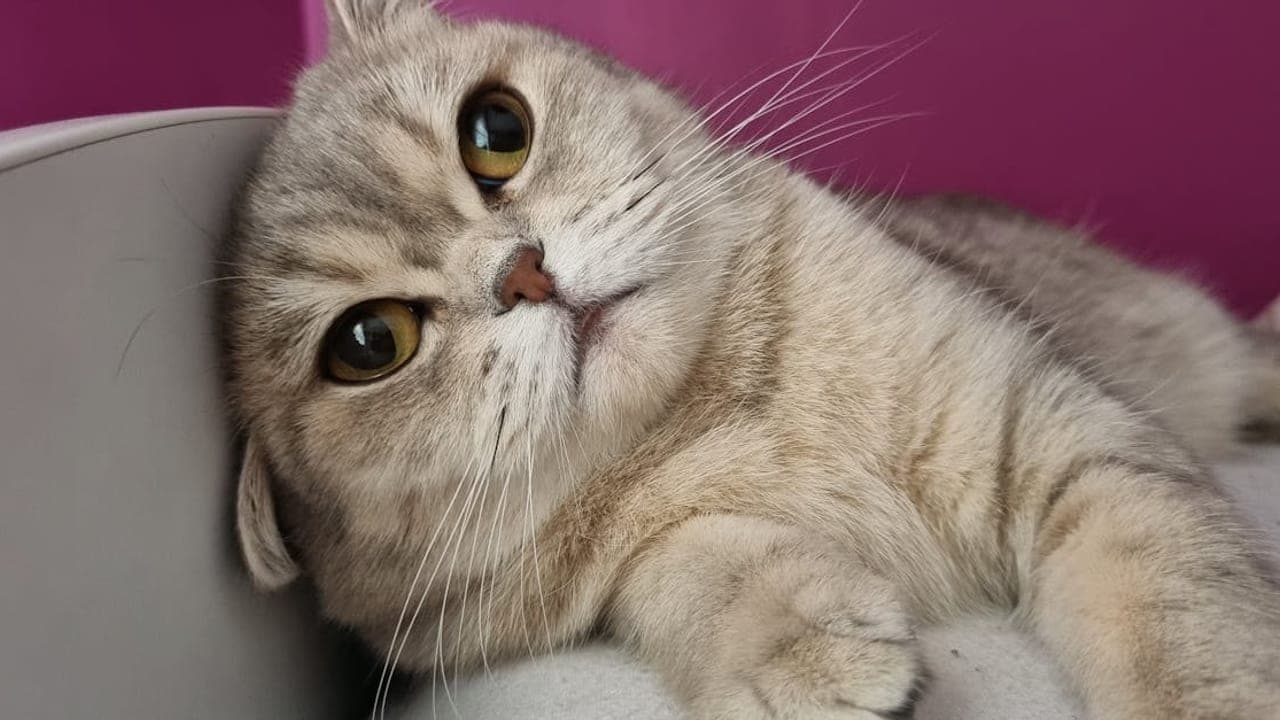
Scottish Fold Cat Care Guide: Understanding the Folded Ear Breed
Scottish Folds are the cats with the folded-down ears that make them look perpetually surprised — owl-like, round-faced, and undeniably charming. They're sweet, quiet, adaptable, and bond hard with th
In This Guide
Overview
Scottish Folds are the cats with the folded-down ears that make them look perpetually surprised — owl-like, round-faced, and undeniably charming. They're sweet, quiet, adaptable, and bond hard with their owners. They also carry a non-negotiable trade-off most buyers don't fully understand at the pet store: the same gene that folds the ears affects cartilage everywhere else in the body. Every Scottish Fold has some degree of osteochondrodysplasia (OCD) — a lifelong joint condition. Severity varies, but the disease itself does not.
This guide covers what actually matters with a Scottish Fold: what the welfare bodies actually say about breeding the cat at all, how to read the early warning signs of joint disease, the weekly ear care that keeps infections out of those folded canals, and the real annual cost — $1,200-$2,000 with the joint-care line included. If you can accept that your cat's signature trait is also its medical reality, and you're prepared to budget $400-$800/year above baseline for joint support, a Scottish Fold is a wonderful, gentle companion. A Scottish Straight has the same temperament and ears that did not fold, but Cats Protection is clear that even cats bred from Scottish Folds without folded ears remain at risk of earlier-onset, faster-progressing arthritis and abnormal bone growth — so it is a lower risk, not a clean one.
Daily Care
Scottish Folds are calm, indoor, routine-loving cats. They're social without being clingy — they want to be in the same room as you, not necessarily on your lap every minute. They tolerate change poorly, so consistency in feeding times, litter location, and household activity matters more than for most breeds.
The indoor-only rule: Scottish Folds should never be outdoor cats. Their joint issues mean they can't run from a threat or jump to safety the way a healthy cat can. They also have low survival instincts and are visually distinctive enough to be theft targets ($800-$2,500 retail). Indoor-only is medical, not just preference.
- Morning: 10-15 minutes of low-intensity floor play (wand toys, kicker toys) before you leave for the day
- Evening: Another 15 minutes of interactive play, ideally before dinner
- Throughout day: Low cat trees, window perches, puzzle feeders for self-entertainment
- Bedtime: Many Scottish Folds will sleep at the foot of the bed — they prefer proximity over contact
Handling note: Scottish Folds famously sit in the "Buddha position" (upright on their haunches with legs stretched out). This looks adorable but can also indicate joint discomfort if it becomes their default resting pose. Watch for whether they choose this position or seem stuck in it.
Litter box: Scoop daily. Use a low-entry box (under 4 inches) — high-walled boxes are painful for cats with joint disease. Place boxes on every floor of your home so the cat doesn't have to navigate stairs when symptoms flare.
Decision rule: If your Scottish Fold stops jumping onto furniture they used to access, or starts using the bottom step of a multi-tier cat tree only, that's an early joint-flare signal. Book a vet visit within the week — don't wait for limping.
Nutrition
Scottish Folds run to overweight, and weight gain accelerates joint disease in a breed already predisposed to it. Every extra pound on a Scottish Fold puts measurable extra load on already-compromised cartilage. Feeding discipline matters more here than for most breeds.
Kitten (0-12 months): Free-feed high-quality kitten food formulated for growth. Introduce wet food at 8 weeks and offer it daily — building the wet-food habit early protects urinary health later.
Adolescent (1-2 years): Switch to two scheduled meals per day. Stay on kitten formula until 12 months, then transition to an adult formula with joint-supportive ingredients (glucosamine, chondroitin, omega-3 from fish oil).
Adult (2-10 years): 200-300 calories/day, split into two meals. Stop free-feeding the moment they hit adult weight (typically 6-13 lbs depending on sex and frame). A Scottish Fold that's even 1 lb overweight is a candidate for accelerated joint pain.
Senior (10+): Reduce calories 10-15% as activity drops. Move to a senior formula with elevated joint support and easier-to-digest protein. Many vets will recommend prescription joint diets at this stage — worth the $60-$80/month if your cat has visible stiffness.
- Glucosamine (dose set by your vet for the cat's weight)
- Chondroitin (paired with glucosamine)
- Omega-3 fatty acids (EPA + DHA from fish oil)
- Green-lipped mussel (research-supported anti-inflammatory)
Wet vs dry — the real answer: Mix both. At least one wet meal per day. Wet food provides hydration that helps with both kidney health and weight management (it's lower-calorie per volume than dry kibble).
Water: A pet water fountain ($30-$50) increases intake measurably. Worth it for any indoor cat, especially one prone to weight issues.
Decision rule: Weigh your Scottish Fold monthly. If they gain more than 4 oz in a month with no growth phase to explain it, cut portions 10% and recheck in 4 weeks. Never let a Scottish Fold get "a little chunky" — it's not cosmetic, it's a joint event waiting to happen.
Exercise
Scottish Folds are low-to-moderate energy cats, and their exercise needs are shaped by one constraint most owners don't think about: jumping is risky. The cartilage abnormalities that come with the breed mean every hard landing stresses joints that are already compromised. The goal is movement without impact.
Daily target: 20-30 minutes of structured play, split into two sessions. Most of it at floor level.
- Wand toys: Top choice. Drag the toy along the floor in arcs — workout without leaving the ground. Da Bird, Cat Dancer, feather wands ($8-$15).
- Kicker toys: Plush bunny-kickers let them grab, rabbit-kick, wrestle without jumping. Great for cats with visible stiffness.
- Puzzle feeders: Add mental work to mealtimes. Especially valuable for indoor-only cats.
- Low cat trees: 2-3 ft platforms with ramps or steps, not 6-foot towers. Scottish Folds use what's accessible and avoid what hurts.
- Platforms requiring vertical jumps over 3 ft
- Laser pointers as the only exercise — frustration without resolution. Use as warm-up, then end with a wand toy they can catch.
- Chase games on hard floors — slipping is a real injury risk
- Carpet runners on slick hardwood/tile
- Pet stairs or ramps next to beds and couches
- Heated bed (joints feel better when warm; $20-$40)
Decision rule: If your cat stops engaging mid-play, or sits down and watches instead of chasing, the session is over — don't push. Two 10-minute sessions beat one long one every time for this breed.
Grooming
Scottish Folds come in two coat lengths: shorthair (standard) and longhair (Highland Fold). Coat care differs, but ear care is the same — and ear care is where most owners under-invest.
- Shorthair: Once a week with a soft slicker brush, 5 minutes. Sheds moderately year-round with heavier blowouts spring and fall.
- Longhair (Highland Fold): 2-3 times per week with steel comb plus slicker, 10 minutes per session. Mat-prone behind ears, armpits, belly, britches.
Ear care — the critical task: Folded ears trap wax and moisture. The fold creates a closed canal that doesn't ventilate the way a normal cat's ear does. Untreated, this becomes ear mites, yeast infections, or chronic otitis — painful and recurring.
- Lift the ear flap and look inside with a flashlight
- Wipe visible wax with a cotton ball dampened with vet-approved cleaner (no Q-tips in the canal — only the outer fold)
- Smell the ear — odor means infection, book a vet visit
- Watch for: dark coffee-ground discharge (mites), yellow/green discharge (infection), excessive head shaking or scratching
Skip this for a month and you'll be at the vet for an ear infection ($150-$300). Do it weekly and you'll likely never need treatment.
Bathing: Every 6-8 weeks (shorthair), every 4-6 weeks (longhair). Cat-specific shampoo only.
Nails: Trim every 2-3 weeks. Indoor cats don't wear nails down naturally.
Dental: Brush 2-3 times per week with cat toothbrush and enzymatic cat toothpaste (never human toothpaste — fluoride is toxic to cats). Professional cleaning under anesthesia runs $400-$800.
Decision rule: If you find yourself skipping the weekly ear check because the cat resists, wrap them in a towel for restraint rather than skipping. A skipped ear week is how chronic ear disease starts.
Health
Scottish Folds have one defining health reality every owner must understand before purchase: osteochondrodysplasia (OCD) is present in 100% of Scottish Folds. It is not a risk; it is a certainty. The same gene (Fd) that folds the ears affects cartilage development everywhere — tail, ankles, knees, spine. Severity varies from mild (stiffness in old age) to severe (debilitating arthritis from kittenhood), but every Scottish Fold has it. There is no "healthy Scottish Fold with folded ears." Anyone who tells you otherwise is wrong.
This is the trade-off the breed asks of you. You get the iconic look; the cat lives with cartilage disease for its entire life.
- Fold-to-Fold (both parents have folded ears): Produces homozygous Fd/Fd kittens with severe, early-onset, crippling OCD. Widely condemned. Note that the CFA breed standard does not itself prohibit it — it regulates the show ring, disqualifying a kinked, foreshortened or inflexible tail. "All-Fold litters" or "guaranteed folded ears in every kitten" are red flags. Walk away.
- Fold-to-Straight (one folded parent, one straight-eared — typically a Scottish Straight or British Shorthair): Heterozygous Fd/fd kittens. About half have folded ears, half are "Straights." The folded kittens still have OCD, but milder and slower-onset. This is the pattern breeders describe as responsible, but no welfare body endorses it: the RSPCA does not support breeding Scottish Folds including breeding a Fold with a cat without folded ears, Cats Protection says the disorder cannot be bred out and does not recommend getting one, and the Governing Council of the Cat Fancy does not recognise the breed for registration. UFAW's position is that ceasing to breed from any cat with folded ears would eliminate the condition within a generation.
Ask every breeder: "Are both parents folded?" If yes, walk away.
Hypertrophic cardiomyopathy (HCM): the Cornell Feline Health Center's list of predisposed breeds does not include the Scottish Fold, though it does include the British Shorthair, which is a permitted outcross. Treat HCM as a general feline concern to raise with your vet rather than a documented breed predisposition. Get a baseline echocardiogram from a board-certified veterinary cardiologist at ages 1-2, then every 1-2 years until age 5. $300-$500 per scan. Caught early, HCM is manageable for years; caught after symptoms (lethargy, labored breathing, sudden hind-leg paralysis from a clot), it's often fatal within months.
Polycystic kidney disease (PKD): Inherited kidney cysts. Genetic test exists; reputable breeders screen. If your cat came from an untested line, ask your vet for a kidney panel by age 5.
- Stiff, inflexible tail that doesn't curl normally
- Reluctance to jump onto furniture they used to access
- Visible limping, even briefly, after rest
- Thickened, swollen-looking ankles or wrists
- Sitting in the Buddha position constantly (vs. by choice)
- Reduced grooming of lower back or hindquarters
- Joint supplements (glucosamine, chondroitin, omega-3) — start at adoption, not at first symptoms
- Weight management (single highest-impact lever)
- Environmental: low litter boxes, ramps, heated beds, carpeted surfaces
- Pain meds (gabapentin, vet-prescribed NSAIDs — many human pain meds are toxic to cats)
- injectable joint therapy where a vet judges it appropriate
Lifespan: 11-15 years. Severe OCD cases shorter, mild at the upper end.
Decision rule: If the joint trade-off feels unacceptable, adopt a Scottish Straight. Same parents, same temperament, ears that did not fold — but per Cats Protection, still at raised risk of early arthritis, so not a disease-free alternative. Often cheaper from the same litters because they lack the "signature" look.
Costs
- Reputable shorthair breeder (Fold x Straight pairing, health-tested): $800-$2,500
- Longhair (Highland Fold) from reputable breeder: $1,500-$3,500
- Scottish Straight from same litters: $400-$1,200 (often the better value — same cat without the disease load)
- Rescue or breed-specific Scottish Fold rescue: $100-$300
First-year costs (kitten): $1,800-$3,000 including initial vet (vaccines + spay/neuter + baseline joint X-rays $400-$700), supplies (low-entry litter boxes, ramps, low cat trees, fountain $300-$500), and food/litter ($600-$900).
- Food (premium with joint support): $400-$700
- Joint supplements (glucosamine/chondroitin/omega-3): $150-$300
- Litter: $150-$300
- Routine vet + dental: $200-$400
- Pet insurance (highly recommended for this breed): $300-$500
- HCM echocardiogram (every 1-2 years): $300-$500 ($150-$250 amortized annually)
- Joint care line items (extra vet visits, X-rays, possible injectable joint therapy): $100-$400
- Toys, replacement scratchers, environmental enrichment: $200-$400
- Total typical year: $1,200-$2,000
The hidden cost line: Joint care adds $400-$800/year above what you'd spend on a healthy cat. Most cost guides for the breed omit this — they shouldn't. If a Scottish Fold develops moderate-to-severe OCD by middle age, expect another $1,000-$2,500/year for advanced management.
Lifetime cost: Roughly $18,000-$30,000 over 11-15 years before any major medical event. Pet insurance ($25-$45/month) is worth the math for this breed — joint surgeries, HCM treatment, or PKD management can each add $3,000-$8,000 in a single year.
Frequently Asked Questions
Is the joint disease only a risk in kittens from two folded parents?
No, and this is the claim buyers most often hear wrong. The UFAW-authored Science for Animal Welfare review states that all heterozygous individuals are affected but to varying degrees, and that there are no carriers of the gene which are not themselves affected. RSPCA Australia puts it plainly: all Scottish Fold cats with folded ears are affected by this disease. Two folded parents worsen severity; they do not create it. Budget for lifelong veterinary joint monitoring from the day you bring a kitten home.
Does buying from a fold-to-straight breeder get me a healthy folded kitten?
Not according to the welfare bodies that have examined the pairing. RSPCA Australia states it does not support breeding Scottish Fold cats, including breeding a Scottish Fold with a cat without folded ears. Cats Protection goes further, warning that even cats bred from Scottish Folds who do not have folded ears are still at risk of earlier-onset and faster-progressing arthritis and abnormal bone growth. Treat breeder reassurance as sales copy, and ask your own veterinarian what the pairing actually changes.
How early do the joint problems usually show up?
Earlier than most buyers expect. A VetCompass study of Australian Scottish Folds, published in the Australian Veterinary Journal, reported that cats clinically diagnosed with the condition had a median age of 20 months, with diagnoses recorded between 3 and 29 months of age. Kittenhood and early adulthood are not a safe window. If a young Fold stops reaching heights it used to manage, or resists having its hind legs or tail handled, book a veterinary examination rather than waiting.
Why won't the UK registry or the cat charities back this breed?
Because they judge the trait itself to be the problem. Cats Protection reports that the Governing Council of the Cat Fancy does not recognise Scottish Folds for pedigree registration on welfare grounds, and states that the disorder cannot be bred out of the breed and that it would not recommend getting a Scottish Fold. The UFAW review concludes that ending breeding from any folded-eared cat would eliminate the condition within a generation. Weigh that before you pay a deposit.
What does the show standard actually say about a Fold's skeleton?
More than most sellers volunteer. The Cat Fanciers' Association Scottish Fold standard disqualifies a kinked tail, a foreshortened tail, and a tail lacking in flexibility due to abnormally thick vertebrae, and requires no hint of thickness or lack of mobility in the cat due to short, coarse legs. Those are the visible marks of the cartilage disorder. If a kitten's tail feels thickened or will not curl, have your own veterinarian examine it before any money changes hands.
Sources
This guide draws on the following published references. Each opens in a new tab so you can check it against what you have read here.
The Cat Fanciers' Association
Scottish Fold Breed Standard(opens in a new tab)Cat Fanciers' Association
Scottish Fold — breed standard and profile(opens in a new tab)RSPCA Australia Knowledgebase
What are the animal welfare problems associated with Scottish Fold cats?(opens in a new tab)ASPCA
Cat Grooming Tips(opens in a new tab)Cats Protection
Scottish Fold Cats(opens in a new tab)Australian Veterinary Journal (via PubMed Central)
An estimation of osteochondrodysplasia prevalence in Australian Scottish Fold cats: a retrospective study using VetCompass data(opens in a new tab)Cornell Feline Health Center, Cornell University College of Veterinary Medicine
Hypertrophic Cardiomyopathy(opens in a new tab)Merck Veterinary Manual
Proper Nutrition for Cats(opens in a new tab)Cornell Feline Health Center
Feeding Your Cat(opens in a new tab)Merck Veterinary Manual
Routine Health Care of Cats(opens in a new tab)Universities Federation for Animal Welfare (Science for Animal Welfare)
Osteochondrodysplasia — Scottish Fold (Genetic Welfare Problems of Companion Animals)(opens in a new tab)
Affiliate disclosure: We may earn a commission from qualifying purchases. This doesn't affect our recommendations.
Recommended Products
Get personalized pet care tips
Join our newsletter for breed-specific advice, care guides, and expert tips delivered weekly.
No spam, ever. Unsubscribe anytime.