
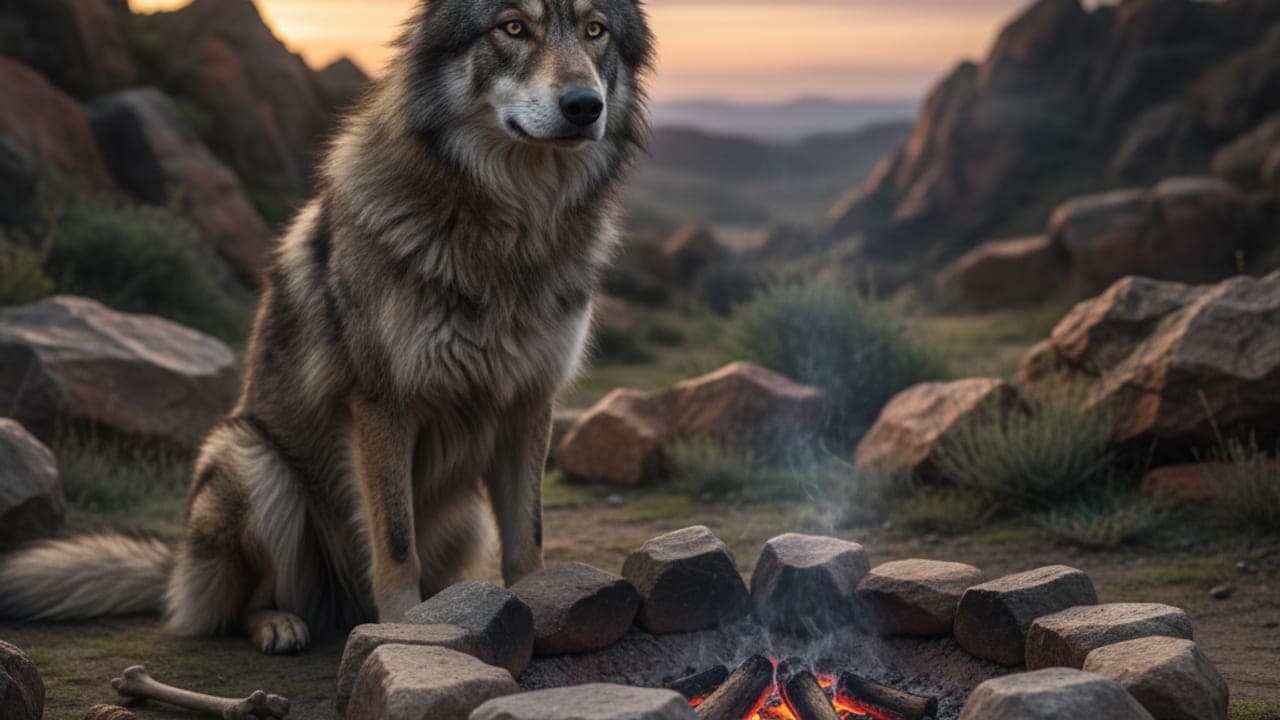
Origins of the Human-Dog Bond
Sometime in the late Pleistocene — between 40,000 and 15,000 years ago, depending on which evidence you trust — a population of wolves stopped being wolves. They became the first animal humans ever domesticated, thousands of years before the first sheep, goat, cat, or horse. Dogs joined us while we were still nomadic hunter-gatherers. Every other domestic species came after we had villages and grain stores. Dogs came first, and that head start shows in every glance your Labrador gives you across the kitchen.
The exact date is contested, and it should be. Archaeological dating runs on a different clock than genetic dating, and the two disagree by tens of thousands of years. What is no longer contested is the broad story: somewhere in Eurasia, a group of Pleistocene wolves and a group of Pleistocene humans started living close enough that natural selection rewrote the wolves into something gentler, more eye-contact-prone, and far more useful around a campfire.
What the Bones Say
The physical evidence is patchy but striking. Three sites carry most of the load.
Goyet Cave, Belgium (~31,700 BP) — A skull re-examined in 2008 by paleontologist Mietje Germonpré was anatomically distinct from contemporary wolves: shorter snout, broader braincase, smaller teeth. She classified it as a "Paleolithic dog." If she is right, this pushes domestication back over 30,000 years. The classification is debated — some argue it could be a wolf morphotype that did not survive — but the skull sits in the Royal Belgian Institute of Natural Sciences and remains the oldest serious candidate.
Předmostí, Czech Republic (~27,000 BP) — Another Germonpré-led analysis identified three canid skulls from this Upper Paleolithic site as Paleolithic dogs. One had a large bone fragment wedged in its mouth, placed there after death — possibly a ritual gesture. These are not casually discarded animals.
Bonn-Oberkassel, Germany (~14,200 BP) — This is the case nobody disputes. A grave in the Rhine valley contained two human adults and the partial skeleton of a young dog. The dog had survived a serious case of canine distemper for weeks before dying — an illness that would have required someone to keep it warm, hydrated, and protected. Healthy hunter-gatherers do not nurse a sick animal through weeks of distemper unless that animal matters to them. The Bonn-Oberkassel dog is the oldest archaeological proof of a bonded relationship between a human and a domestic dog. The remains are housed at the Rheinisches Landesmuseum Bonn.
Between Goyet and Bonn-Oberkassel sits the live debate: how far back does the relationship go? Conservative reading — confirmed dog by 15,000 years ago. Expansive reading — proto-dogs by 30,000 years ago. Most working paleogeneticists today land somewhere in the 15,000-to-40,000-year window, and they hold that range loosely.
The Genetic Origin Story
Here is the most common misconception in pet writing: dogs descended from modern grey wolves. They did not. Dogs and modern grey wolves share a common ancestor — a now-extinct population of Pleistocene wolves — and they diverged from that ancestor as separate lineages. The grey wolf you see in a wildlife documentary is your dog's evolutionary cousin, not its grandparent.
Mitochondrial DNA studies starting in the late 1990s — most notably work led by Robert Wayne at UCLA — established that all modern dogs trace back to wolf populations, not jackals or coyotes. Whole-genome studies since have narrowed this: the wolf population that gave rise to dogs is extinct.
The second great debate is single-origin versus dual-origin. Did domestication happen once, in one place, with dogs spreading from there? Or twice, independently?
- Single-origin camp: A 2015 study from the Chinese Academy of Sciences argued East Asia, around 33,000 years ago.
- Dual-origin camp: A 2016 paper in Science led by Laurent Frantz used ancient DNA from a 4,800-year-old Irish dog (the Newgrange dog) to argue for two domestication events — one in East Asia and one in Western Eurasia — that later met and partially replaced each other.
- Current consensus: Closer to single-origin, somewhere in Eurasia, but the exact location is unsettled.
The practical takeaway: the dog you own is the descendant of a wolf population that no longer exists, shaped by 15,000 to 30,000 years of selective pressure that wild wolves never experienced.
What We Did for Each Other
The partnership was not charity in either direction. Both species got something out of it, and the something was substantial enough to drive co-evolution faster than almost any other domestication event in history.
What ancient dogs did for us:
- Hunting partners — early dogs could track wounded game and flush small prey from cover. Studies of contemporary hunter-gatherer societies (Hadza, Aché) show that hunting with dogs roughly doubles small-game return rate.
- Camp sentinels — a dog hears a stranger or predator long before a human does. In a world of bears, wolves, and rival bands, a night alarm was worth feeding.
- Pack-haulers — once bonded, dogs carried gear. Travois evidence in North America and Siberia shows dogs dragging loads thousands of years before horses arrived.
- Body warmth — dogs are 101°F furnaces. "Three-dog night" likely traces a real Pleistocene survival pattern.
What we did for them: reliable food from scavenging human kill sites, protection from larger predators, and — as Bonn-Oberkassel proves — veterinary care. Sick dogs in our camp lived. Sick wolves in the wild died.
The other animals we eventually domesticated tell us how unusual this was. Cats came in around 10,000 years ago, after grain storage created rodent infestations worth controlling. Sheep and goats around 11,000 years ago. Horses around 5,500 years ago. Dogs predate every one of them by at least 5,000 years.
Burial Customs and the Emotional Bond
Utility explains feeding a dog. It does not explain burying one.
At the Ain Mallaha site in northern Israel, archaeologists found a 12,000-year-old grave: an elderly Natufian human laid to rest with one hand resting on the chest of a puppy. The placement is deliberate. The puppy is not food refuse and not a sacrifice — it is positioned the way a sleeping companion is positioned.
At Skateholm in southern Sweden, Mesolithic dog graves from around 7,000 years ago contained dogs buried with red ochre (a pigment reserved for ritual contexts), flint blades, and antler tools. Some dogs had more grave goods than the humans nearby.
At Koster in Illinois, three dog burials dating to about 10,000 years ago are the oldest confirmed domestic dog remains in the Americas. Each was placed in its own pit, covered, and left undisturbed.
These are not workers being discarded. These are family members being mourned. Long before agriculture, long before writing — humans were burying dogs the way they buried each other.
Co-Evolution Reshapes Both Species
Thirty thousand years of selection pressure leaves marks. Several physical and behavioral changes show up consistently across early dog populations and persist in modern dogs:
- Smaller skulls and teeth than ancestral wolves, with a shorter snout.
- Wider variation in coat color — wolves are mostly grey; dogs come in everything from black to white to red to spotted.
- Floppy ears, curled tails, piebald patches — the classic "domestication syndrome" first described by Belyaev in his Russian fox-domestication experiments. The same physical signatures appear across many domesticated mammals and seem to ride along with selection for tameness.
- Higher carbohydrate tolerance — modern dogs carry multiple copies of the AMY2B gene, which codes for pancreatic amylase and lets dogs digest starch. Wolves have far fewer copies. This shift tracks the rise of agriculture roughly 10,000 years ago and explains why your dog can eat kibble while a wolf cannot.
The behavioral changes are equally striking. The most cited finding: dogs maintain sustained eye contact with humans, and the mutual gaze raises oxytocin levels in both the dog and the human — the same hormonal feedback loop that bonds parents to infants. A 2015 study in Science by Miho Nagasawa's team in Japan documented this loop and showed that wolves raised by humans do not produce it. Dogs do. Wolves do not. That difference is not training. It is biology, written into the species over tens of thousands of years.
Why This Matters for the Dog at Your Feet
If you have ever wondered why your dog tracks your face when you talk, or why a Border Collie watches your hands during fetch, or why your Lab settles the moment you sit down — that is 30,000 years of selection talking.
- Eye contact during training — your dog wants to read you. Wolves do not. Selection favored proto-dogs that paid attention to human faces, generation after generation.
- Breed-specific traits — herding breeds, retrievers, scent hounds, sighthounds, livestock guardians are sub-selections from the same domesticated baseline. The work humans needed done in 8,000 BCE (herding the first sheep) shaped the Border Collie's eye-stalk-chase pattern you see on a frisbee field today.
- Carbohydrate tolerance — the AMY2B duplication is why kibble works. If dogs had remained wolves, modern pet food would not exist.
- Separation anxiety — the same bond that made the partnership work for 30,000 years also makes dogs vulnerable when left alone. We bred a species to need us. We do not get to be surprised when it acts like it needs us.
The bond is older than agriculture, older than writing, older than every other domestic relationship humans have. When your dog rests its head on your foot, that gesture has prehistoric depth. The wolves who learned to do that 30,000 years ago lived. Their descendants are still here.
To see how this ancient partnership shaped modern breed traits, our Hound Group guide covers the breeds with the strongest hunting-ancestor signal, and the Herding Group and Working Group cover breeds shaped by post-agricultural roles. The pet stories section is the modern echo of what archaeologists keep finding in those Pleistocene graves.
Frequently Asked Questions
When were dogs first domesticated?
The defensible window is 15,000 to 40,000 years ago. The oldest undisputed archaeological dog is Bonn-Oberkassel, Germany (~14,200 years ago). Genetics push divergence further back.
Did dogs descend from modern grey wolves?
No. Dogs and modern grey wolves share a common ancestor — a now-extinct Pleistocene wolf population. They are sister lineages, not parent and child.
Where were dogs first domesticated?
Unsettled. Candidates include East Asia, Western Eurasia, and Siberia. Both single-origin and dual-origin hypotheses have credible evidence.
Why do dogs make eye contact with humans when wolves do not?
Thirty thousand years of selection. A 2015 study in Science (Nagasawa et al.) showed that mutual gaze between dogs and humans triggers oxytocin release in both species — a bonding loop wolves do not produce. It is biology, not training.
Author & Reviewer
Related Reading
Continue the History
Understand Your Companion
Find Your Match
Ready to find your perfect companion?
Take the Breed Quiz →