
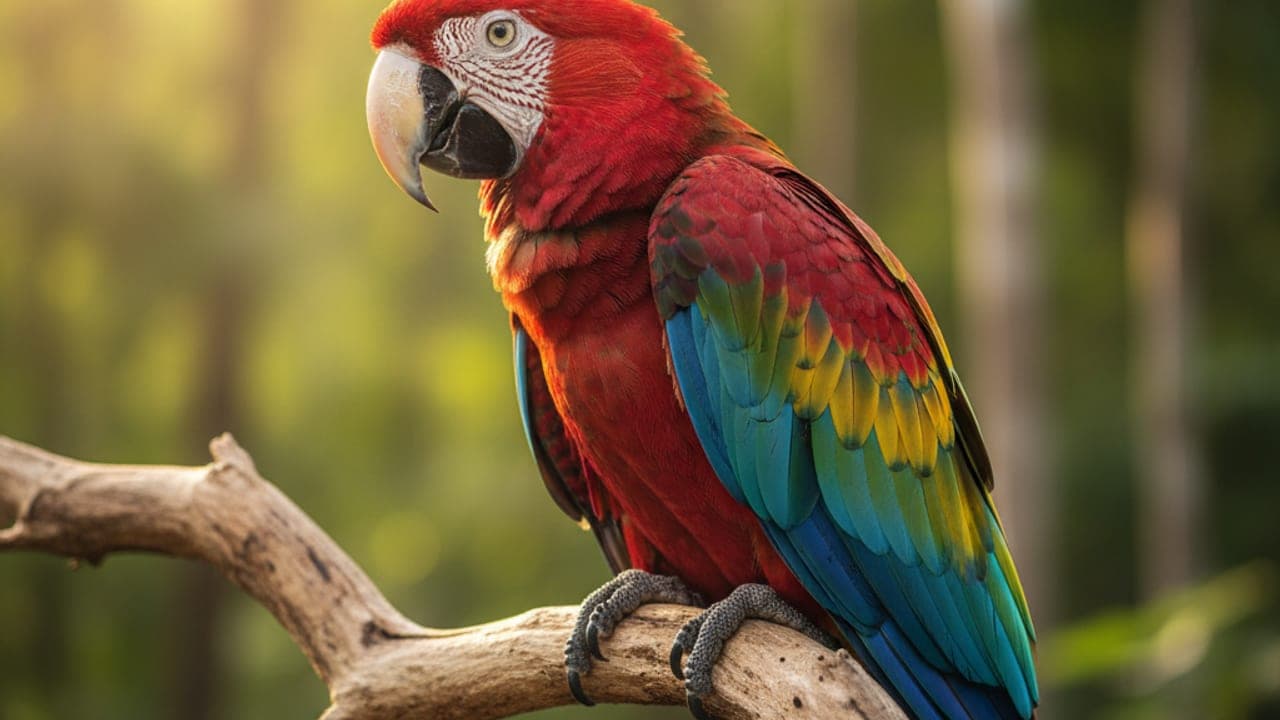
Most pets came to us through hunger. Wolves followed garbage piles, cats followed grain stores. Birds came to us for a different reason — because we wanted what they could do. Hunt for us, sing for us, carry messages, or sit in a cage that announced our wealth. Six thousand years later, that history still shapes the parrot on your shoulder and the budgerigar in your kitchen window.
The first intentional bird keeping (4,000 BCE onward)
The earliest hard evidence of humans deliberately keeping birds comes from Egypt. The Saqqara catacombs north of Memphis contain an estimated four million mummified ibises, bred at temple complexes between roughly 600 BCE and 250 CE specifically to be sacrificed to Thoth. These were not pets in any modern sense — they were a religious supply chain. But they prove something important: by the late dynastic period, Egyptians had already worked out how to breed wading birds in captivity at industrial scale.
Chickens have a longer and stranger story. Recent archaeological work at Ban Non Wat in Thailand and at sites across northern Vietnam pushes red junglefowl domestication back to roughly 6,000-8,000 years ago in mainland Southeast Asia. The early purpose was not eggs or meat. It was cockfighting and ritual display. The Harappan civilization of the Indus Valley kept fighting cocks by 2,500 BCE, and the bird only became primarily a food animal after it spread west into the Mediterranean and Persia, where Greek and Roman writers treated it as commonplace by the 5th century BCE.
Falconry probably emerged on the Central Asian steppe between 4,000 and 6,000 years ago, based on bone-tool evidence and rock art from Mongolia and Kazakhstan. The Mongols treated golden eagles as inheritable property by Genghis Khan's time, and the Kazakh berkutchi — eagle hunters — still ride out with the same equipment design today.
Falconry: the first working partnership with a wild animal
Falconry deserves a section of its own because it is unique. Every other domesticated working animal — the dog, the horse, the ox — was bred for thousands of years until its temperament shifted permanently. A modern Labrador is genetically and behaviorally a different animal from a wolf. A trained peregrine falcon is not. It is a wild bird that has agreed, through careful conditioning, to hunt with you for the duration of one season or one lifetime.
The practice spread along the Silk Road. By the 9th century, Abbasid caliphs in Baghdad were paying enormous sums for trained sakers and gyrfalcons. By the 13th century, the Mongol courts of Kublai Khan reportedly maintained 5,000 falconers — a number Marco Polo cited and modern historians treat with skepticism, though the order of magnitude is consistent with steppe traditions.
The single most important document in the history of human-bird working relationships is Frederick II's De Arte Venandi cum Avibus — The Art of Hunting with Birds — completed in the 1240s. Frederick was the Holy Roman Emperor, but he was also a serious naturalist who dissected birds, conducted incubation experiments, and wrote down what he actually observed instead of what classical authorities had claimed. His treatise corrected Aristotle on bird anatomy, described migration patterns accurately, and established a training methodology so sound that working ornithologists still cite it. Modern raptor biologists genuinely reference an 800-year-old emperor's notebook because nobody between 1250 and roughly 1900 wrote anything better.
UNESCO added falconry to its Representative List of the Intangible Cultural Heritage of Humanity in 2010, with the inscription later expanded to cover 24 countries. That status is administrative, but the fact behind it is striking: this is the only human-animal partnership where the animal remains genetically wild and the training tradition has continued without interruption for at least 1,500 years.
Caged exotic birds and the rise of bird keeping as status
Caged decorative birds entered Europe through Rome. Romans kept peacocks at country villas (Varro complained in the 1st century BCE that they were ruinously expensive to feed), imported African parrots through Alexandria, and built free-flight aviaries for pheasants and guinea fowl. After Rome collapsed, the practice essentially disappeared from Europe for 800 years.
It came back through two routes. Crusader and trade contact with the Islamic world reintroduced parrots to European nobility from the 12th century onward. Then the Atlantic voyages of the 1490s changed everything. Columbus brought Cuban Amazon parrots back from his first voyage in 1493 and presented them to Isabella of Castile. Within a generation, every European court had macaws and Amazons sourced through Lisbon and Seville.
The canary is the cleanest example of a wild bird becoming a household commodity. The Atlantic canary (Serinus canaria) is native only to the Canary Islands, the Azores, and Madeira. Spanish conquerors brought captive birds back to the mainland after about 1480. For roughly 150 years the Spanish Crown tried to maintain a monopoly by exporting only male birds — males sing, females do not, so without a breeding pair the trade could not be replicated. The monopoly collapsed in the late 16th century when a Spanish ship wrecked off Elba and survivors escaped.
The industry that grew from those escaped birds settled in the Harz Mountains of central Germany. By the early 19th century, Harz miners and farm families were running a serious cottage industry breeding canaries through the winter, training them with bird organs and roller cages, and selling them throughout Europe and to the United States. The "Harz roller" canary line — bred for a soft, continuous song rather than volume — is still recognized today, although the German breeding industry never recovered after the Second World War.
Parrots, ships, and the inconvenient truth about pirates
The pirate with a parrot on his shoulder is almost entirely a literary invention. It comes from Robert Louis Stevenson's Treasure Island in 1883 — Long John Silver and Captain Flint the parrot. Real 17th and 18th century ships were hot, salt-soaked, and short of food. Parrots are tropical, fragile, and need fresh fruit and clean water that crews could rarely spare for themselves.
What actually happened was a luxury trade. Captains and supercargoes brought back live parrots from Caribbean and West African ports because a healthy macaw could sell in London for the equivalent of a sailor's annual wage. The birds traveled in cages in the captain's cabin, not on shoulders, and mortality was severe. Samuel Pepys mentions a parrot in his diary in 1661, and by 1700 a fashionable London household often kept at least one. That is the real ancestry of the modern pet parrot trade — colonial-era luxury imports, not pirate folklore.
Pigeons: the most underrated companion bird in history
No bird has done more for humans and received less credit than the rock pigeon. Domesticated in the eastern Mediterranean roughly 5,000 years ago, pigeons were carrying written messages by the 12th century BCE — Egyptian fleets used them, and so did the Persian and later the Roman postal services. Reuters news agency began in 1850 with Paul Reuter using pigeons to fly stock prices between Aachen and Brussels, beating the telegraph by several hours per leg.
Belgian breeders turned the homing pigeon into a sport in the 1820s by selecting for speed over distance. By 1900 there were several hundred thousand racing pigeons in Belgium alone, and the sport spread across northern Europe and into the British working class.
The military used those same birds. Cher Ami is the most famous case. She was a Black Check Cock pigeon — actually a hen, despite the name — bred in Britain and given to the United States Army Signal Corps. On 4 October 1918, the 77th Infantry Division's "Lost Battalion" was pinned down in the Argonne Forest, taking friendly artillery fire from their own side, who did not know their position. Cher Ami was the last available pigeon. She flew 25 miles back to division headquarters in 25 minutes, shot through the breast, blinded in one eye, and missing most of one leg. The message attached to that leg saved approximately 194 trapped soldiers. France awarded her the Croix de Guerre with palm. She died of her wounds the following year, and her body is still on display at the Smithsonian National Museum of American History.
G.I. Joe, an American-bred pigeon, did something similar in Italy in October 1943, flying a recall to British forces in time to abort an air strike on the village of Calvi Vecchia, which the British had captured faster than expected. He saved an estimated 1,000 Allied troops and Italian civilians, and received the Dickin Medal — the British equivalent of the Victoria Cross for animals.
Pigeon racing still exists, though it has shifted geographically. China is now the dominant market — a single bird from a top Belgian loft sold at auction in 2020 for 1.6 million euros.
What this history means now
Three threads from this 6,000-year story matter directly to anyone considering a bird today.
First, lifespan. Most caged companion birds are not domesticated in the way dogs are. They are captive-bred wild types, with wild-type lifespans. An African Grey can live 40-60 years. A blue-and-gold macaw routinely passes 50. Cookie, a Major Mitchell's cockatoo at Brookfield Zoo in Illinois, lived to 83. If you buy a young parrot in your thirties, you are making a decision your adult children will inherit. Reputable rescue networks will not place a large parrot without a written succession plan, because the alternative — birds passed through five owners in twenty years — is well-documented and damaging to the bird.
Second, falconry's survival is not nostalgic. In the United States, falconry is regulated under federal and state law, requires a two-year apprenticeship under a licensed sponsor, mandates facility inspections, and limits the species and number of birds you may possess. The apprentice-to-master tradition Frederick II documented in the 1240s is still the structure used today, because it is the only training method that reliably produces a falconer who will not kill the bird through inexperience.
Third, the word "domesticated" is doing more work than it should in conversations about pet birds. Chickens are domesticated. Some canary and budgerigar lines are domesticated. Almost everything else in the pet trade — cockatiels, conures, macaws, lovebirds, African Greys — is captive-bred wild type. The bird on a perch in a suburban living room is, behaviorally, the same animal that lives in a Brazilian rainforest. That is why bird ownership is more demanding than dog ownership, and why the people who do it well treat it less like pet keeping and more like a long-term wildlife partnership.
Which, if you trace the line back through Frederick II and the Kazakh eagle hunters and the Egyptian temple breeders, is exactly what it has been for six thousand years.
Frequently Asked Questions
What were the first birds humans kept?
The earliest hard evidence comes from Egypt, where the Saqqara catacombs hold an estimated four million ibises bred at temple complexes between roughly 600 BCE and 250 CE to be sacrificed to Thoth. Chickens have a longer story: red junglefowl were domesticated in mainland Southeast Asia some 6,000 to 8,000 years ago, initially for cockfighting and ritual display rather than eggs or meat.
What makes falconry unique among human-animal partnerships?
Every other working animal — the dog, the horse, the ox — was bred over thousands of years until its temperament shifted permanently. A trained peregrine falcon is not. It remains a genetically wild bird that has agreed, through careful conditioning, to hunt alongside a human. That is why falconry is described as the only such partnership where the animal stays wild and the training tradition has continued unbroken for at least 1,500 years.
How did pet parrots reach Europe?
Rome kept imported parrots, but the practice vanished for about 800 years after Rome collapsed. Trade contact with the Islamic world reintroduced them to European nobility from the 12th century, and the Atlantic voyages changed everything: Columbus brought Cuban Amazon parrots back in 1493 and presented them to Isabella of Castile. Within a generation every European court kept macaws and Amazons sourced through Lisbon and Seville.
Did pirates really keep parrots on their shoulders?
The image is almost entirely a literary invention from Robert Louis Stevenson's Treasure Island in 1883. Real 17th and 18th century ships were hot, salt-soaked, and short of food, while parrots are tropical and fragile. What actually happened was a luxury trade — captains carried live parrots in cages in their cabins because a healthy macaw could sell in London for the equivalent of a sailor's annual wage, though mortality was severe.
Why are pigeons considered important companion birds?
The rock pigeon was domesticated in the eastern Mediterranean roughly 5,000 years ago and was carrying written messages by the 12th century BCE. Reuters began in 1850 using pigeons to fly stock prices between Aachen and Brussels. In wartime, Cher Ami flew 25 miles while badly wounded to save some 194 trapped soldiers and earned the Croix de Guerre, and G.I. Joe earned the Dickin Medal for aborting an air strike in Italy.
How long do pet birds live?
Most caged companion birds are captive-bred wild types with wild-type lifespans, not domesticated in the way dogs are. An African Grey can live 40 to 60 years, and a blue-and-gold macaw routinely passes 50. Cookie, a Major Mitchell's cockatoo at Brookfield Zoo in Illinois, lived to 83. Buying a young parrot can be a decision your adult children will inherit, which is why reputable rescues require a written succession plan.
Author & Reviewer
Related Reading
Continue the History
Understand Your Companion
Find Your Match
Ready to find your perfect companion?
Take the Breed Quiz →