
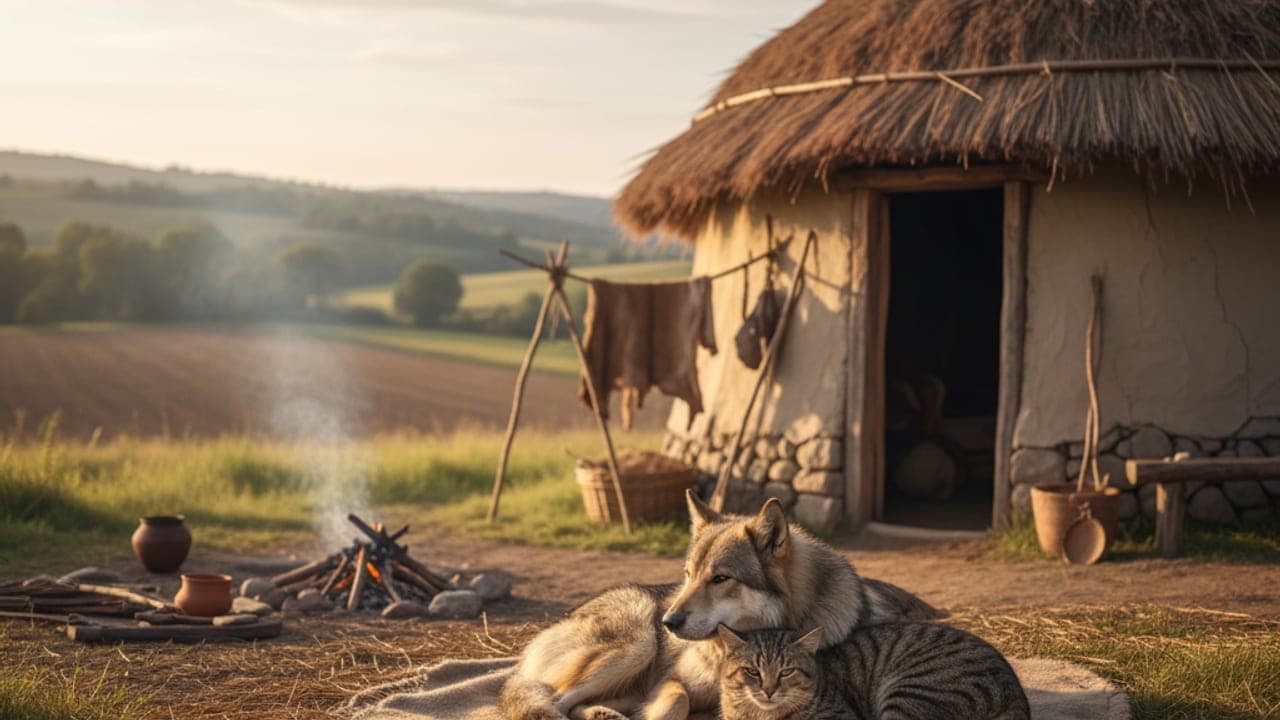
Somewhere around 12,000 years ago, in a small settlement in what is now northern Israel, an elderly person was laid to rest. Their hand rested gently on the body of a puppy — placed deliberately, carefully, so the two faced each other for eternity.
That burial, discovered in the Jordan Valley by archaeologists in the 1970s, is one of the oldest physical records of something we still feel every time a dog curls up at our feet: the bond between humans and animals runs deeper than convenience. It runs deeper than utility. It is, in many ways, one of the oldest love stories on Earth.
This is the timeline of how it happened — how wild creatures became the companions sharing our homes, our beds, and occasionally our dinner plates (we see you, counter-surfing Labrador Retrievers).
The First Partnership: Wolves Who Chose Us
Here is something that might surprise you: we probably did not domesticate dogs. They may have domesticated us.
The traditional story goes like this — early humans captured wolf pups, raised them, and gradually bred the wildness out of them over generations. It is a tidy narrative that puts humans in the driver's seat, but growing evidence suggests reality was messier and more beautiful than that.
The leading theory among researchers today is called "self-domestication." Picture a scene roughly 20,000 to 40,000 years ago: bands of human hunter-gatherers leaving behind scraps of food at the edges of their camps. The boldest, least fearful wolves — the ones willing to inch closer rather than flee — got more to eat. They survived. They reproduced. Their pups were bolder still.
Generation after generation, the wolves that tolerated humans thrived. The ones that snarled and ran did not. Over thousands of years, this natural selection produced animals that were not just tolerating us — they were reading our gestures, following our gaze, and sleeping beside our fires.
"It's complex and so much more interesting than the simple story we used to tell," notes Greger Larson, an expert on genetics and domestication at Durham University, whose research has reshaped how scientists understand the origins of domestic animals.
The oldest confirmed dog remains come from Germany, dating back roughly 14,000 years. But DNA analysis tells a longer story — one that pushes the relationship back to somewhere between 20,000 and 40,000 years ago, deep into the last Ice Age.
Think about that for a moment. Humans had dogs before we had agriculture. Before we had pottery. Before we had permanent settlements. Dogs were our first technology — and unlike every technology that followed, this one loved us back.
Cats: The Animals Who Domesticated Themselves
If the dog story is a love story, the cat story is more of a business arrangement that became a romance.
Around 9,500 years ago in the Near East — modern-day Turkey, Syria, and Iraq — something quiet but revolutionary was happening. Humans were beginning to store grain. And where grain accumulated, rodents followed. And where rodents gathered, wildcats appeared.
Nobody invited the cats. They showed up, assessed the rodent situation, and decided to stay. The humans, watching their grain stores survive the winter for the first time, decided that was fine.
This is what researchers call "commensal domestication" — the animals were not captured or trained. They entered human spaces because it benefited them, and humans tolerated them because it benefited everyone. Over centuries, the wildcats that were calmer around people thrived in villages, while their warier cousins remained in the wild.
Dr. Leslie Lyons, who heads the Feline Genetics Laboratory at the University of Missouri, explains that today's domestic cat descended primarily from the North African wildcat (Felis silvestris lybica). "There are many subspecies of wildcat found worldwide," she notes, "so it's rather hard to figure out" exactly where and when cats made the transition from pest control to pet. What is clear is that the relationship was, from the start, on the cat's terms. Sound familiar to any cat owners reading this?
The most striking evidence of the depth of this ancient bond comes from the island of Cyprus, where archaeologists discovered a 9,500-year-old burial site containing a cat and a human skeleton placed about a foot apart — positioned so they faced one another. Since wildcats are not native to Cyprus, someone deliberately brought this cat across the Mediterranean Sea by boat. You do not sail a wildcat across open water unless that animal means something to you.
By 3,000 BCE, cats had achieved something no other domestic animal has managed before or since: they became gods. In Ancient Egypt, cats were associated with the goddess Bastet, and killing one — even accidentally — was punishable by death. When a family's cat died, household members shaved their eyebrows in mourning. In 1888, a farmer near Beni Hassan uncovered a cemetery containing an estimated 300,000 cat mummies.
Three hundred thousand. Wrapped in linen. Some in tiny painted coffins shaped like cats.
Horses: The Partnership That Reshaped Civilization
Dogs kept us safe. Cats kept our food safe. But horses changed the shape of the world itself.
Around 5,500 years ago on the Central Asian steppes — vast grasslands stretching from modern-day Ukraine to Kazakhstan — humans began domesticating wild horses. The evidence comes from sites like Botai in northern Kazakhstan, where archaeologists found horse teeth with wear patterns consistent with bit use, and pottery fragments containing traces of mare's milk.
Before horses, the fastest a human could travel was the speed of their own feet, or perhaps a river current. After horses, the world shrank. Armies could cover distances in days that once took weeks. Trade routes expanded. Messages could reach across empires. The Silk Road, the Mongol conquests, the settlement of the American West — none of it happens without the horse.
But the relationship was not just strategic. The same Botai settlements show horses living alongside humans in ways that suggest companionship, not just utility. These were not vehicles with legs. They were partners.
Today, the bond between horse and rider remains one of the most profound in the animal kingdom. If you have ever watched a horse respond to a whisper, you have seen the echo of a relationship 5,500 years in the making.
Birds, Rabbits, and Goldfish: The Quieter Domestications
Not every domestication story involves survival or the rise of empires. Some are gentler.
Pigeons were among the first birds domesticated, at least 5,000 years ago in the ancient Near East. They carried messages across continents for thousands of years — the original instant messaging service. Read about Birds as Companions Through History for the full story.
Guinea pigs were domesticated around 5,000 BCE in the Andes of South America. Originally raised as a food source (they still are in parts of Peru), they gradually became household companions — a trajectory that tells you something about the human tendency to grow fond of anything that lives close enough for long enough.
Goldfish emerged from Chinese carp ponds roughly 1,000 years ago, when Buddhist monks noticed naturally occurring color mutations in wild carp and began selectively breeding them. What started as spiritual practice became one of the most popular pet-keeping traditions in the world. A fish that would never have survived in the wild — too bright, too slow, too visible to predators — thrived under human care.
Canaries became fashionable pets in 17th-century Europe after Spanish sailors brought them from the Canary Islands. Their popularity spread when it was discovered that they could be taught to sing specific melodies — the first animals kept purely for the pleasure of their company and their voices.
Budgerigars were first bred in captivity outside Australia in the 1850s, and within decades they had become the world's most popular pet bird. Their ability to mimic human speech made them irresistible to owners who wanted a companion that could, in some small way, talk back.
Each of these stories is smaller in scale than the wolf-to-dog epic, but each reveals the same underlying truth: humans are drawn to animals not just for what they can do for us, but for who they are.
The Science Behind the Transformation
What actually happens to an animal during domestication? The changes are more dramatic — and more interconnected — than you might expect.
In the 1950s, Soviet geneticist Dmitri Belyaev began an experiment that would run for decades. He selected the tamest silver foxes from a fur farm and bred them together, generation after generation. Within just a few generations, something remarkable happened. The foxes did not just become friendlier. They developed floppy ears. Their tails curled. Their coats developed patches of white. Their faces became rounder, more puppy-like.
Belyaev had stumbled onto what scientists now call "domestication syndrome" — a suite of physical changes that appears across virtually every domesticated species, from dogs to pigs to cattle. Floppy ears. Shorter snouts. Smaller teeth. Piebald coloring. Juvenilized features that persist into adulthood.
The explanation, researchers now believe, lies in neural crest cells — a group of embryonic cells that influence everything from adrenal gland size (which controls the fight-or-flight response) to cartilage development (which shapes ears and faces) to melanocyte distribution (which determines coat patterns). By selecting for tameness, Belyaev was unknowingly selecting for changes in neural crest cell behavior — and getting the entire domestication package as a side effect.
Gordon Lark, a University of Utah biologist who studies dog genetics, notes that Belyaev essentially "compressed thousands of years of domestication into a few years." The experiment demonstrated that domestication is not a slow, random process. It is a biological cascade — pull one thread, and the whole tapestry changes.
This is why your Golden Retriever has soft, floppy ears and a shorter snout than a wolf. It is why your tabby cat has a rounder face than a wildcat. The features that make our pets look endearing are not decorative — they are side effects of the very process that made them gentle enough to live beside us.
A Two-Way Street: How Animals Changed Us
Here is the part of the story we rarely tell: domestication changed us too.
A 2013 study published in Nature found that as dogs evolved alongside humans, our genomes shifted in parallel. Both species developed enhanced genes for digesting starch — a dietary adaptation to agricultural living. We did not just change dogs. Dogs changed our biology.
The effects go beyond genetics. The presence of animals in human communities likely shaped our capacity for empathy, our willingness to nurture, and even our social structures. Caring for a creature that cannot speak your language but depends on you entirely is a particular kind of emotional labor — and it may have helped wire us for the compassion that underlies human civilization.
Consider this: your cat shares 95.6 percent of her DNA with a tiger. Your German Shepherd shares most of his genome with a wolf. The difference between wild and domestic is not a vast genetic gulf — it is a narrow bridge built over thousands of years of proximity, patience, and mutual trust.
What This History Means for You and Your Pet
The next time your dog stares at you from across the room, know this: that gaze has been 15,000 years in the making. Dogs evolved the ability to make eye contact with humans — something wolves rarely do — because it strengthened the bond that kept both species alive.
The next time your cat slow-blinks at you, know this: her ancestors crossed the Mediterranean in boats because someone loved them enough to bring them along.
The next time your horse nickers when you enter the barn, your goldfish swims to the front of the tank at feeding time, or your budgie mimics the sound of your morning alarm — you are participating in one of the longest, most extraordinary partnerships in the history of life on Earth.
We did not tame these animals. We grew up together. And we are still growing.
Frequently Asked Questions
When were dogs first domesticated?
The oldest confirmed dog remains date to about 14,000 years ago in Germany, but genetic evidence suggests the process began between 20,000 and 40,000 years ago — making dogs humanity's oldest animal companion by a wide margin.
Did cats domesticate themselves?
Essentially, yes. Wildcats gravitated toward human grain stores to hunt rodents. The calmer individuals thrived in village settings and gradually evolved into domestic cats — a process researchers call "commensal domestication." Learn more about the descendants of these ancient felines in our cat breed guide.
What is domestication syndrome?
A set of physical traits — floppy ears, shorter snouts, curly tails, piebald coats — that appear across nearly all domesticated animals. These changes are linked to neural crest cell development and emerge as a biological side effect of selecting for tameness.
How did horses change human history?
Horse domestication around 5,500 years ago transformed transportation, warfare, agriculture, and trade. Before horses, the fastest humans could travel was on foot. After horses, empires could span continents.
What is the difference between taming and domestication?
Taming is individual — a single wild animal learns to tolerate humans. Domestication is genetic — an entire species changes over many generations through selective breeding, resulting in animals that are fundamentally different from their wild ancestors.
Which animals were domesticated most recently?
Budgerigars (1850s), hamsters (1930s), and certain reptile species are among the most recently domesticated animals. The process continues today as breeders develop new varieties of companion animals.
Curious which breed's history aligns with your personality? Take our dog breed quiz to discover your ideal companion — and the thousands of years of history that shaped them.
References & Fact-Checking
- Greger Larson (2024) — Ancient domestication and human genetics
- Leslie Lyons (2023) — The Evolution of Felidae: Genetic insights into cat domestication
- Gordon Lark (2022) — Canine Genetics: The Science of Dog Evolution
- Dmitri Belyaev (1959) — The Phenomenon of Domestication
- Axelsson et al., Nature (2013) — The genomic signature of dog domestication reveals adaptation to a starch-rich diet
Author & Reviewer
Related Reading
Continue the History
Understand Your Companion
Find Your Match
Ready to find your perfect companion?
Take the Breed Quiz →