
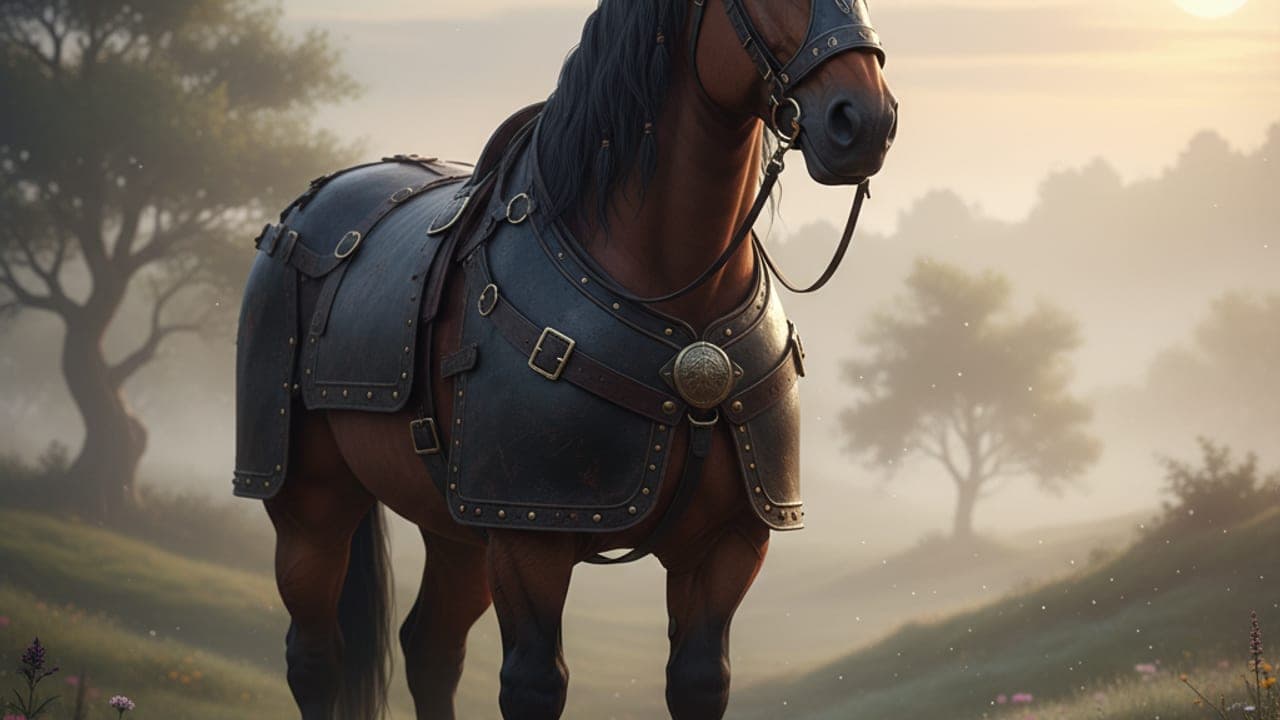
Forget the cinematic image of a knight thundering across a field on a beast the size of a Budweiser Clydesdale. The medieval warhorse was closer in build to a modern Andalusian or a heavy quarter horse — roughly 15-16 hands at the shoulder, 1,200 to 1,400 pounds, compact and quick on its feet. The Shire-sized destrier of fantasy art did not exist. What did exist was something arguably more important: an animal that functioned as engine, weapon, status symbol, and economic instrument all at once, in a way no single creature has done before or since.
The Horse as Medieval Infrastructure
By 1300 CE, scholars estimate roughly 5 million horses lived across medieval Europe — a ratio of about one horse for every 15 humans. That is not pet ownership. That is infrastructure. Horses pulled plows, hauled carts, carried messages, moved armies, ground grain via horse-mills, and powered the early industrial logistics of fairs, ports, and royal courts. A medieval economy without horses would have collapsed in a single growing season.
The critical innovation that made this possible was not the stirrup, important as it was for cavalry. It was the padded horse collar, which spread through northern Europe between roughly 800 and 900 CE. The Roman world had used a throat-and-girth harness that compressed a horse's windpipe under load, capping pulling efficiency at maybe a third of the animal's true capability. The padded collar transferred the load to the horse's shoulders, where the skeleton actually wants to push. Result: roughly triple the draft efficiency. Combined with nailed iron horseshoes (widespread by the 11th century) and the heavy moldboard plow, this was the technology stack that made the agricultural revolution of high medieval Europe possible. Towns grew because horses could plow heavier, wetter northern soils that oxen worked too slowly to make profitable.
The Three Classes Most People Don't Know About
Medieval written records — manorial accounts, chronicles, legal documents — describe horses with the same precision a modern accountant uses for asset categories. The five most common types:
- Destrier — The heavy warhorse, 15-16 hands, 1,200-1,400 pounds, ridden by knights only in actual battle and tournament. Bred for the temperament to charge into a screaming line of pikes without bolting. A trained destrier could cost the equivalent of a small farm. More on this below.
- Courser — Lighter and faster. Used for hard riding, hunting, and sometimes lighter cavalry work. The horse a knight actually rode most days when he was not fighting.
- Palfrey — A smooth-gaited riding horse, prized for the ambling gait that let nobility cover 30-40 miles a day without bruising their backs. Often the most expensive non-warhorse a household owned. Bishops and noblewomen rode palfreys.
- Rouncy — General-purpose horse for squires, men-at-arms, merchants, and ordinary travelers. The Honda Civic of medieval transportation.
- Sumpter — The pack horse. Hauled the goods, the armor, the tents. Did the unglamorous work that kept armies and trade caravans moving.
Note what is missing: the word "breed" in any modern sense. Destrier was a job title, not a bloodline. A horse was a destrier because it had been selected, trained, and certified for the work of carrying an armored knight in battle. The same colt, if it failed destrier training, might end up a courser or a rouncy. This is one of the most persistent misconceptions about medieval horses — that destriers were a distinct genetic population. They were a graduating class.
The Knight and the Destrier: An Economic Reality
The romance of knighthood obscures a brutal economic fact: a war-trained destrier in 13th-century England or France could cost 50 to 100 pounds sterling. A skilled craftsman earned roughly 5 to 10 pounds a year. A working farm with land could be purchased for similar money. When a knight rode into battle, he was riding the equivalent of a small estate.
Training took years. A destrier had to charge a wall of infantry without flinching, stand still under a screaming joust, turn on its haunches in a melee, and not panic when other horses around it were being killed. Knights who lost their destrier in battle often lost their economic standing along with it — which is why ransoming captured horses (not just captured knights) became a formalized part of medieval warfare. By the 1200s, full plate barding (horse armor) added another small fortune to the kit.
Tournament culture institutionalized the warhorse economy. Jousts and melees were both proving grounds for destriers and the marketplace where their reputations — and prices — were set. A horse that performed at a major tournament could double in value the next morning. Knights without their own destrier rode borrowed or rented mounts and accepted the social demotion that came with it.
Working Horses and the Quiet Agricultural Revolution
The story most history books skip is that the horse-collar plus horseshoes plus three-field crop rotation, in combination, did more to reshape Europe than any king or crusade. Between roughly 900 and 1200 CE, northern European farmers gradually replaced oxen with horses for plowing. A horse plow team could work about 50 percent faster than oxen, with shorter rest cycles. Faster plowing meant more land brought into cultivation, which meant grain surplus, which meant more people, which meant towns, which meant markets, which meant the trade networks that fed the high medieval economy.
This is also why horse-collar adoption took roughly 1,500 years after the Romans built their road network. The Roman world had cheap slave labor and the Mediterranean climate that favored ox plowing on lighter soils. Northern Europe — heavy clay, short growing seasons, no slave economy by the early medieval period — desperately needed a more efficient draft animal. Necessity, not invention, drove the technology.
Horses in Medieval Cultural Identity
Heraldry codified the horse's social meaning. Rampant horses appeared on the crests of dozens of noble houses across France, Germany, and the Italian peninsula. The horse on a coat of arms signaled lineage, military service, or both.
In literature, named horses carried meaning. Bayard, the magical bay warhorse of the four sons of Aymon in the chanson de geste tradition, could carry all four brothers at once and outpace any pursuit. Bucephalus, the legendary mount of Alexander the Great, was constantly invoked in medieval texts as the archetype of the warrior's horse. Charlemagne's chronicled horses were named, mourned, and replaced with public ceremony.
Then the Mongols arrived. Between 1237 and 1242, Mongol cavalry under Subutai moved through eastern Europe with a speed and tactical fluidity that European military thinkers found incomprehensible. The Mongol horse — small, tough, fed on grass alone — was the opposite of the destrier in nearly every dimension. European commanders began rethinking the assumption that heavier was always better. The seeds of light cavalry doctrine were planted, though it would take another 200 years to grow.
For the knightly class, losing your horse meant losing your identity. Manorial records describe formerly mounted men reduced to walking as a kind of social death. The phrase "chevalier" itself derives from the French for horseman; an unhorsed chevalier was a contradiction in terms.
The Decline of the Warhorse
What killed the destrier was not a single event but a slow technological squeeze. The English longbow at Crécy in 1346 and Agincourt in 1415 demonstrated that disciplined infantry with the right ranged weapon could shred heavy cavalry charges. The Swiss pike squares of the late 1400s did the same in close combat. By the time gunpowder weapons matured in the 1500s, the heavy cavalry charge as a battle-deciding tactic was essentially obsolete.
Warhorses bred for size and weight did not disappear — they were rebranded. The same bloodlines that had produced destriers became the foundation stock for heavy draft horses. The coach-and-six culture of the 1600s created a new horse economy built around carriage work, urban delivery, and the increasingly industrial logistics of European cities. The destrier's descendants ended up pulling beer wagons.
Past to Present: What Survives
Three concrete inheritances connect the medieval horse to the modern one.
First, bloodlines. The Friesian, native to the Frisian coast of the Netherlands, is descended from medieval Frisian war horses prized by Spanish and German cavalry. The Andalusian (Pura Raza Española) traces directly to Iberian war mounts of the late medieval period — the horses that carried Spanish knights against the Moors and later conquered the Americas. The Shire and the Percheron, the giants of modern draft work, both descend from medieval heavy horse populations bred up in size during the 1700s and 1800s for industrial hauling.
Second, units of measurement. James Watt coined "horsepower" in the 1780s by literally measuring how much weight a working horse could lift over a given distance in a given time. The unit persists in every car engine specification, every electric motor rating, every industrial pump. When you read "450 horsepower" on a modern truck, you are reading a measurement calibrated against a medieval inheritance — the working horse as the standard unit of mechanical capability.
Third, equestrian sport. Modern dressage descends directly from the high school riding traditions developed for warhorses — the piaffe, the levade, the capriole are battlefield maneuvers preserved as art. The Spanish Riding School in Vienna still trains Lipizzaners (themselves an Andalusian-derived breed) in techniques that would have been recognizable to a 16th-century cavalry officer. Show jumping and three-day eventing are formalized echoes of cavalry training. Polo, codified by British officers in colonial India, is a recognizable descendant of mounted warrior games that go back to medieval Persia and beyond.
The medieval farrier's craft also survives almost unchanged. A 21st-century farrier shoeing a horse uses tools a 12th-century farrier would recognize within minutes.
Why This Matters
The medieval horse is the strongest evidence we have that the line between "working animal" and "companion animal" is not fixed but historical. For 1,000 years, the horse occupied a category we no longer have a word for — economic partner, status object, weapon platform, and treasured living being all at once.
Understanding this changes how you see the other animals humans have lived alongside. The categories we use today — pet, livestock, working animal — are not natural divisions. They are choices made by particular societies in particular economic conditions. The medieval horse reminds us that the relationships we build with animals are always shaped by the work we ask them to do and the meaning we project onto them.
Frequently Asked Questions
How big was a medieval warhorse?
The medieval destrier was closer in build to a modern Andalusian or heavy quarter horse — roughly 15-16 hands at the shoulder and 1,200 to 1,400 pounds, compact and quick on its feet. The Shire-sized warhorse of fantasy art did not exist. What mattered was not raw size but temperament: an animal trained to carry an armored knight into battle without bolting.
What were the different types of horses in medieval Europe?
Medieval records describe horses by job, not bloodline. The destrier was the heavy warhorse ridden only in battle and tournament. The courser was lighter and faster for hard riding and hunting. The palfrey was a smooth-gaited riding horse prized by nobility. The rouncy was the general-purpose mount of squires and merchants, and the sumpter was the pack horse that hauled goods and armor.
How much did a knight's warhorse cost?
A war-trained destrier in 13th-century England or France could cost 50 to 100 pounds sterling, at a time when a skilled craftsman earned roughly 5 to 10 pounds a year. That put a single warhorse on par with a working farm and its land. When a knight rode into battle, he was effectively riding the equivalent of a small estate — which is why captured horses were formally ransomed alongside captured knights.
How did horses drive the medieval agricultural revolution?
The padded horse collar, which spread through northern Europe between roughly 800 and 900 CE, transferred a horse's pulling load to its shoulders and roughly tripled its draft efficiency over the older Roman throat-and-girth harness. Combined with nailed iron horseshoes and the heavy moldboard plow, it let horse teams plow about 50 percent faster than oxen, opening heavier northern soils to cultivation and fueling the growth of towns and trade.
Why did the medieval warhorse decline?
No single event killed the destrier — technology squeezed it out. The English longbow at Crécy in 1346 and Agincourt in 1415 showed disciplined ranged infantry could shred a cavalry charge, and Swiss pike squares of the late 1400s did the same in close combat. Once gunpowder weapons matured in the 1500s, the heavy cavalry charge was obsolete, and warhorse bloodlines were rebranded as heavy draft horses.
Which modern horse breeds descend from medieval horses?
Several trace directly back. The Friesian descends from medieval Frisian war horses, and the Andalusian (Pura Raza Española) traces to Iberian war mounts of the late medieval period. The Shire and the Percheron, today's draft giants, both descend from medieval heavy horse populations bred up in size during the 1700s and 1800s for industrial hauling.
Author & Reviewer
Related Reading
Continue the History
Understand Your Companion
Find Your Match
Ready to find your perfect companion?
Take the Breed Quiz →