
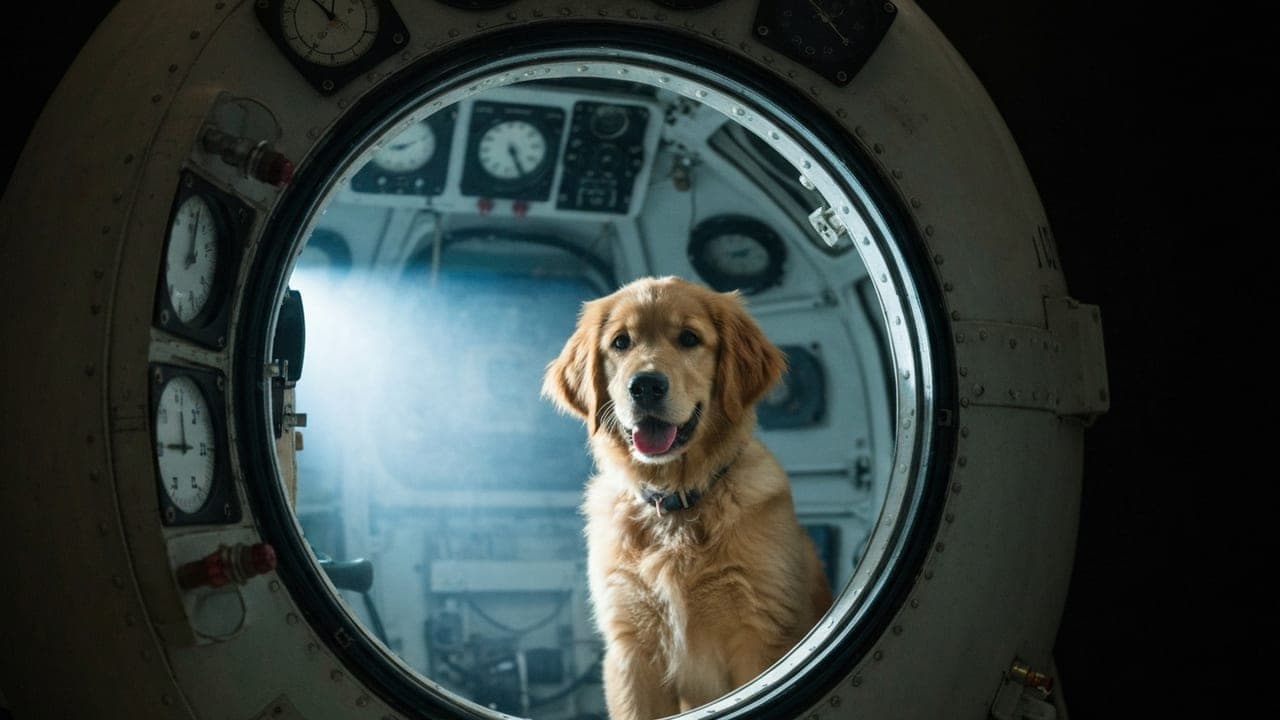
The Animals Who Went First
Space exploration is remembered as a story of human courage and technological ambition. But before any cosmonaut or astronaut left Earth's atmosphere, the path was cleared by animals who had no understanding of what they were doing or why — creatures recruited by science to answer questions that could not yet be answered any other way. Their contributions made human spaceflight possible. Their fates were not always just.
The story begins not with dogs or monkeys, but with something far smaller.
Fruit Flies Lead the Way (1947)
On February 20, 1947, a captured German V-2 rocket launched from White Sands, New Mexico, carrying a small canister into the upper atmosphere. Inside were fruit flies — Drosophila melanogaster, the same creatures biologists had been studying for decades. The United States Air Force sent them up to study the effects of radiation at high altitude, a question with enormous implications for any future human mission beyond Earth's protective magnetosphere.
The flies reached an altitude of 109 kilometers — past the boundary now recognized as the edge of space — and were recovered alive. They showed no significant radiation damage. It was a modest result with enormous implications: living organisms could survive a brief journey to space and return.
This small, unglamorous experiment launched one of the most consequential research programs in the history of science.
Albert and the Monkey Program (1948-1950)
The next phase was less fortunate. The United States began launching rhesus monkeys in modified V-2 rockets to study the physiological effects of spaceflight. Albert I flew in June 1948 and suffocated during the flight. Albert II reached an altitude of 134 kilometers in June 1949 — the first monkey in space — but died on impact when the parachute recovery system failed. Albert III, IV, V, and VI followed, all dying either in flight or during failed recoveries.
These early missions were not managed with the animal welfare standards that would later be demanded by public pressure and ethical oversight bodies. They were raw experiments at the frontier of a science that did not yet know what it needed to know. The results, however grim, established baseline data about pressure suits, oxygen systems, and the physical stresses of launch and reentry — data without which human spaceflight would have been impossible.
Laika: The Dog Who Changed Everything (1957)
On November 3, 1957, less than a month after Sputnik 1 had shocked the Western world by becoming the first artificial satellite to orbit Earth, the Soviet Union launched Sputnik 2. Aboard was a small mixed-breed stray dog named Laika, selected from the streets of Moscow for her calm temperament and small size.
For decades, the Soviet government maintained that Laika had survived for several days in orbit before dying painlessly when her oxygen supply ran out. It was a comfortable story, and it was false. In 2002, Russian scientist Dimitri Malashenkov revealed the truth that had been suppressed for 45 years: Laika died within five to seven hours of launch from overheating caused by a thermal control system failure. Sputnik 2 was never designed to return to Earth. From the moment of launch, there was no plan to bring her back.
The international reaction was immediate and significant. The British National Canine Defence League called for a minute of silence for Laika. Animal rights organizations staged protests. For the first time, the ethics of using animals in scientific research without any possibility of recovery became a mainstream public debate rather than a specialist concern. The moral outcry over Laika directly influenced the development of animal research ethics frameworks in the following decade.
In 2008, a monument was unveiled near the Moscow military research facility where Laika was trained. She is depicted standing atop a rocket, gazing forward — a tribute to an animal who was given no choice but who, in her involuntary sacrifice, changed the course of history.
Ham and the Chimp Program (1961)
The United States chose a different approach. Chimpanzees, whose cognitive and physiological similarities to humans are significant, were trained not merely to survive spaceflight but to perform tasks during it — pressing levers in response to lights, demonstrating that higher cognitive function could be maintained under the stresses of launch, weightlessness, and reentry.
On January 31, 1961, a four-year-old chimpanzee named Ham — named after the Holloman Aerospace Medical Center where he was trained — became the first chimpanzee in space aboard a Mercury Redstone rocket. Ham performed his lever tasks correctly throughout the 16-minute suborbital flight, demonstrating that purposeful activity was possible in space. He splashed down in the Atlantic Ocean, was recovered in good health, and retired to a life of comparative comfort — first at the National Zoo in Washington, then at the North Carolina Zoo in Asheboro, where he died in 1983.
Ham's successful flight cleared the way for Alan Shepard's suborbital mission just months later. The chimpanzee program continued with Enos, who orbited Earth twice in November 1961, directly preceding John Glenn's historic orbital flight in February 1962.
Felicette: The Cat Who Flew to Space (1963)
France, pursuing its own space ambitions, sent a cat into space on October 18, 1963. Her name was Felicette, a black-and-white Parisian stray who had been selected from a pool of 14 candidate cats based on her calm temperament and consistent behavior. She was launched on a Veronique AG1 rocket from Algeria, reached an altitude of approximately 157 kilometers, experienced about five minutes of weightlessness, and was recovered alive after a parachute descent lasting 13 minutes.
Felicette is the only cat to have survived a spaceflight. A second cat was launched a week later but did not survive recovery. Felicette was studied for three months after her flight before being euthanized so researchers could examine her neurological implants — a decision that, assessed by modern standards, reflects the instrumental view of animal subjects that characterized the era. A bronze statue of Felicette was unveiled in 2019 after a crowdfunding campaign, giving her the recognition that history had largely denied her.
What Animal Research Made Possible
Between 1947 and 1968, the United States alone sent 32 monkeys to space. The Soviet program used dogs extensively, launching more than a dozen animals in the years following Laika. France used cats and rats. The data gathered from these missions informed every aspect of human spaceflight: suit design, cabin pressure, oxygen systems, radiation shielding, food and water consumption under zero gravity, psychological monitoring, and recovery protocols.
When Yuri Gagarin orbited Earth on April 12, 1961, and when Neil Armstrong stepped onto the Moon on July 20, 1969, they did so because animals had gone first — because science had learned, through observation and loss, what the human body would need to survive.
Why We Stopped
The transition away from using animals as primary spaceflight test subjects came gradually through the 1970s and 1980s. Two forces drove it. First, public pressure: the debate sparked by Laika had matured into formal ethical frameworks governing animal research, including the Three Rs principle (Replace, Reduce, Refine) that became international standard. Second, technology: computer simulation, cell culture models, and sophisticated mannequin instrumentation had reached a point where many of the questions animals had once been the only way to answer could now be answered differently.
Animals still participate in spaceflight research — mice and rats have been carried to the International Space Station for bone density and immune function studies — but the era of sending dogs, chimps, and cats as primary test subjects is over. The animals who served in that era left a legacy written into every human life saved by the medicine, safety standards, and exploration that their sacrifices made possible.
Frequently Asked Questions
Was Laika the first animal in space?
No. Fruit flies were the first animals in space in 1947, followed by rhesus monkeys beginning in 1948. Laika, launched in November 1957, was the first animal to orbit Earth — a very different achievement from reaching space.
Did the Soviet Union really lie about Laika's fate for 45 years?
Yes. Soviet officials claimed for decades that Laika had survived for several days before her oxygen supply ran out peacefully. In 2002, scientist Dimitri Malashenkov confirmed she died within hours from overheating caused by a thermal control malfunction. Sputnik 2 was never designed to return her alive.
What happened to Ham the chimpanzee after his spaceflight?
Ham lived a long post-service life. He resided at the National Zoo in Washington for several years before moving to the North Carolina Zoo in Asheboro. He died in January 1983, at approximately 26 years old, and is buried at the International Space Hall of Fame in New Mexico.
Are animals still sent to space today?
Yes, though in very different roles. Mice, rats, and occasionally other small animals are carried to the International Space Station to study bone density loss, muscle atrophy, and immune system changes in microgravity — research directly applicable to astronaut health on long-duration missions.
Author & Reviewer
Related Reading
Continue the History
Understand Your Companion
Find Your Match
Ready to find your perfect companion?
Take the Breed Quiz →