
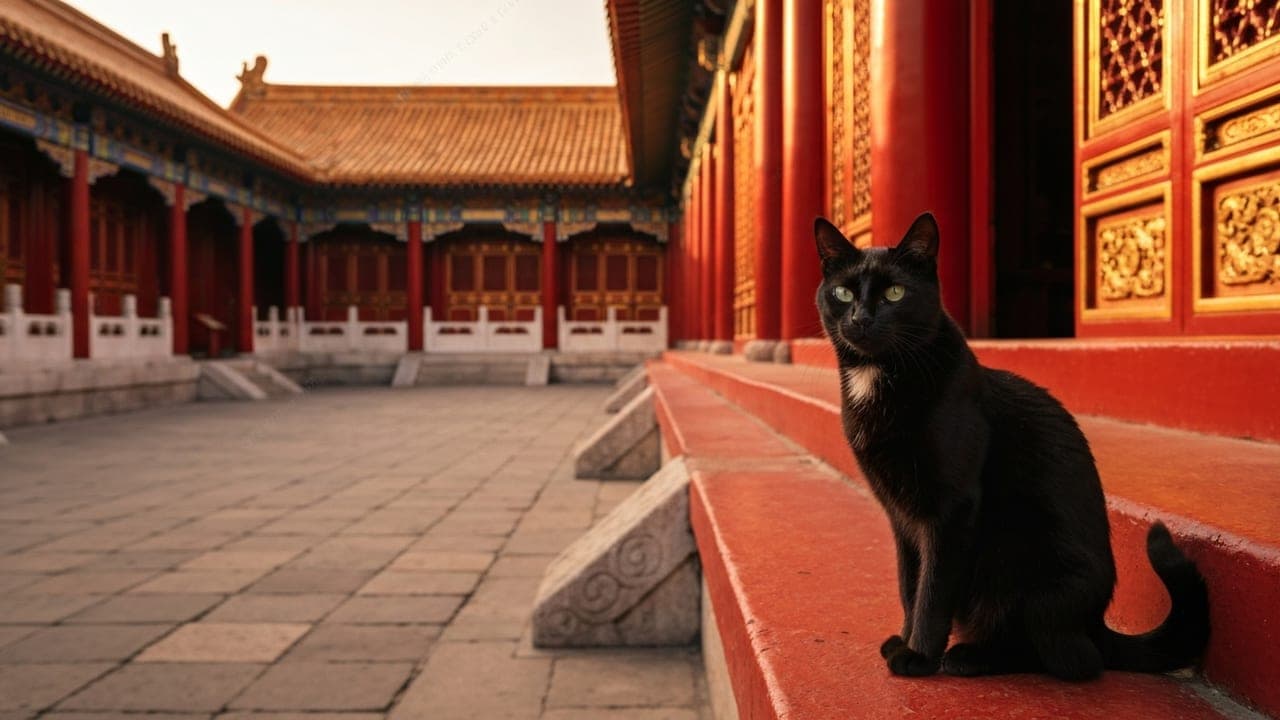
The Silk Road's Smallest Pest Controllers
In the second century BCE, Han Dynasty merchants moving silk westward along the trade routes that would become known as the Silk Road faced a pest problem that threatened the empire's most valuable export. Silk worm cocoons stored in warehouse depots were being destroyed by mice and rats. The solution arrived not through imperial decree but through natural attraction: small felids — likely the Chinese mountain cat (Felis silvestris bieti) or early domestic cats arriving via Central Asian trade connections — discovered that grain depots and silk stores were rich hunting grounds.
Chinese archaeologists working at Han Dynasty sites in Shaanxi province have found cat bones in contexts that suggest controlled keeping rather than wild incursion. By contrast with the Egyptian domestic cat (Felis lybica), whose taming has been traced to around 10,000 BCE in the Fertile Crescent, Chinese cat domestication appears to have been partly independent and partly influenced by cats arriving westward along trade routes — a finding that complicates the old narrative of a single domestication event in Egypt spreading globally.
What is clear from written records is that by the late Han period, cats were understood in China as dual-purpose animals: grain protectors and silk cocoon guardians. The silk connection was explicit and economic. Silk production was a state monopoly, and cats that protected the mulberry leaves, silk worm cocoons, and finished goods from rodent damage were protecting imperial revenue. This gave cats a status in China that was partly practical and partly sacred from the beginning.
Tang Dynasty: The Golden Age of Cat Culture
The Tang Dynasty (618–907 CE) was China's cosmopolitan golden age — the period when Chang'an, then the world's largest city with over a million inhabitants, was a cultural crossroads absorbing influences from Persia, India, Central Asia, and the Byzantine Empire. In this context, the domestic cat transformed from agricultural tool to court companion with remarkable speed.
Emperor Xuanzong (reigned 712–756 CE), one of Tang's most celebrated rulers, was famously devoted to cats. Court records document that he kept numerous cats in the imperial apartments and that specific cats were given ranks and titles within the palace household structure — an echo of the Egyptian tradition of divine cat status that likely arrived in China via Buddhist and Zoroastrian traders. The emperor reportedly wept publicly when a favored cat died, a display of grief that court historians recorded without embarrassment.
Tang Dynasty cat poetry represents one of the most sustained literary treatments of the domestic cat in premodern literature. The poet Du Fu, writing in the mid-eighth century CE during the An Lushan Rebellion that temporarily destroyed Chang'an, composed verses about his cats that mixed domestic affection with political allegory — the cats' ability to hunt rats becoming a metaphor for rooting out corrupt officials. This literary tradition of using cats as moral exemplars would persist through the Song and Ming periods.
Contemporary with Xuanzong, the cat breed we now recognize as the Siamese was likely beginning to be differentiated in Southeast Asia, though it would not reach China as a recognized breed for several more centuries. The cats most prized in Tang China were those with distinctive coat patterns — particularly the "lion cat" with long white fur that was bred in Shandong province and became the most expensive variety in later imperial periods.
Buddhist Monasteries and the Sacred Feline
The spread of Buddhism from India into China during the Han and Tang periods introduced a theological dimension to Chinese cat keeping that had no parallel in the Egyptian or Roman traditions. Buddhist monasteries were repositories of irreplaceable manuscripts — hand-copied sutras on paper or palm leaf that represented centuries of scholarly labor and enormous monetary value. Mice and rats that ate these texts were not merely pests; they were destroyers of dharma.
Monasteries became major cat-keeping institutions. Chan (Zen) Buddhist monks at major centers like the Shaolin Monastery and the monasteries of Mount Wutai kept cats not only as pest controllers but as contemplative companions. A cat's ability to sit motionless for long periods, watching with perfect attention, resonated with Buddhist meditation ideals. Several Chan masters used cats as teaching devices in koans — philosophical puzzles designed to break ordinary thinking patterns.
The most famous Buddhist cat koan comes from Master Nanquan Puyuan (748–835 CE): monks from the eastern and western halls were fighting over a cat, so Nanquan held it up and said, "If any of you can say something, I will spare the cat. If not, I will kill it." No one spoke, so Nanquan killed the cat. The koan continues with Nanquan's student Zhaozhou, who was not present, placing his sandals on his head when told what happened — demonstrating enlightened understanding that transcended the ordinary. This story was taken with absolute seriousness as a teaching tool and appears in major compilations including the Biyanlu (Blue Cliff Record) from 1128 CE.
The monastery connection had an export dimension that shaped world history. When Chinese Buddhist monks traveled to Japan carrying sacred texts in the ninth and tenth centuries CE, they brought cats to protect those texts aboard ship and in transit. This is the most historically documented pathway by which domestic cats reached Japan — not through trade but through Buddhist institutional networks. The Japanese would develop their own distinct cat culture, including the iconic maneki-neko (beckoning cat) lucky charm, but the foundation was Chinese Buddhist cat keeping.
Song Dynasty Cat Markets and the Economics of Breeding
The Song Dynasty (960–1279 CE) produced something genuinely remarkable in premodern animal keeping: a sophisticated commercial market for purebred cats. The capital Hangzhou — described by Marco Polo as the world's greatest city — had established cat markets where specific coat patterns, eye colors, and temperaments commanded premium prices.
Lin Yutang, the twentieth-century Chinese scholar and essayist, documented from Song sources that a "lion cat" (long-haired white cat) of good breeding could cost as much as a fine horse in Song dynasty Hangzhou — a price that would be roughly equivalent to a luxury automobile today. The Song court maintained records of cat lineages, and noble families invested in breeding programs with the same seriousness they applied to horse breeding.
Song Dynasty writer Lu You (1125–1210 CE) composed what may be the most charming cat poems in Chinese literary history. His sequence on his cat "Eleven" (Shi Yi) documented the cat's personality, hunting behavior, and his own grief at her death with an intimacy that reads as entirely contemporary. Lu You noted that he obtained Eleven by trading a bolt of fish for her — evidence that even working-class Song Dynasty households participated in the cat economy.
The Song period also saw the emergence of formal cat care literature. Huang Sheng's Mao Jing ("Cat Classic," c. 1170 CE) addressed cat selection, feeding, health maintenance, and breeding in systematic terms that constitute one of the earliest specialized pet care manuals in world literature. Huang's criteria for selecting a good cat — eye color, coat texture, the shape of the tail, the quality of the meow — reveal how sophisticated Chinese cat breeding standards had become by the twelfth century.
Chinese Cat Mythology and the Zodiac Controversy
The famous absence of the cat from the Chinese zodiac is, according to one widely circulated explanation, the result of betrayal: the rat, riding on the ox's back to the celestial race that determined zodiac positions, pushed the cat off at the last moment. The cat arrived late and found its place taken. This is why cats hunt rats — eternal revenge.
This story, while entertaining, is almost certainly a post-hoc narrative invented to explain the structural difference between the Chinese zodiac (which lacks a cat) and the Vietnamese zodiac (which substitutes a cat for the rabbit). Historical linguists and comparative mythologists have noted that the cat was not yet widely kept in China when the zodiac system was being formalized during the Han Dynasty — the zodiac animals are predominantly working animals with deep roots in Chinese agricultural and pastoral life, and the cat was not domesticated in China early enough to secure a place.
What Chinese mythology did develop was a complex set of cat superstitions and beliefs. Calico cats were considered particularly lucky — a belief that persists in contemporary Chinese culture and shares its reasoning with Japanese mi-ke (three-colored cat) superstitions that clearly derive from the same source. Black cats in some regions were considered protective against evil spirits, reversing the European association. A cat washing its face was understood as a weather prediction system: if it cleaned past its ears, rain was coming.
How China Sent Cats to Japan
The Japanese cat tradition is one of the world's most elaborate, producing everything from the maneki-neko beckoning cat figurine to the island of Tashirojima where cats outnumber humans. But this tradition has Chinese roots that are often underacknowledged.
Historical records from the Japanese imperial court document that cats arrived as diplomatic gifts from the Chinese Tang court to the Japanese imperial family in the ninth century CE. The Nihon Koki chronicle records that Emperor Kanmu received a cat from China in 784 CE. But the broader spread of cat keeping in Japan followed the Buddhist monastery network: as Japanese monks traveled to Tang and Song Dynasty China to study Buddhist philosophy and returned with texts, they brought cats — and the cultural frameworks for understanding them.
The Egyptian cat tradition that gave cats divine status was transmitted through a chain of cultural influence: Egypt to the Mediterranean world, the Mediterranean to Persia and Central Asia via trade, Central Asia to India via the same routes, India to China via Buddhist missionaries, and China to Japan via Buddhist monk networks. This is one of the longest cultural transmission chains in animal history.
Learn more about this global cat history at Egyptian Cats: Divine Status and explore the cat breeds descended from these ancient Asian lineages.
Frequently Asked Questions
Were Chinese cats related to Egyptian domestic cats?
Partially. DNA studies of domestic cat populations suggest that all domestic cats share ancestry from Felis silvestris lybica tamed in the Near East around 10,000 BCE. However, Chinese archaeological evidence suggests some independent domestication events involving local wild cat species. The domestic cats that spread along the Silk Road were likely Near Eastern cats that mixed with local Chinese wild cat populations, creating a distinct genetic lineage.
Why is the cat not in the Chinese zodiac?
Historically, cats were not widely domesticated in China when the zodiac system was formalized during the Han Dynasty. The story of the rat pushing the cat off the ox is a later explanatory myth. The Vietnamese zodiac substitutes a cat for the rabbit, suggesting that regions where cats were domesticated earlier incorporated them into their own zodiac systems.
How did Chinese cats reach Japan?
Primarily through Buddhist monastic networks. Japanese monks studying in Tang and Song Dynasty China returned with cats to protect sacred texts. The Japanese imperial court also received cats as diplomatic gifts from the Chinese court. The maneki-neko lucky cat tradition developed in Japan from this imported Chinese foundation of cat reverence.
What was the 'lion cat' of imperial China?
The lion cat (shizi mao) was a long-haired white cat bred primarily in Shandong province and prized throughout the Ming and Qing dynasties. Named for its resemblance to the lion motifs common in Chinese imperial art, it was among the most expensive cat varieties in Chinese history and was kept as a court companion rather than a working cat.
Author & Reviewer
Related Reading
Continue the History
Understand Your Companion
Find Your Match
Ready to find your perfect companion?
Take the Breed Quiz →