
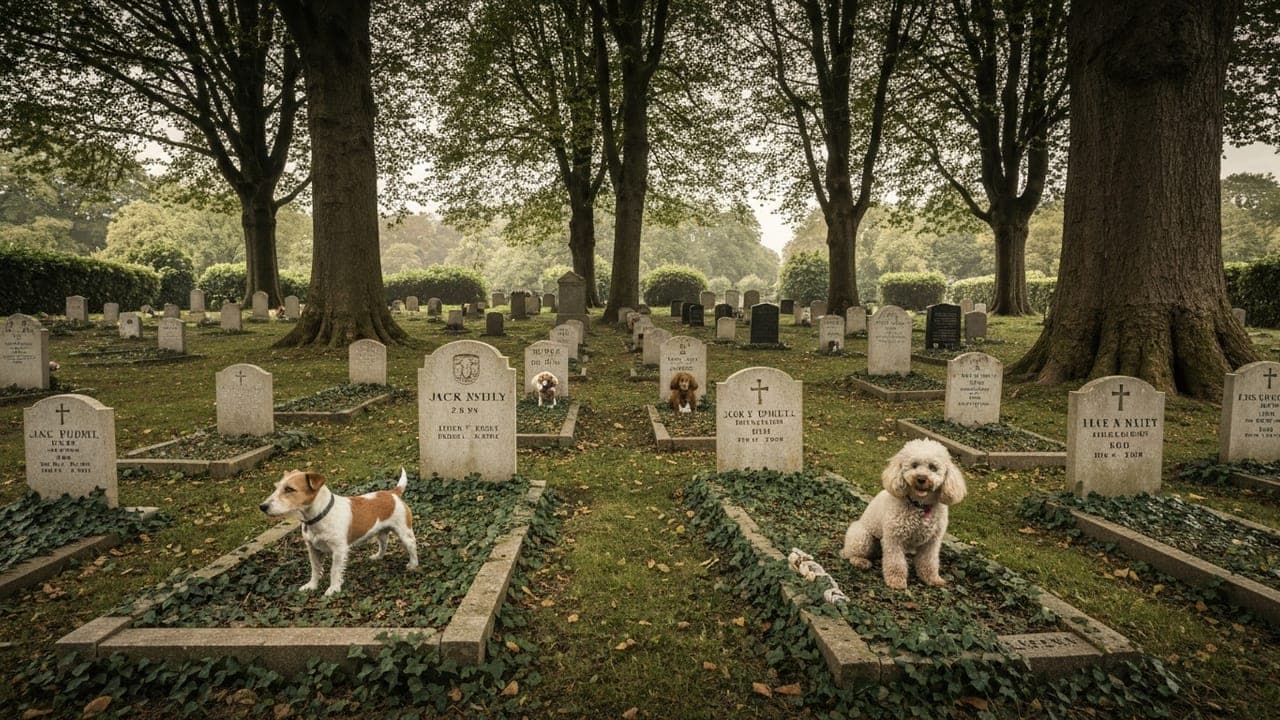
Buried Under Ash, Remembered in Stone
In the ruins of Pompeii, archaeologists excavating in the 19th century found something that stopped them short: a series of inscribed stones marking animal graves. One epitaph, translated from Latin, reads: "I am in tears, while carrying you to your last resting place as much as I ever wept for my own people. In life you were exquisite, well-bred, and a spirited dog. Now death has laid its cold hand upon you and the earth covers all that was beautiful." The dog had a name. The human who buried it was broken-hearted. And this was not 2023 — it was 79 CE.
The history of pet cemeteries is a history of grief, and grief does not follow historical fashions. It turns out that humans have always mourned their animals. What changed over the centuries was whether that mourning received public sanction, dedicated space, and cultural infrastructure.
Medieval Monastery Burials and Sacred Ground
The formal exclusion of animals from Christian burial grounds — decreed by Church doctrine — did not stop medieval Europeans from marking the deaths of beloved animals. Monastery records from the 12th and 13th centuries describe monks burying dogs and cats in garden plots and blessing the graves with prayers. These were private, informal acts, performed outside official Church sanction but within the protective walls of institutions that could afford to ignore doctrine quietly.
Medieval illuminated manuscripts occasionally depict dogs in positions of honor near human figures — suggesting that the animals existed within an emotional economy that death could disrupt. A 13th-century French lyric laments the death of a pet rabbit in terms more typically reserved for a lost companion. These fragments suggest that formalized pet cemeteries, when they arrived in the 19th century, were not inventing something new. They were giving institutional form to grief that had always existed.
Hyde Park and the World's First Pet Cemetery
On a warm day in 1881, the wife of a London diplomat presented herself at the gate of Hyde Park with a dead dog — a small Maltese named Cherry. The head gatekeeper, Mr. Winbridge, was moved by her distress. He allowed her to bury Cherry in a corner of his garden, just inside the park gate at Victoria Lodge.
It was a private act of kindness that became, through repetition, a movement. Word spread among London's dog-owning class that Winbridge would allow burials. More grieving owners arrived with more small coffins. By 1903, when the park's authorities noticed and tried to close the cemetery, 300 animals were buried there — predominantly dogs, but also cats, a monkey, and several birds. The authorities relented and allowed the existing graves to remain.
The epitaphs in Hyde Park's pet cemetery are remarkable documents of grief. "My darling little Rags, who was my companion for 16 years." "To dear, faithful, loving Carlo — a true friend." "In loving memory of my little dog, who was more faithful than many a human friend." That last inscription — the comparison of animal fidelity to human failing — appears in multiple forms across Victorian pet cemeteries. It suggests that people were not merely mourning animals; they were making a claim about the value of animal relationships relative to human ones.
Hartsdale: America's First Pet Cemetery
Fifteen years after Hyde Park, on the opposite side of the Atlantic, a blizzard changed pet burial history. In the winter of 1896, a New York City veterinarian named Samuel Johnson was treating a dog whose wealthy Manhattan owner lived far from any appropriate burial site. When the dog died during a snowstorm that made transport impossible, Johnson offered his apple orchard in Hartsdale, New York, as a temporary resting place.
The temporary resting place became permanent, and then it became a destination. The Hartsdale Pet Cemetery — officially named Hartsdale Canine Cemetery, though it later admitted other species — received 300 animals in its first decade. By the mid-20th century, it had become the final resting place for tens of thousands of pets, including a lion cub owned by a New York socialite, several celebrity animals, and the pets of numerous prominent families.
Hartsdale is now a National Historic Landmark. Its oldest section, where the earliest gravestones date to the late 1890s, reads like a Victorian-era Hyde Park: small marble markers, carved with names, dates, and brief epitaphs that say more about the owners' emotional lives than any formal document could. "Our little darling." "He never gave us one unkind look." The language of grief here is indistinguishable from the language used for human losses.
Legal Gray Areas and the Modern Industry
For most of the 20th century, pet burial existed in legal ambiguity. Animals were property under most legal systems, and burying property in residential yards was regulated inconsistently. Pet cemeteries operated under the same laws governing human cemeteries in some jurisdictions, under agricultural regulations in others, and under no specific regulation in others still.
The Pet Loss Grief movement of the 1980s and 1990s began to address this ambiguity — not just legally, but psychologically. In 1988, the American Veterinary Medical Association published its first guidelines acknowledging that grief for a pet could be clinically significant. Psychologists began studying pet loss systematically and found that the neurological signature of grief for a pet was indistinguishable from grief for a human family member. The same brain regions activated. The same neurotransmitter disruptions occurred. The same stages of denial, anger, and acceptance presented themselves.
This research gave cultural legitimacy to what pet cemetery epitaphs had been saying for a century: this grief is real.
The modern pet cremation industry — now estimated at over $500 million annually in the United States — emerged from these shifts. Cremation offered a legally cleaner alternative to burial (the ash of a cremated animal is not regulated the way burial sites are) and a more portable form of memorial. Pet owners could keep urns at home, scatter ash in meaningful locations, or have it incorporated into memorial jewelry — a practice that did not exist before the 2000s but is now a significant market.
Green Burial and the Future of Pet Memorials
The newest trend in pet memorials reflects the same environmental consciousness shaping human burial practices. Aquamation (alkaline hydrolysis) dissolves animal remains without flame, producing sterile liquid and soft bone fragments. Green burial places animals in biodegradable containers that allow them to return to soil without the formaldehyde and metal caskets of conventional burial. Memorial trees, seeded with cremated remains mixed into planting media, transform loss into living memorials.
None of these forms would have surprised the Roman who inscribed Cherry's epitaph in Pompeii, or the gatekeeper Winbridge who allowed a Maltese's burial in his garden, or the veterinarian who offered his apple orchard during a snowstorm. The specific forms change. The grief — and the human need to mark it with something lasting — does not.
For more on how ancient civilizations honored their animals, see our piece on Egyptian cats and their divine status.
Frequently Asked Questions
Q: Where is the world's first pet cemetery?
The Hyde Park Pet Cemetery in London, established in 1881 when gatekeeper Mr. Winbridge allowed a Maltese named Cherry to be buried in his garden just inside the park's Victoria Gate, is generally considered the world's first formal pet cemetery. By 1903, approximately 300 animals had been buried there.
Q: When was the Hartsdale Pet Cemetery founded?
Hartsdale Pet Cemetery in Hartsdale, New York, was founded in 1896 when veterinarian Samuel Johnson offered his apple orchard as a burial site during a snowstorm. It is now a National Historic Landmark and one of the oldest continuously operating pet cemeteries in the world.
Q: Is grief for a pet as real as grief for a human?
Yes, according to neuroscience. Research beginning in the 1980s and continuing since found that grief for a pet activates the same brain regions and produces the same neurochemical disruptions as grief for a human family member. The American Veterinary Medical Association formally acknowledged this in guidelines published in 1988.
Q: What are the most popular forms of pet memorialization today?
Pet cremation is now the most common form of memorialization in the United States, serving a market exceeding $500 million annually. Options include keeping ash in urns, scattering, incorporation into memorial jewelry, and memorial tree planting. Traditional burial in dedicated pet cemeteries remains available and is the choice of many owners who want a physical grave to visit.
Author & Reviewer
Related Reading
Continue the History
Understand Your Companion
Find Your Match
Ready to find your perfect companion?
Take the Breed Quiz →