
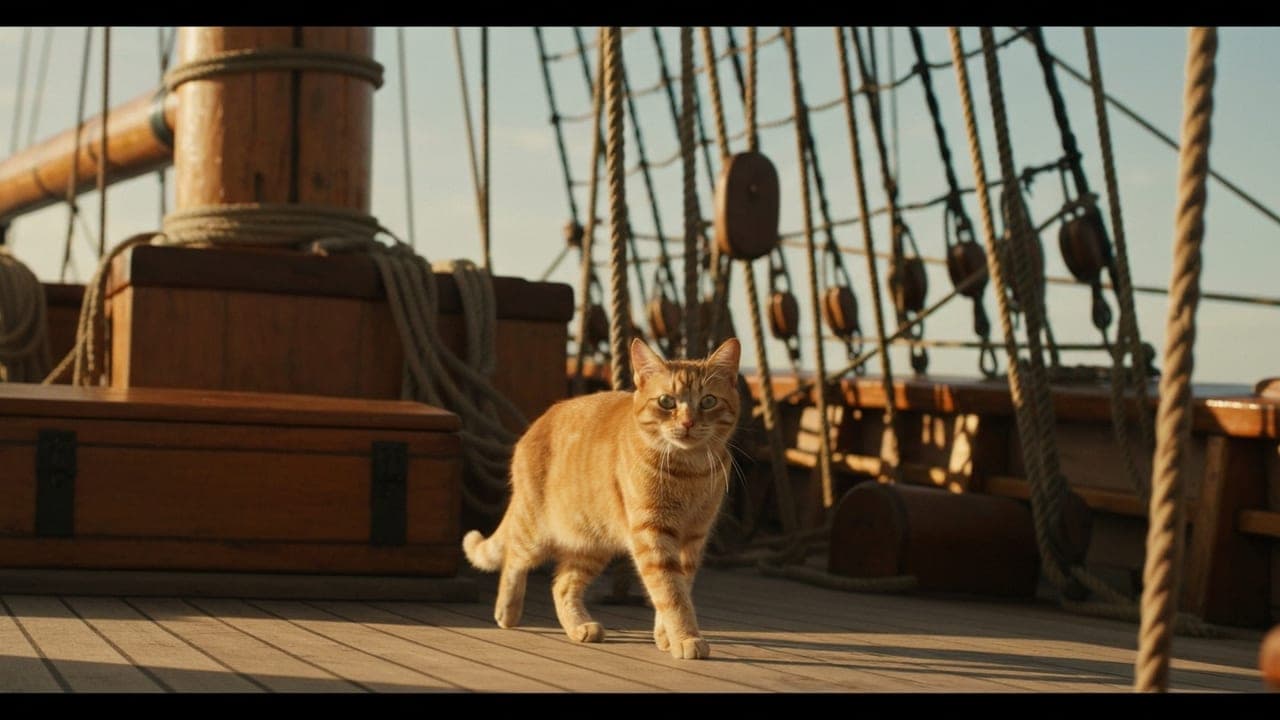
Ship Cats: The Unsung Heroes of Maritime History
Before radar, before sonar, before modern navigation instruments, every ship that sailed the world's oceans carried a crew member whose job was to patrol the darkness below decks and kill whatever moved. This crew member drew no pay, signed no articles, and appeared in no official manifests. Yet the absence of a competent ship's cat could doom a voyage as surely as a failed rudder.
Rats on wooden sailing ships were not a nuisance. They were an existential threat. They gnawed through ropes — including the critical lines controlling sails and rudders. They destroyed the leather seals on water casks and the wooden bungs that kept bilges from flooding. They ate navigation charts, compass housings, and the carefully preserved provisions that stood between the crew and starvation on a long passage. A single breeding pair of rats could produce dozens of offspring on a voyage of any length. Without predators to control them, rat populations aboard ships could reach catastrophic levels within months.
The ship's cat solved this problem with a biological elegance that no human technology of the era could replicate.
Ancient Origins: Phoenicians and the Spread of the Cat
The Phoenicians — the great maritime traders of the ancient Mediterranean — are the most likely candidates for the original ship cat keepers. Phoenician merchant vessels operated from approximately 1500 BCE through the Roman period, connecting the Levantine coast to Egypt, Greece, Carthage, Iberia, and eventually Britain. Their ships carried timber, purple dye, glass, and grain — all cargo that attracted rodents.
Genetic studies of domestic cat populations published in the 2010s found evidence consistent with cats spreading from the ancient Near East along maritime trade routes. Cat populations in Mediterranean coastal settlements show genetic signatures that suggest arrival by sea rather than overland dispersal. The implication is that Phoenician (and later Greek, Roman, and Arab) trading ships carried cats not merely as passengers but as functional crew, and that these animals colonized ports wherever the ships made landfall.
This was the first great feline diaspora — not driven by human deliberate planning but by the practical necessity of rat control on wooden ships, repeated across thousands of voyages over centuries. By the time Europeans began crossing the Atlantic in the 15th century, the ship cat tradition was already ancient, and the cats that traveled aboard those vessels would become the ancestors of every domestic cat population in the Americas and Australia.
Naval Tradition and the Good-Luck Cat
One of the more striking reversals in the history of cat superstition concerns the ship's cat and luck. On land, black cats had suffered centuries of association with witchcraft and evil, particularly in northern Europe following the medieval persecution described in other pet history articles. At sea, the associations ran in precisely the opposite direction.
Black cats were considered exceptionally lucky aboard ships. Some sailors would not sail on a vessel that lacked a cat. The color that made a cat suspect on land made it valuable at sea. The origin of this reversal is not clearly documented, but it likely reflects the independence of maritime culture from the land-based Church hierarchy that had driven cat persecution. Sailors developed their own superstitions from their own experience, and a good black cat that kept a ship's rat population under control was observably beneficial — whatever the priests might say.
Polydactyl cats — those born with extra toes on their front paws, giving them a broader foot that helped with balance on moving decks — were considered especially prized as ship cats. Ports with long maritime histories often have high concentrations of polydactyl cats in their feral and domestic populations today, the genetic legacy of generations of preferential selection by sailors.
Mrs. Chippy: Shackleton's Endurance
Of the famous ship cats in modern maritime history, Mrs. Chippy occupies a particularly poignant place. (Mrs. Chippy was, confusingly, a male cat — named by the carpenter Harry McNish whose constant companion the cat had become, the (missus) a common shipboard nickname for devoted companions.) McNish, a master carpenter, was among the crew of Ernest Shackleton's Endurance, which became trapped in Antarctic ice in January 1915.
Mrs. Chippy adapted to polar conditions with feline equanimity, surviving the initial freezing-in and the months of drifting. But when Shackleton made the agonizing decision to abandon ship and attempt survival on the ice floes, he also decided to shoot the sled dogs and the cat. Saving food for human survival was the rationale — and it was a rational one, given what lay ahead.
Harry McNish never forgave Shackleton. He was among the crew members Shackleton later declined to recommend for the Polar Medal, despite McNish's crucial work building the lifeboat that saved all the expedition's lives. McNish died in New Zealand in 1930, largely forgotten. In 1959, the New Zealand Antarctic Society erected a bronze statue of a cat on McNish's grave — a full-size replica, which remains there today.
Unsinkable Sam: The Cat That Survived Three Ships
No ship cat in the Second World War accumulated a more extraordinary record than the cat known as Unsinkable Sam. The cat began the war aboard the German battleship Bismarck — one of the most powerful warships ever built — and was found floating on a board amid wreckage when the Bismarck was sunk by the Royal Navy in May 1941, the only survivor rescued.
The British sailors who found him brought him aboard HMS Cossack, which was itself severely damaged by a torpedo in October 1941. The surviving crew were transferred along with the ship's cat. Sam then found himself aboard HMS Ark Royal — at the time one of Britain's most important aircraft carriers — which was sunk by a German submarine just days after Sam joined her crew in November 1941.
Sam was found again, floating on a floating board amid wreckage, described by rescuers as (angry but unharmed). After the Ark Royal's sinking, naval authorities decided that this particular cat had perhaps tested fate enough. He was retired from active sea service and spent his remaining years ashore, dying in Belfast in 1955. A pastel portrait painted during his lifetime survives at the National Maritime Museum in Greenwich.
Whether Unsinkable Sam was truly a single continuous cat or (as some historians suggest) a composite legend built around several real ship cats, the story reflects the genuine reverence that sailors extended to cats who survived what human beings could not.
Simon of HMS Amethyst: The Decorated Cat
In April 1949, HMS Amethyst was sailing up the Yangtze River in China when Chinese Communist forces opened fire during what became known as the Yangtze Incident. The attack killed 25 sailors and wounded many more. The ship was trapped in the river for 101 days.
Aboard the Amethyst was a 17-month-old black and white tomcat named Simon, who had been smuggled aboard as a kitten. During the attack, Simon was blown across a deck by the blast, suffering burns to his paws and face and singeing to his whiskers. He nearly died.
What happened next was documented by the surviving crew in their reports. Simon recovered and immediately resumed his duties — visiting wounded sailors in the sick bay, sleeping alongside those in the worst condition, and maintaining his rat-killing patrols with evident purpose even as the ship remained under threat. His presence was credited by multiple crew members with measurably improving morale during the long weeks of captivity.
When the Amethyst finally escaped the Yangtze and reached Hong Kong, Simon was awarded the Dickin Medal — the animal equivalent of the Victoria Cross, the highest honor available to animals in British service. Simon died during the return voyage to England, worn down by the injuries he had sustained during the original attack. He is buried at the PDSA Animal Cemetery in Ilford, where his headstone still receives flowers from visitors.
How Ship Cats Changed the World
The ecological consequences of the ship cat tradition were permanent and global. When European colonization of the Americas began in earnest in the late 15th century, cats traveled on virtually every ship — as working crew members whose presence was considered essential. These cats disembarked at every port, founded feral colonies, interbred with occasional subsequent arrivals, and became the ancestors of every domestic and feral cat in North and South America.
The same process unfolded in Australia and the Pacific Islands. The domestic cat is not native to any of these regions. Its presence is entirely attributable to maritime transport, most of it unplanned and incidental to the practical function of rat control.
This matters because in some regions — particularly island ecosystems where native birds and small mammals had no evolutionary experience with predators — the arrival of cats had significant ecological consequences. The ship cat tradition, born of practical necessity, reshaped ecosystems on every continent except Antarctica.
The 1975 Ban
The United Kingdom's Royal Navy officially banned cats from ships in 1975, citing hygiene concerns and the practical difficulties of maintaining animals in the confined, mechanically complex environment of modern warships. The ban ended a tradition that had operated continuously for at least five thousand years.
The irony is that the same qualities that had made cats invaluable aboard wooden sailing ships — their independence, their hunting instinct, their ability to operate in confined spaces — made them problematic in the era of nuclear submarines and aircraft carriers. The ship's cat was a solution designed for a different kind of ship.
A few navies and merchant fleets maintained cat traditions into the 1980s and beyond, but the practice is now effectively extinct in formal naval contexts. The era of the working ship cat has closed — though the feral and domestic descendants of those ancient maritime passengers continue to inhabit port cities from Boston to Sydney.
Frequently Asked Questions
Did ship cats really spread domestic cats to the Americas?
Genetic evidence supports this. Domestic cat populations in the Americas descend from European cats that arrived with colonists beginning in the late 15th century. Since cats were standard crew on virtually all European sailing ships of the era, maritime transport was the primary mechanism. Cats that escaped, were left behind, or were given to colonists became the founding populations for American domestic and feral cat lineages.
Was Unsinkable Sam really one cat, or is the story a legend?
The Bismarck sinking (May 1941), HMS Cossack torpedo damage (October 1941), and HMS Ark Royal sinking (November 1941) are all historically documented. A cat survivor is referenced in naval records in connection with at least the Ark Royal. Whether the same physical cat experienced all three events, or whether the story grew to encompass multiple incidents into one legendary animal, is debated by maritime historians. The pastel portrait at Greenwich is real.
Why were black cats considered lucky at sea when they were unlucky on land?
Maritime culture developed independently from the land-based religious and superstitious traditions that drove black cat persecution in medieval and early modern Europe. Sailors experienced black cats as effective rat hunters and good ship companions, and built their own tradition of luck around that practical observation. The contrast illustrates how the same animal could carry opposite symbolic values in different cultural contexts.
Why did the Royal Navy ban cats in 1975?
Official reasoning cited hygiene concerns and the difficulties of managing animals in modern warship environments. Modern naval vessels — with complex mechanical systems, confined crew quarters, and strict sanitation requirements — are very different environments from the wooden sailing ships where the cat tradition developed. Rat control in modern ships is also handled through structural prevention and poison programs rather than biological predators.
Author & Reviewer
Related Reading
Continue the History
Understand Your Companion
Find Your Match
Ready to find your perfect companion?
Take the Breed Quiz →