
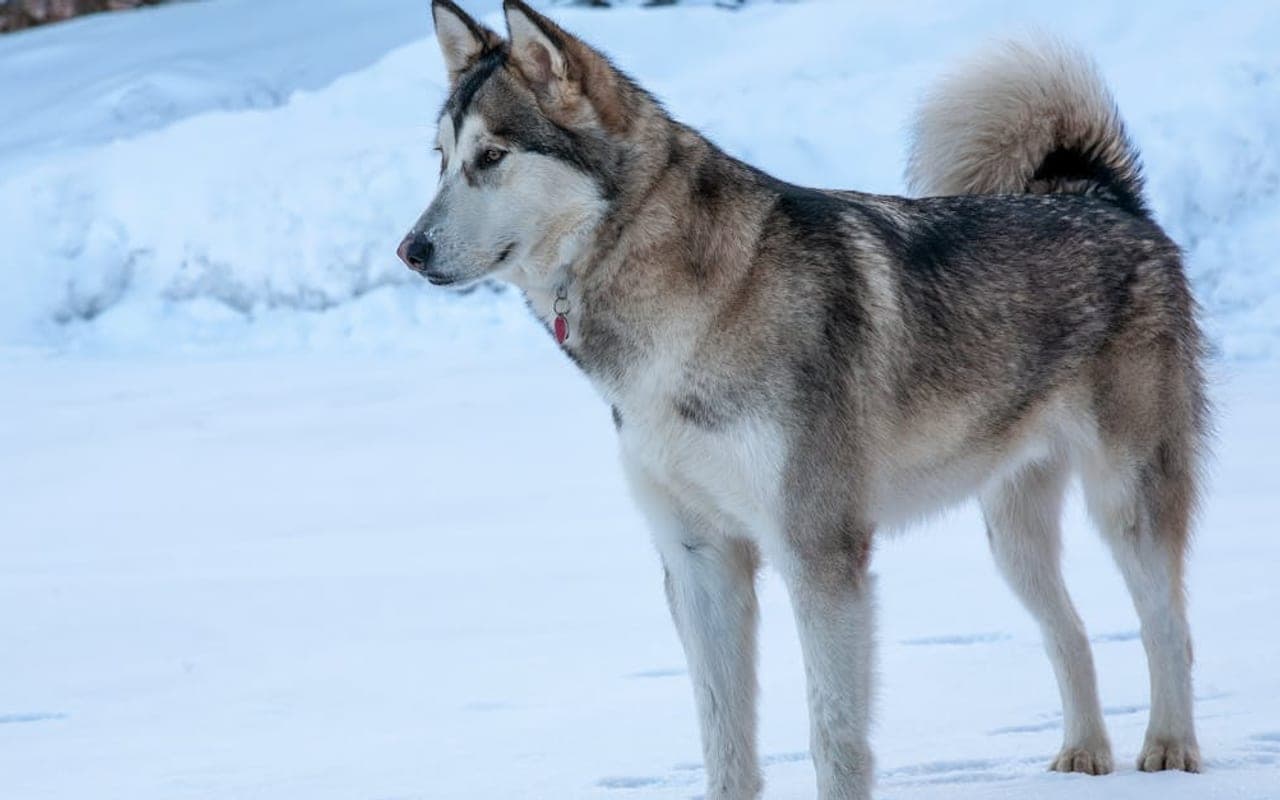
Alaskan Malamute Care Guide
The Alaskan Malamute is a large, powerful arctic sled dog — commonly 75 to 85 pounds and 23 to 25 inches at the shoulder (PetMD) — built to haul heavy freight over long distances in cold. That origin
In This Guide
Overview
The Alaskan Malamute is a large, powerful arctic sled dog — commonly 75 to 85 pounds and 23 to 25 inches at the shoulder (PetMD) — built to haul heavy freight over long distances in cold. That origin dictates its care, and it produces the thing most new owners underestimate: a dog engineered to work hard and stay cool struggles with the two conditions of an ordinary suburban home — inactivity and heat. Per PetMD's veterinary-reviewed profile, Malamutes "can have trouble in hot weather." A bored, under-exercised Malamute is not passive; it digs, escapes, and destroys, because those are the outlets a working brain reaches for when given no job.
Plan for three things before you commit. Time: a heavy daily exercise habit plus a double coat that sheds year-round and blows out twice a year. Space and security: containment that a strong, independent escape artist cannot defeat. Budget: food and vet costs that scale with a large body, plus DNA screening for several inherited conditions. This guide covers care specific to the breed. It does not repeat the breed's history or standard, which live on the Alaskan Malamute breed page; for care guides on other breeds, see the care guide library.
Daily Care
Living with a Malamute turns on managing two hardwired traits: independence and prey drive. This breed was bred to think for itself on the trail, so it is not naturally biddable the way a herding or sporting dog is — it will weigh whether a command is worth obeying. Train early, keep sessions short and rewarding, and stay consistent, because a Malamute that learns it can ignore you will. Harsh handling backfires; this is a dog that shuts down or digs in rather than submits.
Two realities are non-negotiable. First, containment: a strong, motivated Malamute climbs, digs under fences, and works latches, so a secure yard means dig-proof fencing, gates it cannot open, and supervision — not an invisible fence, which does not hold this breed. Second, the prey drive is real: many Malamutes cannot be trusted off-leash around small animals, so a leash or fenced space is the default. Give the dog a predictable rhythm — real exercise, daily coat and eye checks, a calm settle at day's end. Predictability plus a job is what keeps a powerful, independent breed manageable.
Nutrition
Feed to control growth and hold a lean weight — that is the whole strategy, because it is also your strongest defense against the breed's orthopedic risk. Large-breed puppies must be fed a large-breed growth formula, which the AKC notes is "lower in fat, calcium, phosphorus, and vitamin D" than ordinary puppy food, because "growing too quickly" and "high levels of calcium and phosphorus" have both "been linked to developmental orthopedic disease (DOD)." Slower, controlled growth is the goal, not a bigger puppy faster.
Do not free-feed. PetMD is explicit that Malamutes "should never be free-fed, as they will wolf down every scrap," and the AKC adds that "veterinarians discourage free feeding of large breed puppies, as this too has been linked to DOD." Adults do well on two measured meals a day, puppies on three. Feed to the dog, not to the bag: a Malamute at a healthy weight has ribs you can feel without pressing, a visible waist from above, and a tuck at the belly. If those disappear, cut the ration — treats included — because "obesity is particularly dangerous for large breed dogs, as it increases their risk of developing orthopedic diseases later in life" (AKC).
Exercise
A Malamute needs substantial daily exercise, not a walk around the block. PetMD's guidance is blunt — "a tired malamute is a happy malamute" — and points to running, sledding, or skijoring as the workload this breed was bred for. Budget an hour or two a day of real activity for a healthy adult, and give the dog a job: pulling, hiking, weight-bearing walks, and structured training all satisfy a working brain that a leisurely stroll does not.
The failure mode is predictable. An under-exercised Malamute redirects that energy into digging craters, testing every gate, and chewing what it can reach. This is not misbehavior to correct after the fact; it is unspent working drive, and the fix is more and better exercise, not more discipline.
Heat is the hard constraint. As an arctic breed that "can have trouble in hot weather" (PetMD), a Malamute worked in the heat of the day overheats fast under that double coat. Exercise in the cool of early morning or evening in warm months, carry water, and watch for heavy panting. During growth, keep a puppy's exercise low-impact and self-paced — forced distance running, repetitive jumping, and stairs load an immature skeleton and feed the same joint disease covered above.
Grooming
The Malamute carries a thick double coat — a coarse outer coat over a dense, wool-like undercoat that insulated it against arctic cold. PetMD describes a coat that "needs daily brushing," with shedding that "can be overwhelming as hair clings to your couch, carpet, and clothes." That is the honest baseline: this breed sheds year-round and then "blows" its undercoat in two heavy seasonal molts, typically spring and fall, when hair comes out in clumps for two to three weeks.
Match the tool to the coat. A weekly line-brush to the skin with a slicker and an undercoat rake keeps mats from forming behind the ears, in the ruff, and on the trousers of the hind legs, where they form fastest. During a coat blow, brush daily or the shed undercoat packs into felt against the skin and traps moisture. Bathe every six to eight weeks (PetMD); over-bathing strips the coat's protective oils. Never shave a Malamute to keep it cool — the double coat regulates temperature in both directions, and shaving removes that insulation without solving the heat problem. Keep the basics on schedule too: nails every few weeks, weekly ear checks, regular tooth brushing.
Health
There is no published breed-wide prevalence study for the Alaskan Malamute, so anyone quoting a percentage of Malamutes affected by any single disorder is inventing it. What exists instead is solid: gene studies identifying specific inherited conditions, and veterinary evidence on the disorders large breeds carry. Ranked below by how much your daily decisions move the outcome.
- Hip and elbow dysplasia — the risk you can most influence. Hip dysplasia is "predominantly seen in larger dogs," and PetMD lists both hip and elbow dysplasia as breed concerns for the Malamute. The lever is weight, and the evidence is direct: in the growth study VCA cites, puppies fed all they wanted developed hip dysplasia at twice the rate of those fed measured meals — "two thirds of the puppies" versus "only one third" — and "overweight puppies were almost twice as likely to develop hip dysplasia" (VCA). Keep a Malamute lean for life and feed measured meals during growth. That single habit does more than any supplement.
- Hypothyroidism. PetMD lists hypothyroidism as a breed concern. It is "a condition of inadequate thyroid hormone levels that leads to a reduction in a dog's metabolic state," and the signs are easy to mistake for aging: "weight gain without an increase in appetite," lethargy, "dry, dull hair with excessive shedding," and recurrent skin and ear infections (VCA). It is diagnosed with a thyroid panel and "treatable but not curable" with daily levothyroxine, re-testing hormone levels about every six months (VCA). If your Malamute gains weight without eating more, do not assume overfeeding — ask for a thyroid test.
- Inherited polyneuropathy (AMPN). This is a nerve disorder documented specifically in the breed. A 2017 study traced it to a Gly98Val variant in the NDRG1 gene, inherited in an autosomal recessive pattern, with affected dogs showing "exercise intolerance, inspiratory stridor and pelvic limb ataxia" (Jäderlund et al., PMC5414310). That was a case series of 114 dogs, not a population survey, so it establishes the cause and inheritance — not how common the disorder is. PetMD notes there is no cure. A DNA test exists; buy from a breeder who screens both parents.
- Chondrodysplasia (dwarfism). The Alaskan Malamute Club of America describes chondrodysplasia as "a genetically-determined skeletal disorder that occurs primarily in the purebred Alaskan Malamute," producing "excessively shortened front limbs with various degrees of bowing and deformity." It is "transmitted as a simple autosomal recessive trait" (AMCA), so both parents must be carriers to produce an affected puppy. There is no direct DNA test; the AMCA relies on pedigree analysis and a database of known carriers. Ask a breeder how they manage it — vague answers here are a warning.
- Day blindness (cone degeneration / achromatopsia). Affected Malamute puppies inherit a genomic deletion of the CNGB3 gene, an autosomal recessive disease whose signs — "decreased visual acuity, photophobia" and day-blindness — "typically manifest by 8–12 weeks of age" (Yeh et al., PMC3639114). Affected dogs see poorly in bright light but normally in dim light. A DNA test is available, and screening breeding stock prevents it.
- Cataracts. PetMD lists cataracts as a breed concern — "a vision disorder that causes gradual loss of sight" that may require surgical removal. Have any cloudiness in the eye checked early.
This is general information, not a diagnosis. Always consult your veterinarian for medical decisions about your dog.
Costs
For a Malamute, the purchase or adoption fee is a rounding error against the lifetime cost of a large working dog. Food scales with a 75-to-85-pound body and is a real monthly line item for the life of the dog. Veterinary care runs higher too, because medication is dosed by weight and anesthesia, imaging, and hospitalization all cost more for a large patient.
Plan for this breed's specific profile. Buy from a breeder who screens the parents for hip and elbow dysplasia and for the inherited conditions above, and factor a one-time DNA panel — polyneuropathy and cone degeneration both have tests — into the cost of a well-bred puppy. Ongoing, expect to spend on grooming tools, lean-weight food, dental care, and either pet insurance or a dedicated savings buffer set up before you need it — orthopedic surgery on a giant-boned dog is the kind of four-figure bill that lands without warning. Money spent early on screening, measured feeding, and weight control is the cheapest way to hold down the far larger cost of joint disease later.
Frequently Asked Questions
Can Alaskan Malamutes handle hot weather?
No, this is an arctic sled breed that can have trouble in hot weather and overheats fast under its double coat. In warm months, exercise a Malamute in the cool of early morning or evening, carry water, and watch for heavy panting. Never shave the coat to cool the dog down, because the double coat regulates temperature in both directions and shaving removes that insulation without solving the problem.
How much exercise does an Alaskan Malamute need?
Plan for an hour or two a day of real activity for a healthy adult, not just a walk around the block, since this breed was bred to haul freight and a tired Malamute is a happy Malamute. Activities like pulling, hiking, weight-bearing walks, and structured training satisfy a working brain that a leisurely stroll does not. An under-exercised Malamute redirects that unspent energy into digging craters, testing gates, and chewing, and the fix is more and better exercise rather than more discipline.
Do Alaskan Malamutes shed a lot?
Yes. The thick double coat sheds year-round and then blows its dense undercoat in two heavy seasonal molts, typically spring and fall, when hair comes out in clumps for two to three weeks. The coat needs daily brushing, and shedding can be overwhelming as hair clings to your couch, carpet, and clothes. Use a slicker and an undercoat rake, brush daily during a coat blow so the shed hair doesn't felt against the skin, and bathe only every six to eight weeks.
How should I feed an Alaskan Malamute?
Malamutes should never be free-fed, as they will wolf down every scrap, so feed measured portions instead. Adults do well on two measured meals a day and puppies on three, with large-breed puppies on a large-breed growth formula that is lower in fat, calcium, phosphorus, and vitamin D. A Malamute at a healthy weight has ribs you can feel without pressing, a visible waist from above, and a tuck at the belly; if those disappear, cut the ration, treats included.
Are Alaskan Malamutes prone to hip problems?
PetMD lists both hip and elbow dysplasia as breed concerns, and hip dysplasia is predominantly seen in larger dogs. The strongest lever you control is weight: in the growth study VCA cites, puppies fed all they wanted developed hip dysplasia at twice the rate of those fed measured meals, and overweight puppies were almost twice as likely to develop it. Keeping a Malamute lean for life and feeding measured meals during growth does more than any supplement.
Sources
This guide draws on the following published references. Each opens in a new tab so you can check it against what you have read here.
American Kennel Club
American Kennel Club — *Best Dog Food for Large Breeds* (large-breed growth formulas lower in fat, calcium, phosphorus and vitamin D; controlled growth; obesity and rapid growth linked to developmental orthopedic disease; veterinarians discourage free-feeding large-breed puppies)(opens in a new tab)VCA Animal Hospitals
VCA Animal Hospitals — *Hip Dysplasia in Dogs* (predominantly larger breeds; measured feeding vs. free feeding — one third vs. two thirds; overweight puppies almost twice as likely; genetic disease affected by diet, growth rate and weight)(opens in a new tab)VCA Animal Hospitals
VCA Animal Hospitals — *Hypothyroidism in Dogs* (definition, clinical signs, thyroid-panel diagnosis, levothyroxine treatment, re-testing every ~6 months)(opens in a new tab)PetMD (veterinary
PetMD (veterinary-reviewed; reviewed by Barri J. Morrison, DVM) — *Alaskan Malamute Dog Breed Health and Care* (hip and elbow dysplasia, hypothyroidism, cataracts, polyneuropathy and chondrodysplasia as breed concerns; double coat and daily brushing; shedding; bathing every 6–8 weeks; exercise; heat(opens in a new tab)Alaskan Malamute Club of America (AMCA)
Alaskan Malamute Club of America (AMCA) — *Chondrodysplasia* ("genetically-determined skeletal disorder that occurs primarily in the purebred Alaskan Malamute"; shortened, bowed front limbs; simple autosomal recessive; carrier database and control program)(opens in a new tab)Yeh CY, Goldstein O, Kukekova AV, et al., *BMC Genetics* (2013), PubMed Central
Yeh CY, Goldstein O, Kukekova AV, et al., *BMC Genetics* (2013), PubMed Central — *Genomic deletion of CNGB3 is identical by descent in multiple canine breeds and causes achromatopsia* (whole-gene CNGB3 deletion in Alaskan Malamutes; autosomal recessive; decreased visual acuity, photophobia, day-bli(opens in a new tab)Jäderlund KH, Rohdin C, Berendt M, et al., *Acta Veterinaria Scandinavica* (2017), PubMed Central
Jäderlund KH, Rohdin C, Berendt M, et al., *Acta Veterinaria Scandinavica* (2017), PubMed Central — *Re-emergence of hereditary polyneuropathy in Scandinavian Alaskan malamute dogs — old enemy or new entity? A case series* (NDRG1 Gly98Val mutation; autosomal recessive; exercise intolerance, inspirat(opens in a new tab)
Affiliate disclosure: We may earn a commission from qualifying purchases. This doesn't affect our recommendations.
Recommended Products
Alaskan Malamute Care Guide Book
Breed-focused reading and owner references for Alaskan Malamute care, training, grooming, and health planning.
Alaskan Malamute Food and Supplies
Helpful supplies for alaskan malamute dog supplies routines at home.
Alaskan Malamute Grooming Tools
Helpful supplies for alaskan malamute grooming tools routines at home.
Get personalized pet care tips
Join our newsletter for breed-specific advice, care guides, and expert tips delivered weekly.
No spam, ever. Unsubscribe anytime.