
Finnish Spitz Care Guide
A Finnish Spitz weighs 10 to 15.9 kg (about 22 to 35 lb), stands 39.4 to 50.8 cm (about 15.5 to 20 inches) at the shoulder, and usually lives 13 to 15 years. The Royal Kennel Club puts it in its Small
In This Guide
Overview
A Finnish Spitz weighs 10 to 15.9 kg (about 22 to 35 lb), stands 39.4 to 50.8 cm (about 15.5 to 20 inches) at the shoulder, and usually lives 13 to 15 years. The Royal Kennel Club puts it in its Small-Medium size class [8]. The Fédération Cynologique Internationale (FCI) standard, translated by the Finnish Kennel Club, describes the breed as "smaller than medium-sized" [7]. The breed was established in 1892 [6]. The FCI gives its job as a hunting dog mainly for forest game birds, one that is "rather independent, yet works co-operatively to game, marking game by barking" [7].
That last phrase is the care decision. This dog was bred to find a bird and keep barking at it. VCA Animal Hospitals lists "Barks a lot" among the breed's challenges, and says plainly: "Don't get a Finkie with the idea you'll train him not to bark" [9]. If you live in an apartment, share walls, or have neighbours who complain about noise, this is a poor match. No amount of grooming or feeding skill changes that. Plan to manage the bark for the dog's whole life, not to remove it.
The rest of the care load is moderate. You will need up to an hour a day for exercise [8], a good brush-down a few times every week that turns daily during a seasonal coat drop [9], and a leash or a fenced space, because the breed may take off if allowed to roam off leash [9]. For the breed's background and temperament, see the Finnish Spitz breed page. For other breeds, browse the care guide library.
Daily Care
The bark is the centre of daily life with this breed. VCA's advice is that barking "is in his nature, and going against that is not fair to either of you" [9]. So the aim is management. Decide in advance where barking is acceptable, such as outdoors in the day, and where it is not.
Socialise early and widely. The FCI standard says the breed "might be a little reserved towards strangers, but never vicious" [7]. VCA says Finkies need early socialisation to become less suspicious of strangers, and that strangers are fine once you show the dog you accept them [9].
VCA gives the training style for this breed as "Consistent, Firm, Confident" [9]. The FCI standard calls the breed "rather independent, yet works co-operatively" [7]. VCA recommends early training so the dog learns that you control treats and "everything good in life," and says some Finkies like to think they're in charge and, without a firm but fair hand, can take over [9].
Containment is part of daily care. VCA's suggested home is a fenced yard or access to one [9].
If your dog has epilepsy, keep the seizure log and videos on your phone, and record any missed or changed medication there too.
Nutrition
Feed for the adult weight range of 10 to 15.9 kg. One finding from the epilepsy research is worth knowing about, but it is not a feeding rule. In the 2013 Finnish study, the number of feeding times per day was one of the factors associated with whether a dog's seizures had a generalised phase [1]. So was the dog's age at onset, the length of its seizures, and whether it was used for hunting [1]. The abstract reports an association, not a cause, and it does not tell owners to feed more or fewer meals. If your dog has epilepsy, settle its meal schedule with your veterinarian. Then keep it consistent and note any changes in your seizure log.
Exercise
The Royal Kennel Club lists the Finnish Spitz's exercise need as up to one hour per day [8]. VCA says the breed needs "to burn off energy every day, either with a long walk, short jog, or rowdy game in the yard" [9].
The working origin shapes how you spend that hour. The FCI standard describes a gait that changes easily from trot to gallop, and an "explosively fast gallop" when rushing after game [7]. VCA warns that the breed likes to hunt and "may take off if allowed to roam off leash," and that around traffic you should keep the leash "firmly in hand" [9]. Let the dog run free only in fully fenced spaces, and use a long line in open country.
Skipping it has a cost. VCA rates the breed as fine at home alone only "with lots of exercise first" [9].
Grooming
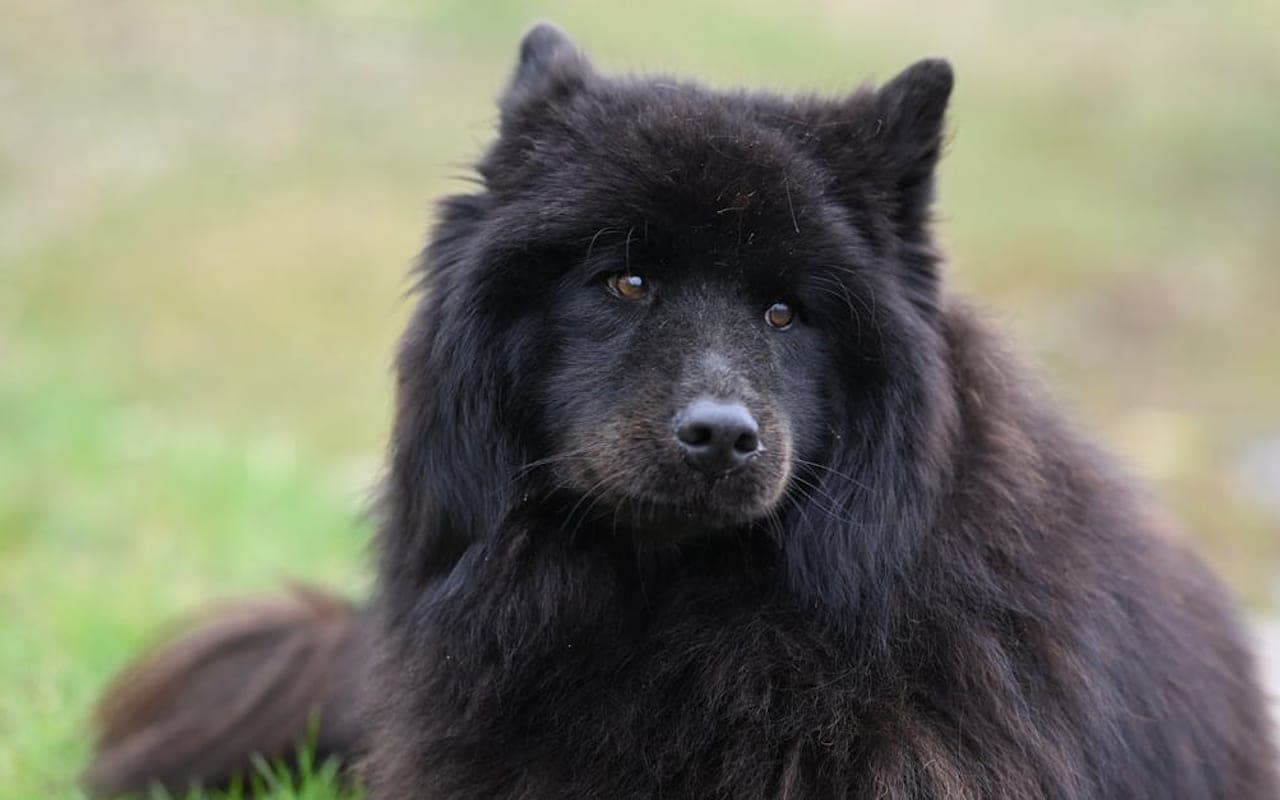
The FCI standard describes a stand-off coat that is moderately long on the body, stiffer on the neck, shoulders and back, and long and dense on the trousers and tail [7]. Underneath sits an undercoat that is "short, soft, dense and light in colour" [7]. On the head and legs the coat is short and close-lying [7].
For most of the year, brushing more than once a week is enough, according to the Royal Kennel Club [8]. VCA puts it as "a good brush-down a few times every week to minimize shedding" [9].
The routine changes during the coat drop. VCA says the Finkie drops its coat and grows a new one about once or twice a year, and recommends daily brushing, and vacuuming, while it happens [9]. Pay extra attention to the trousers and tail, where the standard describes the hair as long and dense [7], and brush through to the skin each day until the shed is over.
After a walk in woodland or long grass, check the paws and run a hand through the long, dense hair on the trousers and tail [7].
Health
The breed-specific studies cited here come from Finland, where the FCI standard says the breed is very common [7]. Most of them concern epilepsy.
- Idiopathic epilepsy. In a prospective study published in the Journal of the American Veterinary Medical Association in 2013, researchers at the University of Helsinki surveyed owners of Finnish Spitz dogs aged 1 to 10 years across Finland. The study covered 2,141 dogs [1]. The estimated prevalence of idiopathic epilepsy was 5.36%, or 111 of the 2,069 dogs still alive. Males were predisposed, and the median age at the first seizure was 3 years, with a range of 0.6 to 10 years [1].
What the seizures look like matters for owners. In the same study, 85% of seizures had a focal onset, meaning they started in one part of the brain, and 54% went on to become generalised [1]. The median episode lasted 11.75 minutes, and the median frequency was 2 seizures a year [1]. If your dog has an episode you cannot explain, film it if you can do so safely. Write down the date and how long it lasted.
The outlook in that study was mostly reassuring. The authors reported that seizures were not progressing in most of the dogs, and that antiepileptic treatment easily controlled seizures in 78.9% of the dogs [1]. A generalised phase during a seizure was a risk factor for the disease progressing [1]. The authors concluded that their results suggested a benign course of epilepsy in the breed [1].
- Why diagnosis can be hard. A clear brain scan does not rule epilepsy out in this breed. A 2006 study in the Journal of Veterinary Internal Medicine examined 11 Finnish Spitz dogs with focal seizures. It concluded they had focal idiopathic epilepsy with "nondetectable findings on MRI or pathology," and that MRI showed poor sensitivity in these dogs [2]. A 2014 PET-imaging study of 11 epileptic Finnish Spitz dogs supported the theory that seizures in the breed may arise in several brain regions [3]. If your dog has a normal MRI after a suspected seizure, that result fits what these studies found. It is not a reason to stop keeping the seizure log.
- Inheritance and genetic testing. The 2013 study estimated the heritability of epilepsy in the breed at 0.22 and found it was best explained as a polygenic trait [1]. Polygenic means many genes, not one. A 2015 study in BMC Genomics included a Finnish Spitz cohort and found a shared risk haplotype in the ADAM23 gene across four breeds [4]. The authors called ADAM23 a low-penetrance risk gene and said the causative variant had yet to be identified [4]. No single DNA result from this work clears a dog. Ask the breeder directly whether either parent, or their close relatives, has had seizures. Ask how old those dogs were when they were last checked, too, because onset can come as late as 10 years [1].
- A small genetic base. A 2017 study in the Journal of Animal Breeding and Genetics combined pedigree data from 28,119 Finnish Spitz with DNA data. It was co-authored by members of the Finnish Spitz Club [5]. It found the breed has undergone repeated male bottlenecks, with a "dramatic loss of genetic diversity," 20 effective founders, and a genetic effective population size of only 57 [5]. The Royal Kennel Club's one listed good-practice item for this breed is "prioritising genetic diversity" [8]. In practice, ask a breeder how they choose sires, and whether the same stud dog appears on both sides of the pedigree.
- Hip dysplasia and patellar luxation. VCA says the Finnish Spitz "occasionally" develops hip dysplasia and patellar luxation, a kneecap that slips out of place [9]. VCA advises asking the breeder about these issues and seeing health test results before choosing a puppy [9]. If a breeder has registered a parent's hip or patella results with the Orthopedic Foundation for Animals, you can look them up there.
For context, the Royal Kennel Club's Breed Watch places the Finnish Spitz in Category 1, stating that no points of concern specific to the breed have been identified [8].
This is general information, not a diagnosis. Always consult your veterinarian for medical decisions about your dog, and contact them promptly after any first seizure or any change in your dog's seizure pattern.
Costs
The cost drivers specific to this breed are:
- Breeder selection. A breeder who can talk through seizure history across the pedigree [1], show any health test results [9], and explain how they protect genetic diversity [5][8] has done work that is part of what you pay for.
- Epilepsy diagnosis and treatment. If seizures appear, the work-up can include advanced imaging, which may be inconclusive in this breed [2], followed by antiepileptic medication [1].
- Containment. A fenced yard or access to one [9], and a long line for open country.
- Grooming tools. A steel comb, which VCA says mats near the skin might require [9].
Frequently Asked Questions
Do Finnish Spitz bark a lot?
Yes. VCA lists "Barks a lot" as a breed challenge and warns against getting one with the idea you will train the barking out. You can manage when barking happens, but expect a vocal dog for life.
Are Finnish Spitz prone to epilepsy?
It is a documented risk. A 2013 Finnish study of 2,141 dogs estimated a prevalence of 5.36%, with males predisposed and a median onset age of 3 years. The same study reported that seizures were not progressing in most of the dogs, and that antiepileptic treatment easily controlled them in 78.9% of the dogs.
My dog's MRI was normal. Can it still have epilepsy?
Yes. A 2006 study found that Finnish Spitz dogs with focal seizures had nondetectable findings on MRI. Keep logging episodes and share the record with your veterinarian.
Is there a DNA test for epilepsy in the Finnish Spitz?
Not one that clears a dog. Epilepsy in the breed is best explained as polygenic, and the causative variant behind the *ADAM23* risk gene had not been identified as of 2015. Ask the breeder about seizure history in the pedigree instead.
How much exercise does a Finnish Spitz need?
Up to an hour a day, according to the Royal Kennel Club. Keep it on a lead or in a fenced area, because VCA warns the breed may take off after game if allowed to roam off leash.
Sources
This guide draws on the following published references. Each opens in a new tab so you can check it against what you have read here.
Journal of the American Veterinary Medical Association (Viitmaa et al., University of Helsinki, 2013)
Journal of the American Veterinary Medical Association (Viitmaa et al., University of Helsinki, 2013) — Phenotype, inheritance characteristics, and risk factors for idiopathic epilepsy in Finnish Spitz dogs(opens in a new tab)Journal of Veterinary Internal Medicine (Viitmaa et al., 2006)
Journal of Veterinary Internal Medicine (Viitmaa et al., 2006) — Magnetic resonance imaging findings in Finnish Spitz dogs with focal epilepsy(opens in a new tab)Veterinary Radiology & Ultrasound (Viitmaa et al., 2014)
Veterinary Radiology & Ultrasound (Viitmaa et al., 2014) — Cerebral glucose utilization measured with high resolution positron emission tomography in epileptic Finnish Spitz dogs and healthy dogs(opens in a new tab)BMC Genomics (Koskinen et al., 2015), via PubMed Central
BMC Genomics (Koskinen et al., 2015), via PubMed Central — Identification of a common risk haplotype for canine idiopathic epilepsy in the ADAM23 gene(opens in a new tab)Journal of Animal Breeding and Genetics (Kumpulainen et al., Finnish Spitz Club / University of Eastern Finland, 2017)
Journal of Animal Breeding and Genetics (Kumpulainen et al., Finnish Spitz Club / University of Eastern Finland, 2017) — Founder representation and effective population size in old versus young breeds-genetic diversity of Finnish and Nordic Spitz(opens in a new tab)PLOS ONE (Pohjoismäki et al., 2018), via PubMed Central
PLOS ONE (Pohjoismäki et al., 2018), via PubMed Central — Origins and wanderings of the Finnish hunting spitzes(opens in a new tab)Fédération Cynologique Internationale (FCI Standard No. 49, Finnish Kennel Club translation, published 11.02.2026)
Fédération Cynologique Internationale (FCI Standard No. 49, Finnish Kennel Club translation, published 11.02.2026) — Suomenpystykorva (Finnish Spitz)(opens in a new tab)The Royal Kennel Club
The Royal Kennel Club — Finnish Spitz breed information(opens in a new tab)VCA Animal Hospitals
VCA Animal Hospitals — Finnish Spitz(opens in a new tab)
Affiliate disclosure: We may earn a commission from qualifying purchases. This doesn't affect our recommendations.
Recommended Products
Finnish Spitz Care Guide Book
Breed-focused reading and owner references for Finnish Spitz care, training, grooming, and health planning.
Finnish Spitz Food and Supplies
Helpful supplies for finnish spitz dog supplies routines at home.
Finnish Spitz Grooming Tools
Helpful supplies for finnish spitz grooming tools routines at home.
Get personalized pet care tips
Join our newsletter for breed-specific advice, care guides, and expert tips delivered weekly.
No spam, ever. Unsubscribe anytime.