
Komondor Care Guide
The Komondor is a Hungarian livestock guardian with a corded white coat, and both halves of that description shape daily care. It stands 64.8 to 78.7 cm (about 25.5 to 31 in) and weighs 36.3 to 59 kg
In This Guide
Overview
The Komondor is a Hungarian livestock guardian with a corded white coat, and both halves of that description shape daily care. It stands 64.8 to 78.7 cm (about 25.5 to 31 in) and weighs 36.3 to 59 kg (about 80 to 130 lb), with a typical lifespan of 10 to 12 years. Those are the figures on our Komondor breed profile, which covers the breed's background; this guide covers what living with one involves.
Owning one means taking on a corded coat that needs regular work and careful drying, and a dog that guards. The club describes the breed as calm and steady when things are normal, very protective of its family, home and possessions, and wary of strangers [1]. The United Kennel Club standard likewise describes a guardian that is wary of strangers [3].
The Komondor Club of America's FAQ says the Komondor will make up its own mind about who is or is not welcome on its property if it is not taught by you how to behave when strangers come to the house [2]. A household with a steady stream of visitors, close neighbours, or no appetite for weekly coat work should think hard before committing. The club also strongly urges buyers to see adult dogs in their home environment before deciding [1]. That is the most direct way to see what the coat and the temperament look like in a grown dog. For other breeds, browse the care guide library.
Daily Care
The Komondor is a stock guardian first, and daily life is built around that. With its own people it is very affectionate, and it is gentle with the family's children [1]. Strangers are accepted once the dog is satisfied they mean no harm [1], and that acceptance has to be built.
Socialisation. The club calls socialisation extremely important. It says a Komondor should be exposed to new situations, people and other dogs as a puppy [1], and it recommends puppy kindergarten classes [2]. Start early and keep going through the first year.
Training. The club says obedience training is a must, preferably starting at four to eight months [1]. A bored Komondor turns stubborn, so lessons need to stay cheerful [1]. Keep sessions short and varied, and stop while the dog is still keen. The club also says every dog must be trained to be handled by the owner and by strangers when necessary [1]. That makes handling practice, including for vet visits and grooming, part of training rather than an afterthought.
Visitors and barking. The club says owners must keep the dog under control when visitors arrive [2]. Decide in advance where the dog goes when guests come, and practise it before you need it. The club notes that a Komondor's bark is meant to get your attention, and some dogs bark constantly over minor triggers, which can be a problem in close quarters [2]. Around the house, the club says, the breed is quiet unless it perceives a threat to those in its care [1]. If your dog's barking is rising, address it early with a trainer.
Nutrition
The breed club says a Komondor's diet need not be a complicated matter. It says the portions printed on dog food bags are generally far too generous, warns against over-feeding and over-supplementing, and notes that many adult Komondors eat no more than three cups of food a day [1].
Adults range from 36.3 to 59 kg, so a single portion figure cannot fit the breed. Start below the bag's guideline for your dog's current weight, weigh the dog every few weeks, and adjust in small steps. Under the cords you cannot judge condition by eye, so feel along the ribs and waist with your hands when you check.
Because bloat (GDV) is a risk in large, deep-chested dogs, mealtime habits matter. The Merck Veterinary Manual lists once-daily feeding, feeding only dry kibble and eating fast as risk factors, and for owners of high-risk breeds it suggests several small meals instead of one large one, limiting exercise before and after meals, keeping mealtimes calm, and avoiding raised food bowls [6]. Merck does not present these steps as proven prevention, but they are easy to build into the day: split the daily amount into at least two meals and keep the dog quiet around them.
Exercise
For a dog of this size, the exercise load is low. The club says adult Komondors are "generally quite inactive, and require very little exercise," while puppies are energetic [2]. The Royal Kennel Club puts the breed's exercise need at up to one hour a day [5].
The club describes the Komondor as a large territorial dog used for flock and home guarding [2]. It says a dog without access to a fenced yard or a large run should be walked two or three times a day [2].
Puppies are a different case. Young Komondors are as lively and mischievous as puppies of any breed, and an eight-month-old should not be held to adult standards [1]. Plan for a busy young dog even though the adult will settle.
Grooming
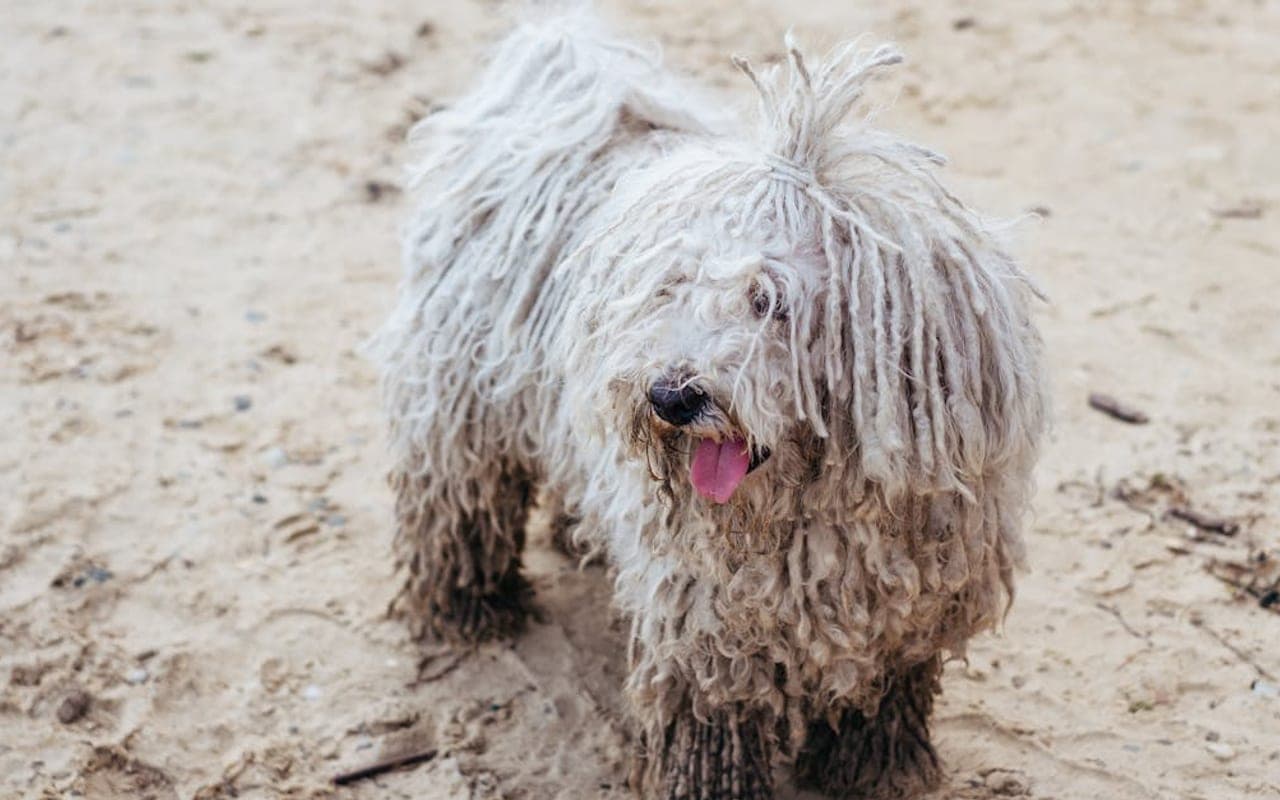
The Komondor coat cords naturally. The UKC standard describes a coarse outer coat over a finer undercoat, with a natural tendency to cord [3]. The club explains that the cords form when the woolly undercoat is trapped by the harsher, curlier outer coat. Cords begin forming between eight and twelve months of age and continue throughout the dog's life [1]. The standards treat the cords as essential. The UKC calls a combed coat undesirable, and it disqualifies a coat that has not corded by the time the dog is two years old [3]. The FCI gives the adult coat lengths. It is longest on the croup, the loin and the rear of the upper thighs, at least 20 to 27 cm. It is 15 to 22 cm on the back and shoulders [4]. The standard colour is ivory [4]. Do not brush out an adult coat.
Weekly cord work. The club says you will need to spend time every week working on the cords to keep them neat [1]. The Royal Kennel Club lists the breed's grooming as more than once a week [5]. Neither source gives a fixed number of hours, and how long it takes will vary with the dog's age and coat. Set aside a regular weekly session rather than waiting until cords start to fuse.
Splitting the cords. When the young coat starts to clump, pull the clumps apart along the natural pattern of the curls, so each one has a base roughly the size of a US quarter (about 2.4 cm across) [1]. Repeated wetting and drying then tightens those sections into cords [1]. In practice, work from the skin outward: hold the clump near its base, find where it already wants to divide, and ease it apart. Check the same areas at the next session, because the club notes that as new coat grows, the cords clump together at the base [1].
Keep it clean, keep it dry. The club is frank that no working Komondor can be kept from getting dirty, and that most mature dogs in full coat cannot be kept immaculate save by extreme measures [1]. It notes that dry hair holds dirt less readily than damp hair, and that after a muddy outing a quick rinse with a garden hose will help get the dirt out [1]. The club also warns that hair which never dries can mildew, and that cutting some of it off may lessen the problem [1]. Set up the drying area before the first rinse. Choose a spot with a washable floor and good airflow, place a floor fan or a dryer there [1], and leave enough time for the cords to dry to the skin, not just on the surface.
Ears and feet. The Komondor's hanging ears block air circulation, so the club says they must be kept especially clean and free of hair [1]. Part the cords around each ear during the weekly session and look inside. Thick hair also grows between the pads of the feet, and the club advises cutting it out with an electric clipper or scissors for the dog's health and comfort [1]. Include a look at the eyelids for any inward roll in the same session.
Health
We found no open-access population study that puts a rate on any condition in this breed.
The Komondor Club of America states: "There are no known health problems which are peculiar to Komondors" [2]. The Royal Kennel Club places the breed in Breed Watch Category 1, with "currently no points of concern specific to this breed" [5]. Neither statement means the breed is free of disease. Both mean that no problem has been identified as particular to it. The club and the standards still name several conditions.
- Hip dysplasia. The club says there is a certain amount of hip dysplasia in the breed [2]. It says responsible breeders have all their breeding stock certified free of dysplasia, and that a puppy's parents should have been X-rayed and certified clear [2]. Ask the breeder for both parents' hip results.
- Bloat (gastric dilatation and volvulus, GDV). The club names bloat as a concern. It describes a stomach that becomes enlarged and filled with gas, can twist, and can be fatal, and it advises owners to talk to their veterinarian about recognising the symptoms [2]. The Merck Veterinary Manual says GDV mainly affects large and giant breeds with deep or narrow chests [6]. The signs Merck lists include retching that brings nothing up, drooling, restlessness, and a swelling belly [6]. If you see those signs, go to an emergency veterinarian straight away. Merck also notes that many veterinary surgeons currently recommend preventive (prophylactic) gastropexy for at-risk breeds [6]. This is general guidance for such dogs, not a Komondor-specific finding, and it is a decision to discuss with your vet.
- Entropion and ectropion. The FCI standard calls for tightly fitting eye rims and lists both entropion and ectropion as disqualifying faults [4]. The club describes entropion as the curling inwards of either the upper or lower eyelid. It treats the condition as genetic and says any dog with it should not be bred [1]. When you meet a breeder's dogs, look at the eyelids. Ask whether entropion has appeared in the line.
- Juvenile cataracts. The club says juvenile cataracts are another genetic eye problem that has recently been documented in the breed [1]. It advises finding out whether a puppy's parents have been properly evaluated for hip and eye problems [1], so eye screening covers more than the eyelids.
- Anaesthetic sensitivity (club-reported). The club states that Komondors are "usually extremely sensitive to anesthetics" and that these drugs should be given to effect, never by weight [1]. This is the club's guidance, not a published research finding. Tell any veterinary practice about it before a procedure, and ask how they plan to dose.
- Flea and tick product sensitivity (club-reported). The club says Komondors are extremely sensitive to some flea and tick products [1]. It advises spot-testing the coat before dipping, and notes that some flea dips have been known to discolour the white coat [1]. As with anaesthetics, this is the club's experience rather than a study. Ask your vet to help you choose a product.
This is general information, not a diagnosis. Always consult your veterinarian for medical decisions about your dog.
Costs
Frequently Asked Questions
How does a Komondor cope with warm weather?
The breed club says the cords both insulate and cool, and that Komondors prefer moving air to cold air; many will lie on their backs in front of a fan when one is available [1].
Can a Komondor live with a cat?
The club describes the breed as happiest when it is responsible for another's well-being, whether livestock, children or a cat [1]. It gives no guidance on introductions, so supervise early meetings and keep them calm.
Can a Komondor live in an apartment?
The breed club says some owners have kept several Komondors in apartments successfully, but that a dog constantly perceiving threats will be noisy, and the situation could become very uncomfortable for both the owner and the dog [2].
Where should I look for a Komondor?
The Komondor Club of America can provide a list of breeders who follow its Code of Ethics, and it runs a rescue program; it does not recommend buying from pet stores [2].
Sources
This guide draws on the following published references. Each opens in a new tab so you can check it against what you have read here.
United Kennel Club
United Kennel Club — Komondor Breed Standard(opens in a new tab)Komondor Club of America
Komondor Club of America — About The Komondor(opens in a new tab)Komondor Club of America
Komondor Club of America — F.A.Q(opens in a new tab)Fédération Cynologique Internationale (FCI)
Fédération Cynologique Internationale (FCI) — FCI Standard N°53 Komondor(opens in a new tab)The Royal Kennel Club
The Royal Kennel Club — Komondor breed page(opens in a new tab)Merck Veterinary Manual
Merck Veterinary Manual — Gastric Dilation and Volvulus in Small Animals(opens in a new tab)
Affiliate disclosure: We may earn a commission from qualifying purchases. This doesn't affect our recommendations.
Recommended Products
Komondor Care Guide Book
Breed-focused reading and owner references for Komondor care, training, grooming, and health planning.
Komondor Food and Supplies
Helpful supplies for komondor dog supplies routines at home.
Komondor Grooming Tools
Helpful supplies for komondor grooming tools routines at home.
Get personalized pet care tips
Join our newsletter for breed-specific advice, care guides, and expert tips delivered weekly.
No spam, ever. Unsubscribe anytime.