
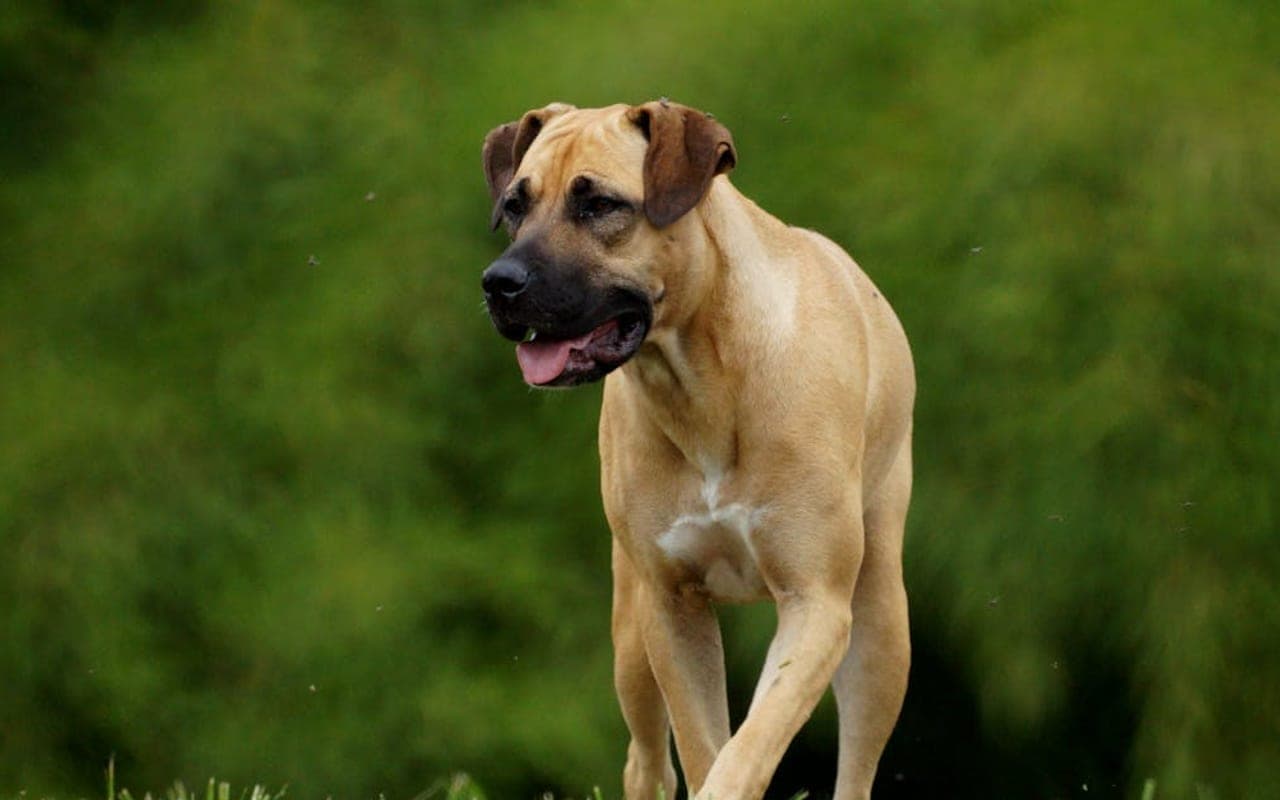
Boerboel Care Guide
The Boerboel is a giant working guardian, bred on South African farmsteads to face leopards and intruders alone, and that job is the reason its care differs from an ordinary large dog's. An adult stan
In This Guide
Overview
The Boerboel is a giant working guardian, bred on South African farmsteads to face leopards and intruders alone, and that job is the reason its care differs from an ordinary large dog's. An adult stands 22 to 27 inches at the shoulder and can reach 200 pounds, per PetMD's veterinarian-written breed profile, so nearly every decision you make is scaled up by mass and by drive — how you grow a puppy, how you contain an adult, how you budget for a vet visit. The same profile puts the breed's typical lifespan at 9 to 11 years, short even for a giant, and the documented health concerns below are why that window is worth protecting.
Be honest with yourself first: this is not a starter dog. An animal wired to guard, in a 150-to-200-pound frame, will probe boundaries, and an owner who cannot out-think and physically handle it ends up with a liability rather than a companion. Everything that follows assumes you can commit to daily training and genuinely secure containment for the dog's whole life, not only through puppyhood.
This guide covers care specific to the breed. Its history, temperament background and how to choose one live on the Boerboel breed page; for guides on other breeds, browse the care guide library.
Daily Care
A Boerboel's guarding instinct doesn't switch off between walks, so daily life is mostly a matter of steering it rather than suppressing it. A predictable household — consistent meals, handlers and rules — leaves the dog fewer things to flag as suspicious.
The most important daily habit is social exposure, and it is lifelong, not a puppy-class graduation. PetMD is explicit that training and socialization are critical here: a guardian that regularly meets varied people, dogs and situations learns to tell a normal event from a real one, while one kept isolated treats everything new as a threat. The other daily reality is physical. This is a dog that can outweigh the person on the other end of the leash, so plain manners — walking without towing, settling on cue, backing off a doorway — are safety equipment rather than polish, kept sharp in short daily sessions. And because a determined 150-to-200-pound dog defeats casual barriers, everyday management leans on a genuinely secure yard and on introducing guests on your own terms, not letting a stranger and a territorial giant meet cold at the threshold.
Nutrition
Start with a number, because it reorganizes feeding this breed: a full-grown Boerboel can go through around ten cups of food a day (PetMD). That volume turns portion control into a health tool: the gap between a lean adult and an overweight one is a few cups a day, compounded across a decade. So let the portion follow the dog rather than the label. A lean Boerboel lets you find its ribs with light pressure and shows a waist from above; when either blurs, the ration has crept too high, treats included. Because deep-chested dogs are the classic bloat patients, that volume should never arrive in one sitting — Cornell advises two or more meals, calm around feeding, and no raised bowls.
Puppies follow a stricter rule that generosity breaks. Keep a giant-breed puppy on a large-breed puppy formula until roughly 24 months (VCA), for the controlled energy and calcium-to-phosphorus ratio — about 1.1:1 to 1.4:1 — that ordinary food lacks. Overfeed one and it won't look fat; it will simply grow faster than its skeleton can safely keep up, and that speed is what drives developmental orthopedic disease.
Exercise
Two clocks govern a Boerboel's exercise, and mixing them up is how owners get it wrong.
The daily clock is about the mind as much as the body. This is a guardian bred to watch and assess, not a runner, so the aim is to occupy a working mind, not tire out an athlete. PetMD's shape for an adult is daily long walks or active play in a securely fenced yard. Meet it and the dog settles. Miss it and the failure is breed-specific — not a dog bouncing off the walls, but a large, under-occupied guardian that turns outward, working the fence line and adopting the street as its post. An under-worked Boerboel guards harder — the last thing you want to amplify in a 150-to-200-pound animal.
The second clock belongs to the skeleton, and runs to roughly 24 months (VCA). While the growth plates are still open they bear load poorly, so the fitter a puppy looks, the more you hold it back — let the joints' readiness, not the dog's enthusiasm, decide how far a young Boerboel goes.
Grooming
Grooming a Boerboel is mostly a story about what the coat doesn't need and what the face does. The coat is short, flat and single-layered, so brushing is light — a rubber curry once a week lifts loose hair, and PetMD puts bathing at about monthly.
The catch is that a flat coat gives no warning: where a fluffy breed shows trouble as a visible tangle, a Boerboel's skin problems sit flush against the body until they smell. Run your hands over the whole dog weekly and part the coat at the creases, paying closest attention to the heavy jowls and loose lower lids. Those folds trap moisture and food — and this is a serious drooler, so keep a wipe cloth by the water bowl — and a fold left damp is where a skin infection starts. Last, the nails: up to 200 pounds drives through those toes at every step, so keep them short enough that they never click on the floor, alongside a weekly ear check and regular tooth-brushing.
Health
No breed-wide prevalence study exists for the Boerboel — it is too uncommon to appear in the large primary-care datasets that carry real percentages for popular breeds — so the concerns below come from PetMD's veterinarian-written profile and the giant-breed veterinary literature. Read them as conditions to watch for, not as odds for your dog.
Eyelid faults (ectropion and entropion). PetMD names both for the Boerboel, and they are the concern most tied to the breed's heavy, loose-skinned face. Ectropion is the more characteristic: VCA Animal Hospitals describes the lower eyelid rolling outward or sagging away from the eye, and lists the Mastiff, Saint Bernard, Newfoundland, Bloodhound and Bernese Mountain Dog among predisposed breeds. The exposed surface dries out, a thick mucoid discharge gathers along the lid margin, and left alone it can progress to conjunctivitis, keratitis and corneal scarring that threatens sight (VCA). Entropion is the reverse fault — the lid turns inward and the lashes scrape the cornea. Both are corrected surgically once a dog is grown; treat a persistently weepy, red or squinting eye in a young Boerboel as a reason to see the vet early.
Hip and elbow dysplasia. PetMD lists both for the breed and notes they are hereditary but made worse by exercise habits, weight and nutrition. A dog carrying giant-breed load on its joints for a decade has little margin, so the levers that matter are keeping it lean and controlling growth (see Feeding). Ask the breeder for hip and elbow screening on both parents.
Bloat (gastric dilatation-volvulus). Deep-chested giants are the classic GDV patients, and PetMD flags the Boerboel by name. Cornell's Riney Canine Health Center describes the stomach filling with gas and twisting on itself, and it kills quickly. The signs Cornell lists — unproductive retching, a swelling and painful abdomen, drooling, restlessness, pale gums, weakness — are a same-hour emergency, not a wait-and-see. To lower the odds, Cornell advises two or more smaller meals a day, limiting activity right after eating, and avoiding raised bowls. A preventive gastropexy, which tacks the stomach to the body wall, drops the recurrence rate to as little as 3–5% against as high as 80% without it (Cornell) — worth raising with your vet, often at the spay or neuter.
Heart disease (dilated cardiomyopathy). PetMD includes DCM among the breed's concerns. Cornell describes it as the heart muscle weakening and the chamber enlarging until it can no longer pump efficiently; it is one of the more common heart diseases of large and giant breeds, though Cornell's named list of predisposed breeds does not single out the Boerboel. Early DCM is usually silent, which is why Cornell recommends screening for predisposed breeds — an echocardiogram and ECG can catch it before heart failure sets in, when coughing, laboured breathing, weakness and a distended belly appear. There is no cure, so finding it early is the point.
A note for intact females. If you keep an unspayed female, learn to recognise vaginal hyperplasia — an exaggerated swelling of vaginal tissue in response to estrogen during heat that can protrude through the vulva. The Merck Veterinary Manual reports it in as many as 8–10% of bitches and records no documented breed predisposition (brachycephalic breeds are overrepresented), so there is no Boerboel-specific figure to give. It usually resolves after the heat passes and is prevented outright by spaying.
This is general information, not a diagnosis. Always consult your veterinarian for medical decisions about your dog.
Costs
The biggest recurring cost of a Boerboel isn't the vet — it's the food bowl. An adult eating up to about ten cups a day (PetMD) works through a quality large-breed diet at a pace a medium dog never approaches, so model it first: a giant appetite, priced daily for nine to eleven years.
Plan the rest as this breed's specific risk list, not a vague "vet care is expensive." Before you buy, pay for evidence the parents were screened for hip and elbow dysplasia. Across the dog's life, budget for a cardiac work-up if your vet recommends DCM screening, an eye exam at the first sagging or weepy lid given the ectropion and entropion risk, and a conversation about preventive gastropexy, which Cornell reports drops GDV recurrence to as little as 3–5%. The cheap money and the expensive money are the same money at different times: screening, a lean weight on those ten daily cups and routine dental care are small and scheduled; the orthopedic surgery, the bloat emergency and the cardiac crisis they help postpone are large and sudden — so spend early.
Frequently Asked Questions
How big does a Boerboel get?
The Boerboel is a giant working guardian: an adult stands 22 to 27 inches at the shoulder and can reach 200 pounds, per PetMD's veterinarian-written profile. That mass scales up nearly every care decision, from how you grow a puppy to how you contain an adult. The same profile puts the breed's typical lifespan at 9 to 11 years, short even for a giant, which is why the documented health concerns are worth protecting against.
Is a Boerboel a good dog for a first-time owner?
No, this is not a starter dog. An animal wired to guard, in a 150-to-200-pound frame, will probe boundaries, and an owner who cannot out-think and physically handle it ends up with a liability rather than a companion. Owning one assumes you can commit to daily training and genuinely secure containment for the dog's whole life, not only through puppyhood, along with lifelong social exposure so the dog learns to tell a normal event from a real threat.
How much does a Boerboel eat?
A full-grown Boerboel can go through around ten cups of food a day, which makes the food bowl the breed's biggest recurring cost. Let the portion follow the dog rather than the label: a lean Boerboel lets you find its ribs with light pressure and shows a waist from above, and when either blurs the ration has crept too high. Because deep-chested dogs are classic bloat patients, that volume should never arrive in one sitting; Cornell advises two or more meals, calm around feeding, and no raised bowls.
How much exercise does a Boerboel need?
This is a guardian bred to watch and assess, not a runner, so the aim is to occupy a working mind rather than tire out an athlete. PetMD's shape for an adult is daily long walks or active play in a securely fenced yard; meet it and the dog settles, miss it and an under-worked Boerboel guards harder and works the fence line. Hold a puppy back until roughly 24 months, because while the growth plates are still open they bear load poorly, so let the joints' readiness decide how far a young dog goes.
What health problems are Boerboels prone to?
PetMD's profile names eyelid faults (ectropion and entropion) tied to the breed's heavy, loose-skinned face, hip and elbow dysplasia, bloat (gastric dilatation-volvulus), and heart disease (dilated cardiomyopathy). Bloat is a same-hour emergency, and a preventive gastropexy drops the recurrence rate to as little as 3 to 5 percent against as high as 80 percent without it, per Cornell. Treat a persistently weepy, red, or squinting eye in a young Boerboel as a reason to see the vet early.
Sources
This guide draws on the following published references. Each opens in a new tab so you can check it against what you have read here.
PetMD (veterinary
PetMD (veterinary-reviewed; written by Teresa Kho-Pelfrey, DVM) — *Boerboel (South African Mastiff) Dog Breed Health and Care* (size 22–27 in / up to 200 lb; lifespan 9–11 years; hip and elbow dysplasia, ectropion, entropion and dilated cardiomyopathy listed for the breed; bloat/GDV in deep-chested (opens in a new tab)VCA Animal Hospitals
VCA Animal Hospitals — *Eyelid Ectropion in Dogs* (lower eyelid rolling outward/everted; predisposed breeds including Mastiff, Saint Bernard, Newfoundland, Bloodhound, Bernese Mountain Dog; mucoid discharge, conjunctivitis, keratitis, corneal damage; surgical correction)(opens in a new tab)Cornell University College of Veterinary Medicine, Riney Canine Health Center
Cornell University College of Veterinary Medicine, Riney Canine Health Center — *Gastric Dilatation Volvulus (GDV) or "Bloat"* (large deep-chested dogs at greatest risk; signs; two-or-more smaller meals, limit activity after meals, avoid raised bowls; gastropexy reduces recurrence to as low as 3–5% (opens in a new tab)VCA Animal Hospitals
VCA Animal Hospitals — *Nutritional Considerations for Large and Giant Breed Dogs* (large/giant-breed puppy formula, giant breeds to ~24 months; Ca:P ratio 1.1:1–1.4:1; overfeeding drives too-fast growth and developmental orthopedic disease; hold puppies at BCS ~4/9 on measured meals)(opens in a new tab)Cornell University College of Veterinary Medicine, Riney Canine Health Center
Cornell University College of Veterinary Medicine, Riney Canine Health Center — *Dilated Cardiomyopathy* (heart muscle weakens and chamber enlarges; common in large/giant breeds — Dobermans, Great Danes, Irish Wolfhounds, Newfoundlands and others; often silent early; screening recommended for predis(opens in a new tab)Merck Veterinary Manual
Merck Veterinary Manual — *Vaginal Hyperplasia in Small Animals* (exaggerated estrogen response during proestrus/estrus; reported in as many as 8–10% of bitches; no documented breed predisposition, brachycephalic breeds overrepresented; often resolves after estrus; prevented by ovariohysterectomy)(opens in a new tab)
Affiliate disclosure: We may earn a commission from qualifying purchases. This doesn't affect our recommendations.
Recommended Products
Boerboel Care Guide Book
Breed-focused reading and owner references for Boerboel care, training, grooming, and health planning.
Boerboel Food and Supplies
Helpful supplies for boerboel dog supplies routines at home.
Boerboel Grooming Tools
Helpful supplies for boerboel grooming tools routines at home.
Get personalized pet care tips
Join our newsletter for breed-specific advice, care guides, and expert tips delivered weekly.
No spam, ever. Unsubscribe anytime.