
Catahoula Leopard Dog Care Guide
The Louisiana Catahoula Leopard Dog at a glance The Catahoula Leopard Dog is a working breed native to north-central Louisiana, taking its name from a Choctaw word for the "sacred lake" region around
Reading Time
📖 7 min read
Guide Type
🐾 Breed-Specific
Last Updated
📅 Sep 10, 2026
In This Guide
Overview
The Louisiana Catahoula Leopard Dog at a glance
The Catahoula Leopard Dog is a working breed native to north-central Louisiana, taking its name from a Choctaw word for the "sacred lake" region around Catahoula Parish. It was shaped over generations by settlers who needed a dog rugged enough to bay and drive semi-wild livestock through swamp and timber, and it remains best known for two demanding jobs: herding free-ranging cattle and hunting feral hogs. Rather than heeling stock from behind like many herding breeds, Catahoulas work as a team to form a "canine fence" around a herd, holding animals in place so a handler can move them. Louisiana named it the official state dog in 1979, the United Kennel Club recognized it in 1995, and the American Kennel Club lists it in its Foundation Stock Service.
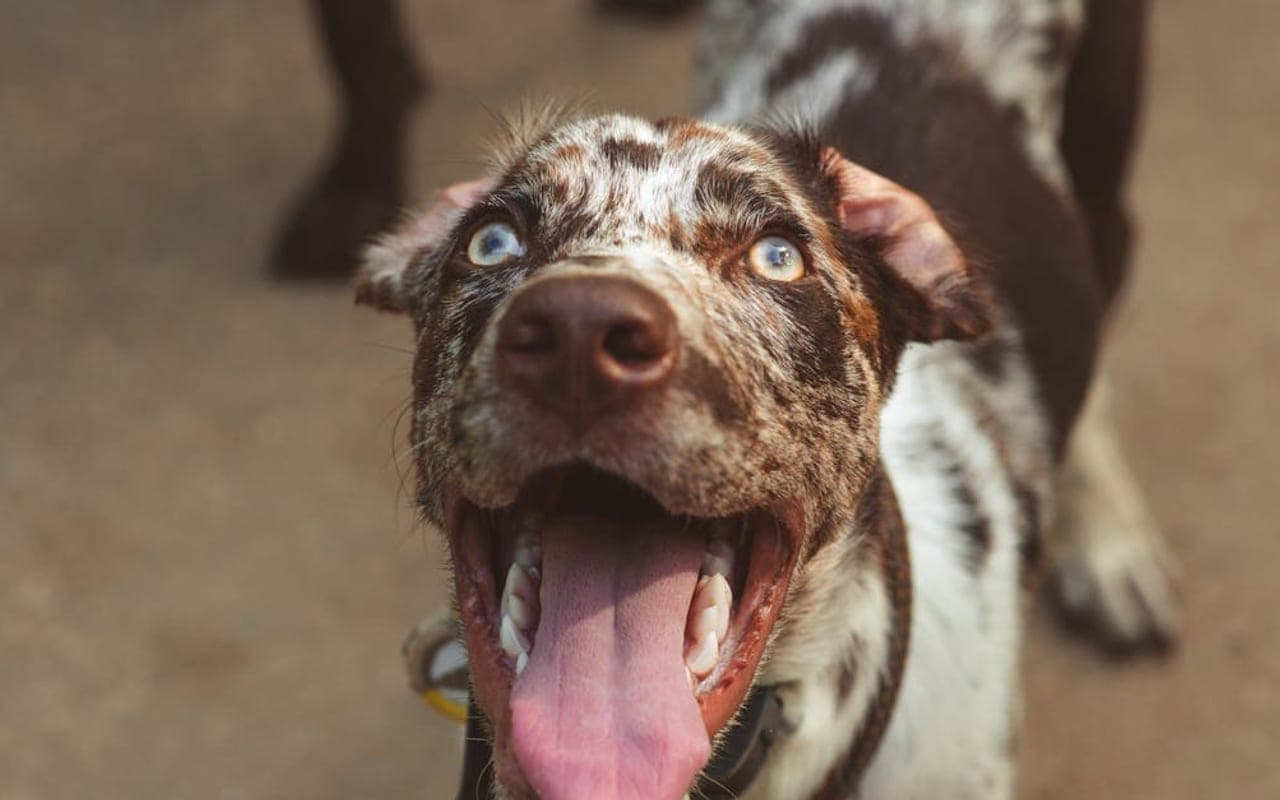
Physically, this is a medium-to-large, athletic dog. Males typically stand about 22 to 26 inches and females 20 to 24 inches, spanning a wide 40 to 95 pound range. The breed's signature is the mottled "leopard" coat produced by the merle gene, often paired with striking eyes in blue, amber, green, or brown, sometimes two different colors or a single "cracked" eye of mixed color.
Temperament is the part prospective owners most underestimate. Catahoulas are intelligent, intensely high-drive, independent, and naturally territorial and protective. Bred to make decisions alone against a boar, they think for themselves and will test soft handling. They thrive with an experienced, active owner who provides firm, consistent leadership, early socialization, and a genuine job or sport to channel their working instincts. Without that structure and outlet, this is not an easy first dog.
Exercise
Exercise and mental work for a Catahoula
The Catahoula was bred to spend long days baying hogs and moving cattle across rough Louisiana country, and that engine does not switch off in a suburban backyard. Plan on a serious daily commitment, generally one to two hours of hard physical activity, and treat it as a floor rather than a target. A leashed walk around the block will not touch it. These dogs want to run, trail, climb, swim, and problem-solve, so long hikes, jogging or bikejoring, fetch on open ground, and access to water all suit them well.
Just as important is a job for the mind. A Catahoula that only gets physical exercise but no mental challenge often reroutes that intelligence into digging, escaping, barking, and destructive chewing. Channel the working drive into structured outlets: obedience and trick training, scent work, herding trials, dock diving, agility, or a real task around a farm. Rotating puzzle feeders and short daily training sessions help absorb the brainpower this breed brings.
Containment deserves particular attention. Catahoulas are athletic, independent, and quick to test boundaries, so a secure, tall fence and reliable supervision are essential. Their strong prey and herding instincts mean off-leash freedom near roads, livestock, or small animals should be earned through training, not assumed. A tired, mentally engaged Catahoula is a calm companion at home; an under-exercised one rarely is.
Grooming
Grooming the Catahoula Leopard Dog
One of the practical rewards of choosing a Catahoula is a coat built for work, not for the grooming table. The breed carries a single, close-lying coat that is either short and smooth or a slightly coarser medium length, with no thick woolly undercoat to mat or blow out in heavy seasonal drifts. That makes weekly upkeep genuinely simple: a quick going-over with a rubber curry or a bristle brush lifts loose hair, spreads skin oils, and keeps the leopard patterning looking sharp. During spring and fall you may notice a modest uptick in shedding, so brushing two or three times a week for those few weeks keeps stray hair off the furniture.
Bathe only as needed, roughly every couple of months or after a muddy day in the field, since over-washing strips the coat's natural oils. The rest of Catahoula grooming is ordinary maintenance done consistently: trim or grind the nails every few weeks, because a hard-charging working dog can wear or crack them; check and gently clean the ears after swampy or wet outings to head off moisture-related infections; and brush the teeth several times a week. Because many Catahoulas love water and rough terrain, a post-adventure once-over for burrs, cuts, and ticks is the most valuable grooming habit you can build.
Health
Health of the Catahoula Leopard Dog
The Catahoula is generally a hardy working breed, but the same merle gene that paints its "leopard" coat carries the breed's most important health considerations, so this section covers what to watch for and where the evidence comes from. None of the following is a diagnosis; use it to ask better questions of a veterinarian who knows your individual dog.
The merle gene, deafness, and eyes
The mottled coat and pale or "cracked" eyes come from the semi-dominant merle (M) allele, which dilutes pigment in patches. Because the cells that make pigment also help build the inner ear and eye, merle is linked to congenital deafness and eye defects (American Kennel Club, "What Makes the Merle in Dog Coats?"). A single-merle dog (Mm) faces a modest risk: in a study of 153 merle dogs, 2.7 percent of single merles were deaf in one ear and 0.9 percent in both (Strain et al., Journal of Veterinary Internal Medicine, 2009; PubMed 19192156). The risk rises sharply in double merles (MM), where about 10 percent were unilaterally deaf and 15 percent bilaterally deaf in the same study. Notably, Catahoulas were the largest group studied and tended to retain more pigment and show lower deafness rates than some other merle breeds.
Double merles, produced when two merle-patterned dogs are bred together, are the central welfare concern. Such a pairing yields roughly 25 percent MM puppies, and these predominantly white dogs are the ones most prone to deafness plus eye abnormalities such as microphthalmia (abnormally small, often nonfunctional eyes) and partial or complete blindness (AKC, "What Makes the Merle in Dog Coats?"). Responsible breeders therefore avoid merle-to-merle crosses, and puppy buyers should ask whether both parents were merle and whether pups received BAER hearing testing, the brainstem auditory-evoked response test used to confirm hearing in each ear (Strain et al., 2009). A deaf or vision-limited Catahoula can live a full life with an informed owner, but the condition should be known, not discovered by accident.
Joints and routine wellness
Like many medium-to-large, athletic breeds, Catahoulas can be affected by hip dysplasia, a malformation of the hip joint that may lead to pain and arthritis; screening breeding stock through evaluations such as OFA or PennHIP helps reduce it (Orthopedic Foundation for Animals). Keeping a Catahoula lean protects those joints, since excess weight accelerates joint wear.
Beyond that, this breed benefits from the same preventive care every dog needs, applied consistently: annual veterinary exams, core vaccinations, year-round parasite prevention, dental care, and a diet matched to age and workload. Discuss a screening and wellness plan, including hearing and eye checks for merle dogs, with your veterinarian.
Frequently Asked Questions
Are all Catahoula Leopard Dogs deaf or prone to deafness?
No. Most Catahoulas hear normally. Deafness is tied to the merle gene, and the risk is low in single-merle dogs (about 2.7 percent deaf in one ear and 0.9 percent in both in one study) but much higher in double-merle (MM) dogs. Ask the breeder about BAER hearing testing, and defer to a veterinarian for any concerns about your dog.
What is a double-merle Catahoula and why is it a concern?
A double merle results from breeding two merle-patterned dogs together, producing puppies with two copies of the merle gene. These often predominantly white dogs have a notably higher chance of deafness and eye defects such as abnormally small eyes or blindness. Responsible breeders avoid merle-to-merle pairings for this reason.
Can a deaf Catahoula still make a good pet?
Yes, many deaf Catahoulas thrive with committed owners who use hand signals, vibration cues, and secure, leashed management for safety. It does require extra training patience and awareness. Talk with your veterinarian or a qualified trainer about setting the dog up to succeed.
Do Catahoulas have joint problems like hip dysplasia?
They can. As an athletic medium-to-large breed, Catahoulas may develop hip dysplasia, so buying from a breeder who screens hips (for example via OFA or PennHIP) and keeping your dog lean and well-conditioned both help. Any limping or stiffness should be assessed by a veterinarian.
Sources
This guide draws on the following published references. Each opens in a new tab so you can check it against what you have read here.
American Kennel Club (AKC)
Catahoula Leopard Dog Breed Information(opens in a new tab)United Kennel Club (UKC)
Louisiana Catahoula Leopard Dog Breed Standard(opens in a new tab)PetMD
Catahoula Leopard Dog Health and Care(opens in a new tab)VCA Animal Hospitals
Hip Dysplasia in Dogs(opens in a new tab)
Affiliate disclosure: We may earn a commission from qualifying purchases. This doesn't affect our recommendations.
Recommended Products
Catahoula Leopard Dog Care Guide Book
Breed-focused reading and owner references for Catahoula Leopard Dog care, training, grooming, and health planning.
Catahoula Leopard Dog Food and Supplies
Helpful supplies for catahoula leopard dog dog supplies routines at home.
Catahoula Leopard Dog Grooming Tools
Helpful supplies for catahoula leopard dog grooming tools routines at home.
Get personalized pet care tips
Join our newsletter for breed-specific advice, care guides, and expert tips delivered weekly.
No spam, ever. Unsubscribe anytime.