
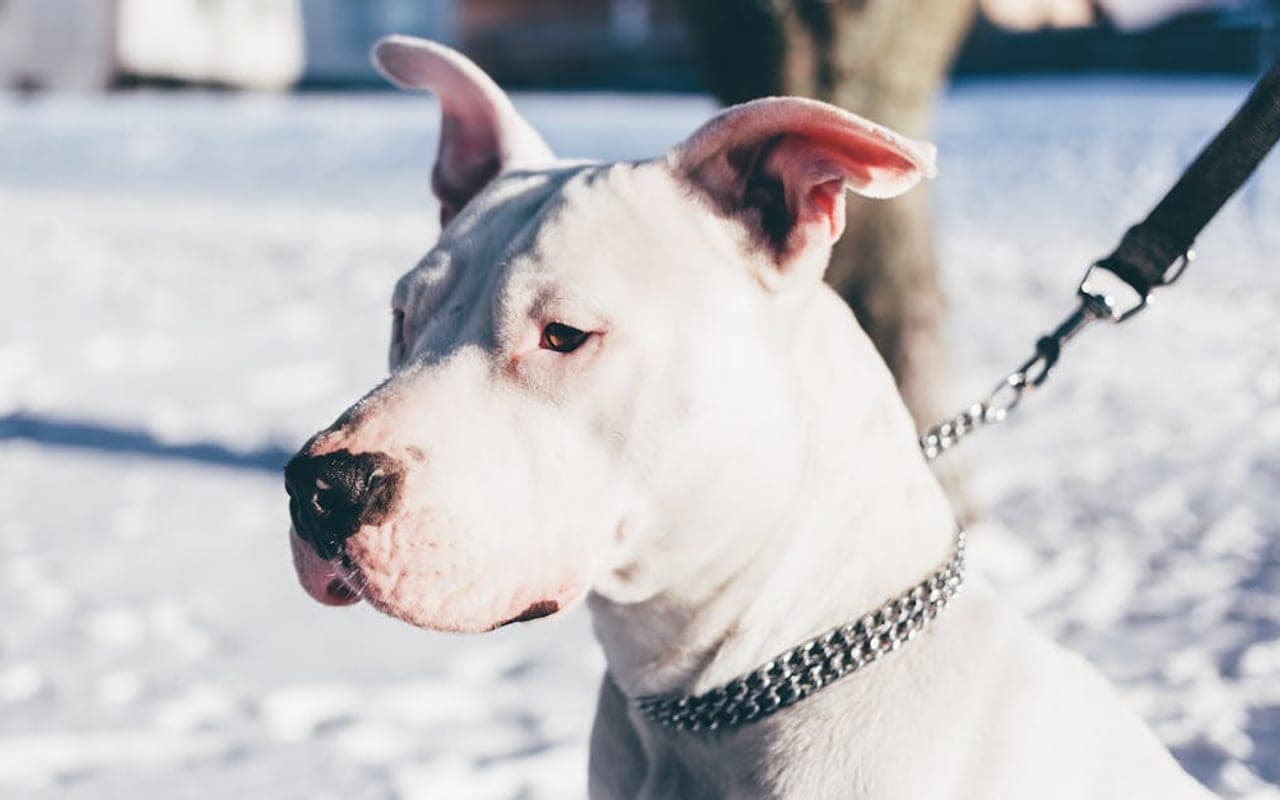
Dogo Argentino Care Guide
Caring for a Dogo Argentino means running a large, high-drive hunting dog every day and managing its strength every day — and then handling a curveball most owners miss. The same solid white coat that
In This Guide
Overview
Caring for a Dogo Argentino means running a large, high-drive hunting dog every day and managing its strength every day — and then handling a curveball most owners miss. The same solid white coat that defines the breed sits on top of two real vulnerabilities: skin that burns in the sun, and a well-documented risk of inherited deafness tied to that white pigment. This is a powerful working animal, commonly 80–100 pounds of muscle, bred in Argentina to hunt boar in a pack. Expect an athletic dog that needs hard daily exercise, secure fencing, a lifelong socialization habit, and an owner confident enough to direct a strong, independent-minded guardian. First-time owners of giant working breeds tend to underestimate the management load — the walking is the easy part.
What follows is the day-to-day of owning one. The breed's history, temperament profile, and breeder-selection advice live on the Dogo Argentino breed page, and other breeds are covered in the care guide library.
Daily Care
Daily life with a Dogo leans as heavily on management as on care, and prey drive is the trait that sets the tone. PetMD describes a dog with "a strong prey drive," and in an 80–100 pound hunting breed that is not a quirk — it is a safety consideration around cats, small dogs, and livestock. The failure mode is concrete: an unmanaged Dogo that locks onto a running animal is very hard to physically stop. Head it off with recall built early and rewarded hard, leashed control anywhere unfenced, and fencing a strong, motivated dog cannot clear or push through.
Layered on top is a guardian temperament that stays confident and self-directed, so socialization has to be a standing habit, not a puppy phase you finish. Keep exposure to new people, dogs, and settings positive and ongoing, and work a few minutes of calm handling into each day. If your dog is deaf or hard of hearing, build the routine around that from day one — teach hand signals, use a light flick or a floor vibration to get its attention, and always approach it where it can see you. On an animal this strong, reliable manners are not a nicety; they are what keeps the breed safe to live with.
Nutrition
Feed a Dogo to grow slowly and stay lean, because both directly lower its two biggest orthopedic risks. VCA is explicit that giant-breed puppies "can grow quickly in just a few months," and that overfeeding during growth means "their skeleton may not grow at the same rate, leading to developmental orthopedic diseases." So a Dogo puppy needs a large-breed puppy formula, not adult food and not a generic puppy food — VCA notes a calcium-to-phosphorus ratio of roughly 1.1:1 to 1.4:1 and a moderate protein level are what keep bone growth controlled. Do not free-feed. VCA recommends measured meals — "at least 4 small meals for puppies, or at least 3 meals for adult dogs" — and keeping a puppy at a lean body condition, around 4 on the 9-point scale, specifically to slow growth.
In adulthood, let the dog's shape set the portion instead of the number on the label. Weigh meals, treat the feeding chart as an estimate, and reassess condition every couple of weeks: a healthy-weight Dogo has ribs you can locate through a thin covering, a clear narrowing behind the ribcage, and a flank that tucks up from the side. When those blur, trim the ration — treats counted in — before the extra pounds reach the hips. Because of the GDV risk, spread the daily food across several sittings rather than one, keep the dog settled around mealtimes, and leave the bowl on the floor rather than raised (Cornell).
Exercise
A Dogo Argentino is a working athlete and needs to be worked. PetMD is direct about the requirement — "lots of daily exercise, such as long walks, running, and playing fetch" — and equally direct about the consequence of skipping it: these dogs "can become destructive when they're bored." An under-exercised Dogo does not sulk quietly; it chews, digs, patrols, and finds its own job, usually one you dislike. Plan for an hour or more of hard activity a day for a healthy adult, split into sessions, plus mental work that engages a hunting brain — scent games, structured obedience, and tasks that give the drive a legal outlet.
Growing puppies are the exception that protects the adult. Because the breed carries hip-dysplasia risk, and because VCA links fast growth and joint disease, keep a puppy's exercise short, self-directed, and off hard surfaces. Skip forced runs, long hikes, and repeated jumping until the skeleton matures. The goal in the first year is a well-socialized, lean, unhurried puppy — not an early athlete.
Grooming
The Dogo's coat is the easy half of its grooming; the skin underneath is the hard half. A short, single white coat needs little more than a weekly once-over with a rubber brush to lift the loose hair — this is a moderate, year-round shedder, not a seasonal blowout breed, so there is no undercoat to blow out and no matting to chase.
The real work is sun protection, because the white coat offers almost no barrier and much of the skin beneath it is unpigmented. PetMD notes the breed's non-pigmented skin "under their white hair" leaves it "prone to sunburn," and the stakes are higher than a red belly. Kansas State University's veterinary diagnostic lab warns that in short-haired, lightly pigmented dogs, repeated sun exposure drives "keratinocyte proliferation, mutagenesis, and premalignant actinic keratosis which can evolve into sun-induced skin tumors like squamous cell carcinoma." Damage concentrates where hair is thinnest — the belly, the inner thighs, the flank, and the bridge of the nose. The lab's blunt conclusion is that "the best treatment option is to minimize the exposure to sunlight": keep the dog out of peak midday sun, give it shade, and ask your vet about a dog-safe sunscreen for exposed areas on bright days. Finish with the upkeep any big dog needs — trim the nails before they click on the floor, check the ears weekly, and brush the teeth regularly, since PetMD flags periodontal disease for the breed.
Health
Organize this breed's health around the problems that are breed-typical, in the order your own decisions can move the outcome.
- Congenital deafness is the signature concern. The Merck Veterinary Manual names the Dogo Argentino directly, grouping it among the piebald gene–carrying breeds in which congenital deafness is "especially prevalent" — the same short list as the Dalmatian and Bull Terrier. The cause is structural, not behavioral: per Merck, this form of deafness "develops within 1–3 weeks after birth, secondary to stria vascularis degeneration that results from melanocyte suppression by the pigmentation gene." The pigment and the deafness ride the same gene: Louisiana State University's veterinary deafness resource lists the Dogo Argentino among breeds with reported congenital deafness and notes that "breeds with white pigmentation are most affected." The loss is frequently one-sided — a dog deaf in a single ear behaves almost normally and is easy to miss — so responsible breeders BAER-test litters, and a puppy's hearing is worth confirming before you build a training plan around your voice. A fully deaf dog is still trainable on hand signals and vibration cues; it must never be startled awake or approached from behind.
- Hip dysplasia. As a large, fast-growing breed, the Dogo is prone to hip dysplasia; PetMD's veterinary profile lists it as a breed health condition. VCA Animal Hospitals frames it as "a genetic disease that is affected by factors such as diet, environment, exercise, growth rate, muscle mass, and hormones" — meaning genetics load the gun, but growth and weight pull the trigger. VCA cites research in which puppies fed unrestricted amounts developed hip dysplasia at roughly twice the rate of littermates fed measured portions, and overweight puppies were nearly twice as likely to develop it as normal-weight ones. Ask about parental hip screening, and keep a growing Dogo lean.
- Gastric dilatation-volvulus (GDV, or "bloat"). Any large, deep-chested dog can develop this fast-killing emergency, in which the stomach bloats with gas and twists. Cornell University's Riney Canine Health Center lists the warning signs: "non-productive retching or attempting to vomit with no production," a swelling abdomen, drooling, restlessness, pale gums, and a "praying" position. Treat these as a same-hour trip to an emergency clinic. Cornell also names the levers you control — avoid feeding one large daily meal, skip raised bowls, and do not exercise hard right after eating. Ask your veterinarian about a preventive gastropexy, which Cornell reports "reduces the risk of recurrence to as low as 3–5 percent, compared to a recurrence rate as high as 80 percent without it."
- Documented but less common. PetMD's DVM-authored profile also lists hypothyroidism, laryngeal paralysis, and periodontal disease for the breed. None is unique to the Dogo, but each is worth a line on your vet's checklist — the throat and thyroid because they surface in middle age, the teeth because they are the most preventable of the three.
None of this replaces a hands-on exam — read it as background, and take any medical decision to your own veterinarian.
Costs
With a Dogo, the recurring costs are driven by size and risk profile rather than grooming. Food scales with an 80–100 pound frame, and so does the vet bill — drug doses track body weight, and a big dog is more expensive to sedate, image, and keep overnight than a small one. On top of that sit the breed-specific items: a BAER hearing test for a puppy, a conversation with your vet about preventive gastropexy given the GDV risk, sun protection you will keep buying, and the joint screening and lean-weight feeding that hold hip disease at bay. Each of these has a cheap preventive version and an expensive emergency version, and the gap is large: the hearing test versus a lifetime of miscommunication, the gastropexy versus a midnight bloat surgery, the measured food versus joint replacement. Spend on the front end.
Frequently Asked Questions
How much exercise does a Dogo Argentino need?
A Dogo Argentino is a working athlete that needs an hour or more of hard activity a day for a healthy adult, split into sessions, such as long walks, running, and playing fetch. It also needs mental work like scent games and structured obedience to engage a hunting brain. An under-exercised Dogo becomes destructive, chewing, digging, and patrolling when bored. Growing puppies are the exception: keep their exercise short, self-directed, and off hard surfaces until the skeleton matures.
Why is my white Dogo Argentino at risk of deafness?
Congenital deafness is the signature concern in the breed because the pigment and the deafness ride the same gene, and breeds with white pigmentation are most affected. This form of deafness develops within 1 to 3 weeks after birth from degeneration tied to melanocyte suppression by the pigmentation gene. The loss is frequently one-sided, so a dog deaf in a single ear behaves almost normally and is easy to miss. Responsible breeders BAER-test litters, and a fully deaf Dogo is still trainable on hand signals and vibration cues.
Do Dogo Argentinos need sun protection?
Yes. The short single white coat offers almost no barrier and much of the skin beneath it is unpigmented, leaving it prone to sunburn. Repeated sun exposure in lightly pigmented dogs can drive premalignant actinic keratosis that can evolve into sun-induced skin tumors like squamous cell carcinoma, with damage concentrating on the belly, inner thighs, flank, and bridge of the nose. Keep the dog out of peak midday sun, provide shade, and ask your vet about a dog-safe sunscreen for exposed areas on bright days.
How should I feed a Dogo Argentino puppy to protect its joints?
Feed a Dogo puppy a large-breed puppy formula, not adult food or generic puppy food, because giant-breed puppies can grow quickly and overfeeding during growth can lead to developmental orthopedic diseases. Do not free-feed; VCA recommends at least 4 small measured meals for puppies and keeping the puppy lean, around 4 on the 9-point scale, to slow growth. This matters because puppies fed unrestricted amounts developed hip dysplasia at roughly twice the rate of littermates fed measured portions.
Is the Dogo Argentino good with cats and small dogs?
The breed has a strong prey drive, and in an 80 to 100 pound hunting dog that is a safety consideration around cats, small dogs, and livestock rather than just a quirk. An unmanaged Dogo that locks onto a running animal is very hard to physically stop. Manage it with recall built early and rewarded hard, leashed control anywhere unfenced, and fencing a strong, motivated dog cannot clear or push through. A guardian temperament also means socialization has to be an ongoing habit, not a puppy phase you finish.
Sources
This guide draws on the following published references. Each opens in a new tab so you can check it against what you have read here.
Merck Veterinary Manual
Merck Veterinary Manual — *Deafness in Animals* (congenital hereditary deafness associated with white pigmentation; cochleosaccular mechanism develops 1–3 weeks after birth via stria vascularis degeneration and melanocyte suppression; names the Dogo Argentino among piebald gene–carrying breeds in wh(opens in a new tab)Louisiana State University, School of Veterinary Medicine (Dr. George M. Strain)
Louisiana State University, School of Veterinary Medicine (Dr. George M. Strain) — *Deafness in Dogs & Cats: dog breeds with reported congenital deafness* ("Breeds with white pigmentation are most affected"; the Dogo Argentino appears in the list of breeds with reported congenital deafness)(opens in a new tab)PetMD (veterinary
PetMD (veterinary-reviewed; author Heather Newett, DVM; reviewed by Molly Price, DVM) — *Dogo Argentino* breed profile (health conditions: hip dysplasia, GDV, deafness, laryngeal paralysis, hypothyroidism, periodontal disease; non-pigmented skin under white hair prone to sunburn; high daily exercise(opens in a new tab)Cornell University College of Veterinary Medicine, Riney Canine Health Center
Cornell University College of Veterinary Medicine, Riney Canine Health Center — *Gastric Dilatation-Volvulus (GDV) or "Bloat"* (warning signs, risk factors including large single meals and raised bowls, gastropexy reduces recurrence to 3–5% vs. up to 80% without)(opens in a new tab)VCA Animal Hospitals
VCA Animal Hospitals — *Nutritional Considerations for Large and Giant Breed Dogs* (large-breed puppy diets, calcium:phosphorus 1.1:1–1.4:1, controlled growth, developmental orthopedic disease, measured meals, lean body condition ~4/9)(opens in a new tab)VCA Animal Hospitals
VCA Animal Hospitals — *Hip Dysplasia in Dogs* (genetic disease influenced by diet, growth rate, and weight; unrestricted-fed puppies developed dysplasia at roughly twice the rate of measured-fed littermates; overweight puppies nearly twice as likely to be affected)(opens in a new tab)Kansas State Veterinary Diagnostic Laboratory (Drs. Charan Ganta and Sarah Schneider)
Kansas State Veterinary Diagnostic Laboratory (Drs. Charan Ganta and Sarah Schneider) — *Canine Solar Dermatitis* (short-haired, lightly pigmented dogs most affected; UV damage progresses through actinic keratosis to squamous cell carcinoma; best prevention is minimizing sun exposure)(opens in a new tab)
Affiliate disclosure: We may earn a commission from qualifying purchases. This doesn't affect our recommendations.
Recommended Products
Dogo Argentino Care Guide Book
Breed-focused reading and owner references for Dogo Argentino care, training, grooming, and health planning.
Dogo Argentino Food and Supplies
Helpful supplies for dogo argentino dog supplies routines at home.
Dogo Argentino Grooming Tools
Helpful supplies for dogo argentino grooming tools routines at home.
Get personalized pet care tips
Join our newsletter for breed-specific advice, care guides, and expert tips delivered weekly.
No spam, ever. Unsubscribe anytime.