Hovawart Care Guide
The Hovawart is a large German working dog, and what decides whether one suits you is not the coat or the food bowl. It is the hours of daily work and the kind of handling it needs. The German breed c
In This Guide
Overview
The Hovawart is a large German working dog, and what decides whether one suits you is not the coat or the food bowl. It is the hours of daily work and the kind of handling it needs. The German breed club, the Rassezuchtverein für Hovawart-Hunde (RZV), and the Royal Kennel Club both set a high daily exercise need [7][9]; the figures are in the exercise section below. The Hovawart Club of North America says it does not usually recommend the breed to first-time owners [10].
The FCI standard sets males at 63 to 70 cm and females at 58 to 65 cm at the withers [1], and the North American club gives a lifespan of 10 to 14 years [10].
The harder part is the guarding instinct. The North American club says that guarding has to be learned and directed, and that without direction the Hovawart will make its own decision, which may not be the one you want [10].
This guide covers day-to-day care. For the breed's background, see the Hovawart breed page. For other breeds, browse the care guide library.
Daily Care
The RZV describes the Hovawart as a family dog, and says that a Hovawart well integrated into the family from the start will tolerate only occasional time in a kennel [7]. Plan for a dog that lives indoors with you and is not left outside alone.
Training is where the breed asks the most of you. The RZV says consistency, patience and a lot of empathy are needed, that harshness does not get results, and that building and keeping trust is what matters [7]. It also says a Hovawart will usually test who leads the household, and that permissive training is completely unsuitable [7]. Keep your rules the same every day, reward the behaviour you want, and do not use force.
Give the guarding instinct the direction described in the overview. Socialise your puppy calmly with visitors and new places, and teach a reliable recall and a settle. Keep that structure going through adolescence, which lasts until about two years [10].
Nutrition
The RZV's dental guidance says high-quality commercial food makes it easier to supply all the nutrients a dog needs, and that almost all the raw-feeding (BARF) rations circulating online or in books have serious flaws [8]. Its thyroid guidance adds that home-prepared diets, including BARF, are often short of iodine [6]. None of these sources publishes a daily portion for the breed, so take the starting amount from your food's feeding guide and adjust it to your dog's body condition.
Weigh your dog regularly and keep a note. The RZV says a dog with hypothyroidism can gain weight even when it eats the same amount or less [6]. If your Hovawart is gaining weight on an unchanged ration, mention it to your vet, especially between the ages of four and seven, when most cases start [6].
The same dental page sets limits on chews [8].
- No antlers or hard chew roots. The club calls the commercial versions too hard and risky, and says overly hard items can break teeth [8].
- Do not count on food to clean the teeth. The RZV says diet has less effect on tartar than many people think [8]. Brushing does the work.
Exercise
The RZV says at least one hour of continuous running a day, plus three to four short walks for toileting [7]. The Royal Kennel Club says more than two hours a day [9]. Treat the RZV figure as the floor.
The RZV is clear about where that exercise happens. Letting a working dog of this kind out in the garden is far too little, and the club quotes the behaviourist Eberhard Trumler: a dog not allowed to work becomes dull, wastes away emotionally and is a pitiable creature [7]. The club suggests cycling or jogging with the dog and daily play [7]. One option the club recommends is dog sport: in competition or in training as a working dog, the Hovawart uses its intelligence and keenness to work [7].
The RZV's dental guidance also shapes how a young Hovawart plays [8].
- Go easy on tug and bite work until your dog is past two. The permanent teeth are fully load-bearing only at two to two-and-a-half years, and the risk of a broken tooth rises when a toy is yanked [8]. Tug games and protection training need suitable material [8].
- Do not use tennis balls. The RZV says their felt cover strongly wears down tooth enamel and that they should not be used as toys at all [8].
Grooming
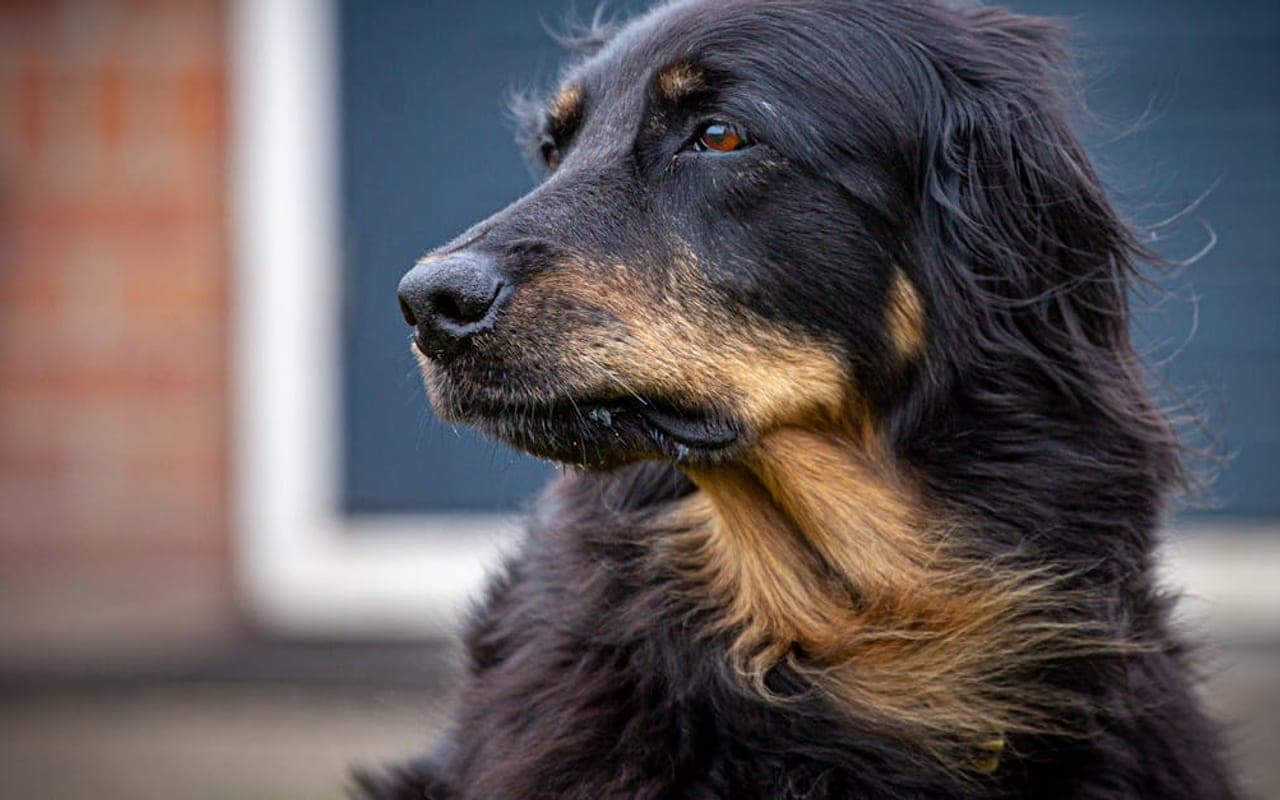
The FCI standard describes a long coat that is thick, slightly wavy and lies flat to the body, with not much undercoat, in three colour varieties: black and tan, black, and blond [1]. The RZV calls the breed easy to care for and says that, outside the shedding period, the dog does not need brushing every day, because the low share of undercoat means the coat does not tend to mat [7]. The Royal Kennel Club puts grooming at more than once a week [9]. None of these sources gives a weekly time figure for grooming the breed.
- Brush more than once a week [9], and daily during the seasonal coat change [7].
- No clipping. The standard describes a coat that lies flat to the body [1], and none of the sources calls for trimming it.
- Brush the teeth. The RZV calls tooth brushing the most effective oral hygiene measure for a dog [8]. Start getting your puppy used to it early, but not during the tooth change, which the club calls the worst time to begin [8]. Regular brushing makes sense once the adult teeth are in [8].
Health
The RZV publishes figures from its own health database. They are not a breed-wide prevalence study, and the club warns that some conditions go unreported, so read them as what one club has recorded, not as a rate for every Hovawart. The club's counts are not on a common scale, so the order below does not rank the conditions by how often they occur.
- Hip dysplasia, and why screening matters here. The FCI standard says that selection for hips free of dysplasia, starting as early as the 1960s, has pushed the disease almost entirely back [1]. The RZV says decades of selection have cut severe hip dysplasia to a few percent, that about 80% of each birth year is X-rayed, and that only dogs whose hips are graded A or B by an independent assessor may be bred [2]. The Royal Kennel Club lists hip testing under the BVA/KC Hip Dysplasia Scheme for the breed [9].
- Laryngeal paralysis. This is a late-life risk that owners of this breed should know by name. The RZV database records 187 cases of laryngeal paralysis in dogs born in 2000 or later [5]. The average age at onset was 11.1 years in males and 11.3 years in females, and the earliest cases appeared at 8.2 years in a male and 7.8 years in a female [5]. Signs include rougher breathing, a hoarse, quieter or toneless bark, and trouble swallowing, and the disease usually begins gradually [5]. The condition was the cause of death in 29 males and 24 females in the database [5]. The club says a family link seems likely, that the exact cause in the breed is not known, and that many cases are never reported [5]. When breathing is badly affected, surgery widens the airway; the RZV says it usually succeeds but raises the risk of inhaling food or water and of pneumonia afterwards [5].
- Degenerative myelopathy (DM). The RZV describes DM as a progressive, incurable disease of the spinal cord that starts in the hind legs: the dog stumbles, falls over and drags its toes [3]. Affected dogs are almost always 8 to 10 years or older [3]. Of the 10,052 Hovawarts the club records as born since 2000, 98 developed hind-end weakness with suspected DM, and only 4 of those were confirmed by tissue examination [3].
The DNA test needs careful reading. A 2014 study in the Journal of Veterinary Internal Medicine tested 64 Hovawarts for the SOD1 variant linked to DM and found 31 clear (G/G), 17 carriers (G/A) and 16 with two copies (A/A) [4]. That is a count of the dogs tested in one study, not a measure of how common the variant is across the breed. The RZV states that an SOD1 result is not a diagnosis, and that a second mutation present in about 26% of the Hovawarts examined can distort the test result [3]. The RZV does not currently require the SOD1 test for breeding [3]. If an older Hovawart starts scuffing or stumbling with its back legs, book a veterinary exam.
- Hypothyroidism. The RZV says an underactive thyroid occurs more often in medium and large breeds such as the Hovawart than in small breeds, that adult cases are caused by autoimmune inflammation, and that most dogs fall ill between their fourth and seventh years [6]. Signs it lists include brittle hair and hair loss, lethargy, a slowed heart rate and poorer tolerance of cold [6]. Weight can rise even when the dog eats the same amount or less [6]. One lab value is not enough for a reliable diagnosis, so expect your vet to look at several [6]. The condition cannot be cured, but the club says it responds well to regular doses of thyroid hormone [6]. We found no published figure for how often it occurs in the breed.
- Eyes and heart. The RZV allows only dogs free of hereditary eye disease into breeding, and recommends a heart examination from 20 months of age [2]. We found no published prevalence figure for heart disease in the breed. Ask a breeder for both parents' eye and heart results.
The RZV says Hovawarts reaching 12 years or older are not rare [2], so plan for the late-onset conditions above.
🩺 When to See Your Vet
See a veterinarian promptly if an older Hovawart's breathing turns rougher, its bark becomes hoarse or quiet, or it has trouble swallowing [5]. The RZV warns that laryngeal paralysis can end in suffocation [5], so treat any struggle for air as an emergency.
This is general information, not a diagnosis. Always consult your veterinarian for medical decisions about your dog.
Costs
The largest ongoing cost of a Hovawart is your time: the daily exercise set out in the exercise section, for the whole of the dog's life.
Frequently Asked Questions
How much exercise does a Hovawart need?
The RZV says at least one hour of continuous running a day, plus three to four short toilet walks, and that time in the garden is far too little [7]. The Royal Kennel Club says more than two hours a day [9].
Does a Hovawart's coat mat?
The RZV says it does not tend to, because the coat has little undercoat [7]. Brush more than once a week [9], and daily during the seasonal shed [7].
Is a Hovawart a good dog for a first-time owner?
The Hovawart Club of North America says it does not usually recommend the breed for first-time owners [10]. The RZV says the dog needs consistent, patient handling and does not respond to harshness [7].
Should I DNA-test my Hovawart for degenerative myelopathy?
You can, but read the result with care. The RZV says the SOD1 result is not a diagnosis, that a second mutation can distort it in about 26% of Hovawarts examined, and that it does not require the test for breeding [3].
When does a Hovawart stop growing up?
The Hovawart Club of North America says the breed takes about two years to mature [10]. The RZV says the permanent teeth are fully load-bearing only at two to two-and-a-half years [8].
Sources
This guide draws on the following published references. Each opens in a new tab so you can check it against what you have read here.
Rassezuchtverein für Hovawart
Rassezuchtverein für Hovawart-Hunde e.V. (RZV) — Hovithek: Zahngesundheit(opens in a new tab)Hovawart Club of North America (HCNA)
Hovawart Club of North America (HCNA) — Hovawart FAQ(opens in a new tab)Fédération Cynologique Internationale (FCI)
Fédération Cynologique Internationale (FCI) — FCI-Standard N° 190 Hovawart (28.03.2025)(opens in a new tab)Rassezuchtverein für Hovawart
Rassezuchtverein für Hovawart-Hunde e.V. (RZV) — Gesundheit(opens in a new tab)Rassezuchtverein für Hovawart
Rassezuchtverein für Hovawart-Hunde e.V. (RZV) — Hovithek: Degenerative Myelopathie(opens in a new tab)Journal of Veterinary Internal Medicine (Zeng et al., 2014)
Journal of Veterinary Internal Medicine (Zeng et al., 2014) — Breed Distribution of SOD1 Alleles Previously Associated with Canine Degenerative Myelopathy(opens in a new tab)Rassezuchtverein für Hovawart
Rassezuchtverein für Hovawart-Hunde e.V. (RZV) — Hovithek: Kehlkopflähmung(opens in a new tab)Rassezuchtverein für Hovawart
Rassezuchtverein für Hovawart-Hunde e.V. (RZV) — Hovithek: Hypothyreose(opens in a new tab)Rassezuchtverein für Hovawart
Rassezuchtverein für Hovawart-Hunde e.V. (RZV) — Erziehung & Haltung(opens in a new tab)The Royal Kennel Club
The Royal Kennel Club — Hovawart breed information(opens in a new tab)
Affiliate disclosure: We may earn a commission from qualifying purchases. This doesn't affect our recommendations.
Recommended Products
Hovawart Care Guide Book
Breed-focused reading and owner references for Hovawart care, training, grooming, and health planning.
Hovawart Food and Supplies
Helpful supplies for hovawart dog supplies routines at home.
Hovawart Grooming Tools
Helpful supplies for hovawart grooming tools routines at home.
Get personalized pet care tips
Join our newsletter for breed-specific advice, care guides, and expert tips delivered weekly.
No spam, ever. Unsubscribe anytime.