
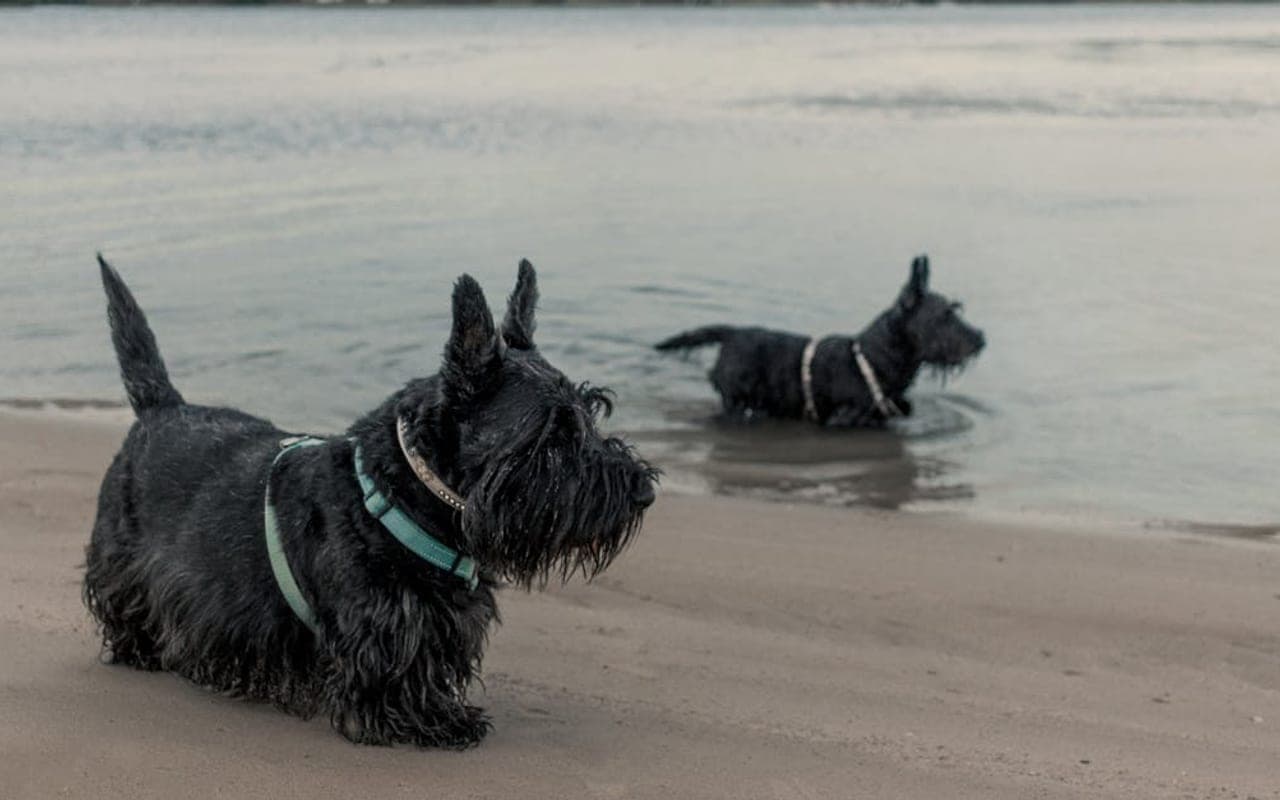
Scottish Terrier Care Guide
A Scottish Terrier is a small, low-slung dog, 25 to 28 cm at the shoulder and 8.5 to 10 kg as an adult, with a usual lifespan of 12 to 15 years. The harder part is something most owners do not expect
In This Guide
Overview
A Scottish Terrier is a small, low-slung dog, 25 to 28 cm at the shoulder and 8.5 to 10 kg as an adult, with a usual lifespan of 12 to 15 years. The harder part is something most owners do not expect from a dog this size: lifelong attention to its bladder. A 2020 review of canine bladder cancer describes Scottish Terriers as having a 20-fold increased risk of invasive urothelial carcinoma compared with mixed-breed dogs [1]. That risk affects the yard you let the dog walk on, what goes in the food bowl, and when you start asking your vet about screening.
Temperament is the other point to weigh before you commit. The UK breed standard describes the Scottie as "dignified, independent and reserved" and "bold, but never aggressive" [8]. Put that independence together with a daily grooming need and bladder surveillance from age 6, and this is a poor match for an owner who wants an eager-to-please dog or who cannot give regular time to coat care and vet visits. For the breed's history and background, see the Scottish Terrier breed page. For other breeds, browse the care guide library.
Daily Care
In a JAVMA case-control study of 83 Scottish Terriers with bladder cancer and 83 Scottish Terrier controls, owners reported lawn and garden chemical use for the year before diagnosis [2]. Compared with untreated lawns, exposure to lawns treated with herbicides alone was associated with an odds ratio of 3.62, and herbicides plus insecticides with 7.19 [2]. Phenoxy herbicides gave an odds ratio of 4.42 [2]. Insecticides alone (OR 1.62) and non-phenoxy herbicides (OR 3.49) were not significantly associated [2]. The authors recommended that owners minimise their dogs' access to lawns or gardens treated with phenoxy herbicides until a cause-and-effect relationship is proven or disproven [2].
In practice, that means not spraying your own lawn with herbicides if your Scottie uses it, asking neighbours, landlords or grounds staff when they treat shared grass, and keeping the dog off grass you cannot vouch for.
Training is the other daily task, and the difficulty here is the breed's independence: The Royal Kennel Club describes the Scottie as "independent to the point of stubbornness" [9], so do not expect a dog that obeys simply to please you.
Keep a simple log of urination habits, any blood in the urine, and every urinary infection with its date. For a breed with this bladder risk, that record is useful at every vet visit after age 6.
Nutrition
In a JAVMA case-control study of 92 Scottish Terriers with bladder cancer and 83 Scottish Terrier controls, owners reported diets for the year before diagnosis [3]. After adjusting for age, weight, neuter status and coat colour, eating vegetables at least three times a week was associated with lower odds of bladder cancer (odds ratio 0.30) [3]. By type, green leafy vegetables (OR 0.12) and yellow-orange vegetables (OR 0.31) showed significant inverse associations. Cruciferous vegetables did not reach significance [3].
This is an association from owner questionnaires, not a trial, and it does not show that vegetables prevent cancer in an individual dog. If you add vegetables, do it as a small part of a complete diet, check that each one is safe for dogs, and count the calories inside your measured daily portion so the extra food does not add weight.
Exercise
The Royal Kennel Club gives the breed's exercise need as "up to 1 hour per day" [9].
Exercise is one of the Scottie cramp triggers described in the health section above [5]. The case series gives no exercise plan for affected dogs, so if episodes follow walks or play, ask your vet how to adjust them. If your dog has never been diagnosed and stiffens or collapses, book a vet visit, and record a video if you safely can. The series authors evaluated videotapes of cramp episodes [5], so footage gives your vet something concrete to look at.
Herbicide-treated lawns were associated with higher bladder cancer risk in Scotties (see daily care below) [2], so choose walking routes and play areas where you know what has been sprayed.
Grooming
The breed standard describes a close-lying double coat. The undercoat is short, dense and soft, and the outer coat is harsh, dense and wiry, "together making a weather-resisting covering" [8]. Accepted colours are black, wheaten or brindle of any shade [8]. The Royal Kennel Club's breed profile lists the coat as one that sheds and gives the grooming need as "every day" [9]. None of the sources used here publishes a figure for how long each session should take.
For the show ring the coat is stripped, and the Scottish Terrier Club of America describes show grooming as "an acquired skill that takes time to learn and perfect" and points owners to an experienced breeder, a regional club seminar, or the club's own grooming guide and video to learn it [10].
Health
- Bladder cancer (invasive urothelial carcinoma, also called transitional cell carcinoma). This is the breed's defining health risk. The Knapp et al. review in Frontiers in Oncology puts the Scottish Terrier's risk at 20 times that of mixed-breed dogs [1]. The same review says blood in the urine is the most common presenting sign. It also notes that a history of urinary tract infections is common in affected dogs, and that when cancer and infection occur together, signs improve on antibiotics but typically return once the course ends [1]. In practice, a Scottie with "UTIs" that keep coming back needs a closer look, not just another round of antibiotics.
- Screening from age 6. A study in the Journal of the American Veterinary Medical Association (2026 extended follow-up of a cohort first published in 2022) screened 120 Scottish Terriers aged 6 or older that showed no outward signs of urinary disease. The dogs had urinalysis and urinary tract ultrasound, with cystoscopic biopsy as follow-up. Biopsy-confirmed urothelial carcinoma was found in 41 of the 120 dogs. That count included 31 high-grade and 6 low-grade cancers, one carcinoma in situ, and 3 dysplasias that later progressed to high-grade cancer [4]. This was a screened research cohort, not a population survey, so it does not tell you what share of all Scotties develop the disease. The authors' conclusion is direct: urothelial carcinoma screening should be implemented for Scottish Terriers [4]. From age 6, ask your vet whether periodic urinalysis and bladder ultrasound make sense for your dog.
- Craniomandibular osteopathy (CMO, "lion jaw"). This is a condition of young puppies. A 2016 PLoS Genetics study identified a variant in the SLC37A2 gene shared by West Highland White, Cairn and Scottish Terriers [6]. Of 249 Scottish Terriers genotyped, all 10 dogs with two copies of the variant were reported with CMO, while 3 of the 43 carriers with one copy were [6]. The authors read this as dominant inheritance with incomplete penetrance [6]. Across breeds, the study describes CMO as a self-limiting bone disease that appears between 4 and 8 months of age. Signs include jaw swelling, periodic fever, poor appetite, pain, difficulty opening the mouth and trouble swallowing [6]. A puppy that suddenly will not chew, or flinches when you touch its jaw, should see a vet promptly.
- Scottie cramp. A 2015 Journal of Small Animal Practice series of 31 affected dogs reported that episodes began in the first year of life in 76% of them and were triggered by excitement, stress and exercise [5]. Some dogs showed generalised stiffening; others showed hind-limb stiffness and a skipping gait [5]. Episode frequency and severity decreased over time, with behaviour modification and less exposure to triggers both playing a role, and the authors note that signs usually improve over time without specific treatment [5]. This is a 31-dog case series, so it does not give a rate for the breed. The exercise section below covers filming an episode for your vet.
- Von Willebrand disease, patellar luxation and the parent club's optional tests. The Scottish Terrier Club of America lists the tests it requires for its CHIC health registry: a von Willebrand disease (vWD) DNA test, a CMO DNA test (required from 1 January 2025), and a veterinary patellar luxation evaluation [7]. Breeders also choose at least one optional test from this list: an autoimmune thyroiditis panel, an ACVO eye examination, a serum bile acid test, a kidney screen (urine protein:creatinine ratio), or Legg-Calvé-Perthes radiographs [7]. The parent club's test list tells you what breeders are asked to check.
When you buy a puppy, ask the breeder for the parents' vWD, CMO and patellar results, and for whichever optional test they ran. A breeder who cannot produce them has not done the club's minimum.
Costs
If you follow the bladder screening recommendation in the health section [4], plan for repeat vet visits for urinalysis and ultrasound from age 6 onward.
Frequently Asked Questions
At what age should I ask about bladder cancer screening for my Scottish Terrier?
A JAVMA study screened Scottish Terriers aged 6 or older with no urinary signs and found biopsy-confirmed urothelial carcinoma in 41 of 120 dogs. The authors recommend screening for the breed. Ask your vet about urinalysis and bladder ultrasound from around age 6.
Does lawn weedkiller really matter for a Scottie?
In a study of Scottish Terriers, exposure to herbicide-treated lawns was associated with higher odds of bladder cancer, and herbicides plus insecticides even more so. The authors advised minimising access to lawns treated with phenoxy herbicides. Keeping your dog off treated grass is a practical step you control.
Will feeding vegetables prevent bladder cancer in my Scottish Terrier?
No study shows that. One case-control study found that Scotties eating vegetables at least three times a week had lower odds of bladder cancer, especially with green leafy and yellow-orange vegetables. It is an association, so treat vegetables as a sensible small addition, not a guarantee.
My Scottie stiffens up and skips when excited. Is that a seizure?
It may be Scottie cramp, which a 31-dog study linked to excitement, stress and exercise, usually starting in the first year of life. Only a vet can tell it apart from other causes, so book an exam and bring a video of an episode if you can.
What health tests should a Scottish Terrier breeder show me?
The Scottish Terrier Club of America requires vWD DNA, CMO DNA and patellar luxation results for its health registry, plus at least one optional test such as an eye exam or thyroid panel. Ask to see the parents' results before you commit.
Sources
This guide draws on the following published references. Each opens in a new tab so you can check it against what you have read here.
The Royal Kennel Club
The Royal Kennel Club — Scottish Terrier breed profile (breed characteristics: exercise, grooming, shedding)(opens in a new tab)Scottish Terrier Club of America
Scottish Terrier Club of America — Grooming(opens in a new tab)Frontiers in Oncology (Knapp et al., 2020, open access)
Frontiers in Oncology (Knapp et al., 2020, open access) — Naturally-Occurring Invasive Urothelial Carcinoma in Dogs, a Unique Model to Drive Advances in Managing Muscle Invasive Bladder Cancer in Humans(opens in a new tab)Journal of the American Veterinary Medical Association (2004, PMID 15112777; 83 cases, 83 controls, all Scottish Terrier
Journal of the American Veterinary Medical Association (2004, PMID 15112777; 83 cases, 83 controls, all Scottish Terriers) — Herbicide exposure and the risk of transitional cell carcinoma of the urinary bladder in Scottish Terriers(opens in a new tab)Journal of the American Veterinary Medical Association (Raghavan et al., 2005, PMID 16013542; 92 cases, 83 controls, all
Journal of the American Veterinary Medical Association (Raghavan et al., 2005, PMID 16013542; 92 cases, 83 controls, all Scottish Terriers) — Evaluation of the effect of dietary vegetable consumption on reducing risk of transitional cell carcinoma of the urinary bladder in Scottish Terriers(opens in a new tab)Journal of the American Veterinary Medical Association (2026, PMID 42716084; 120 screened Scottish Terriers aged 6 or ol
Journal of the American Veterinary Medical Association (2026, PMID 42716084; 120 screened Scottish Terriers aged 6 or older) — BRAFV595E mutation detected across the disease spectrum from non-neoplastic urothelium to invasive urothelial carcinoma in dogs(opens in a new tab)Journal of Small Animal Practice (2015, PMID 25599802; 31
Journal of Small Animal Practice (2015, PMID 25599802; 31-case series) — Clinical characteristics of Scottie Cramp in 31 cases(opens in a new tab)PLoS Genetics (Hytönen et al., 2016, open access)
PLoS Genetics (Hytönen et al., 2016, open access) — Molecular Characterization of Three Canine Models of Human Rare Bone Diseases: Caffey, van den Ende-Gupta, and Raine Syndromes(opens in a new tab)Scottish Terrier Club of America
Scottish Terrier Club of America — STCA Health / CHIC requirements(opens in a new tab)The Royal Kennel Club
The Royal Kennel Club — Scottish Terrier Breed Standard(opens in a new tab)
Affiliate disclosure: We may earn a commission from qualifying purchases. This doesn't affect our recommendations.
Recommended Products
Scottish Terrier Care Guide Book
Breed-focused reading and owner references for Scottish Terrier care, training, grooming, and health planning.
Scottish Terrier Food and Supplies
Helpful supplies for scottish terrier dog supplies routines at home.
Scottish Terrier Grooming Tools
Helpful supplies for scottish terrier grooming tools routines at home.
Get personalized pet care tips
Join our newsletter for breed-specific advice, care guides, and expert tips delivered weekly.
No spam, ever. Unsubscribe anytime.