
Transylvanian Hound Care Guide
A Carpathian scenthound with a broken lineage The Erdélyi kopó — Transylvanian Hound in English — is a Hungarian scenthound built for the mixed forest, rock and deep snow of the Carpathian basin rathe
Reading Time
📖 9 min read
Guide Type
🐾 Breed-Specific
Last Updated
📅 Sep 10, 2026
In This Guide
Overview
A Carpathian scenthound with a broken lineage
The Erdélyi kopó — Transylvanian Hound in English — is a Hungarian scenthound built for the mixed forest, rock and deep snow of the Carpathian basin rather than for open field work. The Magyar Ebfajták Szövetsége (Hungarian Dog Breeds Association) records the kopó as a hound of the medieval Hungarian nobility, prized to the point that a good one traded against a good colt, and used on large game in country where a handler could not keep pace.
That line very nearly ended. The same association records a 1947 Romanian decree that classed the breed as harmful game and ordered it destroyed; what survived did so with Székely families in remote mountain villages who kept the dogs despite the decree, and organised Hungarian breeding restarted only around 1968 from a small number of recovered dogs. The rebuilt Hungarian population rests on that narrow base — which matters more for planning the breed's health than for its looks.
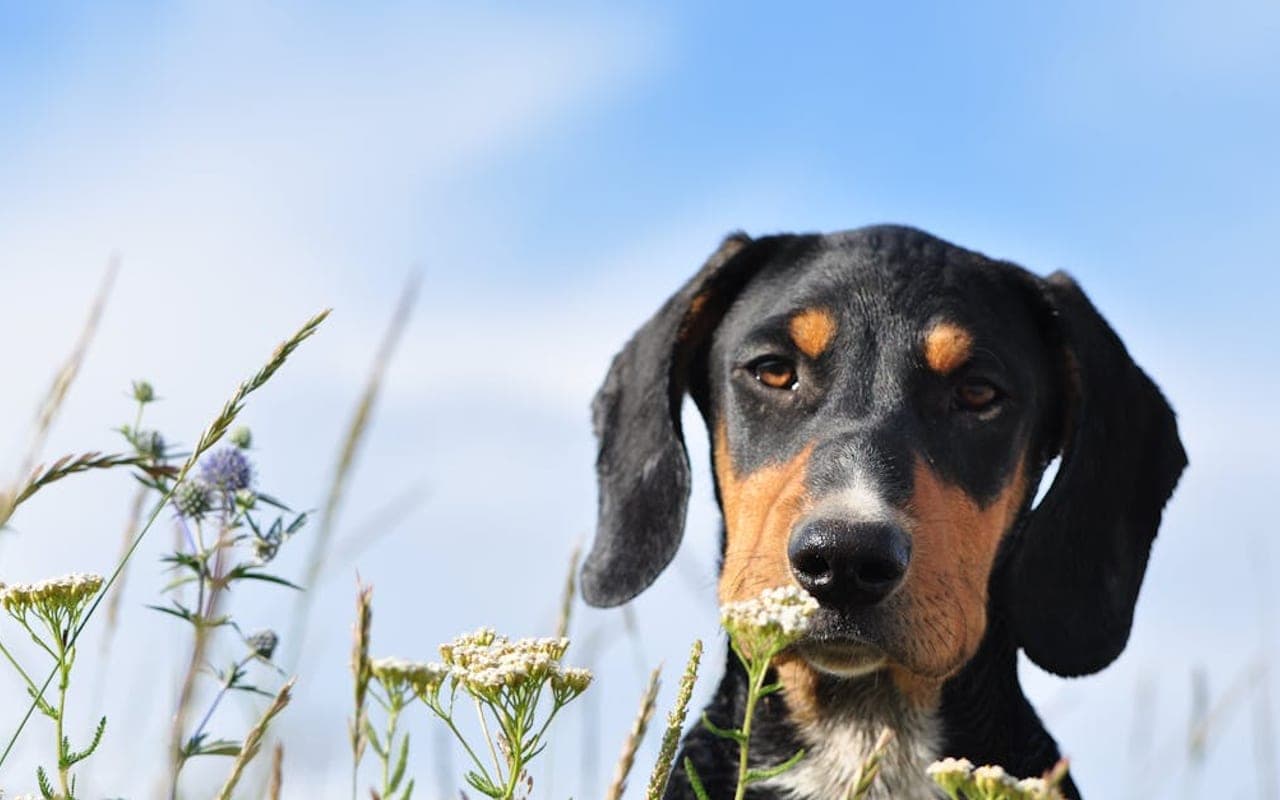
The Fédération Cynologique Internationale keeps the breed as standard number 241, in Group 6 (scent hounds), section 1.2 for medium-sized hounds, with a working trial required. That last detail matters to an owner: the registry still assesses this breed on what it can do, not only on how it is shaped. The FCI describes a black dog carrying tan points above each eye and tan on the muzzle and legs, sharply demarcated from the black, with white permitted on the nose, as a blaze, as a collar, on the chest and lower legs, and at the tail tip.
Temperament follows the job description. The American Kennel Club characterises the breed as good-natured, courageous and enduring — quiet and even at its foundation, but determined and lively. Read "determined" literally rather than as marketing: this is a hound bred to work out of its handler's sight and make its own decisions, and that independence shows up at home as much as in the field.
Exercise
Built for distance, and for deciding on its own
The Fédération Cynologique Internationale keeps the Transylvanian Hound in the section for medium-sized hounds required to pass a working trial, and defines it by the ability to find and follow a line independently, far from its handler. That sets the exercise brief. The American Kennel Club calls the breed enduring, and the Carpathian terrain it was selected in rewards a dog that keeps going for hours rather than one that sprints.
A long daily walk or run is the floor, not the plan; PetMD notes the breed was bred for hunting and needs daily exercise on that basis. Add work that uses the nose, because a hound given nothing to track will find its own quarry in your garden and your neighbourhood: scatter feeding, tracking lines laid in long grass, scentwork or mantrailing classes, and long sniffing walks where the dog sets the route.
Assume the recall will lose to a fresh scent
The independence the registries describe is not disobedience, and it does not train out. A hound built to commit to a line on its own judgement, out of sight, is a poor candidate for off-leash freedom near roads, livestock or wildlife. Use a long line in open country and check fencing is high and dug-in before you rely on it, because the failure mode here is a dog two valleys away, not one that ignored you in the park.
Puppies are the exception. VCA Animal Hospitals lists exercise and growth rate among the factors affecting hip dysplasia, and recommends moderate daily exercise with avoidance of high-impact activity such as jumping for affected dogs. Build distance gradually and save long days for a mature dog. Build distance gradually and save long days for a mature dog.
Grooming
A low-maintenance coat and one high-maintenance detail
The Fédération Cynologique Internationale standard describes a short, straight, dense coat lying flat over the whole body including the belly, a little longer on the neck, withers, backs of the thighs and underside of the tail, coarse to the touch, shiny, and carrying an undercoat. That construction is why grooming is light: a coat of this type sheds dirt as it dries and has no length to mat.
PetMD's guidance for the breed is an occasional going-over with a firm bristle brush and bathing kept to a minimum, because frequent washing strips the coat's natural condition. Weekly is enough for most of the year. Twice a year the undercoat lets go in bulk, and for those weeks a rubber curry or undercoat rake used every day or two pulls far more dead hair out of the dog than off your floor afterwards.
The ears are the real job
The ears hang flat against the cheek, and VCA Animal Hospitals notes that dogs with large, floppy or hairy ears are more prone to ear infections because water and moisture get trapped in the canal and let bacteria grow. A hound that has spent an afternoon in wet undergrowth, a stream or snow has created exactly those conditions. Lift each ear after outings, look and smell, and dry the outer ear and the skin beneath the flap — because a canal that dries promptly is a poorer place for organisms to establish. Any redness, discharge or odour is a vet's job, not a cotton bud's.
Trim nails whenever they meet the ground on a standing dog, because overlong nails change how the foot loads on a breed expected to cover rough ground, and check pads and toes after field days for thorns and grass seed.
Health
A short health record is not the same as a clean one
Very little has been documented about this breed's health, and that is the finding, not a clearance. PetMD describes the Transylvanian Hound as generally healthy and names hip and elbow dysplasia as the conditions to be aware of — close to the whole accessible veterinary literature on it: no breed-wide health survey, no breed-specific DNA panel.
That gap has a cause: as the Magyar Ebfajták Szövetsége (Hungarian Dog Breeds Association) records, organised breeding restarted around 1968 from a small number of dogs recovered after the breed was ordered destroyed in 1947. A population that small produces few reports of anything, so absent records are what you would expect whether the breed is sound or simply unstudied — treat what follows as things to screen for, not as documented frequencies.
Hips, and the parts you control
VCA Animal Hospitals describes hip dysplasia as a genetic disease affected by diet, environment, exercise, growth rate, muscle mass and hormones, arising from unequal growth rates in development. Signs can appear as early as a few months old but most commonly emerge between one and two years, and VCA states that a hip radiograph under general anaesthetic is the preferred diagnostic method — not something you judge by watching a dog move.
Two controllables follow. VCA cites work in which two thirds of puppies fed as much as they wanted developed hip dysplasia, against one third of puppies fed measured meals, and reports overweight puppies were almost twice as likely to develop hip dysplasia as normal-weight ones. That means weighed meals through growth, a lean adult, and patience about distance work. The third lever is the breeder: ask for radiographic hip and elbow evaluations on both parents, and ask what the results were — in a gene pool this narrow, value comes from a breeder using the numbers, not from a certificate existing.
Ears, because of how this dog is built and used
The drop ear hangs flat to the cheek over a canal that stays warm and, after fieldwork, wet. VCA Animal Hospitals notes that dogs with large, floppy or hairy ears are more prone to infection because moisture becomes trapped in the canal, allowing bacteria to grow, and that allergies underlie a large share of cases. Head shaking, scratching, redness, odour and dark discharge are what an owner sees.
These belong with a vet, not a home remedy: VCA notes that different organisms need different medications and that the eardrum must be confirmed intact first, because some drops can cause permanent hearing loss through a ruptured drum. Repeated infections usually point to an underlying cause such as allergy.
The rest is active-dog husbandry
For a hound working rough ground, most veterinary visits are ordinary: cuts, grass seed in feet and ears, ticks and what they carry locally, joint wear from carrying extra weight. Keep vaccination, parasite prevention and dental care on your vet's schedule, and add joint assessment to the annual exam once the dog is middle-aged. PetMD puts average lifespan at 10 to 12 years; longer figures circulate, but no longevity study exists to settle the range, so treat any number as an estimate, not a prognosis. None of this replaces your own veterinarian, the only person who can examine your dog.
Frequently Asked Questions
Is the Transylvanian Hound a healthy breed?
PetMD describes it as generally healthy, naming hip and elbow dysplasia as the conditions to be aware of. But no breed-wide health survey sits behind that: the population has been small since the breed was rebuilt after 1947, so the short record shows how few dogs have been studied, not proof of soundness.
Should Transylvanian Hound breeding stock be hip-screened?
Yes. VCA Animal Hospitals states that a hip radiograph under general anaesthetic is the preferred method for diagnosing hip dysplasia, so ask a breeder for both parents' actual hip and elbow evaluations, not just confirmation that testing happened.
How often should I check my Transylvanian Hound's ears?
After every wet or off-path outing, and weekly otherwise. VCA Animal Hospitals notes that floppy-eared dogs are more prone to infection because moisture gets trapped in the canal, so drying the outer ear and the skin under the flap removes what bacteria need. See a vet for redness, odour or discharge.
How long do Transylvanian Hounds live?
PetMD gives an average of 10 to 12 years. Longer estimates circulate, but no published longevity study covers this breed, so treat it as an approximation, not a measured breed average.
Sources
This guide draws on the following published references. Each opens in a new tab so you can check it against what you have read here.
Fédération Cynologique Internationale
FCI Standard N° 241 — Segugio della Transilvania (Erdélyi Kopó), ENCI-hosted copy(opens in a new tab)American Kennel Club
Transylvanian Hound - Dog Breed Information(opens in a new tab)Magyar Ebfajták Szövetsége (Hungarian Dog Breeds Association)
Erdélyi kopó(opens in a new tab)PetMD
Transylvanian Hound(opens in a new tab)VCA Animal Hospitals
Ear Infections in Dogs (Otitis Externa)(opens in a new tab)VCA Animal Hospitals
Hip Dysplasia in Dogs(opens in a new tab)
Affiliate disclosure: We may earn a commission from qualifying purchases. This doesn't affect our recommendations.
Recommended Products
Transylvanian Hound Care Guide Book
Breed-focused reading and owner references for Transylvanian Hound care, training, grooming, and health planning.
Transylvanian Hound Food and Supplies
Helpful supplies for transylvanian hound dog supplies routines at home.
Transylvanian Hound Grooming Tools
Helpful supplies for transylvanian hound grooming tools routines at home.
Get personalized pet care tips
Join our newsletter for breed-specific advice, care guides, and expert tips delivered weekly.
No spam, ever. Unsubscribe anytime.