
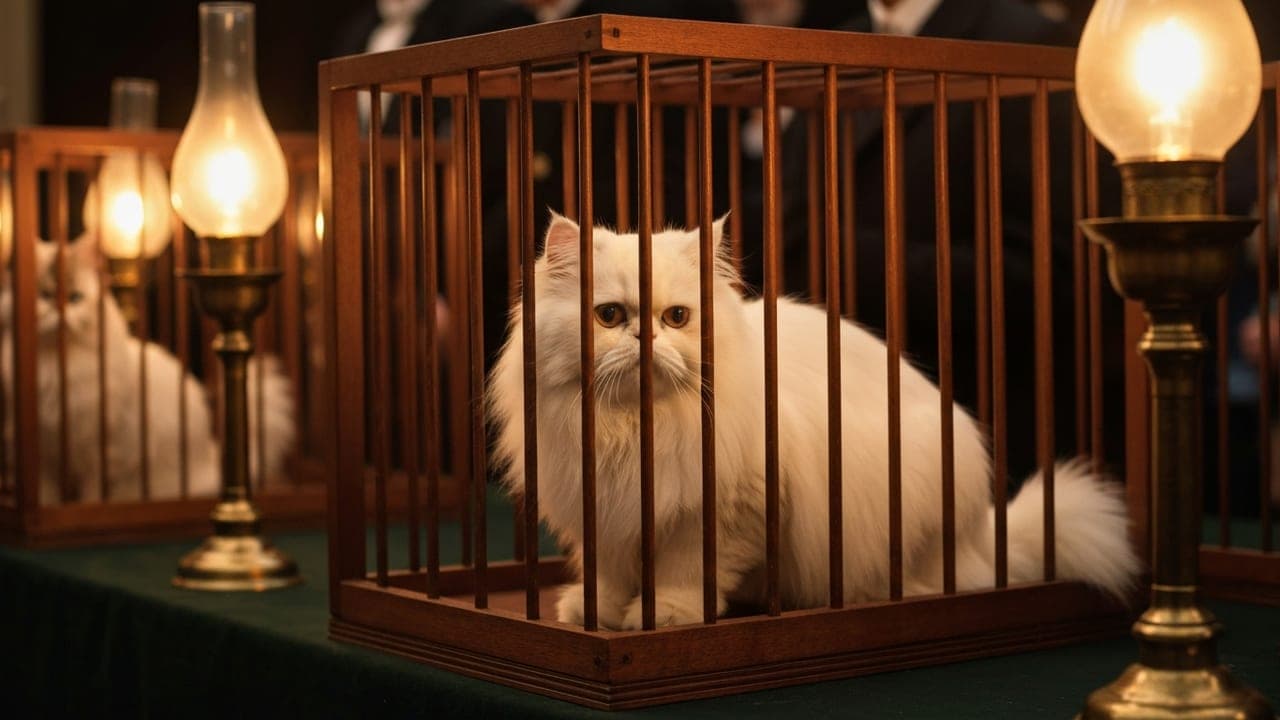
Crystal Palace, 1871: The Father of the Cat Fancy
Harrison Weir was a prolific Victorian illustrator who drew everything from prize cattle to botanical specimens, but cats were his consuming passion. He owned many, observed them obsessively, and believed that they were chronically undervalued as companions precisely because nobody had organized a forum for appreciating them properly. His solution was a cat show.
Organizing the world's first cat show required both vision and stubbornness. Cats, unlike dogs, had never been formally bred for specific traits. There were no registries, no studbooks, no agreed criteria for what a "good" Persian or a "correct" Tabby looked like. Weir invented these categories himself, writing the first breed standards from his own observations and convictions. Then he rented space at the Crystal Palace, London's great exhibition hall, and on July 13, 1871, 160 cats arrived — and an estimated 20,000 people came to see them.
Weir later wrote of his motivation with characteristic Victorian earnestness: "I wish to give them that attention which their cleanly nature, their habits, their very look of ease and comfort demands." Beneath this gentle sentiment was a more ambitious project: elevating the domestic cat from tolerated pest-controller to recognized companion deserving of the same social infrastructure that dogs had been receiving since the Kennel Club's founding two years earlier.
The Breeds That Crystal Palace Created
The 1871 show recognized several distinct categories: Persian, Siamese, Abyssinian, British Shorthair, and various long-haired types that would later be consolidated under the Persian designation. Each category came with a Weir-written standard. Each standard reflected both Weir's aesthetic preferences and his assessment of what already-existing cat varieties looked like when they were at their finest.
The Persian cat as a show animal was particularly transformed by this process. Long-haired cats had been kept as pets in Britain since the 1600s, brought from Persia and Turkey by travelers and merchants. Their long coats were considered exotic and beautiful, but individual cats varied enormously in face structure, coat quality, and overall type. The show system created selection pressure toward a specific version of the Persian: large, round-headed, with a flat face and extremely dense, flowing coat. Each successive generation of winners pushed these traits further.
This is the origin of what veterinarians now call the "extreme" Persian type: a cat whose facial structure has been compressed to the point where the nose sits between the eyes rather than below them, creating chronic respiratory and dental problems. Weir himself would likely have been appalled by this outcome. His original Persian standards called for a moderate, rounded face — not the extreme brachycephalic form that show selection created over subsequent decades.
The Siamese presents a different origin story. Siamese cats had been kept by the Siamese royal family for centuries and were considered sacred. Two Siamese were presented to the British consul in Bangkok in 1884 and brought to England, where they appeared at shows and generated intense controversy. Critics described their appearance as "nightmare cats" and their behavior as strange. Enthusiasts found them mysterious and compelling. The Siamese's pointed coloration and vocal personality divided opinion sharply, but the breed's exotic origin story gave it an authenticity that other breeds lacked.
The Maine Coon, uniquely, was a naturally occurring American breed rather than a deliberate Victorian creation. Large, semi-long-haired cats native to New England's rugged climate, Maine Coons were first shown at the Madison Square Garden cat show in New York in 1895, where a Maine Coon named Cosey won Best in Show. Their robust health, size, and naturally evolved traits made them an interesting contrast to the increasingly refined European pedigree cats.
The National Cat Club and Organized Breeding
In 1887, sixteen years after Crystal Palace, Harrison Weir founded the National Cat Club and became its first president. The NCC created Britain's first cat studbook, began registering pedigree cats, and established a formal show circuit. The organizational model was borrowed directly from the Kennel Club, though Weir adapted it for a rather different animal.
The fundamental challenge of applying dog-show logic to cats was behavioral. Dogs, selectively bred for trainability over thousands of years, could be taught to stand still for judges, to gait on a lead, to hold specific positions. Cats could not. Early show rules had to accommodate the cat's nature: animals were presented in individual cages rather than led around a ring, and judges circulated to evaluate them rather than the reverse. This format — cats in numbered pens, judges moving through the hall — has persisted in essentially unchanged form to the present day.
Cat fancy magazines began appearing in the 1890s: Our Cats (founded 1899), then others, creating the communication infrastructure that bound the cat fancy community together across geographic distances. These publications reported on show results, published breed standards updates, debated the merits of new colors and varieties, and ran advertisements from breeders seeking to sell kittens. The social world of the cat fancy, in miniature, was beginning to resemble the social world of the dog fancy.
America Joins the Cat Fancy
The first American cat show of record was held at Madison Square Garden in New York City in May 1895, organized by the physician James T. Hyde. It drew 176 cats and considerable public attention. The show demonstrated that the cat fancy could cross the Atlantic successfully — American cat owners were as enthusiastic as their British counterparts, if slower to organize formally.
The Cat Fanciers' Association was founded in 1906, providing American cat fancy with the organizational infrastructure that the Kennel Club had given British dog fancy in 1873. The CFA created its own studbook, developed breed standards sometimes in alignment with British ones and sometimes in deliberate divergence, and established a show circuit that continues to operate across North America.
One divergence between British and American cat fancy proved consequential. The British cat fancy had recognized the British Shorthair as a breed from Weir's original shows. American cat fancy was slower to embrace shorthaired domestic cats as subjects of serious breeding, preferring the more dramatically different long-haired and pointed breeds. This preference influenced which breeds received the most development attention in early American cat fancy and shaped the American fancy's character differently from its British counterpart.
The Health Shadow of the Show Ring
The cat fancy's health legacy is mixed in ways that parallel — and in some cases exceed — the problems the dog fancy created. The extreme Persian face is perhaps the most visible example: a standard that began with moderate aesthetic preferences was pushed, over decades of show selection, to a configuration that is biomechanically problematic. Flat-faced Persians experience breathing difficulty, eye drainage problems from compressed tear ducts, and dental overcrowding. Veterinary organizations in Europe and America have pushed the cat fancy to revise standards, with partial success.
The Scottish Fold, a breed not formalized until 1966 but worth noting in this historical context, emerged from a natural mutation discovered by a shepherd in Scotland. The folded ears that give the breed its distinctive appearance are caused by a genetic defect in cartilage development — a defect that affects not just the ears but all cartilage in the body, causing progressive, painful joint disease. Many veterinary organizations consider the Scottish Fold an ethically problematic breed; several European countries have moved toward banning its breeding. This is the show-ring selection problem at its starkest: a striking visual characteristic that is inseparable from suffering.
The cat fancy has also produced healthy, long-lived breeds that represent its better angels. The Maine Coon, Ragdoll, and Bengal all emerged from breeding programs that prioritized temperament and health alongside appearance, producing robust animals with natural vigor. The British Shorthair, one of the cat fancy's founding breeds, is consistently ranked among the healthiest pedigree cats.
For related reading, see our piece on Egyptian cats and their divine status and Victorian dogs and the birth of modern pet culture.
Frequently Asked Questions
Q: Who organized the first cat show and when was it held?
Harrison Weir, a Victorian illustrator and cat enthusiast who called himself the "Father of the Cat Fancy," organized the world's first cat show at the Crystal Palace in London on July 13, 1871. The show attracted 160 cats and an estimated 20,000 visitors.
Q: When did cat shows begin in America?
The first American cat show of record was held at Madison Square Garden in New York City in May 1895, drawing 176 cats and significant public attention. The Cat Fanciers' Association, which provides organizational infrastructure similar to the Kennel Club in Britain, was founded in 1906.
Q: How did the show ring change what Persian cats look like?
The extreme flat face of the modern show Persian was created by generations of show selection that progressively rewarded more compressed facial structures. Harrison Weir's original Persian breed standard called for a moderate, rounded face. Successive show competition pushed the face structure toward extremes that now cause chronic respiratory and dental problems — an outcome Weir himself would likely not have endorsed.
Q: Why were Siamese cats controversial when they first appeared at shows?
Siamese cats, first brought to England in 1884 by the British consul in Bangkok, were controversial because their appearance — pointed coloration, angular build, and blue eyes — was unlike any British cat. Critics described them as 'nightmare cats.' Their distinctive vocalizations and interactive personalities also set them apart from the more reserved British cats. Despite initial controversy, their exotic royal Siamese origin story gave them lasting appeal that made them one of the most recognized pedigree cat breeds in the world.
Author & Reviewer
Related Reading
Continue the History
Understand Your Companion
Find Your Match
Ready to find your perfect companion?
Take the Breed Quiz →