
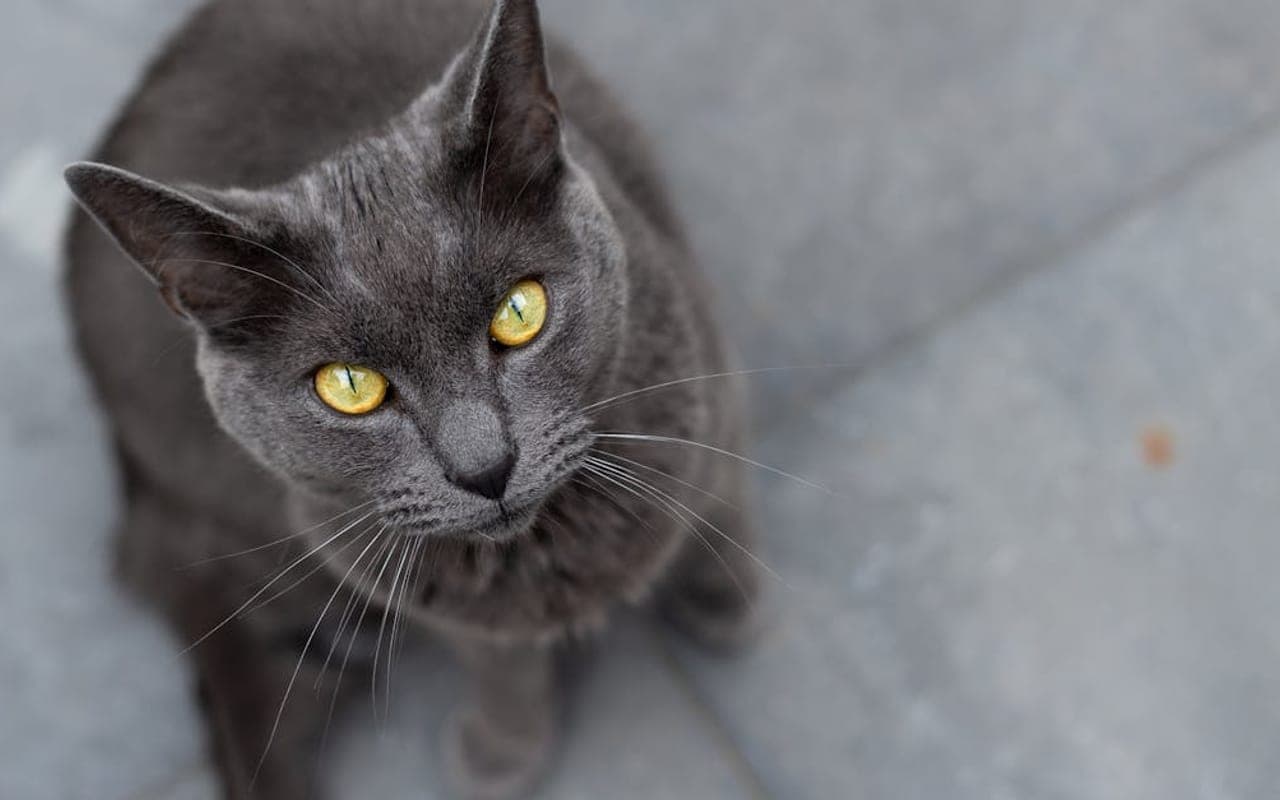
Chartreux Care Guide
Day to day, the Chartreux asks very little of you. The work is in noticing when something has changed. This is a solid, blue, woolly-coated cat of 3 to 7.5 kg and 23 to 30 cm at the shoulder, with a u
In This Guide
Overview
Day to day, the Chartreux asks very little of you. The work is in noticing when something has changed. This is a solid, blue, woolly-coated cat of 3 to 7.5 kg and 23 to 30 cm at the shoulder, with a usual lifespan of 12 to 15 years. Blue is the only colour the major registries recognise [13]. The breed standard describes its voice as "seldom used" [2]. A quiet cat gives you little sound to go on, so weight, appetite and the litter box are the signals to track instead.
Three features shape the care plan. First, a large study of cats with urinary stones found the Chartreux among the breeds at raised risk of struvite stones [8]. Second, the breed matures slowly, and a young cat's weight is not its adult weight [1][2]. Third, it had the highest average inbreeding of the eight French cat populations in a pedigree study [4], so the questions you ask a breeder are part of the cat's health care.
This breed is a poor match for an owner who wants a cat that clearly announces its needs, or who would rather not handle the cat's mouth, coat and belly every week. It suits someone willing to weigh, feel and watch.
This guide covers daily care only. For temperament, history and origin, see the Chartreux breed page. For other breeds, browse the care guide library.
Daily Care
A Chartreux will rarely prompt you, so attach each check to something you already do.
- Litter box, every day: scoop and look for the signs Cornell lists, including straining, more frequent visits, blood in the urine, or urine outside the box [9]. A male straining with little or nothing coming out needs a vet immediately [9].
- While the cat sleeps, now and then: count its breaths for a minute. A resting rate above 35 is one of the heart-failure signs Cornell describes [5].
- Monthly: weigh the cat and write the number down, especially while a young male is still filling out.
Handling is the skill that makes all of this possible. A cat that accepts having its mouth opened, its undercoat combed and its ribs pressed is a cat you can monitor at home. Start young, in short sessions, using the same gradual build-up VCA describes for tooth brushing [11].
With a cat this quiet, change is the warning sign. A skipped meal, a dropped play session or a missed jump onto a favourite shelf is worth writing down.
Nutrition
Two facts drive feeding: the Chartreux keeps developing for years, and the adult gains weight easily.
CFA puts full maturity at three to five years and notes that females may be significantly smaller than males [1]. The breed standard adds that males are slower to mature [2]. The adult range for the breed is 3 to 7.5 kg. A two-year-old male below the top of that range may still be filling out, while a five-year-old carrying extra weight has finished growing. Set portions from body condition rather than from age or a chart.
VCA describes a hands-on check: run your fingers over the ribs just behind the front legs. Ribs that feel like the back of your hand suggest good condition, and ribs that feel like the fleshy part of your palm mean the cat may be carrying too much weight [12]. Do this weekly, pressing through the coat to the body, and weigh the cat monthly.
VCA also notes the breed tends to be sensitive to rich food and to changes in diet [3]. Three habits follow:
- Weigh portions. Use a kitchen scale rather than a scoop, and count treats as part of the day. VCA's guidance is that treats should make up no more than 10% of daily calories [12].
- Choose food with your vet. Because the breed tends to be sensitive to rich food or changes in the diet, VCA advises working with your veterinarian on selecting the right quality commercial food [3].
- Plan weight loss with your vet. VCA advises against simply reducing the volume of a cat's current food for weight loss and recommends a calorie-controlled plan agreed with your vet [12].
Exercise
VCA notes that adult Chartreux "are not as active and can become overweight" [3]. Exercise for this cat is less about burning off energy and more about keeping a low-energy adult moving often enough to hold its weight.
Food puzzle toys, which release kibble as the cat bats and rolls them [14], turn part of the daily ration into movement for an adult that VCA describes as not very active [3].
Climbing and jumping also let you watch the knees. Cornell lists unwillingness to jump among the signs of a slipping kneecap [10], so if your cat stops climbing to its usual high spots, mention it to your vet.
If your cat is getting heavier and playing less, add a session and weigh it.
Grooming
Grooming a Chartreux is mostly about the undercoat. The GCCF standard describes the coat as medium-short, dense and slightly woolly, with a "breaking look" and an abundant undercoat [2]. CFA compares the texture to sheep's wool [7].
The schedule follows the seasons. VCA advises brushing weekly, rising to two to three times a week in fall and spring, when shedding is worst [3]. CFA confirms the breed sheds most in those two seasons [1].
Expect the coat to change with age and sex. The standard allows a silkier, thinner coat in females and in cats under two years [2]. CFA notes the full coat can take several years to develop, and that the cat often looks its best at four to five years [7].
Each grooming session is also the easiest time to trim nail tips, look inside the ears and lift the lips to see the teeth.
Health
We found no breed-wide prevalence study for the Chartreux. What is documented is a large case-control study of urinary stones, a breed listing by a feline health centre, one published case report, a note in a cat registry's breed profile, and a pedigree study of French cat breeds. None of these tells you how often a given Chartreux will get a given disease. The list runs from the problem that can turn dangerous fastest to the slowest.
- Urinary stones (struvite) and blockage. Lekcharoensuk and colleagues compared 7,334 cats with struvite stones, analysed at the Minnesota Urolith Center between 1981 and 1997, against 150,482 cats without urinary disease. The Chartreux was one of the breeds with an increased risk of struvite stones, as were female and neutered cats [8]. That is a raised risk relative to other cats; the study does not say what share of Chartreux develop stones. Cornell lists the signs of lower urinary tract disease as straining, urinating more often, blood in the urine, and urinating outside the litter box [9]. Male cats are more likely to block because their urethra is longer and narrower, and Cornell calls a blockage "an absolute emergency, requiring immediate veterinary treatment" [9]. If your cat, and especially a male, is straining and producing little or no urine, take it to a vet immediately [9].
- Hypertrophic cardiomyopathy (HCM). The Cornell Feline Health Center lists the Chartreux among the breeds predisposed to HCM, alongside the Maine Coon, Ragdoll, Sphynx, British Shorthair and Persian [5]. In HCM the wall of the heart's main pumping chamber thickens [5]. Many cats show no signs early on [5], so a cat that seems normal may still have a thickened heart. The emergency signs are rapid or laboured breathing, a resting breathing rate above 35 breaths a minute, and sudden hind-leg lameness or paralysis with severe pain, caused by a blood clot [5]. Cornell notes that affected cats are also at risk of sudden death [5]. Echocardiography, an ultrasound of the heart, is the standard test [5]. We found no Chartreux-specific prevalence figure, so treat the listing as a reason to ask your vet about heart screening and to ask whether the breeding cats were scanned.
- Polycystic kidney disease (PKD). In 2010, Volta and colleagues reported the first case of PKD in a Chartreux, a 12-year-old female. Ultrasound found multiple kidney cysts, and a genetic test on a blood sample was positive for the PKD1 mutation [6]. The authors describe PKD as progressive, with enlarging cysts compressing the surrounding normal kidney tissue, and they conclude that Chartreux should be included in PKD screening programmes [6]. One case is not a rate, but it shows the mutation occurs in the breed. Ask whether the parents were checked by kidney ultrasound or tested for the PKD1 mutation, and keep the results.
- Kneecap dislocation (patellar luxation). CFA notes that patellar luxation, a heritable condition that can affect mobility, "has also been seen in some Chartreux" [1]. We found no population figure. Cornell lists the typical signs as lameness, skipping on the affected leg, and unwillingness to jump [10]. Luxation is graded one to four; Cornell usually recommends surgery for grades three and four and is less likely to for grades one and two [10]. If your cat stops jumping onto its usual furniture, ask your vet to check its knees.
- Weight gain in mature adults. CFA describes the breed as generally healthy but notes that weight gain can be a problem for some mature Chartreux [1]. The nutrition section explains how to check for it.
Hip dysplasia is not on this list because we found no published report of it in the Chartreux. That is an absence of data, not evidence that the breed is free of it.
The gene pool behind these risks. Leroy and colleagues analysed pedigree records for eight cat populations raised in France [4]. The inbreeding coefficient ranged from 2% in the Maine Coon to 4.4% in the Chartreux, the highest of the group, and only 11% of Chartreux kittens went on to become breeding cats [4]. Ask the breeder how closely the two parents are related and what testing they have done.
Costs
These are the breed-specific drivers to plan around:
- Screening before you buy. Ask whether the parents had an echocardiogram for HCM [5] and a kidney ultrasound or PKD1 test [6].
- An unplanned emergency visit. A blocked bladder needs a vet immediately [9], so know where the nearest emergency clinic is before you need it.
- Possible knee surgery. Cornell usually recommends surgery for grade three and four patellar luxation [10].
- Weight management. A kitchen scale and a calorie-controlled plan agreed with your vet [12] are recurring, planned items.
Frequently Asked Questions
Why does my Chartreux kitten have faint stripes?
The GCCF breed standard says allowances should be made for "ghost" barring on kittens.
My kitten's eyes are not the deep colour I expected. Will they change?
Probably. The GCCF standard notes that eye colour is still maturing in kittens, so judge it once the cat is older.
My adult male has developed heavy cheeks. Is he overweight?
Not necessarily. The GCCF standard describes jowls in males over two years old. Use the rib check behind the front legs, not the face, to judge body condition.
Can a Chartreux be any colour other than blue?
No. The major registries, including CFA, GCCF, FIFe and TICA, recognise blue only. A cat of another colour is not a Chartreux under any of their standards.
Is a breathing check really worth doing on a healthy cat?
Yes, because HCM often shows no early signs. Counting breaths while the cat sleeps takes a minute, and Cornell treats a resting rate above 35 breaths a minute as a warning sign.
Sources
This guide draws on the following published references. Each opens in a new tab so you can check it against what you have read here.
Cat Fanciers' Association
Cat Fanciers' Association — Chartreux breed profile(opens in a new tab)Governing Council of the Cat Fancy (GCCF)
Governing Council of the Cat Fancy (GCCF) — Chartreux Standard of Points(opens in a new tab)VCA Animal Hospitals
VCA Animal Hospitals — Chartreux(opens in a new tab)Leroy G, Vernet E, Pautet MB, Rognon X, Tufts Canine & Feline Breeding and Genetics Conference 2013 (VIN)
Leroy G, Vernet E, Pautet MB, Rognon X, Tufts Canine & Feline Breeding and Genetics Conference 2013 (VIN) — Population structure and gene flow within pure-bred cats raised in France(opens in a new tab)Cornell Feline Health Center
Cornell Feline Health Center — Cardiomyopathy(opens in a new tab)Volta A, Manfredi S, Gnudi G, Gelati A, Bertoni G (2010), Journal of Feline Medicine and Surgery, doi:10.1016/j.jfms.200
Volta A, Manfredi S, Gnudi G, Gelati A, Bertoni G (2010), Journal of Feline Medicine and Surgery, doi:10.1016/j.jfms.2009.06.001 — Polycystic kidney disease in a Chartreux cat(opens in a new tab)Cat Fanciers' Association (Debra Rexelle)
Cat Fanciers' Association (Debra Rexelle) — The Chartreux(opens in a new tab)Lekcharoensuk C, et al. (2000), Journal of the American Veterinary Medical Association 217(4):520
Lekcharoensuk C, et al. (2000), Journal of the American Veterinary Medical Association 217(4):520-525 — Association between patient-related factors and risk of calcium oxalate and magnesium ammonium phosphate urolithiasis in cats(opens in a new tab)Cornell Feline Health Center
Cornell Feline Health Center — Feline Lower Urinary Tract Disease(opens in a new tab)Cornell Feline Health Center
Cornell Feline Health Center — Luxating Patella(opens in a new tab)VCA Animal Hospitals
VCA Animal Hospitals — Brushing Your Cat's Teeth(opens in a new tab)VCA Animal Hospitals
VCA Animal Hospitals — Obesity in Cats(opens in a new tab)World Cat Congress
World Cat Congress — Chartreux breed comparison among member organisations(opens in a new tab)VCA Animal Hospitals
VCA Animal Hospitals — Cat Behavior and Training: Play and Play Toys(opens in a new tab)
Affiliate disclosure: We may earn a commission from qualifying purchases. This doesn't affect our recommendations.
Recommended Products
Chartreux Care Guide Book
Breed-focused reading and owner references for Chartreux care, training, grooming, and health planning.
Chartreux Food and Supplies
Helpful supplies for chartreux cat supplies routines at home.
Chartreux Grooming Tools
Helpful supplies for chartreux grooming tools routines at home.
Get personalized pet care tips
Join our newsletter for breed-specific advice, care guides, and expert tips delivered weekly.
No spam, ever. Unsubscribe anytime.