
Turkish Van Care Guide
A working cat from the highlands of Lake Van The Turkish Van is a natural landrace from the rugged, climatically extreme country around Lake Van in eastern Turkey, where it lived as a self-sufficient
In This Guide
Overview
A working cat from the highlands of Lake Van
The Turkish Van is a natural landrace from the rugged, climatically extreme country around Lake Van in eastern Turkey, where it lived as a self-sufficient farm and village cat long before any registry described it. The International Cat Association calls it an ancient breed of the Lake Van region; the Cat Fanciers' Association dates the Western breeding population to a pair brought to England by British photographers in 1955, with GCCF recognition following in 1969. That late, narrow founding matters practically: the Van reached the show bench as an already-finished working animal rather than a shape someone engineered, which is why its health record reads differently from heavily reconstructed breeds.
Size, pattern and coat
Vans are substantial. The Cat Fanciers' Association gives males roughly 9 to 20 pounds and females 7 to 12, on a long, broad-chested, genuinely muscular frame, and notes the breed takes three to five years to finish maturing. Expect a lanky adolescent for far longer than you would with most cats, and judge body condition on the animal in front of you rather than on age.
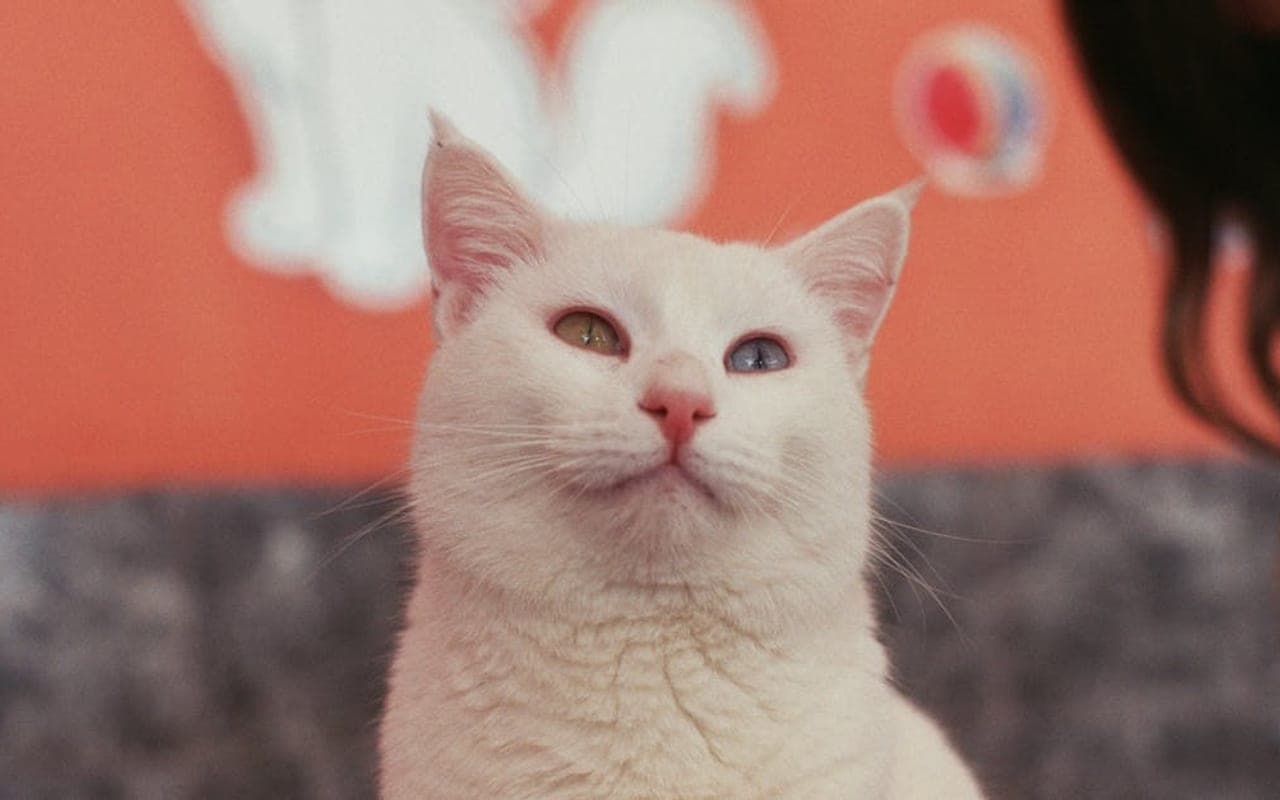
The signature is the van pattern: a white cat carrying colour only on the head and tail, sometimes with tail rings and a "thumbprint" over the shoulder. Solid-white kittens do occur in Van litters, and how registries treat them differs — which becomes relevant to hearing. The semi-long coat lies flat, has no woolly undercoat, and has a cashmere or rabbit-fur texture that sheds water — the physical basis for the breed's swimming reputation, according to the Cat Fanciers' Association. Eyes may be amber, blue, or odd-eyed.
Temperament
This is an energetic, strong-willed, intensely people-involved cat that is generally not a lap cat. Vans supervise from height, fetch, and take a real interest in running water. Plan for a household participant, not an ornament.
Exercise
Build upward, not outward
The International Cat Association describes the Van as solidly built and powerful, with a well-developed chest and real muscularity — plus the drive to use it. Vans jump high, climb hard and settle on the highest surface available, so height satisfies them where floor space does not. PetMD recommends cat trees, scratching posts and wall-mounted shelves for the breed; a Van denied a route upward invents one across your shelving.
Give at least one tall, stable climbing structure with a route between levels that avoids furniture. Stability outranks height: a heavy adult that hits a wobbly tower returns to the bookcase.
Play that actually tires a Van
Two vigorous interactive sessions a day, ten to fifteen minutes each, beat a room full of unattended toys. Use a wand lure and run the full sequence — stalk, chase, pounce, catch — then end on a caught toy and a meal, because an unresolved hunt leaves a cat aroused rather than settled. Rotate toys weekly, because this breed stops chasing a lure it has solved. The Cat Fanciers' Association notes that Vans fetch instinctively and can be trained to tricks and to walk on a lead, so puzzle feeders, clicker work and harness training are real outlets, not novelties.
Water, and the strong-willed streak
The water affinity is genuine, but most Vans express it by batting at taps and splashing their dish rather than swimming. A shallow supervised basin of tepid water with a floating toy is enough. Never force a cat into water and never leave one unsupervised near a full bath, sink or pool.
A bored Van does not go quiet — it gets loud, destructive and pushy — so treat daily play as routine.
Grooming
Why a semi-long coat here is low-effort
Most mats form where a soft undercoat tangles against the guard hairs above it. The Turkish Van does not have that layer. The Cat Fanciers' Association describes a semi-long coat that lies flat with no undercoat and a cashmere-like texture that repels water and sheds dirt, and PetMD describes the same single, cashmere-textured coat as resistant to matting. A Van is a long-haired-looking cat with short-haired grooming demands.
Weekly combing suits most of the year, the same interval The International Cat Association gives. Use a wide-tooth comb rather than a slicker, because the job is to lift and separate a flat-lying coat, not strip a dense one. Work the ruff, breeches and behind the elbows — the friction points where what little tangling happens starts.
The seasonal change catches owners out
Vans carry a heavier winter coat and drop most of it in spring, which PetMD flags as a period of significant shedding. Comb several times a week through that changeover, because loose hair the comb misses is hair the cat swallows.
Ears, claws and teeth
Check ears weekly and clean only the visible outer surface with a vet-approved product; anything pushed into the canal risks packing debris against the eardrum. Trim claw tips every few weeks, taking the clear hook only.
Teeth matter most. Dental disease is among the commonest problems PetMD lists for the breed, and brushing is the only home step that reliably slows plaque, so introduce a finger brush and feline toothpaste early. Human toothpaste is not safe for cats. Red gums, drooling, dropped food or chewing on one side is a veterinary appointment, not a grooming problem.
Health
A robust natural breed with a short disease list
The Cat Fanciers' Association states the Turkish Van has no known genetic defects, and PetMD calls it one of a handful of natural breeds with fewer inherited problems than heavily selected breeds. That describes a population, not your cat.
Deafness: the van pattern is not the high-risk group
Congenital deafness in cats tracks the dominant white gene, W. International Cat Care explains that W produces the white coat and is also associated with blue eyes and deafness, while noting that a W cat is not automatically blue-eyed and a blue-eyed white cat is not automatically deaf.
A classic van-patterned cat is not a dominant-white cat. The Cat Fanciers' Association describes the van pattern as a coloured cat carrying very large patches of white under the piebald (white spotting) gene. That different allele is why the same registry states that, unlike solid white cats, Turkish Vans show no association with deafness, and why PetMD calls the breed typically not prone to hereditary deafness.
The risk does apply to some Vans. Solid-white kittens do occur in Van litters: the Cat Fanciers' Association will not show them, its standard disqualifying a total absence of colour on the head and tail, while The International Cat Association accepts them as Turkish Vans and the GCCF registers them separately as Turkish Vankedisi. A solid-white cat carries the dominant white gene, so that is the individual to have tested. An odd-eyed cat may be affected only on the blue-eyed side, which is hard to spot at home. The objective test is BAER (brainstem auditory evoked response), which International Cat Care describes as simple and non-invasive at specialist centres; ask a breeder of white Vans whether the parents were tested. There is no treatment for inherited deafness, so management is environmental: indoors or a secure enclosure, and light or vibration cues rather than voice.
Heart disease: screen rather than assume
Hypertrophic cardiomyopathy is not established as a Turkish Van breed disease; VCA Animal Hospitals names Maine Coon, Ragdoll and Sphynx as the breeds with heritable HCM mutations. It is still the commonest feline heart disease, and VCA Animal Hospitals describes it as often silent early, with breathlessness and lethargy appearing only once heart failure develops. Diagnosis needs an echocardiogram — VCA Animal Hospitals is explicit that clinical signs, X-rays and an ECG can raise suspicion but a cardiac ultrasound is what makes the diagnosis — so ask your vet to listen at every annual visit and to discuss imaging if anything is heard.
Urinary blockage is the emergency to learn first
The Cornell Feline Health Center calls urethral obstruction a true medical emergency needing immediate veterinary attention, notes males are at higher risk because their urethra is longer and narrower, and warns untreated cats can die within twenty-four to forty-eight hours. Cornell links stress to feline idiopathic cystitis and advises fresh water always available plus one more litter tray than you have cats.
The everyday work that pays most
Dental disease and obesity are the two problems PetMD flags for the breed, and both are owner-controlled: brushing plus veterinary dental checks slow periodontal disease, and measured meals with daily play hold weight down, because obesity compounds joint pain, diabetes and anaesthetic risk. Keep vaccination and year-round parasite prevention on schedule. Any change in appetite, thirst, litter habits or breathing earns a call, as cats conceal illness. This article is general information and does not replace advice from your own veterinarian.
Frequently Asked Questions
Are Turkish Van cats deaf?
Usually not. Deafness tracks the dominant white gene, and a van-patterned cat carries white spotting rather than dominant white — the Cat Fanciers' Association states that, unlike solid white cats, Turkish Vans show no association with deafness. The exception is a solid-white Van, which carries the dominant white gene — that cat should be BAER tested, and a breeder should be able to say whether the parents were. Blue or odd eyes are accepted in van-patterned cats too, where the risk is not established; testing is still the only way to be certain.
Do Turkish Vans need screening for hypertrophic cardiomyopathy?
HCM is not documented as a Turkish Van breed disease; VCA Animal Hospitals names Maine Coon, Ragdoll and Sphynx as the breeds with heritable mutations. It is still the commonest feline heart disease and often silent early, so ask your vet to listen annually and discuss an echocardiogram if a murmur is heard.
Is it safe to let a Turkish Van swim?
Water affinity is genuine and the coat water-repellent, but supervise: offer a shallow basin of tepid water or a running tap, never force a cat in, and never leave one alone near a filled bath, sink or pool.
What health emergency should a Turkish Van owner recognise fastest?
A blocked bladder in a male cat. The Cornell Feline Health Center calls urethral obstruction a true medical emergency needing immediate attention, with death possible within twenty-four to forty-eight hours. Repeated straining that produces little or no urine means going now, not wait-and-see.
Sources
This guide draws on the following published references. Each opens in a new tab so you can check it against what you have read here.
The Cat Fanciers' Association
Turkish Van Article(opens in a new tab)The International Cat Association
Turkish Van - TICA - The International Cat Association(opens in a new tab)International Cat Care
Inherited deafness in white cats(opens in a new tab)VCA Animal Hospitals
Cardiomyopathy in Cats(opens in a new tab)Cornell Feline Health Center
Feline Lower Urinary Tract Disease(opens in a new tab)PetMD
Turkish Van Cat Breed Health and Care(opens in a new tab)
Affiliate disclosure: We may earn a commission from qualifying purchases. This doesn't affect our recommendations.
Recommended Products
Turkish Van Care Guide Book
Breed-focused reading and owner references for Turkish Van care, training, grooming, and health planning.
Turkish Van Food and Supplies
Helpful supplies for turkish van cat supplies routines at home.
Turkish Van Grooming Tools
Helpful supplies for turkish van grooming tools routines at home.
Get personalized pet care tips
Join our newsletter for breed-specific advice, care guides, and expert tips delivered weekly.
No spam, ever. Unsubscribe anytime.