Somali Care Guide
The Somali is the longhaired variety of the Abyssinian [1]. The GCCF describes it as the semi-longhaired version of the Abyssinian, with a longhair gene that is recessive to shorthair [2]. The name re
In This Guide
Overview
The Somali is the longhaired variety of the Abyssinian [1]. The GCCF describes it as the semi-longhaired version of the Abyssinian, with a longhair gene that is recessive to shorthair [2]. The name refers to the African country, but serious breeding of the Somali began in the US [2]. Adults weigh 3 to 5.5 kg and stand 23 to 30 cm at the shoulder, and the usual lifespan is 12 to 16 years.
The coat is longer than an Abyssinian's, though CFA says Somalis are not a challenge to groom [1]. The bigger planning point is health: the Somali is named alongside the Abyssinian for two inherited conditions, pyruvate kinase (PK) deficiency and a form of progressive retinal atrophy (rdAc), and both have DNA tests [5][6]. In one Australian study the PK mutation was more common in Somalis than in Abyssinians [3].
The harder part is the temperament. CFA calls the Somali "active, curious, and bold" [1]. The GCCF says it is not usually considered a lap cat because of its energy and curiosity [2]. If you want a quiet cat that settles on your knee for the evening, this breed is a poor match.
For temperament, history and appearance, see the Somali breed page. For other breeds, browse the care guide library.
Daily Care
Keep the checks short and tie them to things you already do.
- Every day: note appetite, energy and how much the cat drinks.
- Gums: pale or white gums can be a sign of anaemia [9]. Teach your cat to accept having its lip lifted so you can look at the gum colour and check the teeth for the tartar the GCCF warns about [2].
- Eyes: with rdAc, Langford describes changes detectable by eye examination at 1 to 2 years [6], before blindness develops. Ask your vet to examine the eyes at routine checks, even if the cat seems to see well.
- Monthly: weigh the cat and record it.
The training task with a Somali is getting an active, curious cat to hold still for these checks. Practise lifting the lip and handling the paws in brief sessions, and end each one with a game.
Nutrition
Feed a Somali to hold a lean, steady weight, and use the scale as a health check.
Adult Somalis weigh 3 to 5.5 kg. A small cat at 3 kg and a larger one near 5.5 kg can both be at a healthy weight, so set portions against your own cat's adult weight once it has finished growing, not against a single figure for the breed. If your cat needs to lose weight, VCA advises keeping both portions and meal frequency consistent during that phase [10]. Food used in puzzle feeders or as rewards during handling practice should come out of that daily amount.
Weigh your cat monthly and write the number down, as VCA recommends during weight loss [10]. For a Somali the record does a second job. Weight loss appears among the signs owners reported in PK-deficient cats [4] and among Cornell's signs of kidney disease [9]. An adult that loses weight without a change in diet should see a vet.
Exercise
Plan for an athlete that wants a part in whatever you are doing. CFA describes Somalis as busy, active and agenda-driven, says they follow their people from room to room, and notes that they explode with energy when you become more active around the house [1]. CFA also says they are capable of amusing themselves for hours [1].
The GCCF describes the breed as good natured and playful, and says it enjoys games and toys [2].
- Interactive play. Use wand and chase toys in sessions where you take part, since your own activity is what sets off the burst of energy CFA describes. Neither CFA nor the GCCF gives a daily play time for the breed.
- Secure cupboards. CFA says Somalis are intrigued by the challenge of a closed cupboard door [1], so use child-proof latches on any cupboard that holds cleaning products or medicines.
- Water. CFA notes that Somalis tend to be fascinated with water [1]. Keep that in mind around sinks, baths and water bowls.
- Food puzzles. If you use a puzzle feeder, fill it from the daily ration rather than adding extra food.
Think carefully about other cats. The GCCF says Somalis are happiest in the company of others but are not always content in large cat populations where they have to share attention [2]. One or two companions may suit a Somali better than a busy multi-cat household.
Grooming
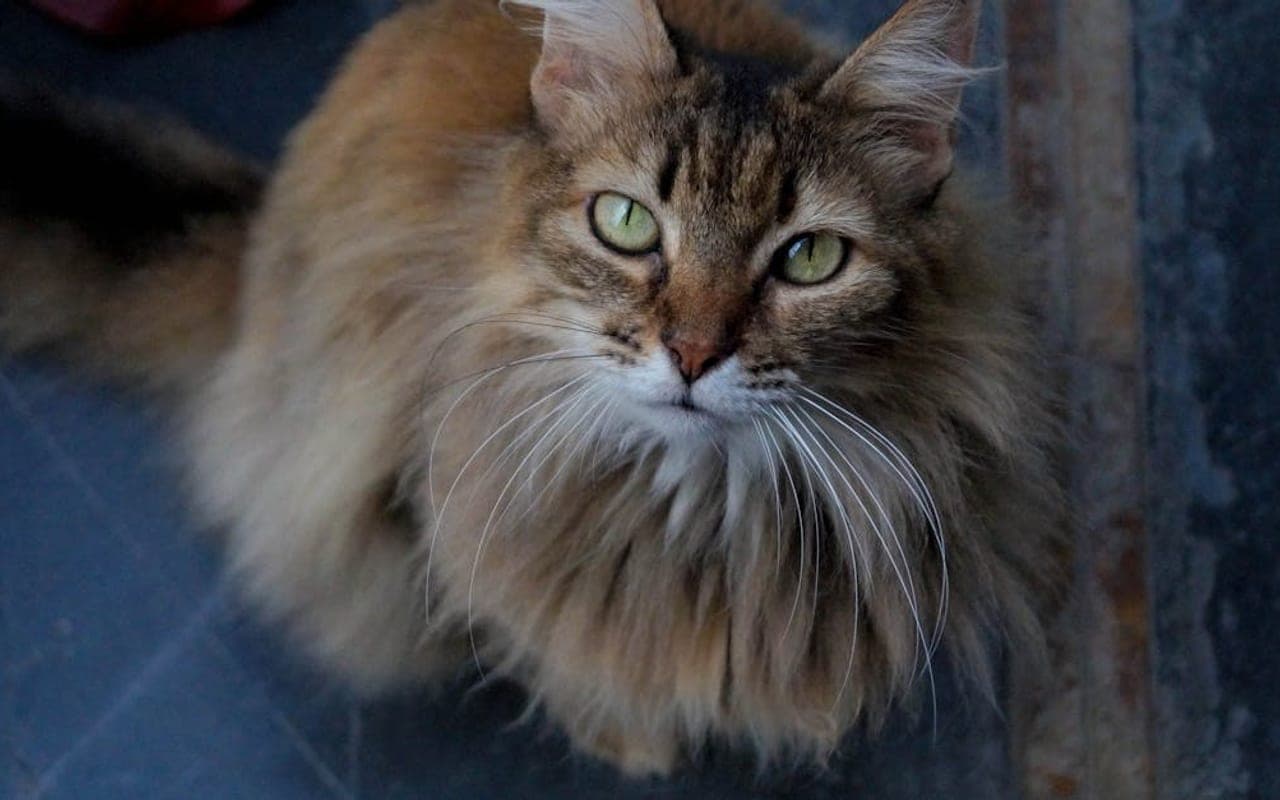
The coat is the main care difference between a Somali and an Abyssinian. CFA describes it as very soft, extremely fine and double coated, longer around the ruff, tummy and britches and longest on the plumed tail [1]. The GCCF describes a soft, fine, dense coat of medium length that lies flat along the spine [2].
- Weekly combing. CFA recommends weekly combing to remove dead hair and control shedding [1].
- Gentle handling. The GCCF says the semi-longhaired Somali needs gentle grooming to keep its coat free from tangles, and that because the hair is not as long as a Persian's, the coat is easy to keep in good order [2]. Work through the ruff, the britches and the tail, the longest areas CFA names [1].
- Baths are rarely needed. CFA says Somalis generally do not need bathing unless they are being shown [1].
- Start young. The GCCF notes that most cats enjoy grooming if the routine is established in kittenhood [2].
The GCCF also recognises a shorthaired Somali with a smooth, close-lying coat of medium length, and says it benefits from hand stroking and perhaps a polish with a silk cloth [2]. If your cat has the shorter coat, the weekly session is mostly a body check.
Use each session to look at the teeth and gums, trim nail tips and run your hands over the body.
Health
We found no breed-wide prevalence study for the Somali. What is documented is a small Australian screening study, a follow-up of PK-deficient cats, a multi-breed retinal gene study, laboratory guidance on the DNA tests, and kidney research in the Abyssinian. None of these tells you how likely a given Somali is to develop a given disease.
- Pyruvate kinase (PK) deficiency. Langford Vets at the University of Bristol describes PK deficiency as an inherited disease of Abyssinian and Somali cats [5]. It is a red blood cell enzyme deficiency that can cause haemolytic anaemia [5]. It is autosomal recessive: only cats with two copies of the defective gene are affected, and carriers are healthy but can pass the gene on [5]. The test reports a cat as Normal, Carrier or Affected [5].
In 2009, Barrs and colleagues tested 60 Australian cats, 36 Abyssinians and 24 Somalis [3]. The mutant allele frequency was 0.29 in the Somalis and 0.13 in the Abyssinians [3]. Three cats were homozygous (affected), and all three were female Somalis [3]. The cats came from Australian breeders, and the sample is small, so read these figures as a picture of that group rather than of the breed worldwide. The authors concluded that PK deficiency screening is advisable before breeding [3].
The disease can stay hidden. Langford notes that the anaemia is often mild and intermittently detectable or may not become evident until the cat is older, and that some affected cats never show signs [5]. Kohn and Fumi followed 25 PK-deficient Abyssinian and Somali cats for 0.8 to 11.3 years [4]. Owners of 11 cats reported no signs [4]. In the other 14 cats, aged 0.1 to 5 years (median 1.7), owners noted signs including lethargy, diarrhoea, pale mucous membranes, poor appetite, poor coat quality, weight loss, jaundice and pica [4]. Langford names lethargy and poor appetite as the main warning signs and describes a rare, rapid, life-threatening form that may be triggered by stress [5]. A healthy-looking adult is therefore not evidence that a cat is clear. Ask for the parents' DNA results.
In the UK, Langford states that PK testing is compulsory for Somalis registered on the GCCF and used for breeding [5]. The GCCF adds that the disease has been eradicated from the Somalis owned by members of the Somali Cat Club, and advises buyers to ask whether a breeder's cats have been tested and are clear [2].
- Progressive retinal atrophy (rdAc). The rdAc mutation in the CEP290 gene causes PRA in Abyssinians and related cats, and Langford lists the Somali among the breeds at risk [6]. Affected cats are born with normal vision [6]. Langford describes clinical signs at 1 to 2 years, detectable by eye examination, and blindness by 3 to 5 years, though some cats do not show signs until 6 years or later [6]. Menotti-Raymond and colleagues give a similar course: affected kittens may have reduced retinal function by 8 months, early changes visible in the back of the eye at 1 to 2 years, and visual impairment by 5 to 6 years [7].
The same study reported rdAc allele frequencies of about 0.07 in US and 0.20 in Scandinavian samples labelled Abyssinian/Somali [7]. Its UK (about 0.21) and Australian (about 0.11) figures come from Abyssinians only, so they are not Somali data [7]. All of these measure gene frequency, not recorded cases. The GCCF says there are no recorded cases of Somalis with PRA in the UK [2]. The paper also records what testing can do: in the early 1980s, incidence in the Swedish Abyssinian population was about 45%, and it fell to about 4% after breeders worked together [7].
One limit matters for buyers. Langford states that a Normal rdAc result means the cat does not carry that mutation, but some cats may still develop retinal atrophy from other, as yet unidentified, mutations [6]. A clear test lowers the risk from one known cause; it does not guarantee sight.
- Renal amyloidosis. The evidence here comes from the Abyssinian, not the Somali. Genova and colleagues studied a familial form of renal amyloidosis in Abyssinians, classified it as AA amyloidosis, and concluded that it is not a simple single-gene trait [8]. CFA notes that it cannot be screened via genetic testing, so there is no DNA test to ask for [1]. CFA advises talking to your breeder about any history of renal amyloidosis in their lines [1]. We found no Somali-specific prevalence figure.
What you can watch for at home are the signs of failing kidneys. Cornell lists drinking more water and passing larger volumes of urine, poor appetite, lethargy, an unkempt coat and weight loss [9]. Cornell also notes that early kidney disease often shows no obvious signs, and that a blood test called SDMA rises earlier than creatinine [9]. Ask your vet when to start routine kidney blood and urine tests.
- Blood type. In the Barrs study, all 60 cats were blood type A, and a commercial typing card wrongly labelled 12 of them as type AB [3]. The authors recommend that cats typed as AB be retyped by a laboratory method [3]. This matters if your Somali ever needs a transfusion. It does not tell you the blood-type mix of the breed as a whole.
- Teeth. The GCCF advises keeping an eye on a Somali's teeth to make sure tartar does not build up [2].
Costs
The tests worth planning for with a Somali are specific to the breed, and most of them happen before you bring a kitten home.
- Parents' PK result. Ask the breeder for the parents' PK deficiency DNA results. The test reports Normal, Carrier or Affected [5], and an affected cat can look healthy for years [4][5]. If no parental results exist, ask whether the kitten itself has been tested.
- Parents' rdAc result. Ask for the rdAc results too [6]. Remember that a Normal result covers that one mutation only [6].
- Blood typing by a laboratory. If your Somali has been typed as AB on a card test, ask for a laboratory retype [3]. This is worth settling before the cat ever needs a transfusion.
Frequently Asked Questions
Is the Somali a separate breed from the Abyssinian?
Yes, the major registries recognise it as a breed. The GCCF says CFA granted the Somali championship status in 1979 and the GCCF did so in 1998 [2]. It is still the longhaired form of the Abyssinian [1][2], which is why the same PK deficiency and rdAc DNA tests apply to both [5][6].
Did the Somali come from Somalia?
No. The GCCF says the name refers to the African country, but serious breeding of the Somali began in the US.
My Somali kitten looks healthy. Does it still need a PK test?
If the parents' results are not available, yes. In Kohn and Fumi's follow-up of 25 PK-deficient cats, owners of 11 reported no signs [4], and Langford notes the anaemia may not become evident until the cat is older [5].
My kitten's parents tested Normal for rdAc. Can it still go blind?
It is possible. Langford states that a Normal result rules out the rdAc mutation only, and some cats may develop retinal atrophy from other, unidentified mutations.
How often does a Somali need grooming?
Once a week. CFA recommends weekly combing to remove dead hair and control shedding [1].
Will a Somali be happy in a house with several other cats?
Not always. The GCCF says Somalis are happiest in company but are not always content in large cat populations where they have to share attention.
Sources
This guide draws on the following published references. Each opens in a new tab so you can check it against what you have read here.
Genova F, Nonnis S, Maffioli E, et al. (2021), Scientific Reports 11:8339
Genova F, Nonnis S, Maffioli E, et al. (2021), Scientific Reports 11:8339 — Multi-omic analyses in Abyssinian cats with primary renal amyloid deposits(opens in a new tab)Cornell Feline Health Center
Cornell Feline Health Center — Chronic Kidney Disease(opens in a new tab)VCA Animal Hospitals
VCA Animal Hospitals — Obesity in Cats(opens in a new tab)Cat Fanciers' Association
Cat Fanciers' Association — Somali breed profile(opens in a new tab)Governing Council of the Cat Fancy (GCCF)
Governing Council of the Cat Fancy (GCCF) — Somali breed page(opens in a new tab)Barrs VR, Giger U, Wilson B, et al. (2009), Australian Veterinary Journal 87(1):39
Barrs VR, Giger U, Wilson B, et al. (2009), Australian Veterinary Journal 87(1):39-44 — Erythrocytic pyruvate kinase deficiency and AB blood types in Australian Abyssinian and Somali cats(opens in a new tab)Kohn B, Fumi C (2008), Journal of Feline Medicine and Surgery 10(2):145
Kohn B, Fumi C (2008), Journal of Feline Medicine and Surgery 10(2):145-153 — Clinical course of pyruvate kinase deficiency in Abyssinian and Somali cats(opens in a new tab)Langford Vets, University of Bristol
Langford Vets, University of Bristol — Pyruvate kinase deficiency genetic test(opens in a new tab)Langford Vets, University of Bristol
Langford Vets, University of Bristol — Progressive Retinal Atrophy (rdAc) factsheet(opens in a new tab)Menotti
Menotti-Raymond M, Narfström K, et al. (2010), The Veterinary Journal 186:32-38 — Widespread retinal degenerative disease mutation (rdAc) discovered among a large number of popular cat breeds(opens in a new tab)
Affiliate disclosure: We may earn a commission from qualifying purchases. This doesn't affect our recommendations.
Recommended Products
Somali Care Guide Book
Breed-focused reading and owner references for Somali care, training, grooming, and health planning.
Somali Food and Supplies
Helpful supplies for somali cat supplies routines at home.
Somali Grooming Tools
Helpful supplies for somali grooming tools routines at home.
Get personalized pet care tips
Join our newsletter for breed-specific advice, care guides, and expert tips delivered weekly.
No spam, ever. Unsubscribe anytime.