
Khao Manee Care Guide
The White Gem of Thailand The Khao Manee is a natural Thai breed whose name means "White Gem" — the Cat Fanciers' Association also renders it "like white diamonds." This is no modern white variant of
In This Guide
Overview
The White Gem of Thailand
The Khao Manee is a natural Thai breed whose name means "White Gem" — the Cat Fanciers' Association also renders it "like white diamonds." This is no modern white variant of another cat: the breed appears as a good-luck cat in the Tamra Maeo, the Thai book of cat poems produced during the Ayutthaya period of 1350 to 1767 (Cat Fanciers' Association), and cats of this type were kept at the royal court of Siam. The breed remained effectively unknown outside Thailand until 1999, when endangered-species specialist Colleen Freymouth brought the first Khao Manee to the United States (Cat Fanciers' Association).
Coat, build and those eyes
Pure white is the entire point: a Khao Manee is solid white with no second colour anywhere, wearing a short, smooth coat that lies close to the body and carries almost no undercoat. The build is medium in length with very firm musculature, though the CFA standard asks for a cat that feels "flexible and springy, not meaty or heavy" — an athletic middleweight, not a cobby one.
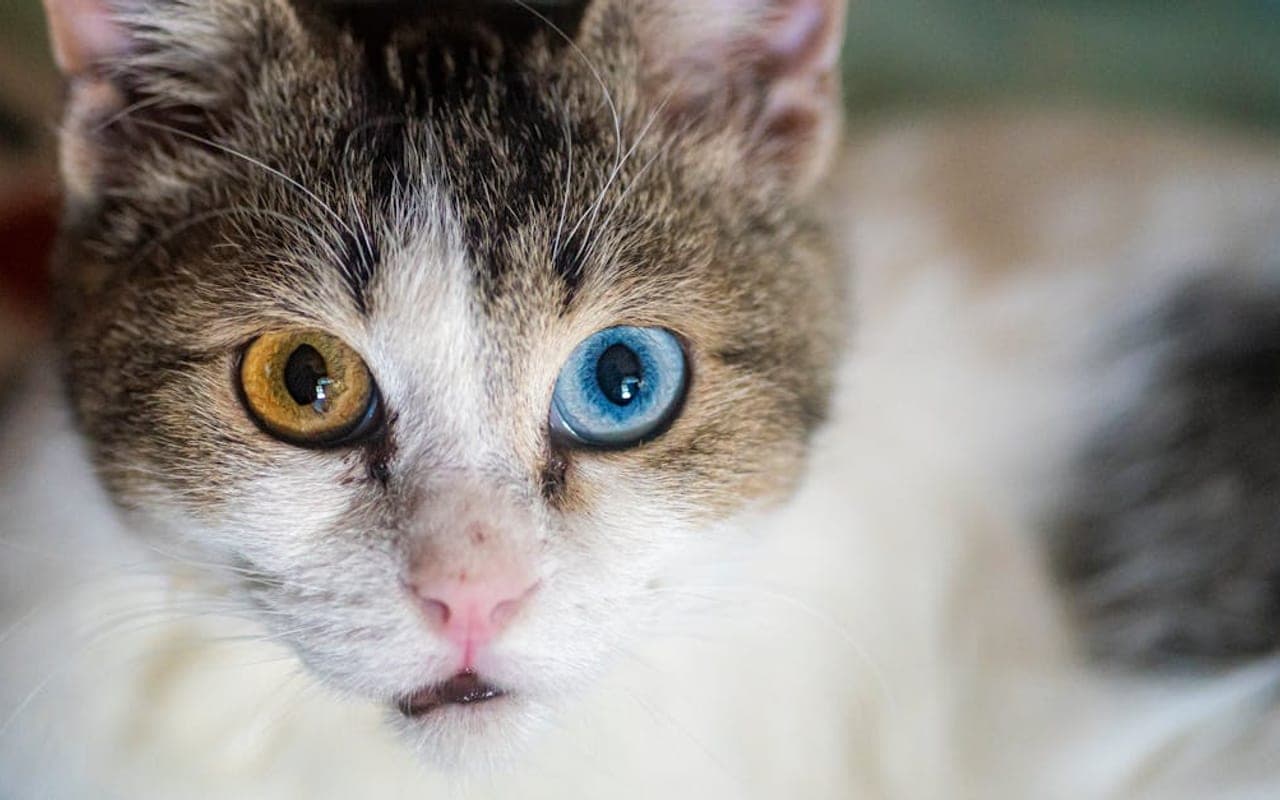
The eyes are the signature. CFA accepts any shade of blue, yellow through amber and hazel, or green from pale peridot to deep emerald. Odd eyes — one blue, one another colour — are the rarest and most prized.
Temperament and rarity
Expect an involved cat, not an ornament. CFA describes the breed as curious and clever with "an enduring sense of mischief," extremely intelligent, friendly and social. They fetch, carry toys in their mouths, and take a close interest in whatever their people do. On noise, the honest answer is quieter than the folklore: CFA notes they are "not necessarily noisy," though some individuals have more to say than others.
The breed remains genuinely rare outside Thailand. CFA accepted it for registration in 2018 and shows it in the Provisional class while The International Cat Association advanced it to championship status in 2015.
Exercise
Play that occupies the brain
The Cat Fanciers' Association calls the Khao Manee extremely intelligent, curious and clever with "an enduring sense of mischief" — a description that predicts the failure mode. A bored one does not sit quietly; it opens cupboards. Plan two or three real play sessions a day, ten to fifteen minutes each, rather than leaving toys out and calling it enrichment — solo play with a static object burns out fast.
Wand toys earn their keep because you control the prey, building a full hunting arc — stalk, chase, pounce, catch, then a small food reward closing it. Fetch is worth trying; CFA notes these cats enjoy it and carry toys in their mouths. Retire any toy that sheds string: swallowed thread is a surgical emergency.
Vertical territory
Give this cat height. A tall multi-level tree or a cleared shelf run changes how an athletic cat uses a room: climbing and jumping recruit far more muscle than floor pacing, and a high lookout satisfies a surveillance instinct that otherwise turns into pestering. Site one perch at a window overlooking a feeder or street, since moving things to watch supply low-effort stimulation.
Puzzle feeders do the other half. Making a cat earn part of its ration slows eating and occupies the problem-solving drive, guarding against weight gain in a well-fed indoor cat.
Company matters
This is a strongly people-oriented breed, and long solitary days suit it poorly. If the house is empty all day, plan for it: a compatible companion cat, timed feeders, and a dependable play session at each end of it. Raise signs of under-stimulation — night yowling, ambushed ankles, over-grooming — with a vet rather than only adding toys, since several have medical causes.
Grooming
A coat that asks for very little
The Khao Manee wears a short, smooth coat that lies flat to the body with almost no undercoat, and that structure is why grooming is so undemanding: there is no dense underlayer to mat behind the elbows or blow out in seasonal drifts. One brushing a week with a soft slicker or rubber curry mitt is enough, because the job is lifting dead hair the cat would otherwise swallow, not detangling.
White fur hides nothing, so that weekly handling doubles as an inspection: note scabs, thinning patches, flea dirt or a greasy spot the cat has stopped tending. They show early on white, which is an advantage worth using.
Sun and unpigmented skin
A solid white cat carries little pigment in the skin of the ear tips, eyelids and nose leather, and pigment is what absorbs ultraviolet light. Limit long spells sunbathing at a south-facing window or on a balcony in strong summer light. Persistent redness, crusting or scabbing there is not a grooming problem to manage at home: sun damage on unpigmented feline skin is a recognised concern, so have a vet look at any lesion that does not settle.
Teeth, ears and claws
Dental care is the part of this routine that actually matters. Brush with a cat-specific toothpaste several times a week, because plaque hardens under the gumline into tartar within days and cats mask oral pain until disease is advanced. Introduce the brush over weeks rather than forcing it.
Check ears weekly for dark debris or odour, but clean only the visible outer flap, with a vet-recommended solution — never push cotton buds into the canal, which packs debris deeper. Trim claw tips fortnightly, stopping short of the pink quick.
Health
The one risk genuinely tied to the coat
A Khao Manee is solid white by definition, and in cats that colour comes from the dominant white gene, W. International Cat Care explains that W does more than strip pigment from the coat: it is also associated with blue irises and with congenital deafness, seen almost exclusively in white-coated cats. The Journal of Veterinary Internal Medicine traces the white coat to a retroviral insertion in the KIT gene, which disrupts the pigment cells that also line the inner ear; without them the cochlea degenerates in the first weeks of life.
The same charity is equally clear that W guarantees a white coat but not blue eyes and not deafness: many white cats hear perfectly well, and so do many Khao Manee. This is a risk to test for, not a diagnosis to assume.
How large the risk actually is
No study gives a rate for the Khao Manee itself, so treat breed-specific percentages with suspicion. The Journal of Veterinary Internal Medicine examined 132 solid white purebred kittens in the UK and found congenital sensorineural deafness in 30.3% — 15.9% bilateral, 14.4% in one ear only — and none among their 61 pigmented littermates. Iris colour mattered: 50.0% of kittens with two blue irises were affected, against 22.2% with none. That link is not universal, though. A later BMC Veterinary Research series of 72 purebred white cats found a lower overall rate of 16.7% and no statistically significant association between blue irises and deafness. Together they suggest a white coat raises risk, blue eyes probably raise it further, and neither predicts an individual cat.
Odd eyes, one-sided deafness and testing
Pigment cells populate each side of the body independently, so a cat can be deaf in one ear only — and in the BMC Veterinary Research series, both odd-eyed cats found unilaterally deaf were deaf on the same side as their single blue eye. Those numbers are very small, so treat it as a pattern to test for, not a rule.
One-sided deafness is easy to miss, because the cat still answers to its name. A BAER test settles it: International Cat Care describes it as a simple, non-invasive test carried out at veterinary specialist centres. Because BAER assesses each ear separately, it catches what home observation cannot. Ask any breeder whether kittens were tested.
A confirmed diagnosis changes the safety plan, not the cat's prospects: a deaf cat cannot hear a car, a dog or a person approaching, so it must live indoors or in secure enclosed outdoor space.
Everything else is ordinary feline care
Beyond hearing, this is a rare natural breed with little documented breed-specific hereditary disease, and saying so is more honest than inventing a signature condition. Keep the cat lean, because excess weight drives diabetes and arthritis; brush the teeth, because cats hide oral pain until disease is advanced; keep vaccination and parasite control on schedule; and book a yearly exam.
One emergency deserves naming. VCA Animal Hospitals notes that urethral obstruction occurs almost exclusively in male cats and calls complete obstruction life-threatening and very painful: a male cat straining in the tray and passing little or no urine needs emergency veterinary attention the same day. VCA adds that lower urinary tract disease is commoner in cats with low water intake and in cats that are inactive and obese — an argument for wet food and several water sources.
Frequently Asked Questions
Are all Khao Manee cats deaf?
No. International Cat Care states that the dominant white gene guarantees a white coat but not blue eyes or deafness. The two studies above report deafness in roughly one in six to one in three of the white cats they examined, so most are unaffected.
My Khao Manee has one blue eye and one gold eye. Can it hear?
Possibly on both, possibly on one. In the BMC Veterinary Research series, the odd-eyed cats deaf in one ear were deaf on the same side as the blue eye, though numbers were small. One-sided deafness is hard to spot at home, so ask your vet about a BAER test.
What is a BAER test and does my cat need one?
BAER stands for brainstem auditory evoked response. International Cat Care describes it as a simple, non-invasive test performed at veterinary specialist centres; it assesses each ear separately. It is standard before breeding white cats and worth requesting if your cat's hearing is uncertain.
Does a deaf Khao Manee need different day-to-day care?
Yes, but the changes are practical, not medical. It must live indoors or in a secure enclosed outdoor area, because it cannot hear traffic or an approaching animal. Wake it with a gentle touch rather than a sudden hand to avoid a startle bite, and teach hand signals. Tell your vet before any anaesthetic.
Sources
This guide draws on the following published references. Each opens in a new tab so you can check it against what you have read here.
The Cat Fanciers' Association
Khao Manee(opens in a new tab)The International Cat Association
Khaomanee(opens in a new tab)International Cat Care
Inherited deafness in white cats(opens in a new tab)Journal of Veterinary Internal Medicine
Prevalence of congenital sensorineural deafness in a population of client-owned purebred kittens in the United Kingdom(opens in a new tab)BMC Veterinary Research
Evaluation of the prevalence of congenital sensorineural deafness in a population of 72 client-owned purebred white cats examined from 2007 to 2021(opens in a new tab)VCA Animal Hospitals
Cystitis and Lower Urinary Tract Disease in Cats(opens in a new tab)
Affiliate disclosure: We may earn a commission from qualifying purchases. This doesn't affect our recommendations.
Recommended Products
Khao Manee Care Guide Book
Breed-focused reading and owner references for Khao Manee care, training, grooming, and health planning.
Khao Manee Food and Supplies
Helpful supplies for khao manee cat supplies routines at home.
Khao Manee Grooming Tools
Helpful supplies for khao manee grooming tools routines at home.
Get personalized pet care tips
Join our newsletter for breed-specific advice, care guides, and expert tips delivered weekly.
No spam, ever. Unsubscribe anytime.