
Arriving With the Scriptures
Cats are not native to Japan. They were imported, deliberately and carefully, from China — most likely during the 6th and 7th centuries CE, as part of the Buddhist cultural transmission that brought writing, architecture, and religious texts across the Korean peninsula and the sea to the Japanese archipelago. The mechanism was practical: Buddhist monasteries kept cats to protect their irreplaceable paper scriptures from rats and mice. When Japanese emissaries traveled to Tang Dynasty China to study Buddhism and return with texts, cats came with the books.
The earliest Japanese record of cats dates to 889 CE, when Emperor Uda received a black cat as a gift and wrote about it with evident delight in his personal diary — one of the more charming moments in any royal record. But the cat's first foothold was not in the palace; it was in the temple library. That origin — as sacred guardian of sacred knowledge — would shape Japan's relationship with cats for the next fourteen centuries.
The Emperor's White Cat
By 999 CE, cats had penetrated the uppermost levels of Japanese society. In that year, Sei Shōnagon — a lady-in-waiting to Empress Teishi and one of the finest prose stylists in Japanese literary history — wrote about the Emperor's white cat in her Makura no Sōshi (The Pillow Book):
"The cat at the palace is so pretty. It has been given the fifth rank and is treated just like a noble. Everyone pampers it and uses very polite language when speaking to it."
The cat Shōnagon described had been formally granted a court rank — the equivalent of human aristocratic standing — and addressed with the honorific language reserved for the nobility. This is not metaphor or humor. Heian court culture was organized around elaborate systems of rank and address, and extending those systems to a cat was a serious social gesture. The cat had become a participant in court culture, not merely a resident of it.
Leashed in the Temple
Despite their aristocratic status, early Heian-period cats remained rare and controlled animals. They were valuable enough to be kept on leashes in temples, where their primary function remained the protection of manuscripts. The leash was not cruelty but custody — a recognition that these animals represented significant financial and spiritual value. Losing a temple cat to the streets was a serious matter.
This scarcity created an interesting paradox: cats were simultaneously the most beloved animals in Japanese elite culture and animals that almost no one could keep freely. The tension between the cat's value as an icon and its accessibility as a companion would resolve itself differently across different historical periods — sometimes toward veneration, sometimes toward suspicion, and eventually toward a democratic accessibility that no Heian courtier could have imagined.
Utagawa Kuniyoshi and the Ukiyo-e Cat
By the Edo Period (1603–1868), cats had diffused through Japanese society well beyond the aristocracy, but their cultural representation reached its artistic peak in woodblock printmaking. Utagawa Kuniyoshi (1797–1861) was the period's most celebrated artist of cats — and one of the most technically brilliant printmakers of the entire ukiyo-e tradition. His cat prints range from precise natural observation to gleeful anthropomorphism: cats standing on their hind legs, cats running businesses, cats forming the shapes of famous kabuki actors through clever arrangement.
Kuniyoshi's cats were not sentimental. They were witty, subversive, and sometimes transgressive — the cat as a vehicle for social commentary that might have been dangerous to express through human subjects. Edo Period censors were active and capricious; showing samurai in unflattering poses could result in punishment. Showing cats doing the same things was protected by deniability. Art historians have argued that Kuniyoshi's cats were a coded visual language, communicating criticism of the shogunate through feline proxies.
The Bakeneko and Nekomata: When Cats Turn Supernatural
Japanese folklore never settled on a single image of the cat. Alongside the beloved imperial companion and the witty ukiyo-e subject existed the bakeneko — a shape-shifting cat monster — and the nekomata, a two-tailed supernatural cat said to cause death and misfortune. These figures emerged partly from real observations: old cats develop distinctive behaviors, and the folk explanation was supernatural transformation. Cats with unusually long tails were particularly suspect; some accounts claim that this belief led owners to deliberately dock cat tails, which would explain why Japanese bobtail cats — with their naturally short tails — became culturally favored.
The bakeneko and nekomata also reflect genuine ambivalence about cats during certain historical periods. During the Edo Period, as silkworm cultivation became central to Japan's textile economy, cats were blamed — sometimes correctly, sometimes not — for disturbing silkworm operations. Cats eating silkworms, or disturbing the careful temperature control of sericulture rooms, made them economically dangerous. The supernatural malevolence attributed to cats during this period may partly encode real economic grievances.
The Maneki-neko: One Gesture, Many Origin Stories
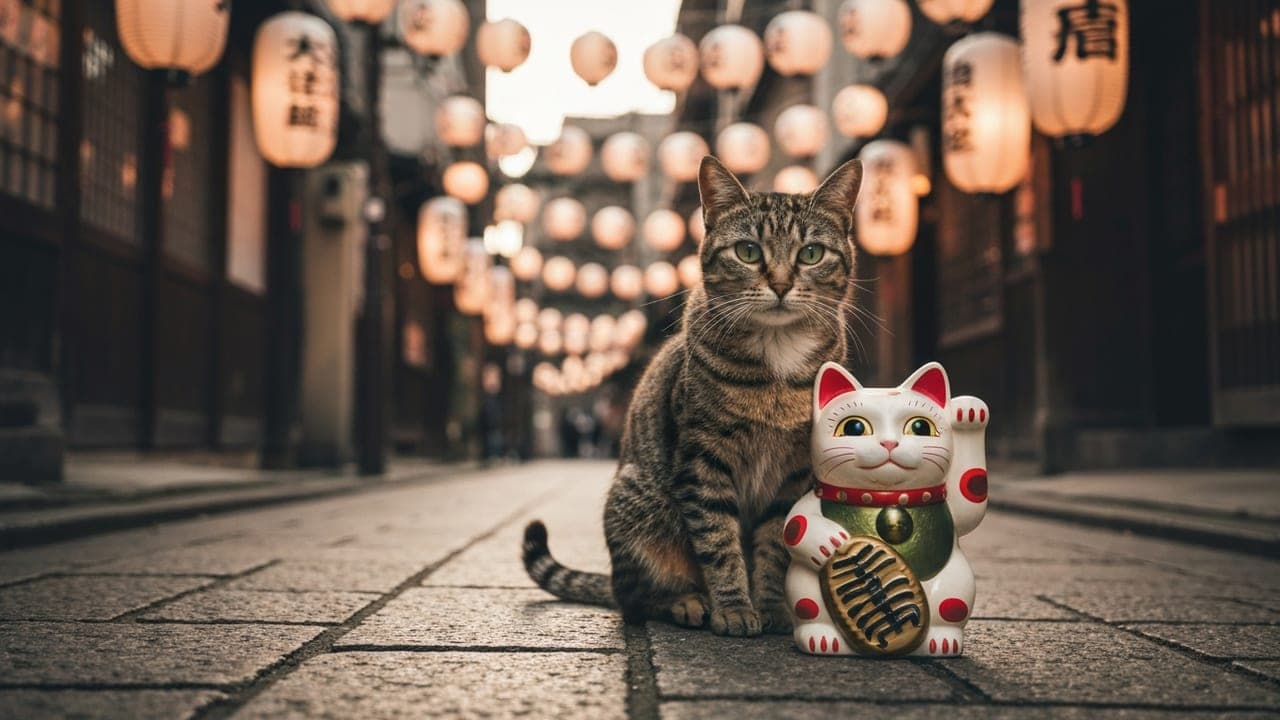
The Maneki-neko — the beckoning cat figurine with one raised paw, familiar from the entrances of restaurants, shops, and homes across Japan and its diaspora — has multiple competing origin stories, all located in the Edo Period.
The most widely told involves Gōtoku-ji temple in what is now Tokyo's Setagaya ward. The story runs that a feudal lord, sheltering under a tree during a sudden storm, noticed a cat at the temple gate raising its paw as if beckoning. He followed the cat toward the temple, and the tree he had been sheltering under was struck by lightning moments later. In gratitude, the lord became the temple's patron, and the beckoning cat gesture became associated with good fortune.
Gōtoku-ji temple still stands and still maintains its association with Maneki-neko — thousands of porcelain cat figurines line the temple's memorial grounds, donated by grateful visitors. Historians note that multiple temples and shrines claim versions of the same origin story, suggesting the legend accrued around the figurine rather than the figurine being created to commemorate a specific event. The Maneki-neko likely emerged from a confluence of folk beliefs about cats as bringers of fortune, evolving gradually into a standardized form during the late Edo and Meiji periods.
Cat Cafés and the Geography of Companionship
Modern Japan's relationship with cats took a new form in 2004, when the first cat café — Neko no Jikan (A Cat's Time) — opened in Osaka. The concept was almost architecturally Japanese: a café space stocked with cats for patrons to interact with, solving the specific problem created by the fact that most Tokyo apartments prohibit pet ownership. For urban professionals living in tiny no-pet apartments, a cat café offered thirty minutes or two hours of feline company on a per-visit basis.
The concept spread with unusual speed. By 2015, Tokyo alone had more than 150 cat cafés. The model expanded internationally — cat cafés now operate in major cities across North America, Europe, and Southeast Asia — but the Japanese version retains specific characteristics: careful cat welfare protocols (mandatory rest periods for cats, visitor number limits, health monitoring), premium pricing justified by the experience quality, and a regularity of visits that makes certain cafés function almost as neighborhood institutions for their cat-specific clientele.
For those who can own cats, Japan's cat breed culture favors Japanese Bobtails and Scottish Folds alongside global favorites like the Ragdoll and British Shorthair.
The Cat Islands
Japan's cat islands — neko-jima — are a phenomenon without close parallel elsewhere. Aoshima island in Ehime Prefecture has approximately 15 human residents and somewhere between 80 and 120 cats, a ratio of more than 6 cats per person. Tashirojima in Miyagi Prefecture has a similar population dynamic. The cats on these islands are fed by local residents and have become tourist attractions drawing visitors from across Japan and abroad.
The cat islands emerged from a specific historical pattern: fishing communities kept cats to control rats on fishing boats and in storage areas where catches were processed. As young residents moved to cities, the human population declined while the cats remained, establishing semi-feral colonies dependent on supplemental feeding from the remaining elders. Tourism has, paradoxically, created an economic rationale for maintaining the cat populations that might otherwise have been managed or reduced.
Hello Kitty: $7 Billion on No Mouth
In 1974, a Sanrio designer named Yuko Shimizu created a white cat character with no mouth. The original backstory placed the cat in London — she was named Kitty White, the daughter of George and Mary White, born on November 1 in the London suburbs. The English setting was chosen to evoke the British chic that Japanese youth culture admired in the 1970s. The cat had no mouth because, Sanrio explained, she speaks from the heart and is meant to be whatever the viewer projects onto her.
Hello Kitty became one of the highest-grossing character franchises in history. Annual revenue from Hello Kitty-branded products has been estimated at $7 billion, making her more commercially valuable than many countries' GDP. The brand has licensed everything from toasters to jumbo jets (ANA operated Hello Kitty-themed aircraft). In 2023, the live-action Barbie film's marketing success prompted renewed academic interest in Hello Kitty as a similar phenomenon: a deliberately affect-neutral face onto which consumers project their own emotional content.
Hello Kitty is arguably the culmination of fourteen centuries of Japanese cat culture — from the imperial court's leashed companions and Kuniyoshi's subversive woodblock prints to the perfect commercial distillation of the cat as a blank canvas for human projection.
For the broader story of how cats first became divine in the ancient world, read our article on Egyptian cats and their divine status.
Frequently Asked Questions
When did cats first arrive in Japan?
The most widely accepted historical evidence places cats in Japan between 538 and 710 CE, during the Asuka and early Nara periods when Japanese emissaries were traveling to Tang Dynasty China to study Buddhism. Cats accompanied Buddhist manuscripts as their protectors. The first datable written reference to a cat in Japan is Emperor Uda's diary entry of 889 CE.
Why does the Maneki-neko raise different paws?
Convention holds that a left raised paw beckons customers and good fortune into a business, while a right raised paw beckons wealth and money. Both paws raised is sometimes used but is considered by some practitioners to be inappropriate — beckoning too aggressively. The color of the cat also carries meaning: white for good luck, black for warding off evil, gold for wealth, and pink for romance. These conventions are relatively modern (mid-20th century) and are not universal across all regional traditions.
Are Japanese cat islands sustainable?
Conservationists have raised concerns about the long-term welfare of cat island populations, including disease transmission in dense feral populations, impact on local seabird colonies (cats on island ecosystems are a documented conservation problem globally), and the welfare of cats dependent on tourist-supplemented feeding that may decline as island tourism fluctuates. Some islands have introduced managed care programs; others remain largely informal. The sustainability question remains genuinely unresolved.
Author & Reviewer
Related Reading
Continue the History
Understand Your Companion
Find Your Match
Ready to find your perfect companion?
Take the Breed Quiz →