
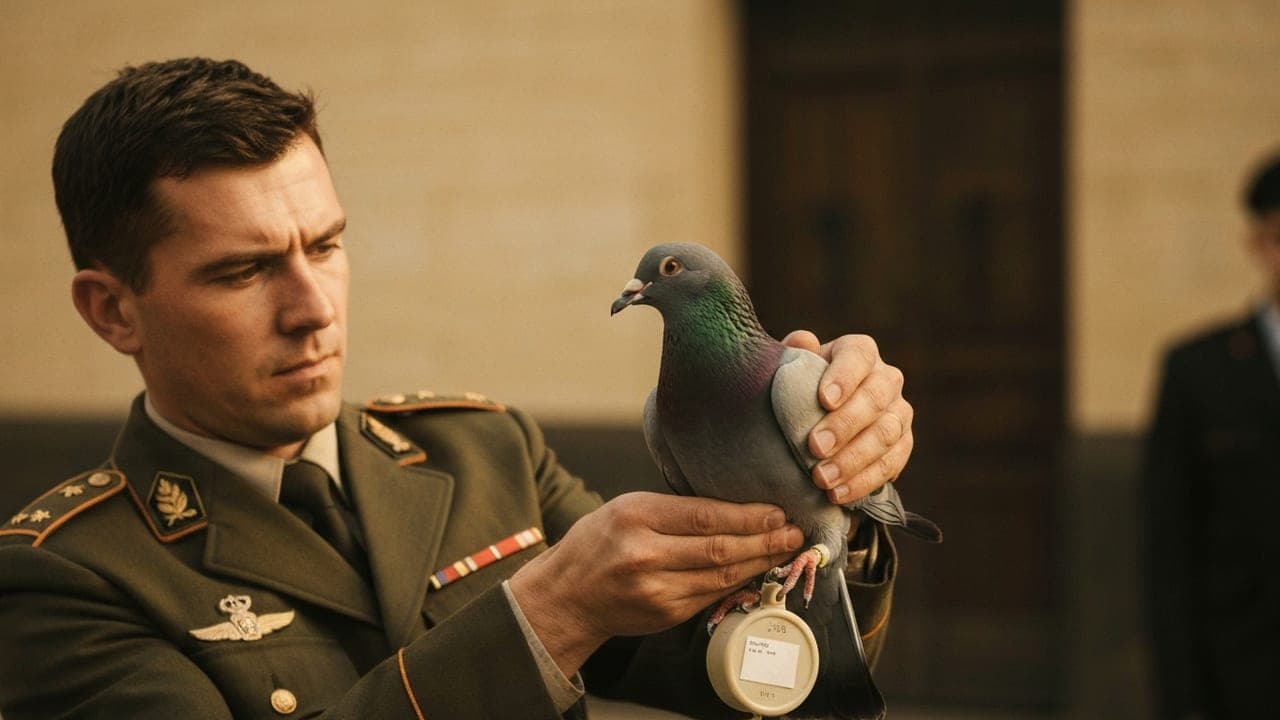
The Oldest Partnership in Postal History
The relationship between humans and homing pigeons is older than writing, or nearly so. Sumerian clay tablets dating to around 3000 BCE depict pigeons in what appear to be messenger contexts, though the evidence is interpretive. What is not interpretive is this: by the time human civilization had developed elaborate written records, the homing pigeon was already a mature communications technology. The pigeon did not grow up with civilization — it was there from the beginning.
The biological phenomenon at the heart of this history is still not fully understood. Homing pigeons can navigate home from distances exceeding 1,000 kilometers, maintaining course across unfamiliar territory, over oceans, through fog and rain. They accomplish this using a combination of mechanisms that researchers have debated for decades: magnetite crystals in the beak that may sense Earth's magnetic field, sensitivity to infrasound that allows them to detect the acoustic signature of specific terrain features from hundreds of kilometers away, polarized-light navigation using the sun, and olfactory mapping that allows them to build a geographic "smell map" of their home territory. No single mechanism explains everything. The pigeon is navigational science's most persistent open question.
What the pigeon's keepers have always known empirically is simpler: released from a distant point, the bird will find its way home. This reliable, seemingly miraculous behavior made the pigeon the most valuable communications technology available to humanity for roughly 4,000 years.
The Caliph's Postal System and the Rothschild Fortune
The Baghdad Caliph al-Rashid, ruling in the late 8th century CE, established what historians consider the first organized pigeon postal system — a network of relay stations stretching across his domains, staffed by pigeon keepers who maintained birds trained to fly between specific points. Messages were written on thin paper, attached to leg capsules, and released. Within hours, information could travel distances that would take human couriers days.
This model was refined and expanded by successive Islamic rulers. By the 12th century, the Fatimid Caliphate in Cairo operated a pigeon postal network sophisticated enough to move information across the entire Middle East faster than any competing communications system. Commercial interests quickly grasped the implications.
The most famous commercial application of pigeon post is also one of history's great information-arbitrage stories. In June 1815, Nathan Rothschild, the London head of the Rothschild banking family, learned of Napoleon's defeat at Waterloo before any British government official — because he had pigeon couriers stationed at key European cities. While other investors, expecting a French victory based on the last available reports, sold British government bonds in panic, Rothschild bought. When the news became official, he had made a fortune. The Rothschilds' pigeon network was not merely a communications curiosity; it was a competitive intelligence system.
Paul Julius Reuter, who founded what would become Reuters news agency, built his first commercial enterprise on carrier pigeons in 1850. Between Brussels and Aachen — a gap in the European telegraph network — Reuter's pigeons filled the breach, carrying stock prices and commercial news faster than the available human alternatives. When the telegraph network closed the gap, Reuters switched to the telegraph. The pigeons retired. But the news agency they helped found is still publishing.
World War I: Cher Ami and the Lost Battalion
The military value of homing pigeons reached its peak expression in the First and Second World Wars. Both sides deployed thousands of pigeons as communications assets; the birds could carry messages through artillery barrages that cut telephone lines and through terrain that killed human runners.
No pigeon's story from WWI is better documented or more remarkable than Cher Ami's. In October 1918, a battalion of roughly 550 American soldiers — the "Lost Battalion" of the 77th Division — was surrounded by German forces in the Argonne Forest, cut off from support and being accidentally bombarded by their own artillery. They had dispatched two pigeons already. Both were shot down. Their last pigeon was Cher Ami.
Released on October 4th with a message in her capsule reading "We are along the road parallel to 276.4. Our own artillery is dropping a barrage directly on us. For heaven's sake, stop it," Cher Ami was immediately shot. She fell, regained altitude, and flew 25 miles in 25 minutes to Allied headquarters. She arrived with a bullet through her chest, one eye blinded, one leg nearly severed, the message capsule hanging from the shattered leg by tendons alone.
The shelling stopped. Between 194 and 197 American soldiers survived, depending on the source. Cher Ami received the French Croix de Guerre. She was treated by American veterinarians, who carved her a prosthetic leg from wood. She died in 1919 from her wounds. Her preserved body is on display at the Smithsonian National Museum of American History.
World War II: GI Joe and the Dickin Medal
The Second World War produced its own generation of pigeon heroes, and an institutional mechanism for recognizing them. The Dickin Medal, founded in 1943 by Maria Dickin — founder of the People's Dispensary for Sick Animals — was established specifically to recognize animal service in wartime. Called the "animal Victoria Cross," 32 pigeons received the Dickin Medal, far more than any other species.
The most celebrated WWII pigeon was GI Joe, an American Signal Corps bird whose mission in October 1943 illustrates the communications stakes of the era. British troops had captured the Italian village of Colvi Vecchia from German forces, but Allied bombers — unaware of the capture — were already airborne and headed for the village. Radio communications had failed. GI Joe was released from the village with the capture news and flew 20 miles in 20 minutes, reaching the airfield with approximately five minutes to spare before the bombers would have been committed to their attack run.
British military authorities estimated that GI Joe's flight saved at least 100 Allied soldiers, and possibly significantly more. GI Joe received the Dickin Medal at the Tower of London in 1946 — the first American animal to be so honored by the British military. He lived until 1961, dying at the Detroit Zoological Institute.
The Science of Navigation and the Racing Pigeon Industry
Belgian pigeon racing culture developed independently of military pigeon use, though the two traditions shared breeding stock. Belgian breeders in the mid-19th century began systematic selection for racing performance, establishing bloodlines — some of which, like the Janssen Brothers' strain developed in Arendonk, Belgium, became globally renowned and enormously valuable. A champion racing pigeon sold in Belgium in recent years for $1.9 million — a price that would be remarkable for a thoroughbred horse.
The pigeon racing industry, valued at approximately $32 million in Belgium alone and extending across dozens of countries, continues as the primary living use of homing pigeons. Chinese pigeon racing has grown rapidly since the 1990s, with wealthy Chinese buyers driving prices for elite European racing bloodlines to extraordinary heights. A black market in stolen champion pigeons operates in Belgium and the Netherlands, where documented thefts reach into the thousands annually.
The navigation science question remains productive research territory. A 2022 study at the University of Auckland confirmed that pigeons can use road networks as navigation aids near their home lofts — suggesting a learned geographic knowledge component alongside their biological instruments. Research teams at Oxford, Georgia Tech, and institutions across Europe continue publishing competing and complementary theories of pigeon navigation, making the bird's brain one of the most studied navigation systems in comparative neuroscience.
The End of an Era
The formal military use of homing pigeons ended with the closure of the British Army Pigeon Service in 1957, which had operated continuously since 1914. Radio communication, ultimately, solved the problem that pigeons had solved biologically: reliable, difficult-to-intercept communication over distance. The pigeon's advantages — no radio silence required, no batteries, no equipment to capture or jam, impossible to electronic-warfare — were outweighed by radio's advantages of speed and two-way capability.
But the pigeon did not disappear from human company. Racing pigeons maintain populations in the tens of millions worldwide. Pigeon fanciers' associations operate in nearly every country. The birds that navigated by infrasound and magnetite through artillery barrages now navigate by the same mechanisms through race courses, their performance tracked by electronic timing chips affixed to their legs.
For related reading on animals as historical companions, see our pieces on horses in medieval Europe and birds as companions through history.
Frequently Asked Questions
Q: How do homing pigeons navigate back to their home loft?
Researchers have identified multiple navigation mechanisms, likely used in combination: magnetite crystals in the beak that may detect Earth's magnetic field, sensitivity to infrasound allowing detection of distant terrain features, polarized-light sun navigation, and olfactory mapping of the home territory's distinctive smells. No single mechanism fully explains pigeons' navigational ability, and the question remains active in comparative neuroscience research.
Q: What is the Dickin Medal and how many pigeons received it?
The Dickin Medal was founded in 1943 by Maria Dickin, founder of the People's Dispensary for Sick Animals, to recognize animal service in wartime. Known as the "animal Victoria Cross," 32 pigeons received the Dickin Medal — more than any other species — for their communications service in World War II.
Q: What happened to Cher Ami after she delivered the message that saved the Lost Battalion?
Cher Ami survived her wounds long enough to be treated by American veterinarians, who carved her a small prosthetic leg from wood. She died in 1919 from the cumulative effects of her wounds. Her preserved body is currently on display at the Smithsonian National Museum of American History in Washington, D.C.
Q: When did military forces stop using homing pigeons?
The British Army Pigeon Service, which had operated continuously since 1914, was officially disbanded in 1957. The development of reliable radio communications ultimately provided the same function — long-distance message transmission — with advantages of speed and two-way capability that outweighed the pigeon's advantages of requiring no equipment and being immune to electronic jamming.
Author & Reviewer
Related Reading
Continue the History
Understand Your Companion
Find Your Match
Ready to find your perfect companion?
Take the Breed Quiz →