
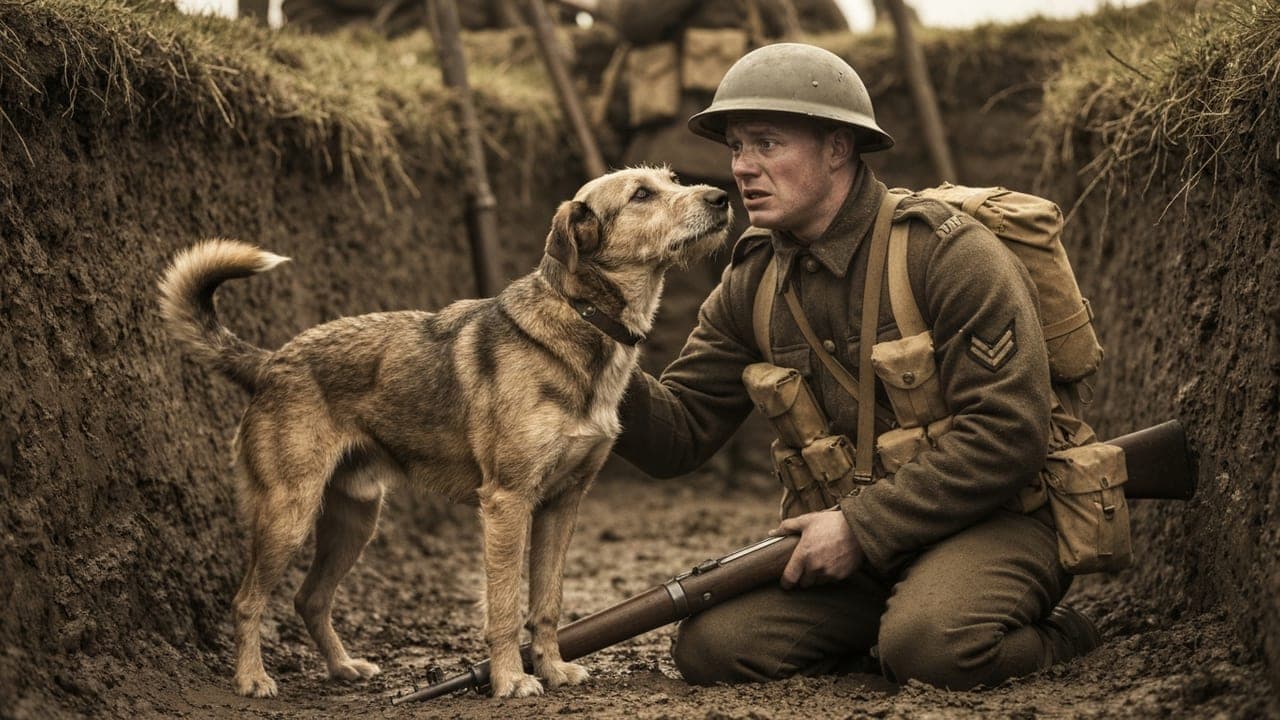
Dogs March to War
When the guns of August 1914 erupted across Europe, an unexpected recruit entered the conflict: the domestic dog. Germany, which had been training military dogs since the Franco-Prussian War of 1870, deployed an estimated 30,000 war dogs during World War I. France and Belgium had already built war dog programs before the first shots were fired. Britain, however, was skeptical. Field Marshal Sir Douglas Haig famously dismissed the idea of using dogs militarily — a position he would quietly reverse as the war dragged on and the animals proved their worth beyond question.
By the time the armistice came in November 1918, war dogs had served in four essential roles: messenger, sentry, search-and-rescue, and ambulance dog. Each role carried its own dangers, and the animals who filled them asked for nothing in return.
The Four Roles That Changed Warfare
Messenger dogs were perhaps the most tactically vital. In a war defined by collapsed communication lines and runners killed before they could cross fifty meters of open ground, a fast dog running low to the earth could carry a message capsule across the same distance far more reliably. Trained to return to a second handler rather than their original one, messenger dogs completed journeys that would have been suicidal for any human soldier.
Sentry dogs extended a unit's perimeter of awareness dramatically. A dog's hearing and smell could detect an approaching enemy patrol hundreds of meters before any human sentry could, giving troops precious seconds to respond. These animals were not attack dogs — their job was to alert, silently tugging a handler's leash or stiffening into a point that could not be misread.
Search-and-rescue dogs, called (casualty dogs) in British parlance, moved through no-man's land after battles to locate wounded soldiers who might otherwise bleed out before stretcher-bearers reached them. Carrying small saddlebags of basic medical supplies, these dogs would lie beside a wounded man or return to the lines carrying his cap or glove as proof of his location. Ambulance dogs — a related category — assisted medics in locating the wounded across the vast, shattered terrain of the Western Front.
Sergeant Stubby: America's Most Decorated War Dog
No war dog story captures the imagination quite like that of Sergeant Stubby, a brindle Boston Terrier mix who started life as a stray wandering the grounds of Yale University. In the summer of 1917, a young soldier named John Robert Conroy found the dog, befriended him, and taught him a partial military salute — pressing his right paw to his brow when a soldier saluted first.
When Conroy's 102nd Infantry Regiment shipped out for France, Stubby came along, hidden in Conroy's overcoat. Once discovered, the dog's temperament won over his commanding officers and he was allowed to stay. What followed was one of the most extraordinary animal careers in military history. Stubby served in 17 battles across the Western Front, learning to warn of incoming gas attacks before human soldiers could smell them, locating wounded men in no-man's land, and once capturing a German spy who was mapping Allied trenches — the dog bit and held the man until American soldiers arrived.
By the war's end, Stubby had been promoted to sergeant by General John (Black Jack) Pershing — the only dog to have been promoted through combat action in the United States Army. He wore a custom chamois coat adorned with his medals, was received at the White House by three presidents, and became a national celebrity before his death in 1926. His preserved remains are held at the Smithsonian Institution today.
Another decorated dog of WWI was Rags, a scruffy mixed terrier found on the streets of Paris by an American soldier. Rags served with the 1st Infantry Division at the Meuse-Argonne, one of the bloodiest campaigns of the war, carrying messages under artillery fire and learning to duck flat when shells came close. He was wounded — losing sight in one eye and hearing in one ear — on the same day his handler was fatally injured. Both were evacuated together.
Dogs for Defense: America's WWII Program
By the time the United States entered World War II after Pearl Harbor in December 1941, military planners had absorbed the lessons of WWI dog deployment. The (Dogs for Defense) program, established in 1942 in partnership with the American Kennel Club, called on American families to donate their pets to the war effort. More than 10,000 dogs were enlisted, trained, and deployed — though not all made the cut. The military accepted 32 specific breeds, with German Shepherds, Belgian Malinois, and Dobermans leading the list.
The Marine Corps made particularly heavy use of war dogs in the Pacific Theater, where jungle terrain made conventional patrols extraordinarily dangerous. The 1st Marine War Dog Platoon served at Bougainville and Guam, where dogs detected ambushes that would have wiped out entire patrols. The Dobermans used by the Marines were nicknamed (Devil Dogs) — a term the Marines themselves had earned in WWI and now shared with their four-legged partners.
The most famous individual dog of WWII was Chips, a mixed German Shepherd-collie-husky who served in the Army's 3rd Infantry Division. During the Allied invasion of Sicily in 1943, Chips broke free of his handler and attacked an Italian machine gun nest that had pinned down his unit, biting and dragging out the soldiers inside. Four men surrendered. Chips was wounded in the process but survived, was awarded the Distinguished Service Cross and Silver Star — and then had those awards revoked because military policy did not permit decorating animals. The decision was widely criticized by soldiers who had served alongside him.
The Difficult Question of Going Home
One of the most troubling chapters in war dog history involves what happened when the wars ended. Many animals deployed in WWI were not returned home — they were sold to European farmers or, in heartbreaking cases, euthanized because demobilization plans had made no provision for them. American families who donated pets to the Dogs for Defense program were told their animals would be returned after the war, but the retraining process to convert combat-conditioned dogs back to civilian pets was lengthy and not always successful.
Veteran advocacy groups pushed hard for better systems, and the treatment of returned dogs improved somewhat after WWII. Still, the animals existed in a legal gray zone for decades. In the United States, military working dogs were officially classified as (equipment) until the year 2000, when President Bill Clinton signed a law allowing handlers to adopt their dogs after service rather than have them destroyed or left overseas.
A Legacy Cast in Bronze
The War Dog Memorial at the Hartsdale Pet Cemetery in New York, unveiled in 1923, was the first monument in the United States dedicated to animals who served in war. It depicts a German Shepherd standing alert, and it has become a pilgrimage site for veterans and animal lovers alike.
Today, military working dogs serve in every branch of the United States Armed Forces, detecting explosives, tracking insurgents, and supporting special operations. Their legal status as service members rather than equipment reflects a hard-won recognition: these animals gave their loyalty completely, and the least we owe them is acknowledgment.
For anyone who has ever wondered what a dog is capable of when asked to give everything, the answer is written in the mud of the Meuse-Argonne, the jungles of Guam, and the hills of Sicily — in stories that never grow old.
Frequently Asked Questions
How many dogs served in World War I?
Estimates suggest approximately 16 million animals served in WWI across all nations in various capacities. Germany alone deployed roughly 30,000 war dogs. France, Belgium, Britain, and Italy all maintained significant dog programs by the war's end.
What happened to Sergeant Stubby after the war?
Stubby became a national celebrity, meeting Presidents Wilson, Harding, and Coolidge. He served as the Georgetown University Hoyas mascot and was featured in newspapers nationwide. After his death in 1926, his remains were preserved and are currently held at the Smithsonian National Museum of American History in Washington, D.C.
Were war dogs ever given official military ranks?
In rare cases, yes. Sergeant Stubby was promoted to sergeant by General Pershing, though the promotion was honorary. Modern military working dogs are typically assigned a rank one level above their handler's to establish a legal framework that discourages handler abuse.
Can I learn more about dog breeds used in military service?
Absolutely. The German Shepherd, Labrador Retriever, and Doberman were among the most frequently used breeds. You can also explore the broader history of dogs and humans at Ancient Dogs: First Companions.
Author & Reviewer
Related Reading
Continue the History
Understand Your Companion
Find Your Match
Ready to find your perfect companion?
Take the Breed Quiz →