
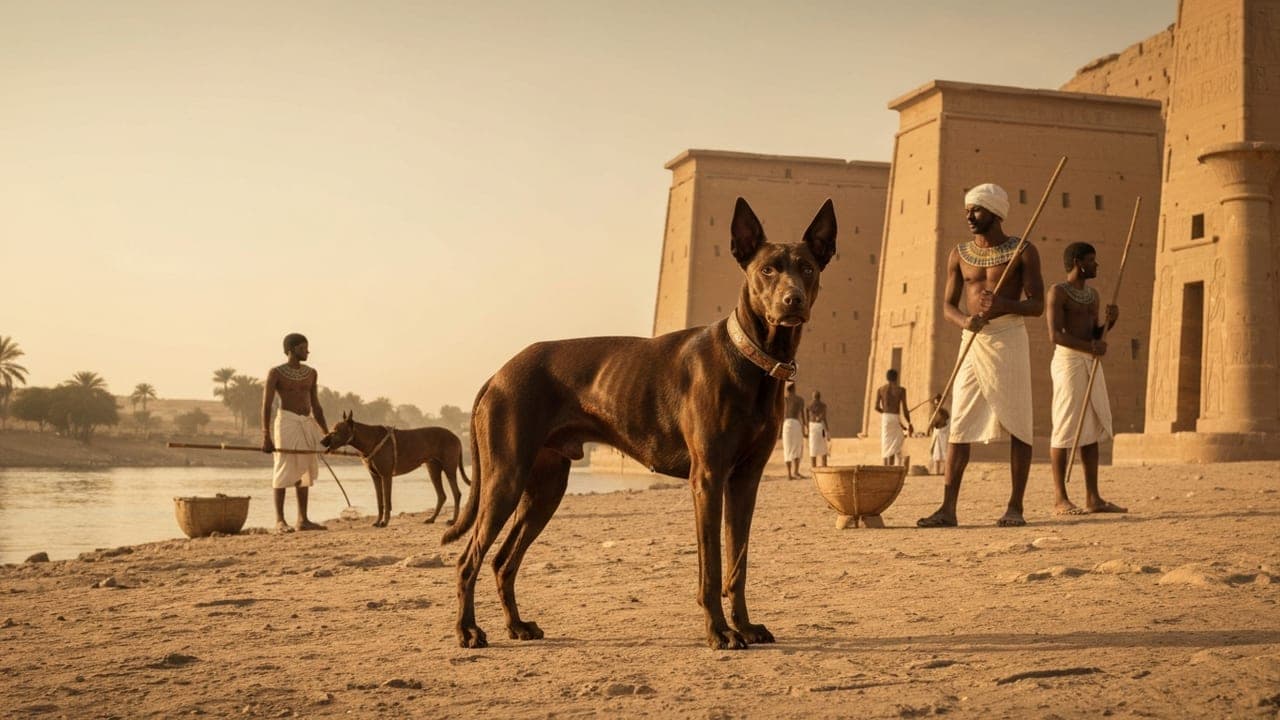
The Earliest Leash
Somewhere around 3400 BCE, an Egyptian artist rendered a scene in paint or relief that would not look entirely out of place on a modern city sidewalk: a person walking a dog on a leash. The image, preserved in tomb paintings from the Predynastic period, is among the oldest visual evidence of humans controlling dogs through a tether. It tells us something essential — Egyptian dogs were not loose camp followers tolerated for their pest-control instincts. They were companions, working partners, and status symbols deliberately managed by their owners.
Egypt offers something no other ancient civilization provides in equivalent depth: continuous, detailed documentation of dog culture across three millennia. Tomb paintings, inscriptions, mummified remains, and administrative records together paint a portrait of human-canine partnership far more sophisticated than most people expect from the ancient world.
Five Types in the Art
Egyptologists studying tomb paintings and relief carvings have identified five morphologically distinct dog types consistently depicted in Egyptian art:
The greyhound-type appears most frequently, shown in hunting scenes pursuing hares and gazelles across desert terrain. Its lean build, deep chest, and long legs are immediately recognizable. The saluki-type — distinguished by feathered ears and tail — appears particularly in New Kingdom paintings associated with noble hunting parties. The basenji-type, with its curled tail, pricked ears, and compact body, is the most distinctively African of the five and likely represents an indigenous breed. The pointer-type shows a heavier, more muscular dog used to locate and flush game. The molossus-type — a heavy, mastiff-like animal — appears in military and guard contexts.
These categories are not rigid; Egyptian artists had varying levels of zoological precision. But the consistency of these five forms across centuries and across different artistic workshops suggests they reflect real, recognizable breed types that Egyptians themselves understood as distinct.
They Named Their Dogs
One of the most humanizing facts about ancient Egyptian dog culture is that Egyptians named their dogs — and those names have survived. Inscriptions from tombs and administrative texts record dog names including Brave One, Good Herdsman, Reliable, North Wind, and Blackie. The stela of a man named Intef II from the 11th Dynasty (around 2100 BCE) depicts four named dogs at his feet: Behekay, Abakaru, Tekal, and Pehtes. These are not generic animals but individuals whose identities were worth recording for eternity.
This practice of naming reveals something important about status. Named dogs in Egyptian records are typically associated with elite owners — pharaohs, nobles, military commanders. The names were carved or painted into tombs because they were expected to accompany their owners into the afterlife.
Hunting Culture and the Tomb of Amenhotep III
The most spectacular documentation of Egyptian hunting with dogs comes from the reign of Amenhotep III (1388–1351 BCE). His mortuary temple complex at Luxor and associated tomb paintings depict organized hunts in the desert, with greyhound-type and saluki-type dogs working alongside hunters on chariots. The quarry included hares, gazelles, ostriches, and wild bulls. Dogs worked in coordinated packs, flushing and coursing prey that archers finished from moving chariots.
These were not casual outings. Royal hunts were logistically complex events that required advance scouting of game areas, preparation of netted enclosures to concentrate animals, and teams of handlers managing multiple dogs. Amenhotep III boasted in one inscription of killing 96 wild bulls in a single hunt. Dogs were essential to achieving such numbers.
For a modern analog to these ancient sighthound types, see our pages on the Saluki, one of the few breeds with a genuinely ancient pedigree, and the Greyhound, whose morphology closely resembles the Egyptian hunting dogs depicted 3,400 years ago.
Dog Mummies and the Necropolis at Cynopolis
Mummification was not reserved for humans and sacred bulls. Egyptians mummified dogs in enormous numbers, particularly during the Late Period and Greco-Roman era. Excavations at Abydos uncovered dog burials dating to around 3500 BCE — some of the earliest evidence of deliberate animal burial anywhere in the world. At Saqqara, the burial ground for the ancient capital Memphis, archaeologists have found hundreds of dog mummies, some interred alongside their human owners.
The most dramatic concentration is at the site the Greeks called Cynopolis — "Dog City" — located at modern Hardai in Middle Egypt. The site was dedicated to the cult of Anubis, the jackal-headed god, and served as a burial site for sacred dogs associated with his worship. Thousands of dog mummies were deposited there, many intentionally bred for the purpose of being dedicated offerings. Analysis of the mummies has revealed they came in all ages — from puppies to elderly animals — and showed evidence of being kept in temple kennels before sacrifice and mummification.
Anubis: The Divine Canine
No discussion of Egyptian dogs is complete without confronting Anubis. Depicted with the head of a jackal or dog and the body of a man, Anubis was one of Egypt's oldest and most important deities. He was the patron of mummification, the guardian of cemeteries, and the divine guide who weighed the hearts of the dead against the feather of Ma'at (truth and justice). His association with dogs likely stems from the observation that jackals and wild dogs were seen around cemeteries — scavenging animals associated with the boundary between the living and the dead, reinterpreted as divine protectors rather than disturbers of graves.
The theological elevation of a canine figure to one of Egypt's most important gods reflects how deeply embedded dogs were in Egyptian cosmology. Death itself — the most serious transition a human could make — was guarded by a dog.
Garrison Dogs and Military Use
Beyond hunting and temple ritual, dogs served Egypt's military and administrative apparatus. Egyptian garrison outposts along the Sinai border — documented in the administrative texts of the New Kingdom — mention dogs kept as sentinels and guard animals. The Papyrus Anastasi IV, dating to the Ramesside period, includes a passage listing food rations for guard dogs at a fortified border outpost, suggesting a formal supply system for military working dogs.
This practical deployment parallels the hunting use but served a different function: the deterrence of unauthorized border crossing and the detection of approaching threats. Military dogs at Egyptian fortifications anticipated modern K-9 units by 3,000 years.
Egypt's Influence Beyond the Nile
Egyptian dog culture did not remain contained within the Nile Valley. Trading connections with Nubia, Libya, and the Levant spread both dogs and dog-keeping practices. The greyhound-type dogs depicted in Egyptian art appear in Canaanite and Levantine archaeology shortly after their peak Egyptian use, suggesting that hunting dogs were prestige trade goods — given as diplomatic gifts and exported alongside other luxury items. Egyptian administrative records from Amarna (14th century BCE) include gifts of hunting dogs exchanged between the Pharaoh and Canaanite and Mitanni rulers.
For a broader view of how dogs spread across the ancient world, read our article on ancient dogs as first companions, and explore the pet domestication timeline for the full sweep of human-animal history.
Frequently Asked Questions
Is the Pharaoh Hound actually from ancient Egypt?
Despite its name and a physical resemblance to dogs depicted in Egyptian art, genetic studies have consistently found that the Pharaoh Hound (known in Malta as the Kelb tal-Fenek) is not an ancient Egyptian breed. Its DNA traces to more recent Mediterranean dog populations, with no direct genetic continuity from ancient Egyptian dogs. The resemblance to Egyptian depictions is a case of convergent form — similar function (sighthound hunting) producing similar morphology — not direct descent.
Why did Egyptians mummify so many dogs?
Dog mummification served multiple purposes. Elite dogs were mummified to accompany their owners in the afterlife, similar to the mummification of servants' tools and household items. Temple dogs were mummified as votive offerings — the equivalent of a religious donation — particularly at sites dedicated to Anubis. Some dog mummies found at Cynopolis appear to have been purpose-bred in temple kennels specifically to be mummified and offered.
What did ancient Egyptians feed their dogs?
Administrative texts and archaeological evidence suggest Egyptian working dogs received bread, fish, and meat as part of their rations, particularly if they were garrison or temple animals on formal supply lists. Depictions of royal hunting dogs show them in good condition, implying deliberate feeding. Dogs in poorer households likely subsisted on food scraps and supplemented with small prey they caught themselves.
Author & Reviewer
Related Reading
Continue the History
Understand Your Companion
Find Your Match
Ready to find your perfect companion?
Take the Breed Quiz →