
Buddy and Bean: The Dog and Cat Who Grew Up Together
Story Subject
Buddy and Bean
Type
Dog
Read Time
7 min
Shared By
The Okafor Family
Editor
Mr Pet Lover Admin
In This Guide
The Okafor family didn't plan to adopt two pets on the same day. They went to the rescue event for a puppy — a Cavalier King Charles Spaniel mix named Buddy. But in the neighboring pen, a five-week-old tabby kitten was playing with Buddy's tail through the barrier.
"They were already friends," said ten-year-old Amara Okafor. "We couldn't separate them."
Her parents looked at each other. They looked at Buddy, sitting patiently while a tiny kitten batted at his tail. They signed two adoption forms.
The First Night
Buddy was eight weeks old. Bean was five weeks old. Neither had ever been in a house before. That first night, the family set up a puppy crate and a kitten bed on opposite sides of the room.
By morning, Bean was curled up inside Buddy's crate, tucked against his belly. They've slept that way ever since.
Growing Up Together
The early months were comical. Bean used Buddy as a climbing structure. Buddy used Bean as a grooming project, licking the kitten's face until Bean would swat him — gently, always gently — and walk away with wet, spiked fur.
They played chase through the house in a way that terrified the Okafors at first — until they realized it was always Bean who initiated, and always Bean who won. The kitten would hide behind a doorway, leap onto the passing puppy, ride his back for three seconds, then disappear.
"Buddy is twice her size now," said Amara's mother, Nneka. "But Bean is in charge. She always has been."
The Bond
At two years old, Buddy and Bean have a relationship that visitors find hard to believe.
They eat from adjacent bowls. They share the sunny spot by the window — Bean on the windowsill, Buddy on the floor below. When the family gets home, both greet them at the door: Buddy with full-body wiggles, Bean with a single, dignified chirp.
But the most remarkable thing is how they comfort each other. When Buddy went to the vet for his neuter surgery, Bean paced the house and howled — a sound the family had never heard from her. When Bean had a dental procedure, Buddy refused to eat until she came home.
"They check on each other," Nneka observed. "If one is in a room alone, the other goes looking."
What They Taught the Family
The Okafors had heard every warning: dogs chase cats, cats scratch dogs, they'll never get along. The internet was full of cautionary tales about multi-species households.
"Buddy and Bean didn't read those articles," Amara said.
The family learned that animals raised together from a young age often form bonds that transcend species. They also learned that personality matters more than species — Buddy's gentle Cavalier temperament and Bean's confident, social nature were a perfect match.
"The biggest lesson," Nneka said, "is that the best relationships aren't always the ones you planned."
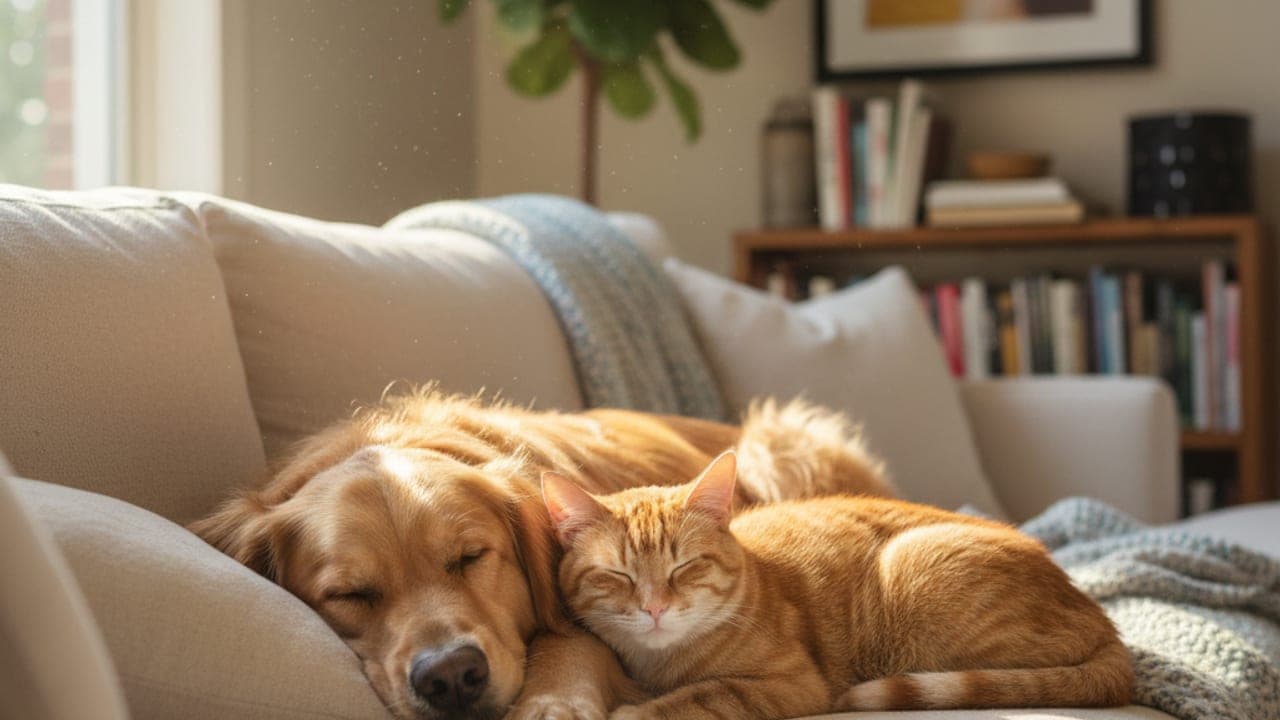
Buddy and Bean, as if on cue, were curled together on the couch. Buddy's nose rested on Bean's back. Bean purred.
Buddy and Bean grew up together from their first week — the gentlest possible dog-and-cat introduction. Most families instead join an adult dog and an adult cat, and the story's real lesson — temperament and setup matter more than species — is exactly what makes those pairings work too.
Why Buddy's breed made this easier — and what actually decides it
Nneka named the reason herself: "Buddy's gentle Cavalier temperament." That instinct is well founded. Our Cavalier King Charles Spaniel profile records the breed as affectionate, gentle, patient and sociable, marks it explicitly good with other pets, and scores it 4 out of 5 for cat-friendliness. Cavaliers are a low-aggression toy companion bred for the lap, not the field — much of why one settled so readily beside a kitten.
But temperament is a head start, not a guarantee. Two other things decided this outcome as much as breed did: age — animals raised together from a few weeks old, before either learns to fear the other, skip the wariness adult introductions must work through — and the fact that Bean held the confidence and set the pace. Personality on both sides, plus the right introduction, matters more than the label on either animal. Browse temperament and pet-compatibility notes across our dog breed profiles before choosing a breed to share a home with your cat.
Setting up a home where a dog and cat get along
Most pairings don't begin like Buddy and Bean's — they begin with an adult of each species meeting a stranger. Our multi-pet household care guide lays out what makes those introductions succeed, and the throughline is go slow and give each animal its own resources. Introduce gradually rather than face-to-face on day one: let each pet grow familiar with the other's scent and presence first, then keep together-sessions short and supervised (roughly 15–30 minutes), extending them only as comfort grows.
The setup does the quiet work. Feed the dog and cat separately to head off food theft and resource guarding. Give the cat exclusive territory — a litter area the dog can't reach, at least one dog-free room to decompress in, and vertical space (shelves, a tall cat tree) to climb out of reach. Keep play size-matched and step in if the dog gets too rough, since a game that's harmless to a 20-pound dog can hurt an 8-pound cat. And one thing is quietly on your side: dogs and cats run on offset energy cycles — dogs busiest morning and evening, cats at dawn and dusk — so their active periods rarely collide.
What Buddy and Bean prove about mismatched roommates
Buddy and Bean aren't a promise that any dog and any cat will end up asleep on the same couch. They're a clear example of what tips the odds: a gentle, sociable breed like the Cavalier, two animals introduced before fear could set in, a confident cat allowed to set the pace, and enough separate space that neither had to compete. Take those levers — temperament, patience, and setup — and most of the outcome is in your hands. The Okafors didn't plan their pairing; they just gave it everything a planned one needs.
Questions About Buddy and Bean
Common questions answered to help you better understand this story
Go slowly and never force a first-day, face-to-face meeting. Let each pet get used to the other's scent and presence through a barrier first, then run short, supervised together-sessions — about 15–30 minutes — and lengthen them only as both animals stay relaxed. Feed them separately and give the cat escape routes and a dog-free room throughout, so neither feels cornered while trust builds.
Generally very well. Our Cavalier profile marks the breed good with other pets, scores it 4 out of 5 for cat-friendliness, and describes an affectionate, gentle, patient and sociable dog with low aggression — a toy companion bred for the lap, not the chase. As with any breed, individual personality and a proper gradual introduction still decide the outcome, but the Cavalier's disposition starts you well ahead.
There's no fixed clock — it depends on both animals' ages and personalities. Pets raised together from a few weeks old, like Buddy and Bean, often bond almost immediately, while two adult strangers may need weeks of patient, supervised introductions before they relax. Let the animals set the pace; forcing contact before either is comfortable slows trust rather than building it.
Look for relaxed, loose body language near each other, resting willingly in the same room, eating calmly together, and play where both can disengage freely. Buddy and Bean's shared window spot and mutual "checking in" are the settled end of that spectrum. Warning signs run the other way — a cat hiding, over-grooming, or avoiding the litter box, or a dog fixated and unable to look away — and mean you should slow down and give each more space.
Didn't find your answer?
Get in touch →More Stories

Get more stories like this
Weekly heartwarming pet stories and care tips, straight to your inbox.
No spam, ever. Unsubscribe anytime.