
Luna the Rescue Cat Who Became a Therapy Animal
Story Subject
Luna
Type
Cat
Read Time
7 min
Shared By
Sophie Chen
Editor
Mr Pet Lover Admin
In This Guide
A truck driver spotted the kitten on a highway median — a tiny black-and-white ball of fur, somehow surviving between lanes of traffic. He pulled over, wrapped her in his jacket, and drove to the nearest vet.
She was about five weeks old, dehydrated, and covered in fleas. But she was alive. And she purred the entire drive.
The vet posted about the kitten on social media. Within hours, Sophie Chen — a retired occupational therapist — saw the post. "I wasn't looking for a cat," Sophie told us. "But I kept thinking about that purr."
Growing Up Luna
Sophie named her Luna. From the start, Luna was unlike any cat Sophie had known. She was social with strangers, calm during vet visits, and completely unbothered by loud noises or new environments.
"Most cats are cautious," Sophie said. "Luna walks into a room like she owns it. She finds the most stressed person and sits on their lap."
By the time Luna was a year old, Sophie — drawing on her therapy background — began to wonder if Luna had the temperament for animal-assisted therapy.
The Training
Animal therapy certification isn't just about having a friendly pet. Luna needed to demonstrate:
- Tolerance for handling by strangers (including unpredictable movements)
- Calm behavior in noisy, unfamiliar environments
- No aggression or fear responses
- Comfort being held in various positions
- Patience during long visits
Luna passed every evaluation with ease. The evaluator noted she had an unusual quality: she seemed to sense who needed her most.
The Visits
Sophie and Luna now visit two nursing homes weekly. The routine is always the same: Sophie carries Luna in, sets her on a chair, and lets the residents come to her.
"There's a woman named Dorothy who hasn't spoken in months," Sophie said. "The first time Luna climbed into her lap, Dorothy said 'pretty kitty.' The nurses cried."
For residents with dementia, Luna provides a sensory anchor — the warmth, the purring, the soft fur. For those who are lonely, she offers non-judgmental companionship.
"Cats don't require anything from you," Sophie observed. "They're not waiting for you to throw a ball or give a command. Luna just sits there and purrs, and somehow that's enough."
The Full Circle
Sophie sometimes thinks about that highway median. About the chain of small decisions — the truck driver who stopped, the vet who posted online, Sophie who scrolled at the right moment — that brought Luna to where she is now.
"She was found abandoned in the most dangerous place imaginable," Sophie said. "Now she brings comfort to people in their most vulnerable moments. If that's not a rescue story, I don't know what is."
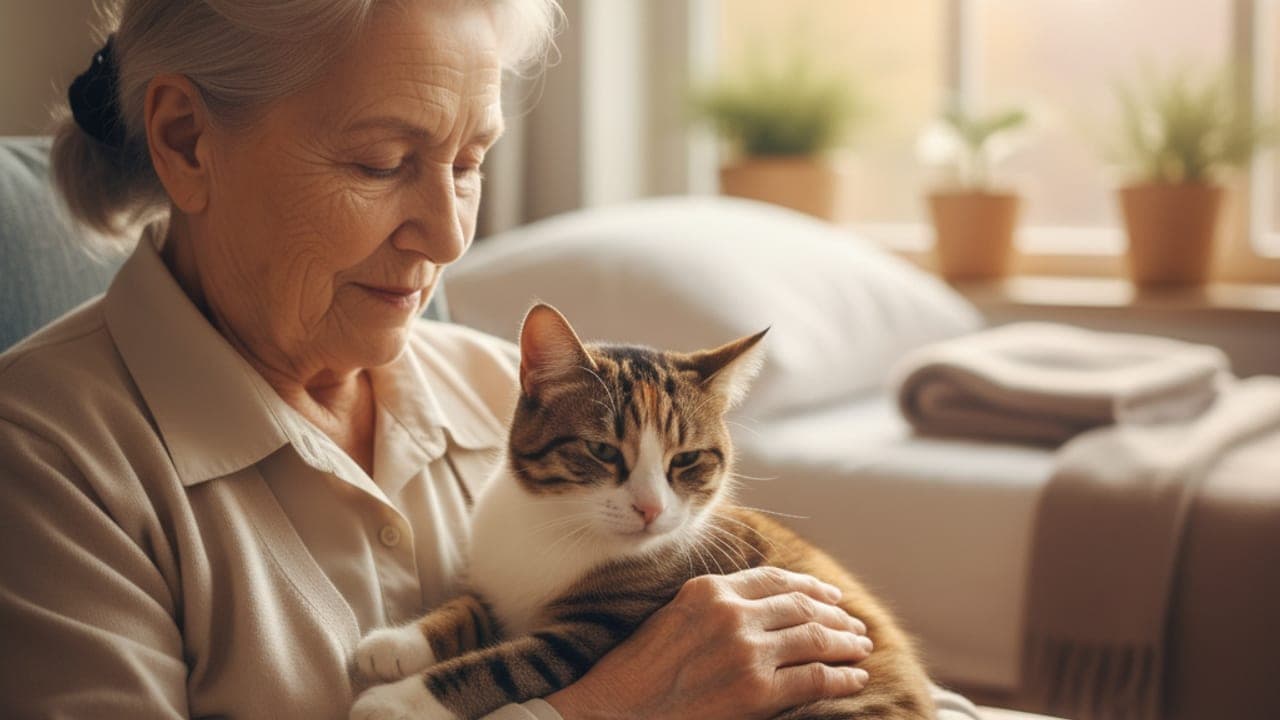
Luna, curled in the lap of a smiling 92-year-old, continued to purr.
Inspired by Luna? Learn more about cat temperaments in our cat breed guides. Some breeds, like Ragdolls and Maine Coons, are known for their gentle, sociable nature.
Can a cat actually be a therapy animal?
Yes — and Luna's nursing-home rounds are exactly what the role means. A therapy animal is a pet that, with its handler, volunteers to bring comfort to other people in settings like nursing homes, hospitals and schools. The work is defined by temperament, not species, and the programs that register these teams — Pet Partners and Love on a Leash among them — accept cats, not only dogs.
What a therapy cat is not is a service animal — under the Americans with Disabilities Act only a dog (or, separately, a miniature horse) trained to perform tasks for a person with a disability qualifies, so a cat cannot be an ADA service animal and a therapy cat has no public-access rights. That is why Sophie carries Luna in and waits: the facility has invited the team. For owners weighing their own cat's disposition, our cat breed guides show which temperaments lean sociable and unflappable.
What makes a good therapy cat — and how one is registered
Temperament, not affection, decides it. The traits Luna's evaluation tested — tolerating handling by strangers, staying calm in a noisy unfamiliar room, showing no fear or aggression, accepting being held, and lasting patiently through a long visit — are the core of every therapy-animal assessment. A cat that hides, startles or swats under pressure isn't a candidate, however loving it is at home.
Much of that steadiness is built early: kittens handled gently and often during their socialization window grow into adults that accept strangers and new places without alarm — the foundation our kitten socialization guide covers in detail. It has to be maintained, too, since a secure, well-enriched indoor life keeps an adult cat relaxed enough to work a room — much of what our indoor cat care guide is about.
Registration runs through a handler-and-animal program, not a paid online "certificate": the cat passes a veterinary health screening, the handler completes a short orientation, and the two are evaluated and registered together as a team, renewed periodically. The partnership is what gets certified — which is why Sophie's therapy background and Luna's temperament had to pass together.
Why Luna was built for this
Sophie didn't set out to certify a therapy animal — she scrolled past a photo of a flea-covered kitten and couldn't forget the purr. What made Luna work wasn't the rescue backstory but the temperament that came with her: bold instead of cautious, drawn to the most stressed person in the room, unbothered by noise and handling that send most cats under the bed. Registration didn't create that; it verified it, then paired it with a handler who'd spent a career reading what fragile people need. Dorothy said "pretty kitty" because a calm cat sat in her lap and asked nothing of her — that is the whole job, and Luna was made for it.
Questions About Luna
Common questions answered to help you better understand this story
Yes. A therapy animal, with its handler, volunteers to comfort other people in places like nursing homes, hospitals and schools, and national programs such as Pet Partners and Love on a Leash register cats, not only dogs. The role is temperament-based, so a calm, sociable, handleable cat like Luna qualifies. Therapy cats have no public-access rights; they visit only where invited.
Temperament, not affection alone. A therapy cat must tolerate handling by strangers, stay calm in noisy, unfamiliar rooms, show no fear or aggression, accept being held, and stay patient through a long visit — the criteria Luna's evaluation tested. Cats that hide, startle or swat under stress aren't suited, however loving they are at home.
They serve different people. An emotional support animal comforts its own owner and needs only a licensed mental health professional's letter — no task training or evaluation — and keeps Fair Housing Act housing protection, though airlines no longer must accommodate ESAs. A therapy cat is evaluated to comfort other people in facilities. Neither is a service animal.
Through a handler-and-animal program such as Pet Partners or Love on a Leash — not a paid online "certificate." Typically the cat passes a vet health screening, is well-socialized and settled at home, the handler completes an orientation, and the two are evaluated together as a team. Registration covers the team and is renewed periodically.
No. Under the Americans with Disabilities Act, a service animal is narrowly a dog — or, separately, a miniature horse — trained to perform tasks for one person with a disability, so cats cannot be ADA service animals. Therapy cats have no legal public-access rights; they are welcomed guests, not working animals entitled to enter public spaces.
Didn't find your answer?
Get in touch →More Stories
Get more stories like this
Weekly heartwarming pet stories and care tips, straight to your inbox.
No spam, ever. Unsubscribe anytime.