
Puppy Socialization: The 16-Week Window That Shapes Your Dog's Entire Life
Fact-checked against published AKC, ASPCA and AVMA guidance. Not individually reviewed by a veterinarian. Read our editorial standards.
Last updated:
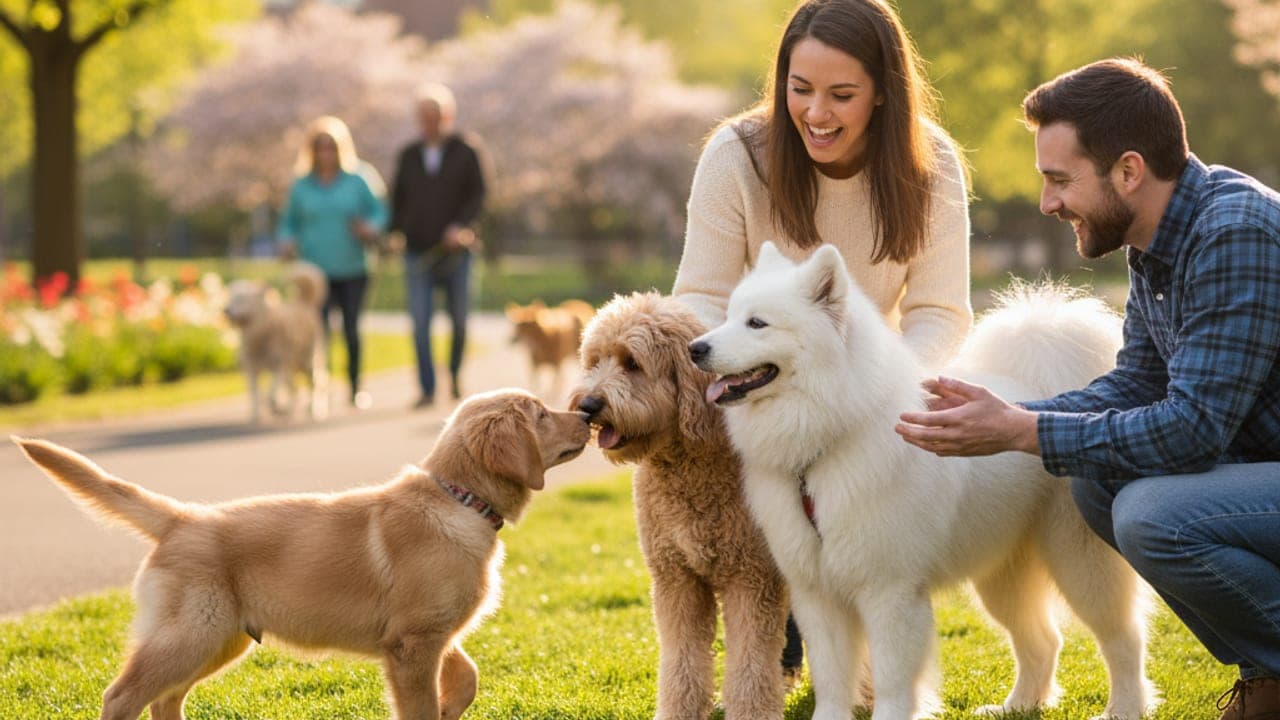
- The critical socialization window closes around 16 weeks — experiences during this period shape lifetime behavior
- Positive exposure means treats and praise during new encounters, not just being near something unfamiliar
- Aim for 100 new positive experiences by 16 weeks: different people, surfaces, sounds, animals, and environments
- Under-socialization is the leading cause of fear-based aggression in adult dogs
- Even before full vaccination, safe socialization (puppy classes, controlled home visits) is veterinarian-recommended
A twelve-week-old Golden Retriever puppy named Rosie sits on the sidewalk outside a hardware store, watching the world go by. A delivery truck rumbles past. A man in a hat walks by carrying bags. A child on a scooter zooms along the opposite sidewalk. A shopping cart rattles across the parking lot.
Rosie's ears swivel. She watches. She sniffs. But she doesn't cower, pull, bark, or panic. She looks up at her owner, gets a treat, and goes back to observing. In two years, Rosie will be a calm, confident dog who navigates the world with steady curiosity rather than reactive fear.
This isn't because Rosie is genetically exceptional. It's because her owner understood one of the most important principles in canine behavioral science: the socialization window — and she didn't waste a single week of it.
What the Socialization Window Actually Is
This matters because training built on trust and positive association lasts longer and generalizes better to new situations.
Between approximately 3 and 16 weeks of age, puppies are in what behavioral scientists call the "sensitive period for socialization." During this window, a puppy's brain is uniquely receptive to new experiences. Sights, sounds, textures, people, animals, and environments encountered during this period become filed as "normal" in the puppy's neural framework.
After approximately 16 weeks, this window begins to close. It doesn't slam shut — it narrows gradually — but the ease with which a puppy can accept novelty decreases dramatically. Things not encountered during the sensitive period are more likely to be classified as "potentially threatening" by default.
Dr. Ian Dunbar, a veterinarian and animal behaviorist who pioneered modern puppy socialization training, describes it: "Socialization during the sensitive period is like saving money in a high-interest account. Every deposit pays dividends for years. After the window closes, you're still making deposits, but the interest rate drops to almost nothing."
For example, if you're trying to stop your dog from jumping on guests, the most effective approach is teaching an incompatible behavior (like 'sit') rather than just saying 'no' to the jumping.
This doesn't mean adult dogs can't learn to tolerate new things — they can, through desensitization and counterconditioning. But it's exponentially harder, slower, and less reliable than getting it right during puppyhood.
The Science: What's Happening in the Puppy Brain
During the sensitive period, a puppy's brain is producing new neural connections at an extraordinary rate. Synaptic density peaks during this window. Experiences literally shape the physical structure of the brain — neural pathways that fire together wire together, creating the foundation for how the dog will perceive and respond to the world for the rest of her life.
Research by Dr. Michael Fox at Washington University demonstrated that puppies raised in enriched environments during the sensitive period showed measurably different brain structure compared to puppies raised in isolation. The enriched-environment puppies had denser cortical tissue, more synaptic connections, and better problem-solving abilities as adults.
For instance, clicker training works so well because the click is a precise marker that tells your pet exactly which behavior earned the reward — much clearer than voice alone.
Fear responses, conversely, are also being calibrated during this period. A single traumatic experience — a dog attack, a painful veterinary visit, a frightening noise — can create a fear imprint that persists for life. This is why quality of socialization matters as much as quantity.
The Vaccination Paradox (And How to Solve It)
Here's the tension every new puppy owner faces: the socialization window and the vaccination schedule overlap. Puppies aren't fully vaccinated until 16-18 weeks. Traditional veterinary advice was to keep puppies isolated until the vaccine series was complete. But by then, the most critical socialization window has closed.
The American Veterinary Society of Animal Behavior addressed this directly in their position statement: "The primary and most important time for puppy socialization is the first three months of life. During this time, puppies should be exposed to as many new people, animals, stimuli, and environments as can be achieved safely and without causing overstimulation."
The key word is "safely." This doesn't mean taking your 10-week-old puppy to a dog park full of unknown dogs. It means finding low-risk ways to provide diverse experiences.
Safe socialization before full vaccination:
In practice, dogs who are trained using positive reinforcement not only learn faster but also show fewer stress behaviors and a stronger bond with their owners.
- Puppy socialization classes run by qualified trainers (participants are screened for health and vaccine status)
- Controlled dog introductions with known, fully vaccinated, healthy adult dogs
- Outdoor exposure in low-traffic areas (avoid dog parks, pet stores, and high-traffic sidewalks where unvaccinated dogs may have been)
- Car rides to different environments (your puppy can observe from the car)
- Visitors to your home — invite people of different ages, appearances, and energy levels to meet your puppy in a controlled setting
- Surface exposure at home — let your puppy walk on different textures: tile, carpet, grass, gravel, metal grates, wet surfaces
- Sound exposure — play recordings of thunderstorms, fireworks, traffic, babies crying, doorbells at low volume during positive experiences (treats, play, meals)
The Socialization Checklist: What Your Puppy Needs to Experience
Understanding this is important because how you train affects your pet's emotional wellbeing, not just their behavior.
Effective socialization isn't random exposure — it's systematic and positive. Each new experience should be paired with treats, play, or calm praise. The goal is to create a positive association, not just an exposure.
People (aim for variety):
- Men, women, children, elderly people
- People wearing hats, sunglasses, hoodies, uniforms
- People using walkers, wheelchairs, crutches
- People of different body types and skin tones
- Bearded people, bald people, people with backpacks
- Delivery workers, mail carriers, joggers
Other animals:
- Calm, vaccinated adult dogs of various sizes
- Cats (if you want your dog to be cat-friendly as an adult)
- Livestock or small animals (if relevant to your environment)
Environments:
- Urban sidewalks, quiet suburban streets, parks
- Veterinary clinic (just for treats and happy visits, not just for shots)
- Pet-friendly stores (after second vaccination, with carrier or held)
- Different floor surfaces: wood, tile, carpet, concrete, grass, gravel
- Stairs, ramps, elevated surfaces
- Cars, elevators, automatic doors
Sounds:
- Thunder, fireworks (recorded, at low volume)
- Vacuum cleaners, blenders, hair dryers
- Doorbells, knocking, sirens
- Children playing, babies crying
- Construction noises, lawn mowers
Handling:
- Paw handling (essential for future nail trims)
- Ear examination, mouth opening
- Being lifted, carried, restrained gently
- Grooming tools (brush, comb, nail clipper — just touching, not cutting)
- Being touched by strangers (with permission and treats)
How to Socialize: Quality Over Quantity
The biggest mistake new puppy owners make is flooding. Flooding means overwhelming a puppy with too many stimuli too quickly — a busy farmer's market, a loud street festival, a chaotic dog park — and hoping the puppy "gets used to it."
Flooding doesn't create confident dogs. It creates shut-down or reactive dogs. A puppy who freezes at a street festival isn't "being good" — she's overwhelmed and has stopped processing.
The right approach:
-
Start at a distance. Watch the busy street from across the road. Watch the dogs at the park from outside the fence. Let your puppy observe before she participates.
-
Watch for stress signals. Lip licking, yawning, whale eye, tucked tail, ears pinned back, refusing treats — these all mean your puppy has had enough. (Our guide to reading dog body language covers these signals in detail.)
-
End on a high note. Short, positive sessions (5-15 minutes) are better than long, exhausting ones. Stop while your puppy is still happy and curious, not when she's tired and stressed.
-
Let the puppy choose. Don't force her to approach something scary. Let her investigate at her own pace. Forced exposure creates avoidance, not confidence.
-
Pair everything with good things. New person? Treat. Strange surface? Treat. Loud sound? Treat. You're building an association: new things predict good things.
What Happens When You Miss the Window
Incomplete socialization is the leading predictor of behavioral problems in adult dogs. Fear aggression, resource guarding, separation anxiety, noise phobias, and leash reactivity are all more common in dogs who were inadequately socialized during the sensitive period.
This doesn't mean an under-socialized puppy is doomed. Adult dogs can improve significantly with professional behavioral intervention — desensitization, counterconditioning, and in some cases, medication to reduce baseline anxiety. But it's harder, slower, and more expensive than getting it right the first time.
Breeds with naturally cautious temperaments — including many herding breeds like Border Collies and German Shepherds — are particularly vulnerable to insufficient socialization. Their genetic predisposition toward vigilance means that without early positive exposure, they're more likely to develop fear-based reactivity as adults.
Week-by-Week Socialization Guide
Weeks 3-5 (breeder's responsibility): Gentle handling by humans, exposure to household sounds, different surfaces in the whelping area, brief separations from littermates.
Weeks 5-8 (breeder + new owner transition): Broader human contact, introduction to car rides, basic sound exposure, beginning of alone-time tolerance training.
Weeks 8-12 (your critical window): Maximum variety of people, controlled dog introductions, different environments (carried or in car before full vaccination), puppy class enrollment, handling exercises, sound desensitization.
Weeks 12-16 (window narrowing): Continue adding new experiences but at a pace that maintains confidence. Introduce more complex environments. Practice calm behavior in mildly distracting settings. This is your last high-interest window.
After 16 weeks: Continue exposing to new things, but expect slower adaptation. Reinforce everything with positive associations. If you notice fear responses to things not encountered during the sensitive period, consider professional guidance early — before the behavior calcifies.
Founder Insight: What Most People Get Wrong
From experience working with pet owners on training: the biggest mistake is expecting immediate results and giving up too soon. Real behavior change takes weeks of consistent practice, not a single session. In practice, the owners who succeed are the ones who commit to short, daily sessions (5–10 minutes) rather than occasional marathon training days. Patience and consistency beat intensity every time.
Frequently Asked Questions
Is it safe to take my unvaccinated puppy outside?
Yes, with precautions. Avoid areas with heavy dog traffic (dog parks, pet stores, popular dog-walking trails). Carry your puppy, use a stroller, or choose low-risk outdoor areas. The behavioral risk of NOT socializing outweighs the disease risk of controlled exposure.
My puppy is 14 weeks old and I haven't done much socialization. Is it too late?
Not too late, but the window is narrowing. Prioritize the most important experiences (people variety, basic sounds, other dogs) and work intensively over the next 2-4 weeks. Quality is more important than quantity at this stage.
Should I take my puppy to a dog park?
Not before she's fully vaccinated and confident. Dog parks are unpredictable environments. A negative interaction at a young age can create lasting fear. Controlled playdates with known, gentle dogs are much safer.
How do I know if my puppy is enjoying socialization or just tolerating it?
Watch the body language. A puppy who is engaged — loose body, tail wagging, approaching voluntarily, taking treats — is having a positive experience. A puppy who is frozen, hiding behind you, refusing treats, or trying to leave is overwhelmed. Adjust accordingly.
Wondering which breed is right for your family? Take our breed matching quiz or explore all dog breeds to find a temperament that fits your lifestyle.
Angel Lequiron
The Mr Pet Lover team is dedicated to providing warm, accurate, and practical pet care advice backed by veterinary research and real-world experience.
Related Articles
New Puppy Owner? 5 Habits That Make a Real Difference
Five habits that set new puppy owners up for years of success. Start these from day one.

Can Dogs Eat Chocolate? Toxicity by Weight + What to Do Right Now
No — chocolate is toxic to dogs. How much is dangerous by your dog's weight and the chocolate type, the symptoms to watch, and exactly what to do in the next 10 minutes.
Can Cats Eat This? The Complete Toxic & Safe Human-Foods List
A cat-specific list of which human foods are safe, which are risky, and which are an emergency — with the active risk and a clear vet-now trigger for each.