
Sporting group
Gordon Setter
The Gordon Setter is the largest and most substantial of the three setter breeds, and it is also the most owner-focused — a trait that cuts both ways.


Size
44-79 lb
Lifespan
12-13 years
Exercise
20-40 minutes
Shedding
Moderate
Experience
Match to owner routine
Decision first
Is a Gordon Setter right for you?
Start with fit before history or trivia. These are ownership signals, not guarantees about any individual dog.
Best suited for
- Households with children.
- Homes with other compatible pets.
- Apartment homes with a consistent routine.
- Owners seeking a manageable daily exercise routine.
Think carefully if
- You need a dog with almost no daily routine.
- You cannot keep up with grooming and preventive care.
- The dog will spend most days alone without support.
Conditional fit
Apartment fit depends on exercise, enrichment, noise management, and outdoor access.
Daily reality
Gordon Setter commitment snapshot
Daily exercise
20-40 minutes
Match activity to age, health, weather, and training goals.
Coat care
Moderate
Grooming needs vary by coat, shedding, and lifestyle.
Time alone
Needs planning
Most dogs need gradual alone-time conditioning and support.
Structured facts
Gordon Setter at a glance
The measurements and traits that most affect day-to-day life with this breed.
Group
Sporting
Weight
44-79 lb
Height
23-27 in
Lifespan
12-13 years
Temperament
Affectionate | Confident | Bold
View all characteristics and methodology
Lifestyle fit
- Apartment suitability
- Likely fit
- Child friendliness
- Often good, with socialisation and supervision
- Other-pet fit
- Often compatible with careful introductions
Owner commitment
- Exercise
- 20-40 minutes
- Grooming
- Moderate
- Shedding
- Moderate
- Training
- Moderate
Environment and health
- Health risk
- Needs planning
Ratings combine structured breed data, visible breed fields, and editorial context. They are planning aids, not predictions for an individual dog.
Daily life
Gordon Setter temperament and behavior
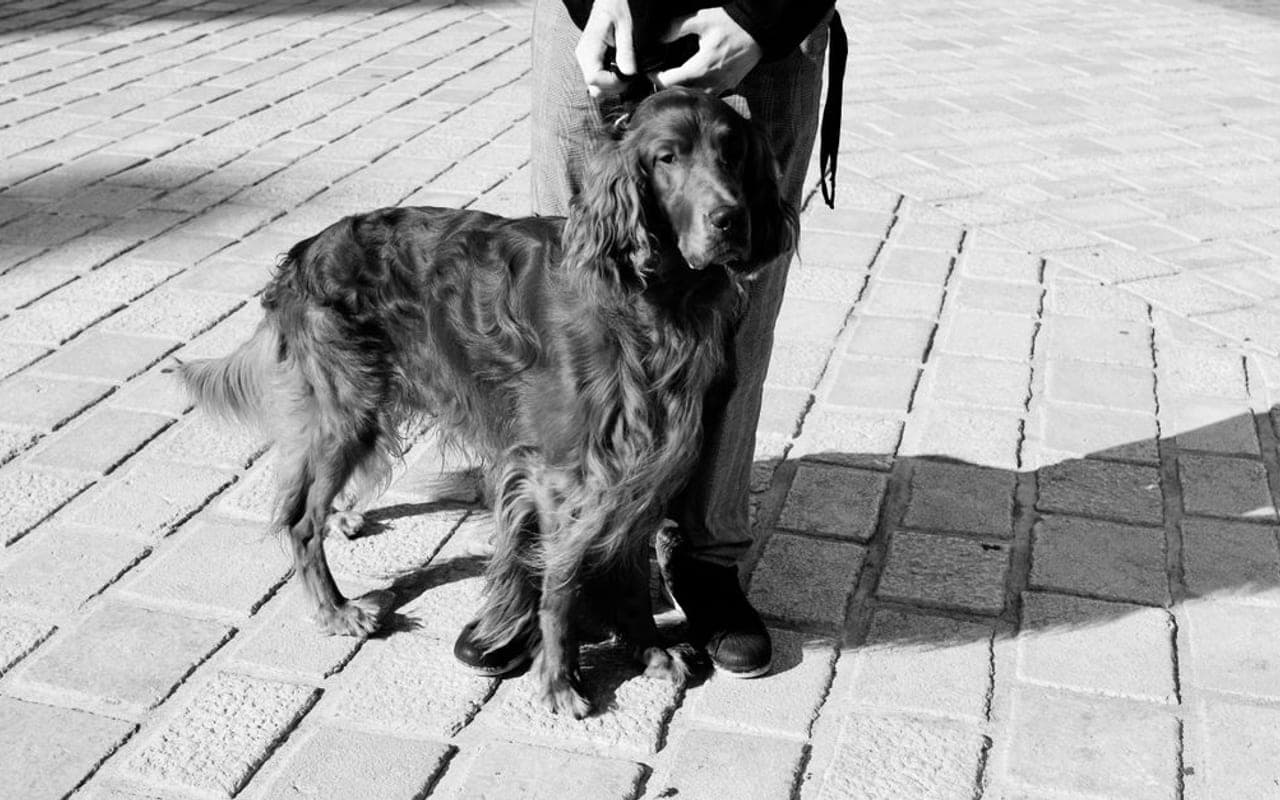
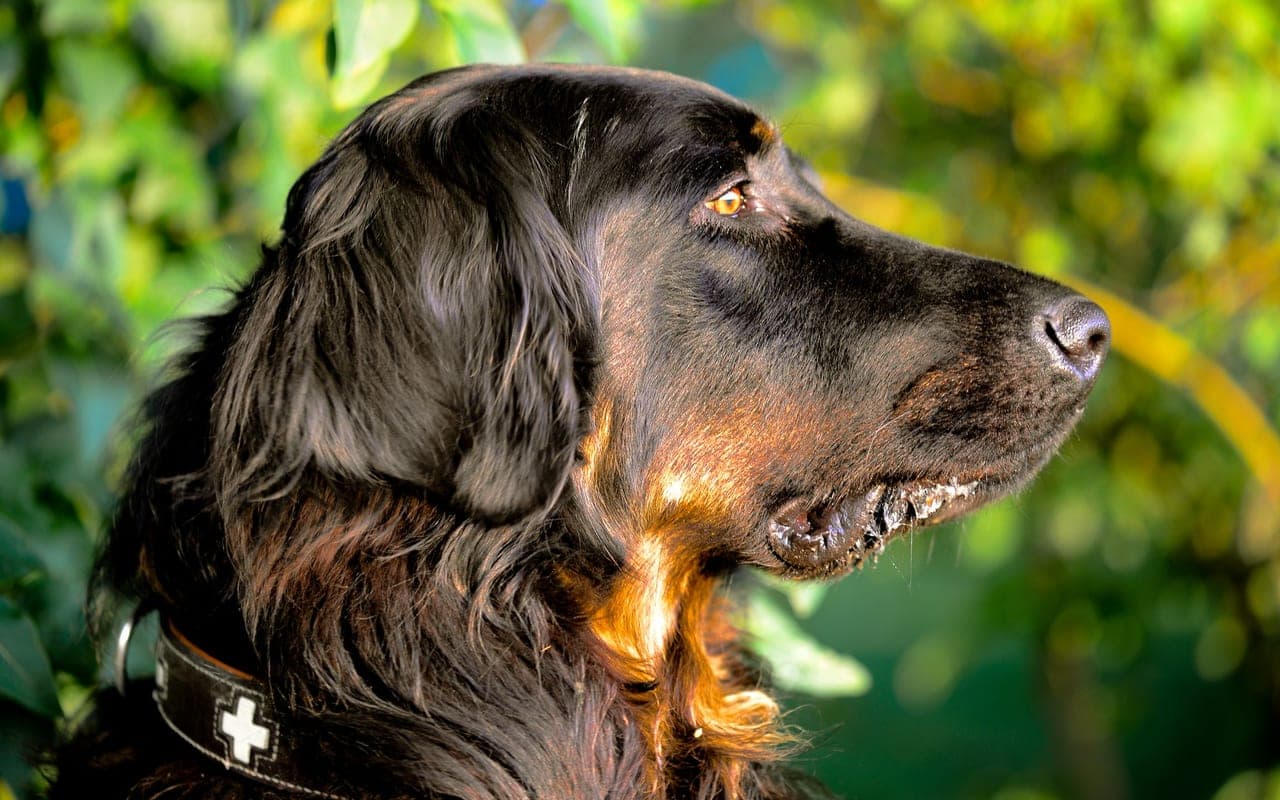
The Gordon Setter is the largest and most substantial of the three setter breeds, and it is also the most owner-focused — a trait that cuts both ways. People who research the breed often expect a striking black-and-tan version of the more familiar Irish Setter. What they get is a heavier, more deliberate, more intensely bonded dog with a working-bird-dog engine and a low tolerance for being left alone. The Gordon's devotion is its best quality and the source of its most common behavioral problem: separation distress in homes that are out all day. Physically the Gordon is a powerful, sturdy gun dog: males stand about 24-27 inches and weigh 55-80 pounds, females are smaller. The coat is shining coal black with distinct chestnut or mahogany tan markings over the eyes, on the muzzle, chest, legs, and under the tail, with feathering on the ears, belly, legs, and tail that requires real maintenance. The expression is described as wise and willing, and the build is for stamina over a day's hunt rather than flashy speed. Temperament is affectionate, confident, bold in the field, and loyal to the point of one-family attachment. Gordons are slower to mature and slower to warm to strangers than other setters, can be reserved or aloof with people they do not know, and need early, ongoing socialization. They are intelligent and trainable but have an independent streak and a memory for unfair handling. Who the Gordon Setter is right for: an active household that is home a good part of the day, wants a deeply devoted single-family dog, can deliver 1-2 hours of daily exercise, and will keep up with feathered-coat grooming. Who it is wrong for: people gone long hours, those wanting an instantly social butterfly, and anyone unprepared for a large, high-energy bird dog that bonds hard and grieves isolation.
Affectionate | Confident | Bold
Affectionate
A common Gordon Setter temperament descriptor that should be interpreted alongside training, exercise, and household fit.
Confident
A common Gordon Setter temperament descriptor that should be interpreted alongside training, exercise, and household fit.
Bold
A common Gordon Setter temperament descriptor that should be interpreted alongside training, exercise, and household fit.
Owner note
Temperament labels are starting points, not guarantees. Meet the individual dog and ask about behavior history whenever possible.
Care essentials
How to care for a Gordon Setter
What looking after one actually involves: exercise, grooming, food, training, and routine health.
ExerciseAs needed
- Lower-energy breed that is content with daily walks and moderate play. Avoid over-exercising.
GroomingAs needed
- Regular grooming needed — brush 2-3 times per week and bathe monthly.
TrainingAs needed
- Moderately trainable — consistent, patient training with positive methods works best.
NutritionAs needed
- Feed a high-quality dog food appropriate for their age, size, and activity level. Monitor portions to prevent obesity.
Veterinary CareAs needed
- Annual wellness exams, core vaccinations, dental care, and parasite prevention. Breed-specific health screenings as recommended by your vet.
Health planning
Gordon Setter health risks and screening
Every breed has individual health variation. Use this profile for planning and discuss medical decisions with a veterinarian.
Responsible ownership
Finding a Gordon Setter responsibly
What to ask a breeder or rescue is the same conversation for every breed, so we keep it in one place and keep it current.
Health documentation, meeting the parents or foster, contracts and return support, and the warning signs worth walking away from.
Original purpose
Gordon Setter history
History is useful when it explains today's behavior, coat, exercise needs, and training style.
Read the breed history
The Gordon Setter was developed in Scotland and is named for the Dukes of Gordon, whose kennel at Gordon Castle popularized and stabilized the black-and-tan setter type in the late 1700s and early 1800s. Setters as a working class are old — bred to find game birds and 'set' (crouch) so a net could be drawn over the birds, later adapting to wing-shooting with guns. The Gordon strain was selected to be heavier, more powerful, and more enduring than the lighter setters, prized as a methodical, reliable hunting companion that worked closer to the gun and had the stamina for rugged Scottish moorland and weather. The breed reached the United States in the 1840s and was among the breeds recognized when the AKC was formed, recognized in 1884. Its origin as a deliberate, devoted, close-working bird dog explains the modern Gordon's stamina, its strong handler bond, and its slower, more serious maturation compared with other setters.
Gallery
Gordon Setter photos
Images are cropped consistently and loaded progressively to keep the page responsive.
Lower-page context
Gordon Setters in culture
Where the breed shows up in film, sport, work and folklore — the enjoyable part, once the practical questions are answered.
Fun facts
- The Gordon Setter belongs to the Sporting Group.
- The average lifespan of a Gordon Setter is 12 to 13 years.
- Gordon Setter dogs are valued for their affectionate, confident, bold nature.
Gordon Setter FAQs
How long do Gordon Setters live?
Gordon Setters typically live 12-13 years, which is about average for a large breed and shorter than the smaller setters. The two factors that most influence whether a Gordon reaches the upper end are bloat and inherited disease: the deep-chested build makes gastric torsion a real lifespan risk, and rcd4-PRA, hip dysplasia, and hypothyroidism run in the breed. Buying from DNA- and OFA-tested lines, feeding split meals to lower bloat risk, and keeping the dog lean are the practical levers that matter most here.
Are Gordon Setters good with children?
Yes, with active families and reasonable supervision. Gordons are affectionate, loyal, and tolerant with children in their own household, and their deep bonding makes them devoted family dogs. The cautions are size and energy — a large, exuberant, slow-to-mature setter can bowl over small children during play well into adolescence, and the breed's reserve with strangers means children's visiting friends should be introduced calmly. With early socialization and supervision around toddlers, the Gordon is a solid family companion for households that can meet its exercise needs.
Do Gordon Setters need a lot of exercise?
Yes. Despite being calmer indoors than the Irish Setter, the Gordon is a stamina-built hunting breed that needs 1-2 hours of genuine daily exercise — long walks plus running, hiking, fieldwork, or dog sports. They are also slow to mature, so the high adolescent energy persists into roughly the third year. An under-exercised Gordon becomes restless, vocal, and destructive. This is not a low-energy dog despite the dignified appearance, and matching its exercise need honestly is the difference between a settled companion and a problem dog.
Can Gordon Setters be left alone during the workday?
This is the breed's biggest mismatch risk. Gordons bond intensely to their family and tolerate isolation poorly; a dog left alone 9-10 hours a day commonly develops separation anxiety, excessive barking, and destructive behavior. The breed genuinely needs company. Households that are out for full workdays should plan for doggy daycare, a dog walker, a companion, or honestly reconsider the breed. The devotion that makes the Gordon a wonderful family dog is the same trait that makes prolonged solitude a real welfare problem for it.
How much grooming does a Gordon Setter need?
Moderate and ongoing. The medium-length black-and-tan coat has feathering on the ears, chest, legs, belly, and tail that mats and tangles without attention, so plan on brushing and combing 3-4 times a week, periodic trimming of the feet and ears, and bathing as needed. It is less demanding than a long-coated breed like the Afghan Hound but well above a short-coated dog like the Pointer. Owners should budget either consistent home grooming time or regular professional grooming visits to keep the feathered coat healthy.
Are Gordon Setters easy to train?
Moderately. Gordons are intelligent and capable, with strong working drive that makes them responsive to training that engages their bird-dog instincts, but they also have an independent streak, mature slowly, and remember unfair or harsh handling. Positive, consistent, patient methods started early work best; pressure-based training tends to make them resistant or shut down. Early and ongoing socialization is especially important because the breed is naturally reserved with strangers. Expect a smart but somewhat sensitive dog that rewards fair handling and resents the opposite.
Sources
These are the published sources this page draws on. Each opens in a new tab so you can check it yourself.
American Kennel Club
Gordon Setter — breed standard and profile(opens in a new tab)Supports: Breed standard and recognition details.
Similar breeds to consider

Golden Retriever
Also in the Sporting group, with different care and temperament tradeoffs.

German Shorthaired Pointer
Also in the Sporting group, with different care and temperament tradeoffs.

Labrador Retriever
Also in the Sporting group, with different care and temperament tradeoffs.

Vizsla
Also in the Sporting group, with different care and temperament tradeoffs.
Explore More About Gordon Setter
Dive deeper into everything Gordon Setter — costs, care, and expert insights.
Considering a cat instead?
Browse Cats