
Working group
Portuguese Water Dog
The Portuguese Water Dog is a 35-to-60-pound working water dog marketed heavily as the 'hypoallergenic, low-shedding family dog' — and that marketing is exactly where buyers go wrong.



Size
35-60 lb
Lifespan
11-13 years
Exercise
30-60 minutes
Shedding
Moderate
Experience
Match to owner routine
Decision first
Is a Portuguese Water Dog right for you?
Start with fit before history or trivia. These are ownership signals, not guarantees about any individual dog.
Best suited for
- Households with children.
- Homes with other compatible pets.
- Apartment homes with a consistent routine.
- Owners seeking a manageable daily exercise routine.
Think carefully if
- You need a dog with almost no daily routine.
- You cannot keep up with grooming and preventive care.
- The dog will spend most days alone without support.
Conditional fit
Apartment fit depends on exercise, enrichment, noise management, and outdoor access.
Daily reality
Portuguese Water Dog commitment snapshot
Daily exercise
30-60 minutes
Match activity to age, health, weather, and training goals.
Coat care
Moderate
Grooming needs vary by coat, shedding, and lifestyle.
Time alone
Needs planning
Most dogs need gradual alone-time conditioning and support.
Structured facts
Portuguese Water Dog at a glance
The measurements and traits that most affect day-to-day life with this breed.
Group
Working
Weight
35-60 lb
Height
17-23 in
Lifespan
11-13 years
Temperament
Affectionate | Adventurous | Athletic
View all characteristics and methodology
Lifestyle fit
- Apartment suitability
- Likely fit
- Child friendliness
- Often good, with socialisation and supervision
- Other-pet fit
- Often compatible with careful introductions
Owner commitment
- Exercise
- 30-60 minutes
- Grooming
- Moderate
- Shedding
- Moderate
- Training
- Moderate
Environment and health
- Health risk
- Needs planning
Ratings combine structured breed data, visible breed fields, and editorial context. They are planning aids, not predictions for an individual dog.
Daily life
Portuguese Water Dog temperament and behavior
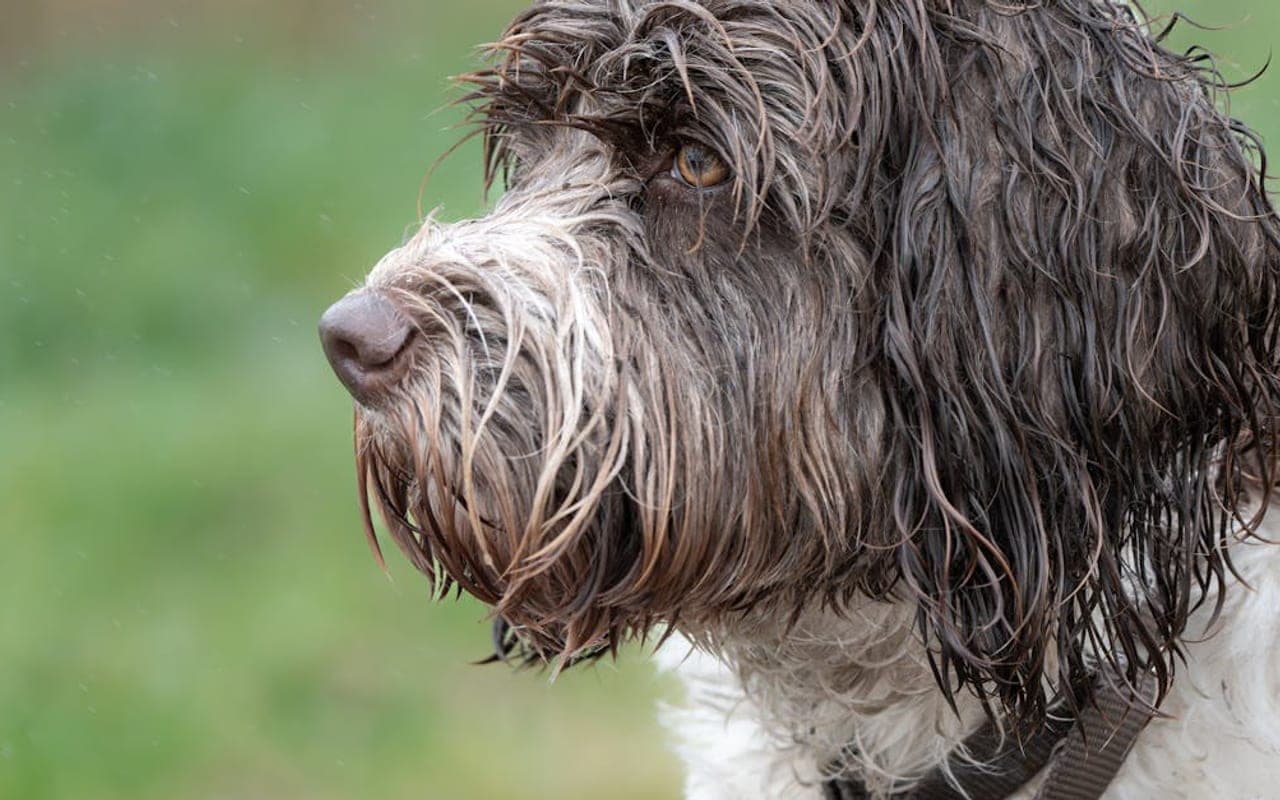
The Portuguese Water Dog is a 35-to-60-pound working water dog marketed heavily as the 'hypoallergenic, low-shedding family dog' — and that marketing is exactly where buyers go wrong. The low-shedding curly coat is real, but it is not low-maintenance, and the dog under it is a high-energy, highly intelligent working breed that needs serious daily exercise and a job. People choose the PWD for the coat and discover they own an athletic, busy, smart dog that will out-think and out-stamina an under-prepared owner. This profile leads with that mismatch because it is the main reason PWDs are rehomed. Physically the PWD is robust and athletic with webbed feet and a single, non-shedding coat that is either tightly curled or wavy, in black, brown, white, or particolor. 'Low-shedding' means the hair stays in the coat rather than on the floor — which means it mats and needs constant grooming, not less grooming. Temperament is bright, biddable, affectionate, and intense. PWDs bond hard to their family, are excellent with children, highly trainable, and thrive on having work to do. The flip side: they are mouthy as youngsters, can be vocal, dislike being left alone for long stretches, and become destructive and anxious when under-exercised or under-stimulated. They are velcro dogs, not independent ones. Who the PWD is right for: an active owner or family that wants a trainable, affectionate companion for sport, swimming, hiking, and daily engagement, and who will commit to professional grooming every 6-8 weeks plus home brushing. Who it is wrong for: anyone choosing it primarily as an allergy-friendly low-effort pet, a sedentary household, or someone who is away long hours. Buy the dog, not the coat.
Affectionate | Adventurous | Athletic
Affectionate
A common Portuguese Water Dog temperament descriptor that should be interpreted alongside training, exercise, and household fit.
Adventurous
A common Portuguese Water Dog temperament descriptor that should be interpreted alongside training, exercise, and household fit.
Athletic
A common Portuguese Water Dog temperament descriptor that should be interpreted alongside training, exercise, and household fit.
Owner note
Temperament labels are starting points, not guarantees. Meet the individual dog and ask about behavior history whenever possible.
Care essentials
How to care for a Portuguese Water Dog
What looking after one actually involves: exercise, grooming, food, training, and routine health.
ExerciseAs needed
- Moderately active breed needing 30-60 minutes of daily exercise.
GroomingAs needed
- Brush 2-3 times per week.
TrainingAs needed
- Consistent, patient training works best.
NutritionAs needed
- Feed high-quality dog food appropriate for age, size, and activity level.
Veterinary CareAs needed
- Annual wellness exams, vaccinations, dental care, and parasite prevention.
Health planning
Portuguese Water Dog health risks and screening
Every breed has individual health variation. Use this profile for planning and discuss medical decisions with a veterinarian.
Responsible ownership
Finding a Portuguese Water Dog responsibly
What to ask a breeder or rescue is the same conversation for every breed, so we keep it in one place and keep it current.
Health documentation, meeting the parents or foster, contracts and return support, and the warning signs worth walking away from.
Original purpose
Portuguese Water Dog history
History is useful when it explains today's behavior, coat, exercise needs, and training style.
Read the breed history
The Portuguese Water Dog (Cão de Água) was developed along the coast of Portugal, particularly the Algarve, as an all-purpose fisherman's working dog. For centuries it herded fish into nets, retrieved gear and broken nets from the water, carried messages between boats and from ship to shore, and guarded the catch — work that demanded a strong swimmer with webbed feet, a water-resistant coat, stamina, intelligence, and biddability. As traditional fishing methods declined in the 20th century the breed nearly went extinct and was rebuilt from a very small number of dogs by dedicated breeders, which is why the modern gene pool is comparatively narrow and DNA health screening matters so much. The breed gained worldwide attention when one was chosen as a U.S. presidential family dog, prized for its low-shedding coat. That fisherman heritage explains the modern dog precisely: the working drive, the love of water, the need for a job, and the trainable, people-focused temperament are all selected traits, not accidents.
Gallery
Portuguese Water Dog photos
Images are cropped consistently and loaded progressively to keep the page responsive.
Lower-page context
Portuguese Water Dogs in culture
Where the breed shows up in film, sport, work and folklore — the enjoyable part, once the practical questions are answered.
Fun facts
- The Portuguese Water Dog belongs to the Working Group.
- The average lifespan of a Portuguese Water Dog is 11 to 13 years.
- Portuguese Water Dog dogs are valued for their affectionate, adventurous, athletic nature.
Portuguese Water Dog FAQs
Is the Portuguese Water Dog truly hypoallergenic?
No dog is fully hypoallergenic, but the PWD is genuinely low-shedding because hair stays in the coat rather than falling out, which reduces dander spread for many allergy sufferers. The catch buyers miss: 'stays in the coat' means it mats and demands brushing 3-4 times a week plus professional grooming every 6-8 weeks. You are trading floor hair for grooming labor and cost, not eliminating maintenance. Allergy-sensitive buyers should spend time with the breed first.
How much grooming does a Portuguese Water Dog really need?
A lot. The non-shedding coat grows continuously and mats quickly, so it needs thorough brushing and combing to the skin 3-4 times a week and professional grooming roughly every 6-8 weeks (about $70-$120 a visit) in a retriever or lion clip. Surface brushing is not enough — mats form against the skin and a neglected coat must eventually be shaved off. Factor ongoing grooming cost and time into the decision, not just purchase price.
What health tests should a PWD breeder show me?
Insist, before purchase, on DNA test results for both parents for juvenile dilated cardiomyopathy (JDCM), progressive retinal atrophy (prcd-PRA), and GM1 storage disease, plus OFA/PennHIP hip clearances and current eye exams. JDCM and GM1 are fatal puppy diseases unique-risk to this narrow gene pool and are entirely avoidable through testing. A breeder who cannot produce these results for both parents is not one to buy from.
How much exercise does a Portuguese Water Dog need?
60-90 minutes a day minimum of vigorous activity, ideally including swimming, plus mental work like training, fetch, or scent games — this is a working water dog, not a low-energy companion. Under-exercised PWDs become destructive, vocal, and anxious. Walks alone will not satisfy the breed's stamina or intelligence. If your lifestyle cannot reliably supply daily real exercise, this is the wrong breed regardless of the appealing coat.
Are Portuguese Water Dogs good family dogs?
Yes for active families — they are affectionate, highly trainable, and excellent with children they are raised with, and they bond intensely to the household. The realistic caveats: they are mouthy and energetic as youngsters, can be vocal, and strongly dislike being left alone for long periods, which can drive separation-related destruction. They suit an engaged family that is home often and exercises the dog daily, not a household away long hours.
How long do Portuguese Water Dogs live?
Typically 11-13 years. Lifespan is most threatened not by old-age decline but by the breed's inherited diseases — JDCM and GM1 can kill puppies, and hip dysplasia plus Addison's disease affect adults. Buying from a breeder who DNA-tests both parents for JDCM, PRA, and GM1 and screens hips and eyes is the single biggest determinant of a long, healthy life in this narrow-gene-pool breed; keep the dog lean to protect the joints.
Sources
These are the published sources this page draws on. Each opens in a new tab so you can check it yourself.
American Kennel Club
Portuguese Water Dog — breed standard and profile(opens in a new tab)Supports: Breed standard and recognition details.
Similar breeds to consider

Siberian Husky
Also in the Working group, with different care and temperament tradeoffs.
Rottweiler
Also in the Working group, with different care and temperament tradeoffs.

Boxer
Also in the Working group, with different care and temperament tradeoffs.

Akita
Also in the Working group, with different care and temperament tradeoffs.
Explore More About Portuguese Water Dog
Dive deeper into everything Portuguese Water Dog — costs, care, and expert insights.
Large Dog Care Guide: Everything Over 50 lbs
Owning a large or giant breed dog means accepting one of biology's...
Puppy Teething & Biting: Timeline and What Actually Works
A puppy has all 28 deciduous ("baby") teeth by roughly eight weeks of age, and...
Considering a cat instead?
Browse Cats