
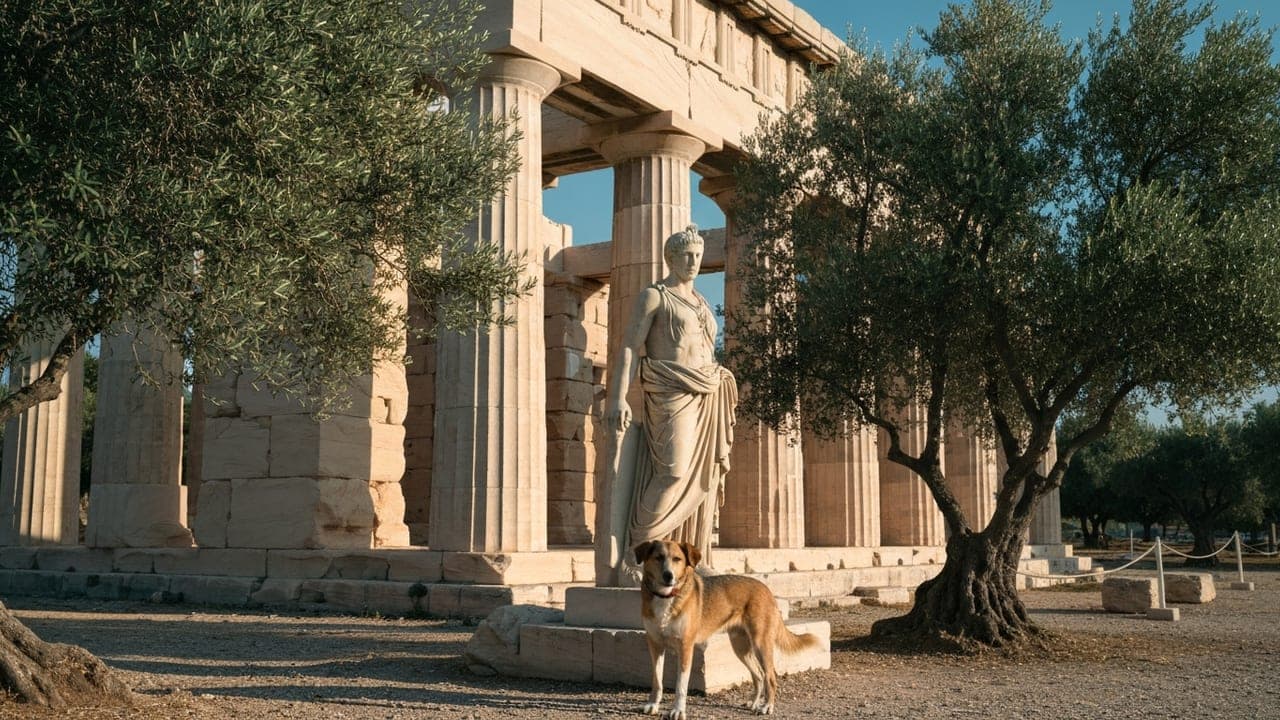
The Dog That Waited Twenty Years
Homer's account of Argos in Book XVII of the Odyssey is 23 lines long, and classicists have argued for centuries about its literary function. Some read it as a contrast device — the faithful dog recognizing his master while the faithless suitors do not — others as a meditation on loyalty, time, and neglect. What is rarely discussed is what the scene tells us about the actual status of dogs in eighth-century BCE Greek culture: that Homer's audience would immediately understand the emotional weight of a dog's recognition and death, that this understanding required no explanation, and that a poet of Homer's stature considered it worthy of serious literary treatment.
This is our entry point into Greek dog culture: a culture where dogs were important enough to appear in the foundational texts of Western literature, in mythology, in philosophy, in medicine, and in law — but whose history is rarely told as a coherent story. Greece between 800 and 146 BCE was a world where dogs occupied every social register, from the massive Molossian war hounds of the aristocracy to the street dogs of Athens that Socrates used as philosophical examples, from the healing dogs of Asclepian sanctuaries to the tiny lapdogs that wealthy Athenian women kept in their gynaikonitis (women's quarters).
Argos and the Greek Literary Tradition
The name Argos is itself significant. In Greek, argos means "shining white" or "swift" — both are plausible dog names, and the dual meaning is likely deliberate, since Argos was presumably once a swift hunting dog before twenty years of abandonment reduced him to a heap on a dunghill. Homer's description is precise: Argos lies infested with fleas, his coat matted, but his ears prick at Odysseus's voice and his tail wags, though he is too weak to rise.
The scene works partly because Homer's audience understood dog behavior. The ear-pricking and tail-wagging in the context of recognition are accurately observed — dogs do specifically respond to the voices of bonded humans even after long separation, a phenomenon documented in modern behavioral research. Homer was not sentimentalizing; he was accurately describing what a dog whose hearing remained sharp but whose body had failed might actually do.
Greek lyric poetry produced numerous dog references, from Pindar's praise of hunting hounds in his victory odes to Simonides' epitaph for a hunter's dog (one of the earliest dog elegies in Western literature). The philosopher-poet Xenophanes complained that Pythagoras had recognized the voice of a deceased friend in a dog's whimper — evidence that the Pythagorean belief in metempsychosis (the transmigration of souls) included dogs as potential vessels for human souls, a view that gave dogs a philosophical dignity not found in every culture.
Greek Dog Breeds: The Molossian and the Laconian
Greek writers documented dog breeds with the same classificatory enthusiasm they applied to plant species, horse bloodlines, and human ethnic groups. The two most prestigious Greek breeds were the Molossian and the Laconian, each associated with a specific Greek regional identity and a specific functional role.
The Molossian hound — named for the Molossians of Epirus in northwestern Greece — was the Greek world's answer to the Roman Molossus (which was the same breed under a Latin name). These massive, heavy-boned dogs were used for hunting large game (especially boar and bear), estate guarding, and war. Aristotle in his Historia Animalium described Molossians as surpassing all other dogs in size and courage, while noting that they were specifically bred by the people of Epirus who also bred war horses — suggesting that Epirote animal breeding was understood as a distinct expertise.
The Molossian lineage is ancestral to modern giant breeds including the Great Dane, Mastiff, and Saint Bernard. Their journey from Epirus through the Roman military machine and into medieval European estates is one of the longest continuous breed traditions in canine history.
The Laconian hound — bred in Laconia (Sparta) — represented the opposite physical extreme: lean, long-legged, and bred for speed and scent tracking. Xenophon's Cynegeticus ("On Hunting," written c. 400 BCE) devoted extensive attention to the Laconian, praising its nose, its voice when on a scent, and its ability to run all day without tiring. These dogs are recognized by modern breed historians as ancestral to the Greyhound and Saluki lineages — the ancient sight hound tradition that produced some of the world's fastest dog breeds.
Aristotle's Classification and What It Tells Us
Aristotle's Historia Animalium (c. 350 BCE) is the most systematic attempt at animal classification in the ancient world, and it includes substantial material on dogs that modern veterinary historians find remarkably accurate in some respects and entertainingly wrong in others.
Aristotle correctly described dog pregnancy duration (approximately 60 days), noted that blind-born puppies open their eyes in sequence from the smallest to the largest of a litter (actually not reliably accurate, but his observation was careful), and documented what we now recognize as the early socialization window in puppies — the period during which puppies bonded most readily with humans. He correctly noted that puppies taken from their mothers too early were psychologically damaged; modern animal behaviorists have confirmed a sensitive socialization period between 3 and 12 weeks in which early human contact is crucial for normal social development.
Where Aristotle went wrong was in his taxonomy of dog crosses. He believed that dogs could successfully interbreed with wolves, foxes, and even — in extraordinary cases — tigers, producing hybrid offspring with enhanced hunting abilities. This reflected a general Greek confusion about species boundaries that persisted for centuries and was not resolved until the development of modern genetics.
Aristotle's student and successor Theophrastus extended animal observation into behavioral territory, and fragments of his lost work suggest he had opinions about dog personality differences between breeds that anticipate modern breed temperament research. The Peripatetic tradition of careful empirical observation — watch what animals actually do, then reason from observation — was the closest thing the ancient world produced to animal behavioral science.
Dogs in Greek Mythology: Cerberus, Hecate, and Actaeon
Greek mythology's dogs are more varied and more philosophically interesting than the standard summary suggests. Cerberus, the three-headed dog guarding the entrance to Hades, is the most famous — but his characteristics were debated by ancient writers in ways that reveal real disagreement about what made dogs dangerous. Hesiod in the Theogony gave Cerberus fifty heads; later writers standardized this to three. What remained constant was that Cerberus was simultaneously a loyal guardian (he kept the dead in) and a terrifying predator (he kept the living out) — a characterization that reflected Greek ambivalence about large dogs in general.
Hecate, the goddess of crossroads, night, and magic, was accompanied by dogs whose barking was understood as her voice. Dogs were sacrificed to Hecate at crossroads — a practice that the philosopher Plutarch found distasteful but documented without surprise. The association of dogs with Hecate likely reflected the reality that stray dogs frequented crossroads where food scraps accumulated, making their nocturnal barking a natural element of the uncanny nighttime soundscape.
The myth of Actaeon is the most psychologically complex: a hunter who accidentally saw the goddess Artemis bathing was transformed into a stag and torn apart by his own hunting hounds, who could not recognize their master in his new form. The horror of the story lies precisely in the dogs' loyalty — they are not punished for killing Actaeon because they were acting exactly as trained, hunting the stag before them. Actaeon's fate is the inverse of Argos's recognition: one dog sees through transformation to recognize his master; fifty dogs cannot.
Alcibiades and His Expensive Dog: Status and Extravagance
The Athenian general and statesman Alcibiades (450–404 BCE) was one of the most controversial figures in Greek history: brilliant, reckless, spectacularly handsome, and capable of the kind of extravagance that ancient biographers recorded with mixed admiration and horror. His dog story is one of Plutarch's most-quoted anecdotes.
Alcibiades paid seventy minas for a particularly beautiful large dog — an extraordinary sum, roughly equivalent to seventy months of a skilled craftsman's wages. He then had the dog's tail cut off, explaining to friends who were outraged at the waste that he wanted Athenians to be discussing his dog's tail rather than something worse about him. The story is usually read as evidence of Alcibiades's manipulative genius for controlling his public image, but it also reveals the market for expensive, high-status dogs in fifth-century Athens. A dog worth seventy minas was a status symbol as legible as a fine horse or an expensive symposium service.
The Healing Dogs of Asclepius
One of the most unusual chapters in Greek dog history is the role of dogs at the sanctuaries of Asclepius, the god of medicine. At Epidaurus, Corinth, and other healing sanctuaries, trained dogs were kept as therapeutic agents — patients with wounds or skin lesions would have the affected areas licked by the sanctuary dogs, and numerous cure inscriptions (iamata) from Epidaurus record apparent healing following dog licking.
Modern medicine has partially vindicated this practice. Dog saliva contains lysozyme (an enzyme with antibacterial properties), immunoglobulins, and growth factors that can promote wound healing under specific conditions. The Epidauran dogs were not superstition; they were delivering a crude but not entirely ineffective medical intervention.
The deeper point is that the Greeks integrated dogs into their medical institutions — a decision that required both cultural trust in dogs and practical observation that the intervention worked often enough to be worth maintaining. The sanctuary at Epidaurus was among the most visited healing sites in the ancient Mediterranean world, and its dogs were part of a formal therapeutic protocol administered by trained priests.
Explore related history in Dogs in Ancient Rome and Ancient Dogs: First Companions, and take the dog breed quiz to discover which ancient breed type matches your personality.
Frequently Asked Questions
Who was Argos in the Odyssey?
Argos was the hunting dog of Odysseus, described in Book XVII of Homer's Odyssey. He was the only being to recognize Odysseus immediately upon his return to Ithaca after twenty years of absence. After wagging his tail in recognition, Argos died — having waited, Homer implies, for his master's return. The scene is considered one of the most affecting animal portraits in ancient literature.
What were Molossian dogs?
Molossian dogs were a breed type from the region of Epirus in northwestern Greece, described by Aristotle and other Greek writers as the largest and most powerful dogs in the Greek world. They were used for hunting large game, estate guarding, and warfare. The Molossian lineage is ancestral to modern giant breeds including the Mastiff and Great Dane. The Romans adopted the breed enthusiastically and spread it across the empire.
Did Alexander the Great really name a city after his dog?
Yes. Alexander named the city of Peritas in modern-day Pakistan after his dog Peritas, who died during Alexander's Indian campaign (c. 325 BCE). The sources vary on how Peritas died — some say defending Alexander from an elephant, others that he died of wounds sustained in battle. Alexander's grief was genuine and public; he also famously named the city of Bucephala after his horse Bucephalus, making him the ancient world's most extravagant commemorator of animal companions.
How did Greek dog keeping influence modern breeds?
The Laconian hound is ancestral to modern Greyhound and Saluki lineages. The Molossian is ancestral to the Mastiff, Great Dane, and Rottweiler families. Greek interest in systematic dog classification — documented by Aristotle, Xenophon, and later writers — established the intellectual framework for breed differentiation that Roman writers extended and medieval European nobility elaborated into the diverse breed landscape we have today.
Author & Reviewer
Related Reading
Continue the History
Understand Your Companion
Find Your Match
Ready to find your perfect companion?
Take the Breed Quiz →