
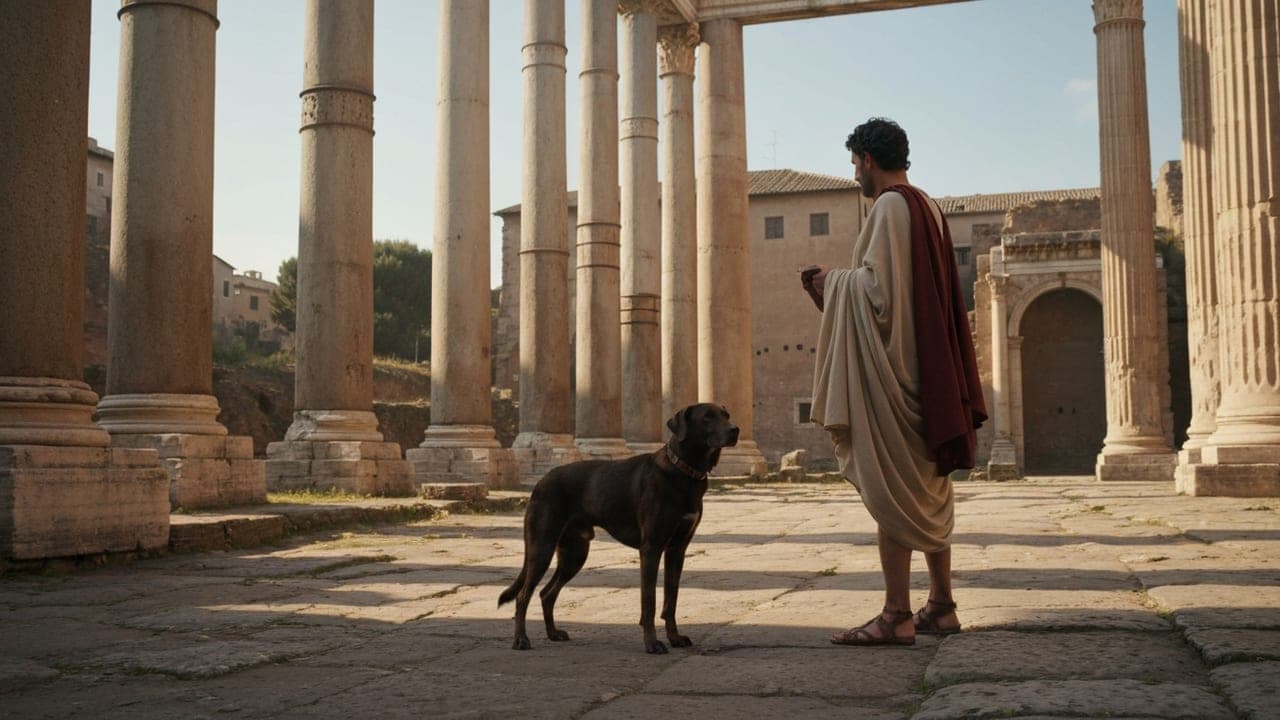
The Dog That Died Protecting Its Family
In 79 CE, when Vesuvius buried Pompeii under twelve meters of volcanic ash, a dog named Delta died chained to the entrance of the House of the Tragic Poet. We know his name because his owner had inscribed it on his collar — a bronze tag that archaeologists recovered nearly 1,800 years later. Delta had saved his young master from drowning three times. His owner commemorated this in a mosaic still partially visible today, with the Latin inscription hic habitat felicitas: "Here lives happiness."
This is not the story most people expect when they think about Roman dogs. We imagine the famous Cave Canem — "Beware of the Dog" — mosaics as evidence of Roman practicality, dogs as tools rather than companions. But the archaeological and literary record tells a far more nuanced story. Romans loved their dogs with an intensity that would be recognizable to any modern pet owner, and they built legal, philosophical, and cultural frameworks around that love that shaped how dogs were kept across the Western world.
The Breeds Romans Kept
Roman writers were the first in Western literature to produce systematic breed classifications. Marcus Terentius Varro, writing his agricultural treatise Rerum Rusticarum around 37 BCE, distinguished between farm dogs (canes villatici), sheep dogs (canes pastorales), and hunting dogs (canes venatici). The poet Grattius, writing his Cynegetica during the reign of Augustus, catalogued breeds from across the empire with something approaching modern taxonomic precision.
The most prestigious Roman breed was the Molossus, imported from Epirus in northwestern Greece (modern Albania). These massive, heavy-boned dogs — ancestors of today's Mastiff and Rottweiler lineages — were prized as war dogs and estate guardians. Roman general Lucius Aemilius Paullus deployed hundreds of them against Perseus of Macedon in 168 BCE. Their reputation was so formidable that mere knowledge of their presence was considered a military asset.
The Laconian hound from Sparta was the Roman aristocrat's preferred hunting companion — lean, fast, and with an exceptional nose. Grattius described them as "swift beyond all others at the scent." These dogs carried the genetic heritage that would eventually flow into modern Greyhounds and sight hound breeds.
At the opposite extreme sat the Melitaeus — the Maltese lapdog, imported from the island of Melita (modern Malta). Roman women of the upper classes kept these tiny white dogs as constant companions, and their popularity is documented in literature from Catullus to Martial. The elder Pliny mentioned that fashionable Roman women sometimes carried Melitaei inside their clothing for warmth — a practice that would have been recognizable to any modern Chihuahua or Maltese owner.
Dogs in Roman Law: Property, Protection, and Liability
Roman jurisprudence produced the first systematic legal framework for dog ownership in Western history. The Digest of Justinian, compiled in 533 CE, contains extensive provisions governing dogs — and they reveal how seriously Romans took canine liability.
The actio de pauperie — literally "the action for damage caused by an animal" — allowed victims of unprovoked dog attacks to sue owners for the full value of damages. But Roman law was sophisticated enough to distinguish between provoked and unprovoked attacks. If a victim had aggravated the dog, the owner's liability was reduced. Legal scholar Ulpian, writing in the early third century CE, noted that a dog used for hunting or herding that was not inherently vicious should not make its owner liable if strangers provoked it.
Guardian dogs occupied a special legal category. Jurist Paul wrote that an owner who posted a Cave Canem warning had discharged their duty of notice — the sign itself was legally meaningful, not merely decorative. The proliferation of these mosaics in Pompeii and Herculaneum was therefore both cultural expression and legal practice.
Dogs were classified as property under Roman law, but valuable property. Stealing a trained hunting dog or a guard dog could result in damages calculated at four times the dog's market value — the same penalty as stealing grain or livestock. A working sheepdog was worth more legally than most household items.
The Roman Agriculture Writers and Their Dog Wisdom
Lucius Junius Moderatus Columella, writing his twelve-volume De Re Rustica around 65 CE, devoted substantial attention to dogs with a specificity that modern veterinarians find impressive. He recommended white dogs for pastoral work — so shepherds could distinguish them from wolves in low light — and black dogs for estate guarding, to maximize their nocturnal menace.
Columella's dog medicine was a mix of genuine insight and spectacular error. He recommended treating ear infections with rose oil mixed with wine — not ineffective, as rose oil has mild antiseptic properties. For mange, he suggested a mixture of hellebore, sulfur, and tar that, while toxic if misapplied, reflects genuine understanding that mange was caused by something external and transmissible. His advice that puppies should be separated from their mothers at a specific age to improve bonding with humans anticipates modern animal behaviorist research on socialization windows by nearly two millennia.
Varro was more philosophical. He argued that the dog was humanity's oldest and most loyal ally, preceding even the horse as a working partner, and that this relationship imposed reciprocal obligations. A farmer who worked a dog hard owed that dog adequate food, shelter, and rest. This was not sentimentality — it was Stoic ethics applied to animal husbandry.
War Dogs and the Roman Military Machine
Roman legions used dogs operationally in ways that most military historians underemphasize. The Molossian war dogs were equipped with spiked collars and body armor in some documented campaigns. They were deployed to break enemy cavalry formations — horses would often panic at the sight and smell of large dogs — and to pursue fleeing soldiers in the chaos following a battle.
The military writer Aelian, in his De Natura Animalium, recorded that the army of King Alyattes of Lydia unleashed war dogs against Cimmerians, and that the dogs killed more enemies in the subsequent rout than the soldiers had in the formal engagement. Whether accurate or embellished, this account was taken seriously by Roman military planners.
More documented is the use of dogs in Roman siege warfare as message carriers, and as sentries at camp perimeters. The historian Polyaenus recorded that Corinth was saved from Macedonian night attack because its garrison dogs raised the alarm before the sentries heard anything — an account so widely known in the Roman world that it became a standard justification for maintaining guard dogs at military installations.
Roman Dog Burials and the Evidence of Affection
The most direct evidence of Roman emotional attachment to dogs comes from burial sites and funerary inscriptions. At least forty dog burials with inscribed epitaphs have been identified across the Roman world, from Britain to Syria.
A first-century CE epitaph from Rome reads: "To Helena, foster child, soul without comparison and deserving of praise." Helena was a dog. Her owner used the word alumna — foster child — rather than canis, the standard word for dog, and the phrase anima incomparabilis (soul without comparison) was a formulation typically reserved for beloved humans.
At Pompeii, the skeletal remains of dogs found in collapsed buildings show that some were unchained at the last moment — their owners had freed them to give them a chance to escape. The dog later cast in plaster in the House of the Tragic Poet died still leashed, still at his post, in the posture of a dog that fought to free himself as the ash deepened.
The Transition from Utility to Companionship
Roman writers tracked a cultural shift that is visible across the first two centuries CE: dogs were moving from primarily functional roles into something closer to modern pet keeping. Martial, writing his Epigrams in the late first century CE, described the lapdog Issa belonging to his friend Publius in terms that would not be out of place in a modern Instagram caption: "Issa is more mischievous than Catullus' sparrow, purer than a dove's kiss, gentler than any girl, more precious than Indian gems."
This shift was not universally admired. Plutarch complained that some Romans were lavishing on animals the affection that should go to humans. The philosopher Epictetus noted with distaste that Roman women were kissing their dogs on the mouth — a habit he considered undignified. The very fact that these writers felt the need to complain about dog affection tells us how widespread it had become.
The Roman experience with dogs established patterns that persisted through medieval Europe and into the present: the guard dog as legal institution, the hunting dog as aristocratic status symbol, and the lapdog as intimate companion. When you look at a Pomeranian or a Greyhound today, you are looking at the living inheritance of Roman breeding decisions made two thousand years ago.
Explore more of this history in Ancient Dogs: First Companions and Dogs in Ancient Greece.
Frequently Asked Questions
What breeds did ancient Romans keep?
Roman writers documented at least several distinct types: the Molossus (a massive guardian, ancestor of modern mastiffs), the Laconian hound (a swift hunting dog related to greyhound ancestors), the Melitaeus or Maltese lapdog, and various herding and farm dogs. Columella and Grattius wrote detailed breed descriptions that are still legible today.
Did Romans really use dogs in warfare?
Yes. Molossian war dogs with spiked collars and sometimes armor were used to break cavalry formations and pursue routed enemies. Dogs also served as camp sentries, and their use in this role was widespread enough that military writers discussed optimal deployment strategies.
What do the Cave Canem mosaics actually tell us?
Beyond their function as warnings, these mosaics had legal significance — posting one demonstrated that an owner had given notice of a dangerous animal, reducing liability under the actio de pauperie. They also represent remarkable artisanship; the most famous example from the House of the Tragic Poet in Pompeii shows a chained dog with fine naturalistic detail that suggests real affection for the subject.
How did Roman dog keeping influence modern practices?
Roman legal frameworks for dog ownership — liability for attacks, property classification, duty-of-care provisions — fed directly into medieval European law and eventually into modern animal law. Roman selective breeding practices for hunting, herding, and companionship established breed lineages that remain recognizable today in breeds like the Greyhound, Mastiff, and Maltese.
Author & Reviewer
Related Reading
Continue the History
Understand Your Companion
Find Your Match
Ready to find your perfect companion?
Take the Breed Quiz →