
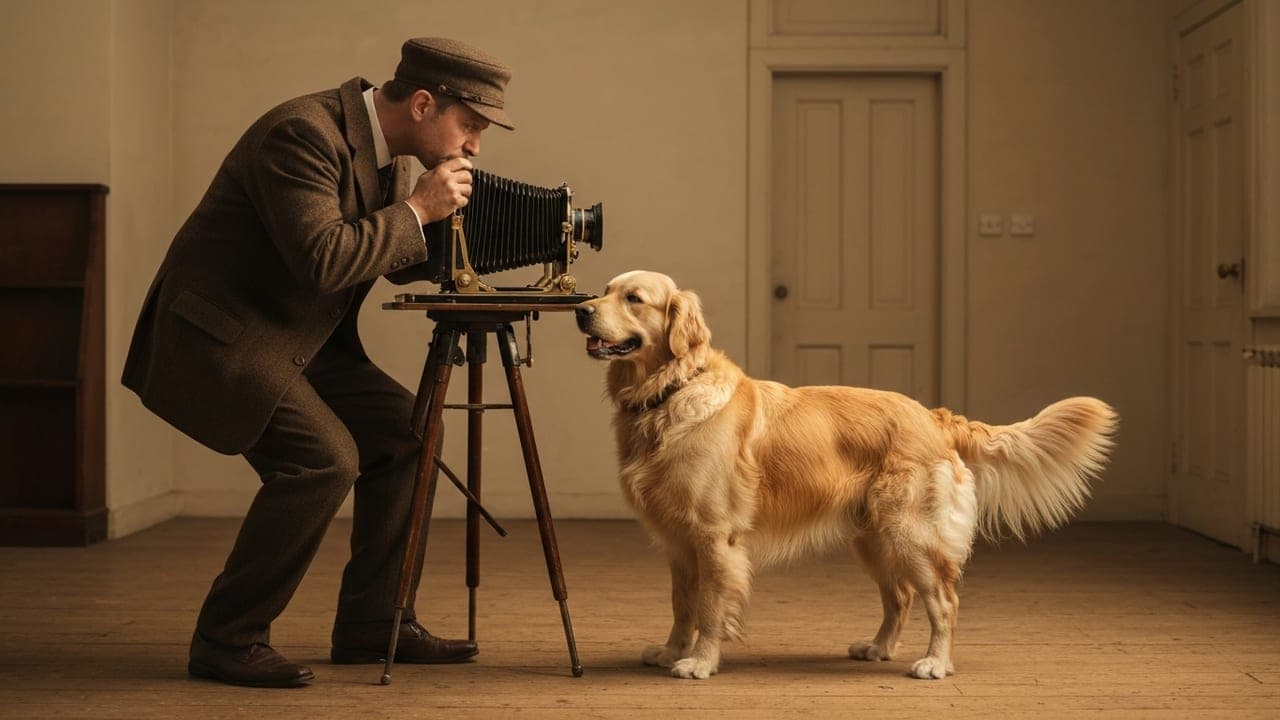
The Blurry Dog Problem
The first known photograph of a dog dates to 1839 — the same year that Louis Daguerre announced his daguerreotype process to the French Academy of Sciences and effectively invented public photography. Someone, somewhere, pointed one of those extraordinary new instruments at a dog almost immediately. The resulting image is what you might expect: the dog is blurry. The exposure required 15 or more seconds of absolute stillness, and dogs, being dogs, did not cooperate. That blur is, in a way, the origin story of pet photography — the gap between what technology could achieve and what humans desperately wanted to capture.
For the next 180 years, virtually every major advance in photographic technology would be tested against, and partially driven by, the challenge of capturing animals in motion. The history of pet photography is also a history of photography itself.
Victorian Studios and Royal Endorsement
Despite the technical limitations of early photography, commercial studios began accepting animal subjects almost from the start. By the 1850s, photographers in London and Paris were offering studio portraits of pets alongside human clients. The sessions required elaborate staging: animals were positioned against neutral backdrops, sometimes physically held in place, occasionally sedated with mild compounds.
Queen Victoria's enthusiastic adoption of photography — and her equally enthusiastic love of dogs — lent the practice cultural legitimacy. Victoria owned over 60 dogs during her lifetime, predominantly Collies, Pomeranians, and Dachshunds. She sat for portraits with multiple dogs and commissioned photographs that were widely reproduced as carte-de-visite cards — small photographic prints traded and collected throughout Victorian society. When the queen photographed her pets, pet photography became respectable.
High society followed. By the 1880s, formal pet portraits were a standard offering at London, New York, and Paris studios. Families that could not afford oil paintings — a centuries-old aristocratic tradition for documenting beloved animals — could now afford photographs. Pet portraiture democratized downward along the class structure, though it remained expensive enough to remain a middle-class luxury.
Eadweard Muybridge and Motion's Revelation
The most significant early contribution to animal photography came not from a pet photographer but from a man trying to settle a horse racing bet. In 1872, railroad magnate Leland Stanford commissioned photographer Eadweard Muybridge to determine whether a galloping horse ever had all four feet off the ground simultaneously. The answer — yes — required Muybridge to develop the first high-speed sequential photography system, using multiple cameras triggered in rapid succession by tripwires.
By 1887, Muybridge had published Animal Locomotion, a landmark eleven-volume collection of sequential photographs capturing the movement of horses, dogs, cats, birds, and humans. The work was simultaneously a scientific breakthrough, an artistic revelation, and a practical guide for artists who had been drawing animals in motion incorrectly for centuries. Galloping horses in paintings before Muybridge almost universally showed the animal in a "rocking horse" pose that never occurs in actual galloping. His photographs corrected this error permanently.
For pet photographers, Muybridge's technical innovations pointed toward what would eventually become possible: the action shot, the candid capture, the image that preserves the blur-free truth of an animal in motion.
Dogs Playing Poker: Advertising's Most Famous Animals
In 1903, a Brown and Bigelow advertising executive commissioned the painter Cassius Marcellus Coolidge to produce a series of paintings for a cigar advertisement campaign. The result was sixteen paintings of anthropomorphized dogs engaged in human activities, the most famous of which depicts dogs playing poker around a table. A Friend in Need — featuring two dogs cheating at cards — has become one of the most reproduced images in American art history, appearing on everything from dorm room posters to auction house walls (a pair of the original paintings sold at Doyle New York in 2005 for $590,400).
The Dogs Playing Poker series is not photography, but it represents a crucial moment in pet image culture: the point at which animal imagery became a reliable vehicle for mass-market advertising. The insight that images of animals create emotional engagement that transfers to products — cigars, in this case — would be rediscovered repeatedly across the next century.
Rin Tin Tin, Lassie, and the Celebrity Animal Photograph
The early film industry created a new category: the celebrity animal, subject to the same portrait photography apparatus as human stars. Rin Tin Tin, a German Shepherd rescued from a World War I battlefield by American soldier Lee Duncan, became Warner Bros.' most bankable star in the 1920s, appearing in 27 films and reportedly receiving more fan mail than any human actor on the studio's roster. His official publicity photographs — formal studio portraits showing the dog in three-quarter profile — were distributed in the millions.
Lassie followed in the 1940s, a Rough Collie character portrayed across seven MGM films beginning in 1943. The dog playing Lassie — actually a male named Pal — was photographed in promotional materials that emphasized his shaggy, noble profile in ways that directly echoed the formal pet portraiture tradition of Victorian studios. Celebrity animal photography had its own grammar: the heroic angle, the steady gaze, the suggestion of intelligence and loyalty.
LIFE Magazine and the Art of the Animal Feature
Between its founding in 1936 and its peak circulation in the 1960s, LIFE magazine published animal photography that brought a documentary aesthetic to pet imagery for the first time. Staff photographers like Alfred Eisenstaedt — who photographed everything from Hitler to Churchill — also photographed animals with the same compositional rigor. Animal features in LIFE proved to be among the magazine's best-performing issues; editors learned early that animals on covers reliably increased newsstand sales.
This commercial discovery was important. It established, in the economics of mass media, that people's attention to animal images was not merely sentimental — it was reliably monetizable. That insight would resurface sixty years later on the internet.
The Digital Revolution and Democratization
The transition from film to digital photography during the 1990s and 2000s removed the cost-per-shot calculation that had always constrained photography. Film photographs cost money — each frame was an investment. Digital photographs cost nothing marginal. The result was an explosion in casual animal photography. Pet owners who had previously taken one or two rolls of film per year now took hundreds or thousands of photographs.
Smartphone cameras amplified this further. By 2010, a device that fit in a pocket contained a camera superior to the professional equipment available to most photographers twenty years earlier. The quality gap that had separated professional pet photographers from amateurs collapsed. What remained was the gap in vision and timing — but technology was closing that too, with AI-assisted autofocus systems designed specifically to track and lock on animals.
Instagram, Grumpy Cat, and the Pet Influencer Economy
The internet's relationship with animal imagery was apparent from the first days of widespread use. As early as 1996, cat photographs circulated on Usenet groups. YouTube's earliest viral content included cat videos; by some analyses, cat content remained the most-watched category on the platform for most of its first decade of existence.
Instagram crystallized this dynamic into an economy. Grumpy Cat — a Persian mix named Tardar Sauce whose genetic condition produced a permanently unhappy expression — accumulated 2.8 million followers before her death in 2019, generating an estimated $100 million in merchandise revenue during her lifetime. Jiffpom, a Pomeranian who holds multiple Guinness World Records for dog tricks, maintains 10.7 million Instagram followers and commands five-figure rates for sponsored posts. Nyan Cat, an animated GIF of a cat with a Pop-Tart body flying through space, became one of the most referenced internet memes of the 2010s and sold as an NFT for $590,000 in 2021.
The pet influencer economy now supports talent agencies, brand partnership networks, and professional management — an entire industry premised on the reliable human attention response to animal imagery that advertising executives first noticed in 1903.
Professional Pet Photography Today
The professional pet photography industry generates an estimated $4.5 billion annually in the United States alone, encompassing studio portraits, outdoor lifestyle sessions, pet event photography, and the growing niche of pet memorial photography. Specialized equipment — longer telephoto lenses for candid captures, high-speed shutters for action shots, LED lighting rigs that avoid the eye-reflecting characteristics of flash — has developed alongside the market.
The AI-generated pet portrait trend that accelerated through 2023 and 2024 added a new dimension: apps using stable diffusion models could transform smartphone snapshots into oil paintings, watercolors, or royal portraits within minutes. The blurry daguerreotype dog of 1839 had, in 185 years, become the algorithmically idealized digital portrait — the gap between desire and technical capability finally closed, and then transcended.
For portraits of the breeds most photographed today, see our pages on the Labrador Retriever, Golden Retriever, and French Bulldog — perennial favorites in professional pet photography.
Frequently Asked Questions
What was the first photograph of a pet?
The earliest known photograph of a dog dates to 1839, the same year photography was publicly announced. The image exists but the dog is blurred, a consequence of the 15+ second exposure times required by early daguerreotype processes. It was taken almost certainly in France or Britain, but the specific photographer and dog are not recorded.
How did Rin Tin Tin save Warner Bros.?
Rin Tin Tin's films in the 1920s were consistently profitable at a period when Warner Bros. was financially precarious. Studio historians have credited his box office reliability with providing the cash flow that allowed Warner Bros. to invest in the sound technology that produced The Jazz Singer (1927) — the film that launched the sound era. Without Rin Tin Tin's commercial success, the studio might not have survived long enough to make that gamble.
How much do pet influencers earn?
Top-tier pet accounts with 5+ million followers command $15,000–$50,000 per sponsored post from major brands. Mid-tier accounts (100K–1M followers) typically earn $1,000–$10,000 per post. The economics depend on engagement rate, audience demographics, and niche alignment with the sponsoring brand's target market.
Author & Reviewer
Related Reading
Continue the History
Understand Your Companion
Find Your Match
Ready to find your perfect companion?
Take the Breed Quiz →