
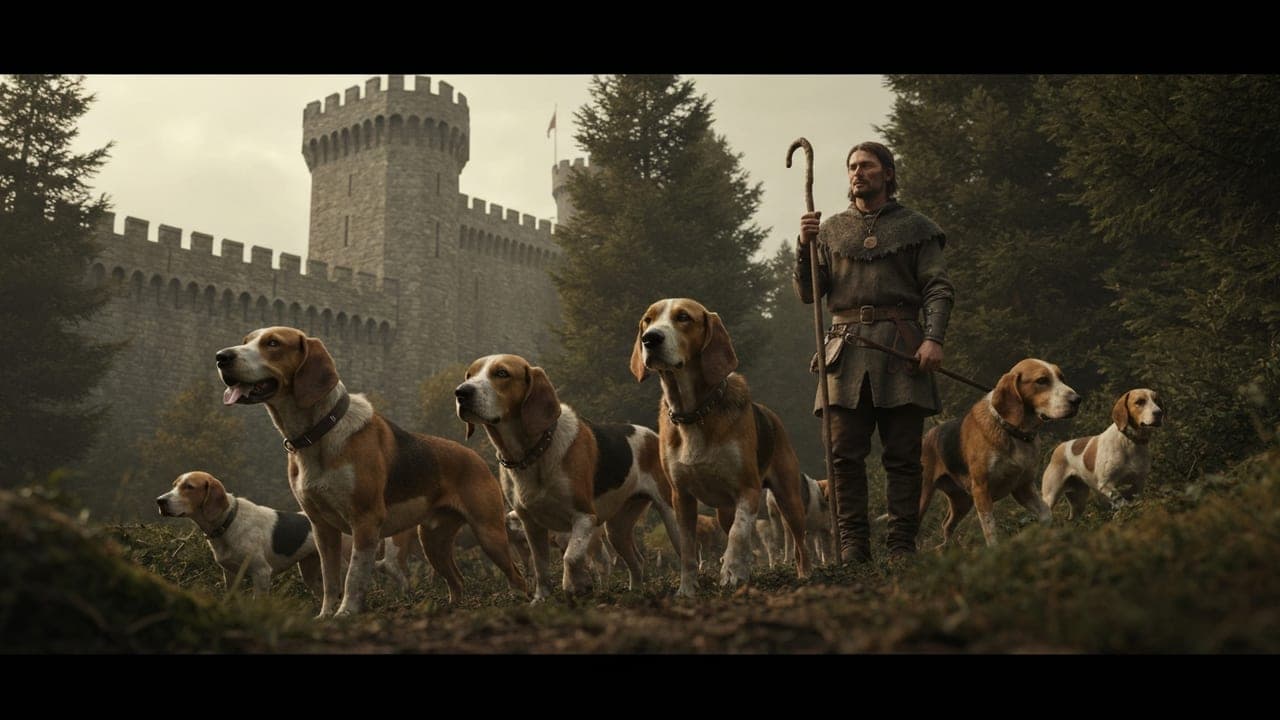
Hunting Dogs of the Middle Ages
In medieval Europe, a nobleman's dogs were not pets in any modern sense. They were instruments of war, symbols of status, economic assets, and — according to the moral philosophy of the era — tools of spiritual development. Hunting was understood by the aristocracy as a form of training for battle: it required physical endurance, tactical thinking, cooperation between men and animals, and the controlled application of lethal force. A lord who hunted well was presumed to be a lord who could fight well. His dogs were as essential to this identity as his armor.
The sophistication that medieval Europe applied to hunting dogs was remarkable. By the 13th century, specialized breeds performed specialized roles within a single hunt. Training protocols were documented and debated. Veterinary medicine — primitive by modern standards but serious in intent — was practiced by designated staff. And the law, in England and France especially, protected hunting dogs with penalties severe enough to deter all but the most desperate thieves.
The Five Types: A Medieval Taxonomy
Medieval huntsmen recognized five broad categories of hunting dog, each with a distinct role in the elaborate choreography of the aristocratic hunt.
The lymer — sometimes called the limer — was the scent hound used to find and track quarry before the main hunt began. Held on a long leash called a liam, the lymer worked slowly and quietly, nose to ground, locating deer or boar and confirming their direction of travel. This dog needed exceptional scenting ability and a calm, methodical temperament. A good lymer was invaluable and correspondingly expensive.
The greyhound (and related sight hounds including the saluki-descended coursing dogs) operated on entirely different principles. Where the lymer followed invisible trails of scent, the greyhound pursued visible prey at extraordinary speed. Greyhounds were the aristocrat's dog par excellence — fast, elegant, and utterly unsuited for any practical purpose beyond the chase. Their ownership was, in many periods and jurisdictions, legally restricted to the nobility.
The alant was a heavy mastiff-type dog used for the most dangerous phase of hunting: the final confrontation with large, dangerous prey like boar or bear. Where other dogs chased and tired the quarry, the alant seized and held it — grappling with animals that could kill a man. These dogs were bred for power, courage, and pain tolerance. They frequently died in service.
The spaniel — named from the Old French for Spanish, reflecting its believed origins — was a versatile flushing dog used in bird hunting. Spaniels worked cover, driving birds into the open for falconers or, later, for hunters with nets. Their gentle mouth and willingness to retrieve made them useful after the kill as well as before it. The ancestors of today's English Springer Spaniel and related breeds trace their lineage directly to these medieval hunting companions.
The running hound (chien courant in French sources) was the backbone of the pack hunt — a medium-sized, voice-giving scenthound that pursued quarry in numbers, baying continuously to guide huntsmen toward the chase. Running hounds needed stamina above all else. A successful deer hunt might cover twenty miles of mixed terrain over several hours. Dogs that could not sustain the pace were culled from breeding programs without sentiment.
The Book That Defined a Science
In 1387, Gaston III, Count of Foix — known universally as Gaston Febus for his golden hair and his near-religious devotion to hunting — completed the Livre de chasse (Book of the Hunt). It was not the first hunting manual ever written, but it was incomparably the most thorough and the most influential.
Febus wrote from fifty years of personal experience. His book covered the habits and habitats of every huntable species in Europe, the training of each type of hunting dog from puppyhood through maturity, the treatment of common canine injuries and illnesses, the management of large kennels, and the ethics of the hunt. The text was accompanied by extraordinary illuminated illustrations showing dogs, huntsmen, and quarry in precise, lively detail.
Livre de chasse circulated across Europe in dozens of manuscript copies and was translated into English — as The Master of Game — by Edward, Duke of York, around 1406. Edward added his own observations and dedicated the work to Henry IV of England. The book remained the authoritative reference on hunting dogs for two centuries. Its influence on the development of specific breeds — through the selective practices it encoded and disseminated — is difficult to overstate.
Law, Theft, and the Forest Codes
The seriousness with which medieval society regarded hunting dogs is nowhere clearer than in the law. William the Conqueror's Forest Laws of the late 11th century, extended and elaborated by his successors, created an entire legal regime around hunting and hunting animals. The forest — in the medieval legal sense, a protected hunting reserve — was the exclusive domain of the king and those he licensed. Unauthorized hunting was a serious crime. Unauthorized possession of hunting dogs capable of pursuing deer was evidence of criminal intent.
The (expeditation) clause of the Forest Laws required that any large dog kept within forest bounds have three toes of one front foot removed — rendering them incapable of the sustained running needed for deer hunting. Smallholders could keep small dogs, but greyhounds and large hounds were legally restricted. A commoner found with an unlamed greyhound faced severe penalties.
Dog theft, within this legal framework, was treated with corresponding gravity. Stealing a nobleman's trained hunting hound was a property crime with potentially harsh consequences — not because the dog was merely valuable, but because it represented years of training, a specific role within a specialized system, and a piece of the lord's identity and honor. Some English sources treated the theft of a trained hunting dog with penalties comparable to those for stealing horses.
Early Veterinary Practice
Medieval huntsmen developed practical veterinary knowledge out of economic necessity. A trained lymer or a pack of running hounds represented substantial investment. Losses to injury or preventable disease were financially painful and operationally damaging.
The Livre de chasse devotes considerable space to canine medicine: treatments for mange, worms, distemper-like illnesses, wounds from boar encounters, and foot injuries from hard ground. The treatments were a mixture of empirical observation and inherited classical medicine — often ineffective by modern standards, but reflecting genuine attention to canine health. Dedicated kennel staff included individuals whose primary responsibility was dog care, not hunting.
This early veterinary tradition represents one of the unacknowledged roots of modern animal medicine. The aristocratic investment in canine health created demand for knowledge, which created practitioners, which created a body of accumulated — if imperfect — expertise.
The Legacy in Modern Breeds
Walk into any dog park today and the genetic shadows of medieval hunting types are visible everywhere. The Greyhound, Saluki, and Afghan Hound carry the sight-hound tradition unchanged across centuries. The Beagle, Dachshund, and related scenthounds descend from the running hound packs. The various spaniel breeds — Cocker, Springer, Clumber — trace their working roles directly to the medieval spaniel. Even the Rottweiler and other large mastiff-type dogs carry echoes of the alant.
The Border Collie and herding breeds took a different path — pastoral rather than hunting — but the same principle applies: centuries of deliberate selective breeding for specific working roles created the genetic diversity that dog lovers inherit today.
Frequently Asked Questions
What was the most valued type of medieval hunting dog?
This varied by region and century, but the greyhound was consistently treated as the most prestigious. Its legal restriction to nobility in England and France reflected its symbolic as much as practical value. A fine greyhound was a diplomatic gift worthy of kings.
Did ordinary people have hunting dogs?
Commoners kept dogs for pest control and herding, but Forest Laws in England restricted large hunting dogs among common folk in royal forest areas. Rural smallholders could keep small dogs. The elaborate hunting dog culture was overwhelmingly aristocratic.
How accurate was medieval veterinary medicine for dogs?
Much of it was ineffective by modern standards, mixing herbal treatments with superstition. However, some empirical observations — wound care, recognizing contagious illness, isolating sick animals — reflected genuine practical wisdom. The tradition created the foundation for more systematic animal medicine in later centuries.
Which modern breeds descend most directly from medieval hunting dogs?
The Greyhound, Saluki, and Beagle have the most direct and least interrupted lineages. Spaniel breeds as a group also descend continuously from medieval flushing dogs. Most modern hound breeds can trace their functional origins to the five medieval hunting types described in sources like the Livre de chasse.
Author & Reviewer
Related Reading
Continue the History
Understand Your Companion
Find Your Match
Ready to find your perfect companion?
Take the Breed Quiz →