
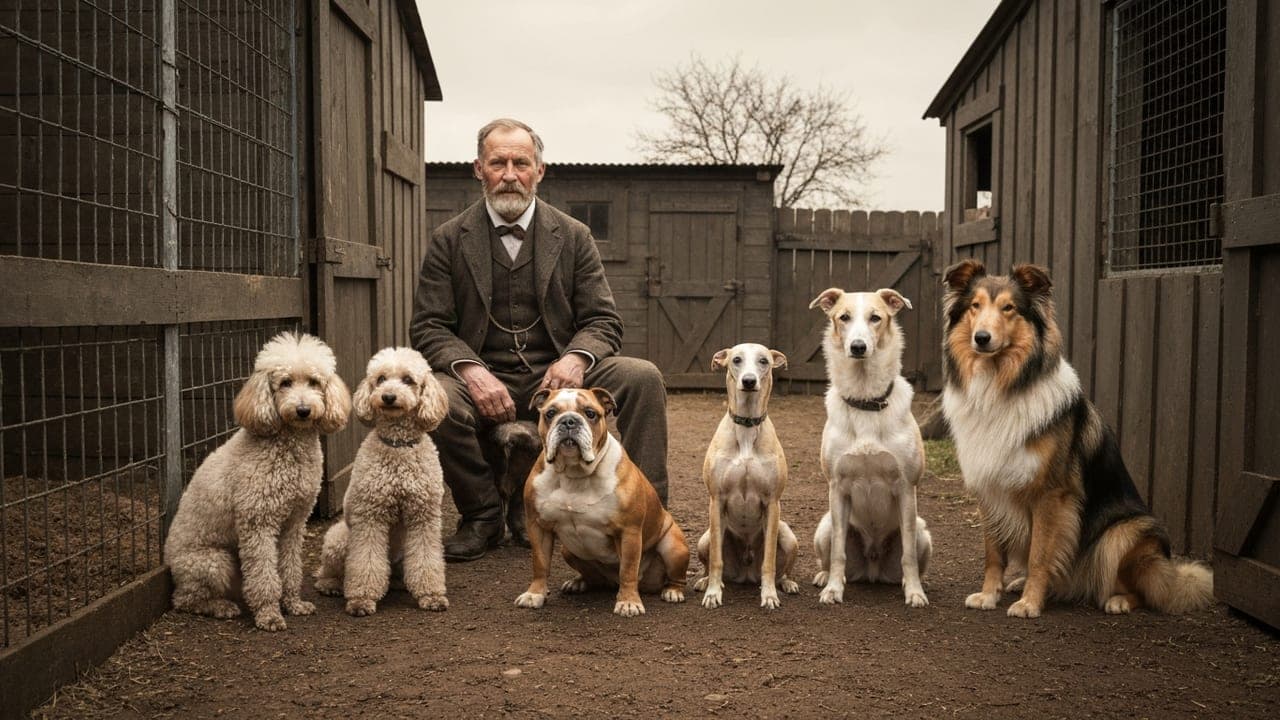
The 14,000-Year Gap Nobody Talks About
The domestic dog has walked beside humans for at least 14,000 years — some genetic studies push that figure past 40,000. Yet if you asked a time-traveling Victorian to identify a Labrador Retriever or a Doberman Pinscher, they would stare blankly. Most of today's recognized breeds did not exist before 1850. The explosion of deliberate breed creation compressed more morphological change into 150 years than nature had achieved in millennia. To understand why, you need to understand what the 19th century did to the human relationship with dogs: it institutionalized it.
Before kennel clubs, breeds were loose regional populations — hounds from this valley, terriers from that county, shepherd dogs from the mountain passes of Alsace. Working farmers cared about function: could the dog flush a pheasant, pull a sled, herd sheep through a narrow gate? Conformation — what the dog looked like — was an afterthought. Then came the dog show.
The Kennel Club and the Architecture of Breeds
The world's first formal dog show was held in Newcastle, England, in 1859. Sixty pointer and setter entries competed. Within a decade, shows spread across Britain, and the need for rules became urgent: what exactly was a pointer? How should judges compare dogs across regions?
The Kennel Club was founded in London in 1873 to answer those questions. Its solution was the breed standard — a written description of the ideal physical form for each breed. The American Kennel Club followed in 1884. These organizations didn't just record existing dogs; they defined them. Once a standard was written, breeders began selecting toward it, sometimes diverging sharply from the working dogs that had inspired the standard in the first place.
The consequences were profound. A working sheepdog from the Scottish Borders might be brilliant at herding but wrong in head shape for the show ring. Over generations, two populations emerged from a single ancestry: working lines and show lines. By the 20th century, they were sometimes barely recognizable as the same breed.
Case Studies in Deliberate Creation
The Labrador Retriever: An Aristocrat's Import Project
The Labrador Retriever is now the world's most popular dog breed, but its origins lie in a specific Canadian fishing village and the obsessions of two English earls. St. John's Water Dogs — smaller, short-coated retrievers used by Newfoundland fishermen to haul nets and retrieve fish — were imported to England in the early 1800s aboard trading vessels. The 2nd Earl of Malmesbury began breeding them; his son, the 3rd Earl, wrote in an 1887 letter that he always called them "Labradors" to distinguish them from the Newfoundland dog. That name stuck. The Kennel Club recognized the breed in 1903. Within thirty years, the Lab had become the dominant gun dog in Britain, prized for its soft mouth, water-resistant coat, and eager temperament.
The German Shepherd: Purpose-Built From Scratch
On April 3, 1899, a cavalry captain named Max von Stephanitz attended a dog show in western Germany and saw a dog he believed was the perfect working animal. He bought it on the spot, named it Horand von Grafrath, and founded the Verein für Deutsche Schäferhunde — the Society for German Shepherd Dogs — that same day. Stephanitz was explicit about his goal: not a beautiful dog, but a useful one. He drew from regional herding dogs across Germany, selecting ruthlessly for intelligence, trainability, and physical endurance. When German industrialization reduced demand for herding dogs, Stephanitz lobbied the German military and police to adopt the breed, personally writing to government officials to demonstrate the German Shepherd's capabilities. His intervention saved the breed from irrelevance and gave it a new mission. The breed reached the United States after World War I, carried home by soldiers who had encountered them as military working dogs.
The Doberman Pinscher: A Tax Collector's Problem Solved
Louis Dobermann of Apolda, Germany, had a dangerous job. Traveling the countryside to collect taxes in the 1880s put him in regular contact with hostile citizens. Dobermann needed a dog that could protect him — intimidating enough to deter attackers, intelligent enough to follow his commands, and loyal enough to work as a one-man dog. He was uniquely positioned to solve this problem: he also ran the town's dog pound, giving him access to a wide range of breeds. Over the next decade, he crossed Rottweilers, Greyhounds, Weimaraners, and possibly Black and Tan Terriers to create a new type. He died in 1894 before formal breed recognition, but Otto Goeller continued the work, and the Dobermann Pinscher was recognized by the German Kennel Club in 1900.
Lord Tweedmouth's Secret Records
For decades, the origin of the Golden Retriever was disputed. Then, in 1952, a descendant of Lord Tweedmouth donated his great-great-uncle's private breeding records to the Kennel Club. The records, kept from 1840 to 1890, revealed a meticulous breeding program at the Guisachan estate in the Scottish Highlands. Tweedmouth had crossed a yellow Flat-coated Retriever with a now-extinct Tweed Water Spaniel, then added Irish Setter and Bloodhound lines, selecting across generations for gentle temperament and retrieving instinct. The Golden Retriever that emerged from those Highland estates was essentially the same dog we recognize today.
The Dachshund: Engineering a Body for a Burrow
The Dachshund is perhaps the clearest example of form following function to an extreme conclusion. German foresters in the 15th century needed dogs that could follow badgers — aggressive, powerful animals — into their underground dens. The solution required a dog with an elongated body and short legs to navigate tunnels, deep chest for stamina, loose skin that wouldn't tear on burrow walls, and floppy ears that wouldn't fill with dirt. Every physical characteristic was selected for a specific functional reason. The breed worked so well that three sizes emerged: standard for badgers and wild boar, miniature for foxes, and rabbit Dachshunds for smaller quarry. Today, without badger hunting, those engineering choices persist as aesthetics — but they also persist as health risks, including intervertebral disc disease at rates far exceeding other breeds.
The Show Ring's Dark Bargain
When breed standards prioritized appearance over health, some breeds paid a steep price. The English Bulldog's wrinkled, pushed-in face — the brachycephalic skull — was deliberately accentuated through the 20th century as judges rewarded shorter muzzles and more extreme folds. The same process occurred with Pugs and French Bulldogs. Today, brachycephalic obstructive airway syndrome affects a significant proportion of these breeds. Studies from the Royal Veterinary College found that Bulldogs were 38 times more likely to require airway surgery than other breeds. Pugs have a median lifespan of just 7.7 years, compared to 12-13 years for mixed-breed dogs of similar size.
Reform movements have gained traction. In 2009, the BBC cancelled its coverage of Crufts after a documentary exposed health problems in show dogs. Several major kennel clubs subsequently revised standards to reduce extreme features. The work remains incomplete, but the direction has changed.
What DNA Is Revealing
Modern genomic studies have complicated the tidy breed histories that kennel clubs once published. Research published in Science in 2022 analyzed 4,000 dogs across 78 breeds and found that behavioral traits are far less heritable than appearance — suggesting that personality differences between breeds are smaller than many owners believe. More surprisingly, DNA testing routinely reveals that many dogs sold as purebreds carry genetic markers from multiple breeds, the result of undocumented crossings in the breed's history. The Labrador, the Golden, the Poodle — all carry traces of earlier mixing that official stud books do not record.
For more on how herding breeds developed their distinctive traits, explore our Border Collie and Australian Shepherd breed pages. And if you want to test your knowledge of breed origins, try our dog breed quiz.
For modern examples of how selective breeding shaped companion traits, compare the reviewed history sections for the Golden Retriever, German Shepherd, Siberian Husky, Poodle, and Newfoundland.
Frequently Asked Questions
When were most modern dog breeds created?
The majority of recognized breeds were standardized between 1850 and 1930, the period corresponding to the founding of major kennel clubs and the rise of formal dog shows. A small number of breeds — Salukis, Basenjis, Chow Chows — have genuinely ancient lineages, but even these were formally standardized during the 19th and 20th centuries.
Why do purebred dogs have more health problems than mixed breeds?
Standardized breeds are genetically closed populations — breeding must occur within the breed. This limited gene pool increases the probability that recessive genes causing health conditions will be expressed. Mixed-breed dogs draw from a wider genetic pool, a phenomenon called hybrid vigor. This is not universal — some mixed breeds carry breed-specific health risks from both parent breeds — but statistically, mixed-breed dogs tend to have lower rates of inherited disease.
Did Louis Dobermann actually name the breed after himself?
Not exactly — the breed was named after him posthumously by the German Kennel Club in recognition of his founding work. During his lifetime, the dogs were sometimes called "Dobermann's dogs" informally. The official breed name was formalized after his death in 1894.
Can a dog's breed really be determined by DNA testing?
Modern DNA tests are reasonably accurate at identifying breed ancestry, particularly for breeds that have been genetically distinct for several generations. However, results are probabilistic and depend on the reference database the testing company uses. Dogs from recently created or rare breeds may show unexpected results.
Author & Reviewer
Related Reading
Continue the History
Understand Your Companion
Find Your Match
Ready to find your perfect companion?
Take the Breed Quiz →